 Image 1 of 1
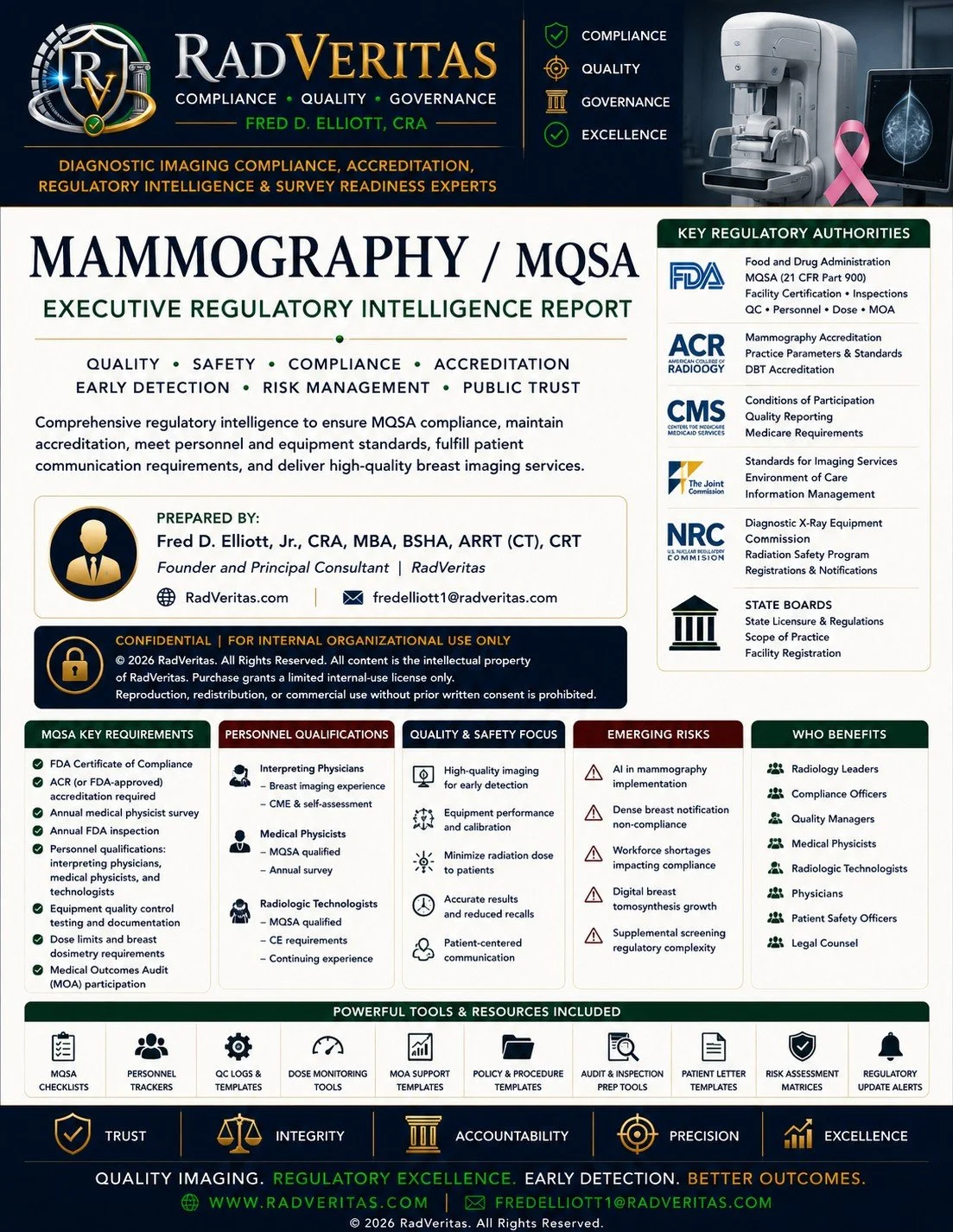
Mammography/MQSA Regulatory Intelligence Report
The Complete Compliance, Accreditation, Quality, and Survey Readiness System for Breast Imaging Leaders
One Compliance Failure Can Shut Down an Entire Mammography Program
No imaging modality faces more regulatory scrutiny than Mammography.
Every mammography facility in the United States operates under the Mammography Quality Standards Act (MQSA), one of the most prescriptive and actively enforced regulatory frameworks in healthcare.
An expired certificate.
A missed physicist survey.
A personnel qualification lapse.
A missing dense breast notification.
Any one of these can trigger FDA enforcement action, accreditation loss, public reporting, civil penalties, and suspension of mammography services.
The RadVeritas Mammography / MQSA Regulatory Intelligence Report provides healthcare leaders with a comprehensive framework for maintaining certification, protecting accreditation, ensuring patient safety, and building a continuously survey-ready breast imaging program.
Why This Report Matters
Breast imaging is more than a regulatory obligation.
It is a life-saving service.
Every quality failure creates the potential for delayed cancer detection, patient harm, regulatory action, and reputational damage.
The organizations that consistently succeed are not those that prepare for inspections once a year.
They are the organizations that maintain readiness every day.
This report helps leaders identify vulnerabilities before they become findings.
What You'll Learn
MQSA Compliance and Certification
Understand the federal requirements governing:
MQSA Certification
FDA Inspections
Accreditation Maintenance
Personnel Qualifications
Quality Control Programs
Medical Outcomes Audits
Patient Notification Requirements
Personnel Qualification Management
Strengthen oversight of:
Interpreting Physicians
Mammography Technologists
Medical Physicists
Continuing Education
Continuing Experience Requirements
Digital Breast Tomosynthesis (DBT) Training
Quality Control and Equipment Compliance
Develop effective systems for:
Weekly Quality Control Testing
Phantom Image Evaluation
Compression Testing
Artifact Monitoring
Physicist Surveys
Dose Monitoring
Corrective Action Documentation
Dense Breast Notification Compliance
Navigate evolving federal and state requirements involving:
Patient Lay Summary Letters
Dense Breast Notifications
Communication Timeliness
Documentation Requirements
Medical Outcomes Audits
Build effective pathology correlation and performance improvement processes that support regulatory compliance and patient safety.
Key Areas Covered
✓ MQSA Certification Requirements
✓ FDA Inspection Readiness
✓ ACR Mammography Accreditation
✓ Digital Breast Tomosynthesis Compliance
✓ Personnel Qualification Tracking
✓ Medical Physicist Survey Requirements
✓ Quality Control Program Management
✓ Dense Breast Notification Compliance
✓ Medical Outcomes Audits
✓ Patient Communication Standards
✓ Leadership Accountability
✓ Survey Readiness and Risk Reduction
Powerful Tools Included
✔ MQSA Compliance Assessments
✔ Accreditation Readiness Checklists
✔ Personnel Qualification Tracking Systems
✔ Risk Assessment Matrices
✔ Quality Control Audit Tools
✔ Survey Readiness Dashboards
✔ Gap Analysis Frameworks
✔ Corrective Action Plans
✔ Executive Action Roadmaps
✔ Policy and Procedure Reviews
✔ Compliance Monitoring Tools
✔ Leadership Accountability Assessments
Designed For
Breast Imaging Directors
Mammography Managers
Radiology Administrators
Compliance Officers
Accreditation Specialists
Medical Physicists
Interpreting Physicians
Quality Leaders
Patient Safety Officers
Hospital Executives
Healthcare Consultants
The Cost of Non-Compliance
Most imaging deficiencies result in corrective action plans.
MQSA deficiencies can result in loss of certification.
A single overlooked requirement can lead to:
FDA Enforcement Action
Accreditation Risk
Public Disclosure of Deficiencies
Service Interruption
Revenue Loss
Increased Liability Exposure
Patient Safety Concerns
The consequences extend far beyond a survey finding.
Protect Your Certification. Protect Your Patients.
The RadVeritas Mammography / MQSA Regulatory Intelligence Report provides healthcare leaders with the intelligence, tools, and governance strategies needed to maintain certification, strengthen quality, improve patient safety, and sustain accreditation readiness.
Because in Mammography, compliance is not simply a regulatory requirement.
It is a commitment to every patient who trusts your organization to detect cancer when it matters most.
Protect Certification.
Strengthen Quality.
Save Lives.
Prepared By
Fred D. Elliott, Jr., CRA, MBA, BSHA, ARRT (CT), CRT
Founder and Principal Consultant
RadVeritas
Compliance • Quality • Governance
Turning MQSA Compliance Into Operational Excellence.
REGULATORY COMPLIANCE AND PATIENT SAFETY
CONTRAST MEDIA SAFETY AND MANAGEMENT
The Complete Patient Safety, Medication Management, and Regulatory Readiness System for Diagnostic Imaging Leaders
One Preventable Contrast Event Can Change Everything
A severe contrast reaction.
An undetected kidney impairment.
An extravasation injury.
A missed allergy history.
A delayed emergency response.
These events occur every day in healthcare organizations across the country, and many are entirely preventable.
Contrast media are among the most frequently administered medications in Diagnostic Imaging. Yet many organizations underestimate the regulatory, clinical, operational, and legal risks associated with their use.
The RadVeritas Contrast Media Safety and Management Regulatory Intelligence Report provides healthcare leaders with a comprehensive roadmap for protecting patients, strengthening compliance, reducing liability, and building a safer contrast administration program.
Built upon current CMS Conditions of Participation, The Joint Commission Medication Management standards, FDA requirements, and the American College of Radiology Manual on Contrast Media, this report transforms complex regulatory expectations into practical operational solutions.
Why This Report Matters
Every contrast administration carries risk.
Whether administering iodinated contrast for CT, gadolinium-based contrast for MRI, or contrast agents used in fluoroscopy and advanced imaging procedures, organizations are expected to maintain systems that protect patients before, during, and after administration.
Regulators, surveyors, accreditors, attorneys, and patients increasingly expect organizations to demonstrate:
Effective patient screening
Renal function assessment
Allergy identification
Emergency preparedness
Adverse reaction management
Personnel competency
Documentation integrity
Continuous quality oversight
This report helps leaders identify vulnerabilities before they become patient safety events, survey findings, or legal exposure.
What You'll Learn
Contrast Media Safety Governance
Build a structured framework for safe contrast administration across all imaging modalities.
Patient Screening and Risk Assessment
Strengthen processes for:
Renal Function Assessment
Contrast Allergy Screening
Pregnancy Assessment
Medication Review
NSF Risk Identification
High-Risk Patient Stratification
Emergency Preparedness
Develop effective systems for:
Contrast Reaction Response
Anaphylaxis Management
Emergency Medication Availability
Staff Competency Validation
Simulation Training Programs
Regulatory Compliance
Navigate requirements from:
CMS
The Joint Commission
ACR
FDA
State Licensing Agencies
Documentation and Audit Readiness
Improve compliance related to:
Contrast Administration Records
Adverse Event Reporting
Extravasation Documentation
Medication Management Standards
Quality Improvement Monitoring
Key Areas Covered
✓ Contrast Media Safety Programs
✓ Iodinated Contrast Management
✓ Gadolinium-Based Contrast Agent Safety
✓ Nephrogenic Systemic Fibrosis Prevention
✓ Contrast-Induced Kidney Injury Risk Reduction
✓ Extravasation Prevention and Response
✓ Emergency Medication Readiness
✓ Personnel Training and Competency
✓ Medication Management Compliance
✓ Adverse Reaction Reporting
✓ Accreditation Readiness
✓ Leadership Accountability
Powerful Tools Included
✔ Contrast Safety Assessments
✔ Regulatory Risk Analysis Tools
✔ Survey Readiness Checklists
✔ Gap Analysis Frameworks
✔ Corrective Action Plans
✔ Executive Dashboards
✔ Emergency Response Readiness Evaluations
✔ Personnel Competency Tracking Systems
✔ Policy and Procedure Assessment Tools
✔ Risk Scoring Matrices
✔ Leadership Accountability Reviews
✔ Executive Action Roadmaps
Designed For
Imaging Directors
Radiology Administrators
CT Leaders
MRI Leaders
Interventional Radiology Leaders
Quality Improvement Professionals
Patient Safety Officers
Compliance Officers
Accreditation Specialists
Nursing Leaders
Medical Directors
Healthcare Consultants
The Hidden Risk Most Organizations Miss
Most contrast-related failures are not caused by a lack of policy.
They are caused by inconsistent execution.
A screening question that was never asked.
A kidney function result that was never reviewed.
An emergency medication that expired unnoticed.
A staff member who never received annual competency validation.
These seemingly small gaps can create significant patient safety and regulatory consequences.
The organizations that consistently perform well are those that build contrast safety into everyday operations, not just accreditation preparation.
Protect Patients. Reduce Risk. Lead With Confidence.
The RadVeritas Contrast Media Safety and Management Regulatory Intelligence Report provides the intelligence, tools, and governance framework needed to strengthen patient safety, improve regulatory compliance, reduce liability exposure, and support operational excellence.
Because contrast safety is more than a clinical responsibility.
It is a leadership responsibility.
Protect the Patient.
Protect the Organization.
Protect the Mission.
Prepared By
Fred D. Elliott, Jr., CRA, MBA, BSHA, ARRT (CT), CRT
Founder and Principal Consultant
RadVeritas
Compliance • Quality • Governance
Turning Contrast Media Safety Into Operational Excellence.
The Complete Compliance, Accreditation, Quality, and Survey Readiness System for Breast Imaging Leaders
One Compliance Failure Can Shut Down an Entire Mammography Program
No imaging modality faces more regulatory scrutiny than Mammography.
Every mammography facility in the United States operates under the Mammography Quality Standards Act (MQSA), one of the most prescriptive and actively enforced regulatory frameworks in healthcare.
An expired certificate.
A missed physicist survey.
A personnel qualification lapse.
A missing dense breast notification.
Any one of these can trigger FDA enforcement action, accreditation loss, public reporting, civil penalties, and suspension of mammography services.
The RadVeritas Mammography / MQSA Regulatory Intelligence Report provides healthcare leaders with a comprehensive framework for maintaining certification, protecting accreditation, ensuring patient safety, and building a continuously survey-ready breast imaging program.
Why This Report Matters
Breast imaging is more than a regulatory obligation.
It is a life-saving service.
Every quality failure creates the potential for delayed cancer detection, patient harm, regulatory action, and reputational damage.
The organizations that consistently succeed are not those that prepare for inspections once a year.
They are the organizations that maintain readiness every day.
This report helps leaders identify vulnerabilities before they become findings.
What You'll Learn
MQSA Compliance and Certification
Understand the federal requirements governing:
MQSA Certification
FDA Inspections
Accreditation Maintenance
Personnel Qualifications
Quality Control Programs
Medical Outcomes Audits
Patient Notification Requirements
Personnel Qualification Management
Strengthen oversight of:
Interpreting Physicians
Mammography Technologists
Medical Physicists
Continuing Education
Continuing Experience Requirements
Digital Breast Tomosynthesis (DBT) Training
Quality Control and Equipment Compliance
Develop effective systems for:
Weekly Quality Control Testing
Phantom Image Evaluation
Compression Testing
Artifact Monitoring
Physicist Surveys
Dose Monitoring
Corrective Action Documentation
Dense Breast Notification Compliance
Navigate evolving federal and state requirements involving:
Patient Lay Summary Letters
Dense Breast Notifications
Communication Timeliness
Documentation Requirements
Medical Outcomes Audits
Build effective pathology correlation and performance improvement processes that support regulatory compliance and patient safety.
Key Areas Covered
✓ MQSA Certification Requirements
✓ FDA Inspection Readiness
✓ ACR Mammography Accreditation
✓ Digital Breast Tomosynthesis Compliance
✓ Personnel Qualification Tracking
✓ Medical Physicist Survey Requirements
✓ Quality Control Program Management
✓ Dense Breast Notification Compliance
✓ Medical Outcomes Audits
✓ Patient Communication Standards
✓ Leadership Accountability
✓ Survey Readiness and Risk Reduction
Powerful Tools Included
✔ MQSA Compliance Assessments
✔ Accreditation Readiness Checklists
✔ Personnel Qualification Tracking Systems
✔ Risk Assessment Matrices
✔ Quality Control Audit Tools
✔ Survey Readiness Dashboards
✔ Gap Analysis Frameworks
✔ Corrective Action Plans
✔ Executive Action Roadmaps
✔ Policy and Procedure Reviews
✔ Compliance Monitoring Tools
✔ Leadership Accountability Assessments
Designed For
Breast Imaging Directors
Mammography Managers
Radiology Administrators
Compliance Officers
Accreditation Specialists
Medical Physicists
Interpreting Physicians
Quality Leaders
Patient Safety Officers
Hospital Executives
Healthcare Consultants
The Cost of Non-Compliance
Most imaging deficiencies result in corrective action plans.
MQSA deficiencies can result in loss of certification.
A single overlooked requirement can lead to:
FDA Enforcement Action
Accreditation Risk
Public Disclosure of Deficiencies
Service Interruption
Revenue Loss
Increased Liability Exposure
Patient Safety Concerns
The consequences extend far beyond a survey finding.
Protect Your Certification. Protect Your Patients.
The RadVeritas Mammography / MQSA Regulatory Intelligence Report provides healthcare leaders with the intelligence, tools, and governance strategies needed to maintain certification, strengthen quality, improve patient safety, and sustain accreditation readiness.
Because in Mammography, compliance is not simply a regulatory requirement.
It is a commitment to every patient who trusts your organization to detect cancer when it matters most.
Protect Certification.
Strengthen Quality.
Save Lives.
Prepared By
Fred D. Elliott, Jr., CRA, MBA, BSHA, ARRT (CT), CRT
Founder and Principal Consultant
RadVeritas
Compliance • Quality • Governance
Turning MQSA Compliance Into Operational Excellence.
REGULATORY COMPLIANCE AND PATIENT SAFETY
CONTRAST MEDIA SAFETY AND MANAGEMENT
The Complete Patient Safety, Medication Management, and Regulatory Readiness System for Diagnostic Imaging Leaders
One Preventable Contrast Event Can Change Everything
A severe contrast reaction.
An undetected kidney impairment.
An extravasation injury.
A missed allergy history.
A delayed emergency response.
These events occur every day in healthcare organizations across the country, and many are entirely preventable.
Contrast media are among the most frequently administered medications in Diagnostic Imaging. Yet many organizations underestimate the regulatory, clinical, operational, and legal risks associated with their use.
The RadVeritas Contrast Media Safety and Management Regulatory Intelligence Report provides healthcare leaders with a comprehensive roadmap for protecting patients, strengthening compliance, reducing liability, and building a safer contrast administration program.
Built upon current CMS Conditions of Participation, The Joint Commission Medication Management standards, FDA requirements, and the American College of Radiology Manual on Contrast Media, this report transforms complex regulatory expectations into practical operational solutions.
Why This Report Matters
Every contrast administration carries risk.
Whether administering iodinated contrast for CT, gadolinium-based contrast for MRI, or contrast agents used in fluoroscopy and advanced imaging procedures, organizations are expected to maintain systems that protect patients before, during, and after administration.
Regulators, surveyors, accreditors, attorneys, and patients increasingly expect organizations to demonstrate:
Effective patient screening
Renal function assessment
Allergy identification
Emergency preparedness
Adverse reaction management
Personnel competency
Documentation integrity
Continuous quality oversight
This report helps leaders identify vulnerabilities before they become patient safety events, survey findings, or legal exposure.
What You'll Learn
Contrast Media Safety Governance
Build a structured framework for safe contrast administration across all imaging modalities.
Patient Screening and Risk Assessment
Strengthen processes for:
Renal Function Assessment
Contrast Allergy Screening
Pregnancy Assessment
Medication Review
NSF Risk Identification
High-Risk Patient Stratification
Emergency Preparedness
Develop effective systems for:
Contrast Reaction Response
Anaphylaxis Management
Emergency Medication Availability
Staff Competency Validation
Simulation Training Programs
Regulatory Compliance
Navigate requirements from:
CMS
The Joint Commission
ACR
FDA
State Licensing Agencies
Documentation and Audit Readiness
Improve compliance related to:
Contrast Administration Records
Adverse Event Reporting
Extravasation Documentation
Medication Management Standards
Quality Improvement Monitoring
Key Areas Covered
✓ Contrast Media Safety Programs
✓ Iodinated Contrast Management
✓ Gadolinium-Based Contrast Agent Safety
✓ Nephrogenic Systemic Fibrosis Prevention
✓ Contrast-Induced Kidney Injury Risk Reduction
✓ Extravasation Prevention and Response
✓ Emergency Medication Readiness
✓ Personnel Training and Competency
✓ Medication Management Compliance
✓ Adverse Reaction Reporting
✓ Accreditation Readiness
✓ Leadership Accountability
Powerful Tools Included
✔ Contrast Safety Assessments
✔ Regulatory Risk Analysis Tools
✔ Survey Readiness Checklists
✔ Gap Analysis Frameworks
✔ Corrective Action Plans
✔ Executive Dashboards
✔ Emergency Response Readiness Evaluations
✔ Personnel Competency Tracking Systems
✔ Policy and Procedure Assessment Tools
✔ Risk Scoring Matrices
✔ Leadership Accountability Reviews
✔ Executive Action Roadmaps
Designed For
Imaging Directors
Radiology Administrators
CT Leaders
MRI Leaders
Interventional Radiology Leaders
Quality Improvement Professionals
Patient Safety Officers
Compliance Officers
Accreditation Specialists
Nursing Leaders
Medical Directors
Healthcare Consultants
The Hidden Risk Most Organizations Miss
Most contrast-related failures are not caused by a lack of policy.
They are caused by inconsistent execution.
A screening question that was never asked.
A kidney function result that was never reviewed.
An emergency medication that expired unnoticed.
A staff member who never received annual competency validation.
These seemingly small gaps can create significant patient safety and regulatory consequences.
The organizations that consistently perform well are those that build contrast safety into everyday operations, not just accreditation preparation.
Protect Patients. Reduce Risk. Lead With Confidence.
The RadVeritas Contrast Media Safety and Management Regulatory Intelligence Report provides the intelligence, tools, and governance framework needed to strengthen patient safety, improve regulatory compliance, reduce liability exposure, and support operational excellence.
Because contrast safety is more than a clinical responsibility.
It is a leadership responsibility.
Protect the Patient.
Protect the Organization.
Protect the Mission.
Prepared By
Fred D. Elliott, Jr., CRA, MBA, BSHA, ARRT (CT), CRT
Founder and Principal Consultant
RadVeritas
Compliance • Quality • Governance
Turning Contrast Media Safety Into Operational Excellence.