
Welcome to RadVeritas
Where Confidence Begins
Every day, people make important healthcare decisions. Patients want clear answers. Families want peace of mind. Healthcare professionals want reliable guidance. Healthcare leaders need practical solutions that improve safety, quality, and compliance.
That is why RadVeritas exists.
I founded RadVeritas to make diagnostic imaging easier to understand and healthcare compliance easier to achieve. Whether you are preparing for an MRI, reviewing a CT scan report, managing a Nuclear Medicine department, or leading an entire imaging program, our goal is the same: provide trustworthy information you can understand and use with confidence.
Our mission is simple:
Help people make informed decisions through accurate information, practical guidance, and proven best practices.
For patients and families, that means answering questions such as:
What should I expect during my imaging exam?
Is MRI, CT, PET/CT, or Nuclear Medicine safe?
What do my imaging results mean?
Why was this test ordered?
What happens after my exam?
How can I prepare for my appointment?
For healthcare professionals, RadVeritas provides practical resources to support high-quality patient care, operational excellence, regulatory compliance, and continuous learning.
For imaging leaders and organizations, we deliver real-world guidance to help identify risk before it becomes a finding, strengthen compliance before it becomes a deficiency, improve operational performance, and maintain readiness for accreditation and regulatory surveys.
Our resources include:
Patient education guides
Imaging safety information
Regulatory intelligence
Compliance toolkits
Accreditation and survey readiness resources
Quality improvement tools
Continuing education materials
Interactive learning games
Leadership resources
Healthcare continues to evolve, and so do patient expectations, regulatory requirements, and quality standards. The strongest organizations and the most informed patients are those who prepare before challenges arise.
Whether you are a patient preparing for your first imaging exam, a family member looking for trustworthy answers, a technologist expanding your knowledge, a physician seeking reliable information, or a healthcare executive responsible for an imaging program, RadVeritas is designed to help you navigate diagnostic imaging with confidence.
Thank you for visiting RadVeritas. We are committed to providing clear, accurate, evidence-informed information that helps improve understanding, support informed decision-making, enhance patient safety, and promote excellence throughout diagnostic imaging.
Fred D. Elliott, Jr., MBA, BSHA, CRA, ARRT (CT), CRT
Founder and Principal Consultant
YouTube Videos located at: https://www.youtube.com/channel/UC6IFtYV5Ea0YugNF98C6Y0w
RadVeritas
Where Confidence Begins with Clear Answers.
~ Clear Answers. Confident Decisions. Better Outcomes.~
Stop Reacting. Start Leading.
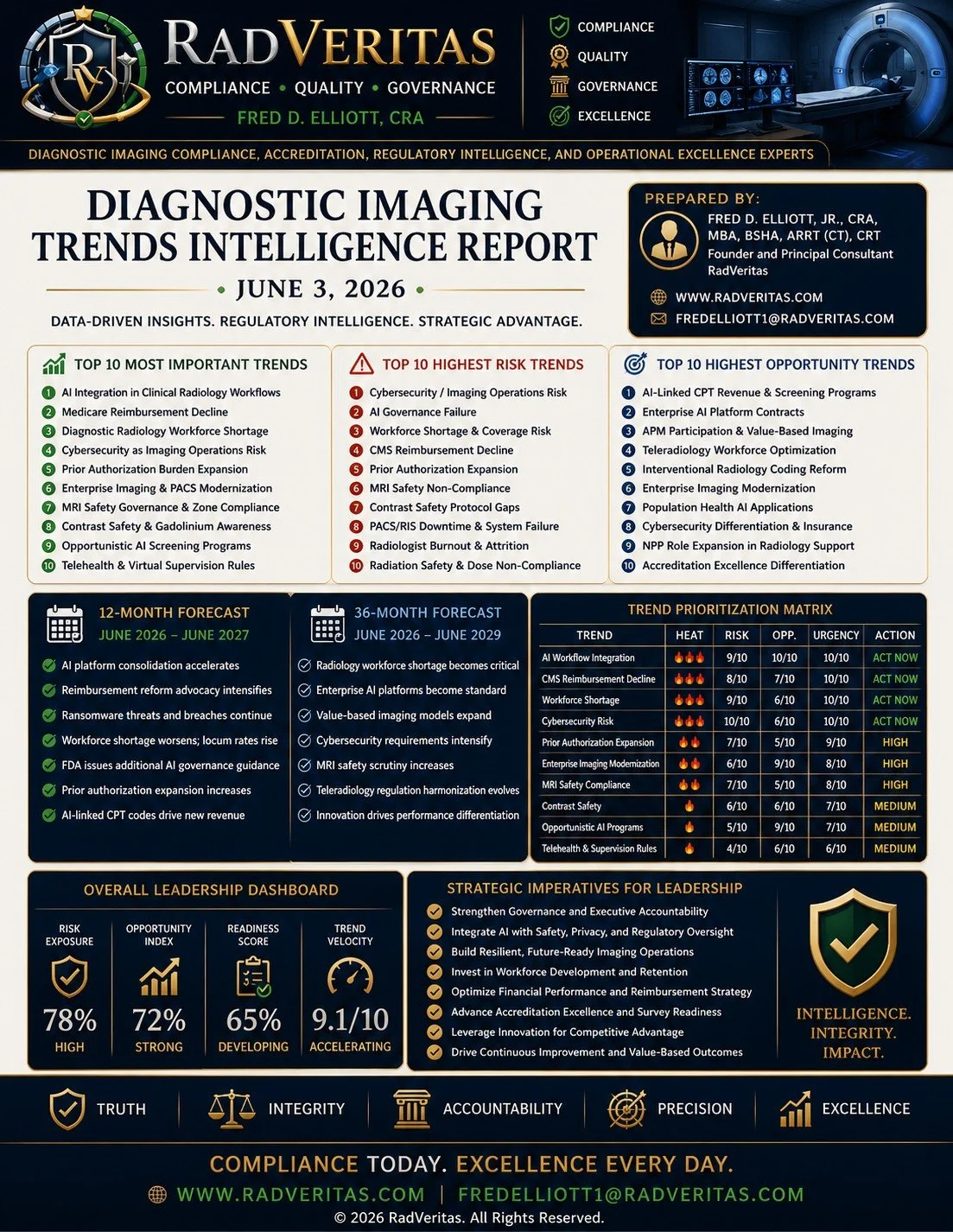
Artificial intelligence, workforce shortages, cybersecurity threats, reimbursement pressures, and evolving regulations are transforming Diagnostic Imaging.
Will your organization be ready?
The RadVeritas Diagnostic Imaging Trends Intelligence Report delivers executive-level intelligence on the trends, risks, opportunities, and strategic priorities shaping the future of imaging.
What You'll Gain
✔ Emerging trend analysis
✔ Risk and opportunity forecasting
✔ 12- and 36-month outlooks
✔ Regulatory intelligence
✔ Strategic leadership guidance
✔ Executive decision-support insights
Ideal For
Healthcare Executives
Imaging Directors
Compliance Leaders
Accreditation Specialists
Quality Professionals
Healthcare Consultants
Why It Matters
The organizations that succeed tomorrow are preparing today.
Identify emerging risks, capitalize on opportunities, strengthen strategic planning, and stay ahead of industry change with confidence.
Data-Driven Insights. Regulatory Intelligence. Strategic Advantage.
Intelligence Today. Advantage Tomorrow…
Current Trends Reports for Medical Professionals
Current Trends Reports for Medical Professionals
Navigate Change with Confidence. Prepare for Accreditation with Precision.
The American College of Radiology (ACR) continues to evolve its CT Accreditation Program, creating new opportunities for imaging organizations while introducing new operational, competency, documentation, and readiness challenges.
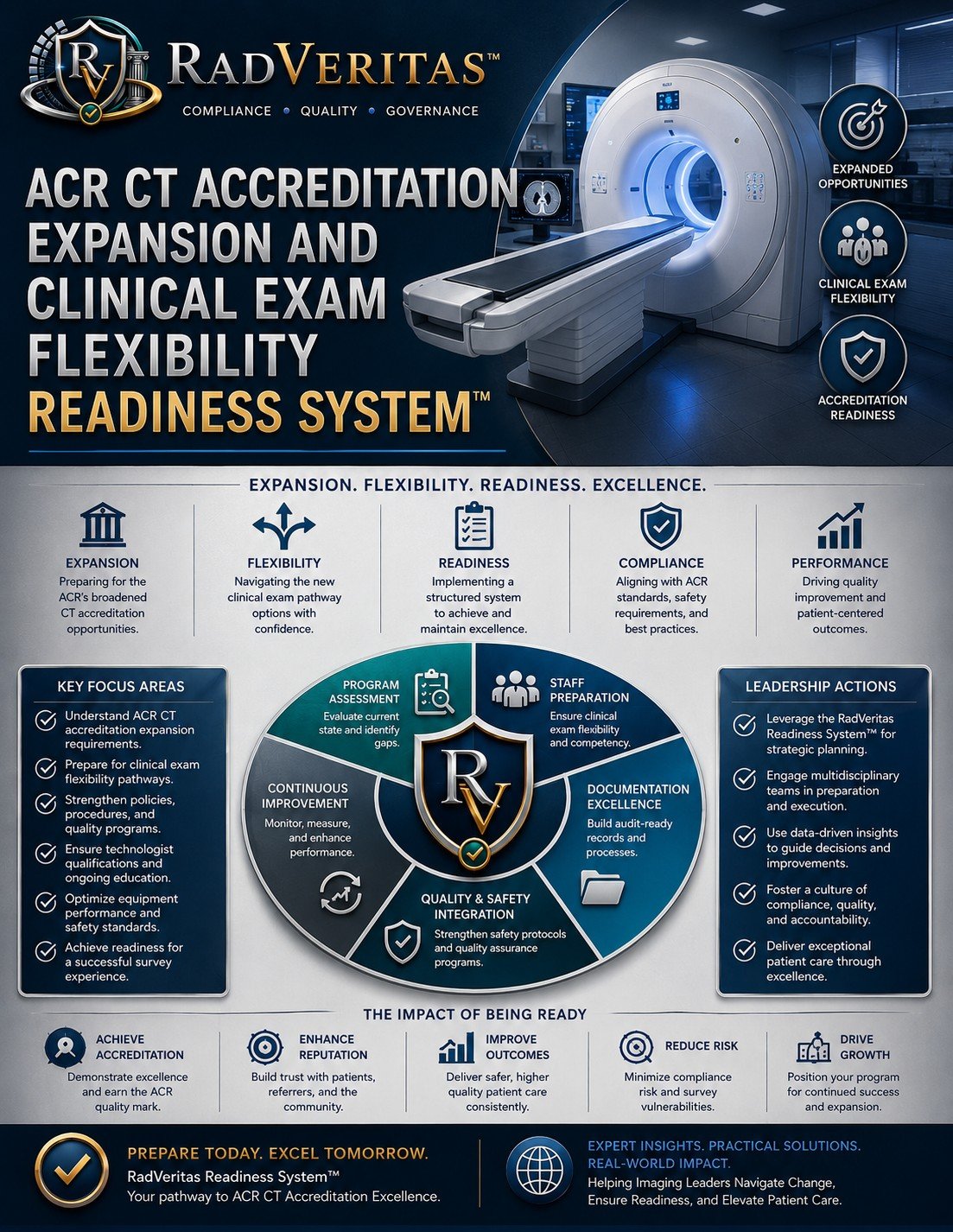
The ACR CT Accreditation Expansion and Clinical Exam Flexibility Readiness System™ from RadVeritas™ is a comprehensive regulatory intelligence and operational readiness framework designed to help Diagnostic Imaging leaders, CT managers, accreditation coordinators, educators, and technologists successfully prepare for expanded accreditation opportunities while maintaining compliance, quality, and patient safety excellence.
Built specifically for today's evolving accreditation environment, this executive-level readiness system provides the structure, tools, and strategic guidance organizations need to transition from uncertainty to accreditation confidence.
Why This Matters
Changes in accreditation requirements can create significant challenges for healthcare organizations.
Questions quickly emerge:
Are our current CT processes aligned with the latest accreditation expectations?
How do the new clinical examination flexibility pathways impact our workforce?
Are our technologists appropriately prepared and qualified?
Do our policies, procedures, and competency programs support accreditation success?
Can we demonstrate readiness during an accreditation review?
Organizations that proactively address these questions position themselves for success. Those that do not may face accreditation delays, compliance gaps, and unnecessary operational risk.
What the Readiness System Delivers
The ACR CT Accreditation Expansion and Clinical Exam Flexibility Readiness System™ provides a structured approach to accreditation preparedness through five integrated readiness pillars.
Program Assessment
Evaluate current CT accreditation readiness, identify operational gaps, and establish a roadmap for improvement.
Staff Preparation
Strengthen technologist competency, education, clinical exam pathway readiness, and workforce development initiatives.
Documentation Excellence
Develop audit-ready records, competency files, policies, procedures, and supporting accreditation documentation.
Quality and Safety Integration
Align patient safety initiatives, quality assurance programs, dose optimization practices, and performance improvement activities with accreditation expectations.
Continuous Improvement
Implement ongoing monitoring processes that support sustained accreditation readiness and operational excellence.
Key Focus Areas
This readiness system helps organizations:
✔ Understand ACR CT Accreditation expansion requirements
✔ Navigate new clinical examination flexibility pathways
✔ Evaluate workforce competency and qualification readiness
✔ Strengthen policies, procedures, and governance structures
✔ Enhance quality assurance and performance improvement programs
✔ Improve documentation accuracy and defensibility
✔ Support survey and accreditation preparation activities
✔ Promote patient safety and operational excellence
✔ Reduce compliance risk and accreditation vulnerabilities
✔ Build long-term sustainability into CT accreditation programs
Designed for Imaging Leaders
Ideal for:
Diagnostic Imaging Directors
Radiology Administrators
CT Managers and Supervisors
Accreditation Coordinators
Quality Improvement Leaders
Compliance Officers
Clinical Educators
CT Lead Technologists
Regulatory Affairs Teams
Executive Healthcare Leaders
Strategic Benefits
Achieve Accreditation Success
Build a structured readiness program designed to support successful accreditation outcomes and demonstrate organizational excellence.
Enhance Organizational Reputation
Strengthen confidence among patients, physicians, executives, and accreditation reviewers.
Improve Patient Care
Support consistent, high-quality CT services through strong governance, competency validation, and safety integration.
Reduce Regulatory Risk
Identify and address readiness gaps before they become accreditation findings or operational liabilities.
Drive Sustainable Growth
Position your CT program to successfully adapt to future accreditation changes and evolving industry expectations.
A Practical System for Real-World Healthcare Operations
Unlike generic accreditation guidance, this system focuses on operational execution.
It bridges the gap between accreditation requirements and daily practice by providing a framework that integrates:
Strategic Planning
Accreditation Readiness
Workforce Development
Competency Validation
Documentation Management
Quality Assurance
Patient Safety
Continuous Performance Improvement
The result is a more resilient, compliant, and accreditation-ready CT program.
Prepare Today. Excel Tomorrow.
Accreditation success is not achieved during the survey.
It is built through preparation, leadership, accountability, and continuous readiness.
The ACR CT Accreditation Expansion and Clinical Exam Flexibility Readiness System™ provides the intelligence, structure, and practical tools necessary to help your organization confidently navigate change, strengthen compliance, and achieve sustained accreditation excellence.
RadVeritas™
Compliance • Quality • Governance
Expert Insights. Practical Solutions. Real-World Impact.
Your Pathway to ACR CT Accreditation Excellence.
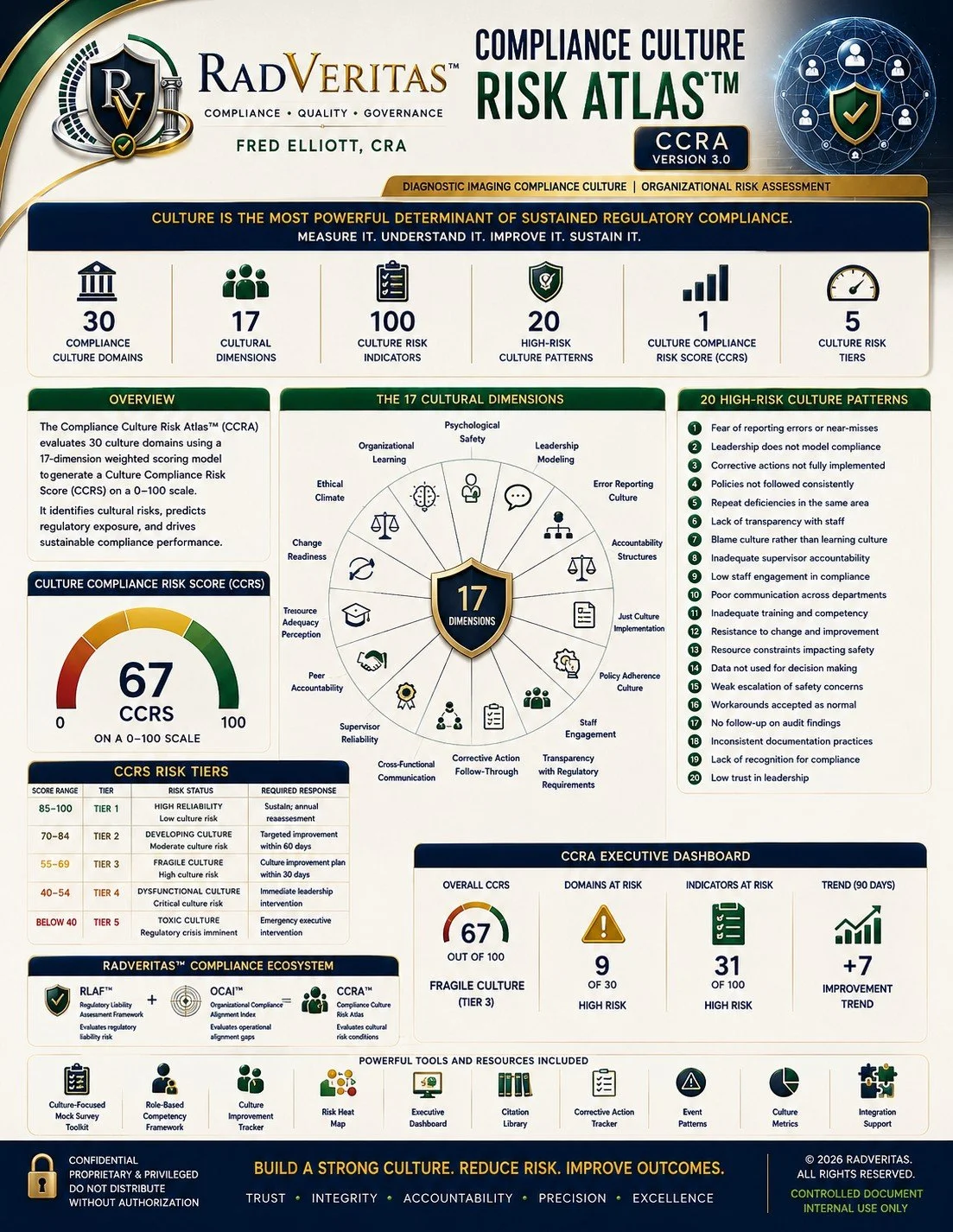
The Hidden Risks in Your Department Are Not Always Found in Your Policies.
They Are Found in Your Culture.
Most healthcare organizations do not struggle because they lack policies.
They struggle because workarounds become normal, staff stop speaking up, corrective actions lose momentum, and compliance slowly becomes a survey event instead of an organizational value.
By the time these issues are discovered, the consequences may already include accreditation findings, regulatory citations, patient harm, financial loss, and damage to organizational credibility.
The RadVeritas™ Compliance Culture Risk Atlas™ (CCRA) was created to help healthcare leaders identify these hidden vulnerabilities before they become crises.
Built specifically for Diagnostic Imaging, this proprietary executive framework transforms compliance culture into measurable data, giving leaders a practical way to assess, monitor, and strengthen the behaviors that drive long-term regulatory success.
Move Beyond Policy Reviews
Traditional audits tell you whether a document exists.
The Compliance Culture Risk Atlas tells you whether people actually follow it.
Using a structured scoring methodology, the CCRA evaluates the organizational conditions that influence regulatory performance, leadership accountability, patient safety, and operational reliability.
What Makes This System Different?
Comprehensive Culture Assessment
Evaluate 30 critical compliance culture domains across the imaging enterprise.
Executive Risk Scoring
Generate a measurable Culture Compliance Risk Score (CCRS) that identifies organizational strengths and hidden vulnerabilities.
100 High-Risk Culture Indicators
Identify observable behaviors and conditions associated with repeat survey findings, regulatory exposure, and patient safety risk.
Executive Dashboards and Heat Maps
Visualize risk patterns, prioritize corrective actions, and support leadership decision-making.
Survey Readiness Integration
Prepare leaders and frontline staff with culture-focused tracer questions and mock survey resources.
Turn Culture Into a Strategic Advantage
The strongest organizations do not wait for surveyors to identify their weaknesses.
They identify them first.
The RadVeritas™ Compliance Culture Risk Atlas™ helps leaders uncover the organizational behaviors that create hidden risk, prioritize improvement efforts, and build a sustainable culture of accountability, transparency, and operational excellence.
Because lasting compliance is not created by policies alone.
It is created by people, leadership, and culture working together every day.
Build a Culture That Withstands Scrutiny
Whether you are preparing for accreditation, strengthening governance, reducing organizational risk, or building a high-reliability imaging program, the Compliance Culture Risk Atlas™ provides the intelligence and structure needed to move forward with confidence.
Identify Hidden Risk.
Strengthen Accountability.
Build a Culture of Compliance.
RadVeritas™
Compliance • Quality • Governance
Compliance Today. Excellence Every Day.
RadVeritas™ Executive Preview Library - Regulatory Intelligence Resources
RadVeritas™ Executive Preview Library - Regulatory Intelligence Resources
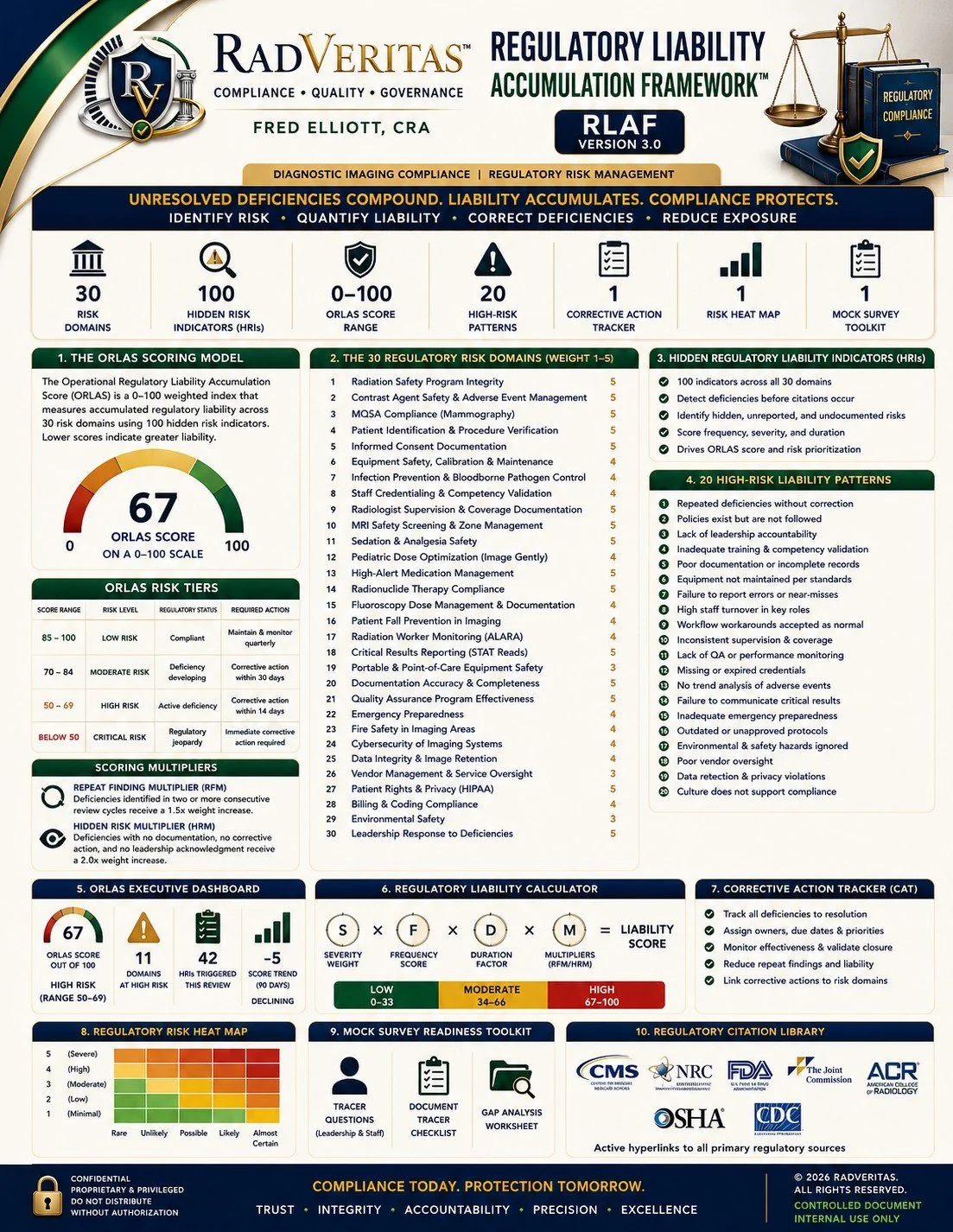
Hidden Compliance Risk Does Not Disappear.
It Accumulates.
Most healthcare organizations address compliance issues one finding at a time.
The problem is that regulatory liability rarely develops that way.
Small documentation gaps, overdue corrective actions, inconsistent processes, outdated policies, and unresolved survey findings quietly build over time. Left unchecked, they create hidden organizational risk that may not be discovered until an accreditation survey, regulatory inspection, patient safety event, or legal review.
The RadVeritas™ Regulatory Liability Accumulation Framework™ (RLAF) was created to help healthcare leaders uncover and eliminate these hidden vulnerabilities before they become costly problems.
Built specifically for Diagnostic Imaging, the RLAF transforms regulatory risk into measurable data, giving leaders a practical roadmap for protecting patients, strengthening compliance, and improving operational performance.
Stop Managing Findings. Start Managing Risk.
Traditional compliance programs often focus on individual deficiencies.
The RLAF focuses on the accumulation of risk across the entire imaging enterprise.
Using a proprietary scoring methodology, the framework identifies hidden liabilities, prioritizes corrective actions, and provides leadership with a defensible view of organizational readiness.
What Makes the RLAF Different?
Hidden Liability Detection
Identify compliance deficiencies before they become citations or survey findings.
Executive Risk Scoring
Measure organizational exposure with the Operational Regulatory Liability Accumulation Score (ORLAS).
30 High-Impact Regulatory Domains
Evaluate the areas most frequently associated with accreditation deficiencies and regulatory action.
Executive Dashboards and Risk Calculators
Track trends, prioritize resources, and support strategic decision-making.
Gap Analysis and Corrective Action Tools
Turn findings into measurable improvement plans with clear accountability.
Build a More Defensible Imaging Program
The organizations that perform best during surveys are not the ones that scramble to fix problems at the last minute.
They are the ones that know where their risks are and address them before regulators arrive.
The RadVeritas™ Regulatory Liability Accumulation Framework™ provides the structure, intelligence, and executive tools needed to reduce exposure, strengthen governance, and create a culture of continuous readiness.
Because the most dangerous compliance risks are often the ones no one sees accumulating.
Lead With Confidence
Whether your goal is to improve survey readiness, reduce regulatory exposure, strengthen operational oversight, or build a high-reliability imaging program, the RLAF gives your organization a practical and defensible advantage.
Detect Hidden Risk.
Prioritize What Matters.
Protect Your Organization.
RadVeritas™
Compliance • Quality • Governance
Compliance Today. Excellence Every Day.
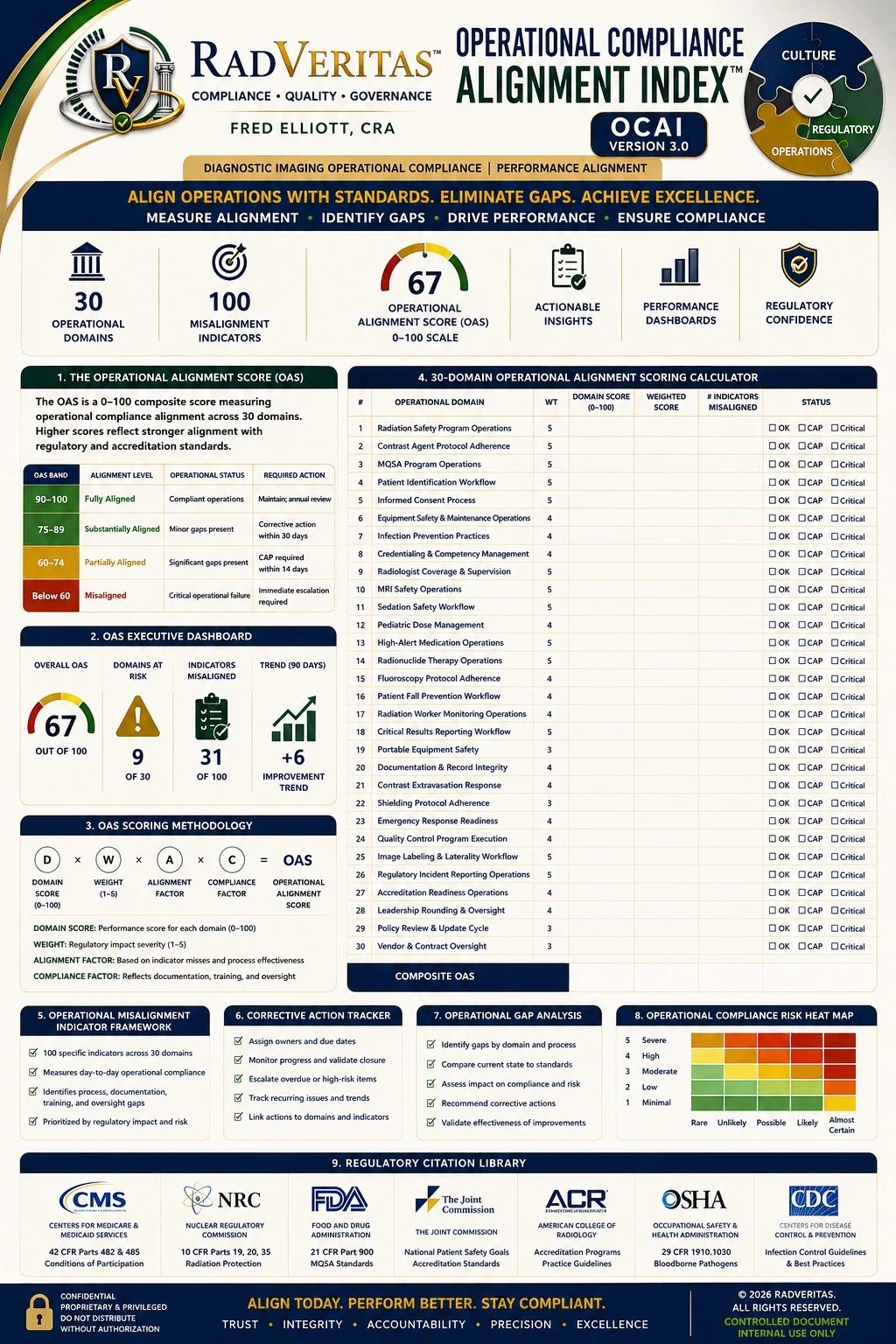
Compliance Is Not What Your Policies Say.
It Is What Your Team Does Every Day.
Most regulatory findings are not caused by missing policies.
They happen because daily operations slowly drift away from the standards leaders believe are being followed.
A process is skipped.
A checklist is outdated.
A competency expires.
A workflow changes.
No one notices until a surveyor, auditor, or patient safety event does.
The RadVeritas™ Operational Compliance Alignment Index™ (OCAI) was built to detect that drift before it becomes a regulatory liability.
Designed specifically for Diagnostic Imaging, the OCAI measures how closely daily operations align with the expectations of CMS, The Joint Commission, ACR, FDA, OSHA, and other governing authorities.
Turn Daily Operations Into Measurable Intelligence
The OCAI answers one critical leadership question:
Does our daily practice truly match the standards that govern our department?
Using a structured scoring model, the framework transforms operational performance into clear, measurable data that leaders can monitor, improve, and defend.
Why Healthcare Leaders Choose the OCAI
Detect Operational Drift Early
Identify hidden workflow failures before they become survey findings.
Measure Real-World Performance
Score operational alignment across the imaging enterprise with the Operational Alignment Score (OAS).
Strengthen Accountability
Provide leaders with objective data to guide corrective actions and resource allocation.
Build Survey Confidence
Demonstrate ongoing operational oversight and continuous readiness.
Build an Imaging Department That Is Always Ready
Whether your goal is stronger compliance, improved survey performance, better operational consistency, or greater executive visibility, the Operational Compliance Alignment Index™ provides a practical system for measuring what matters most.
Align Daily Practice.
Reduce Hidden Risk.
Lead With Confidence.
RadVeritas™
Compliance • Quality • Governance
Compliance Today. Excellence Every Day.
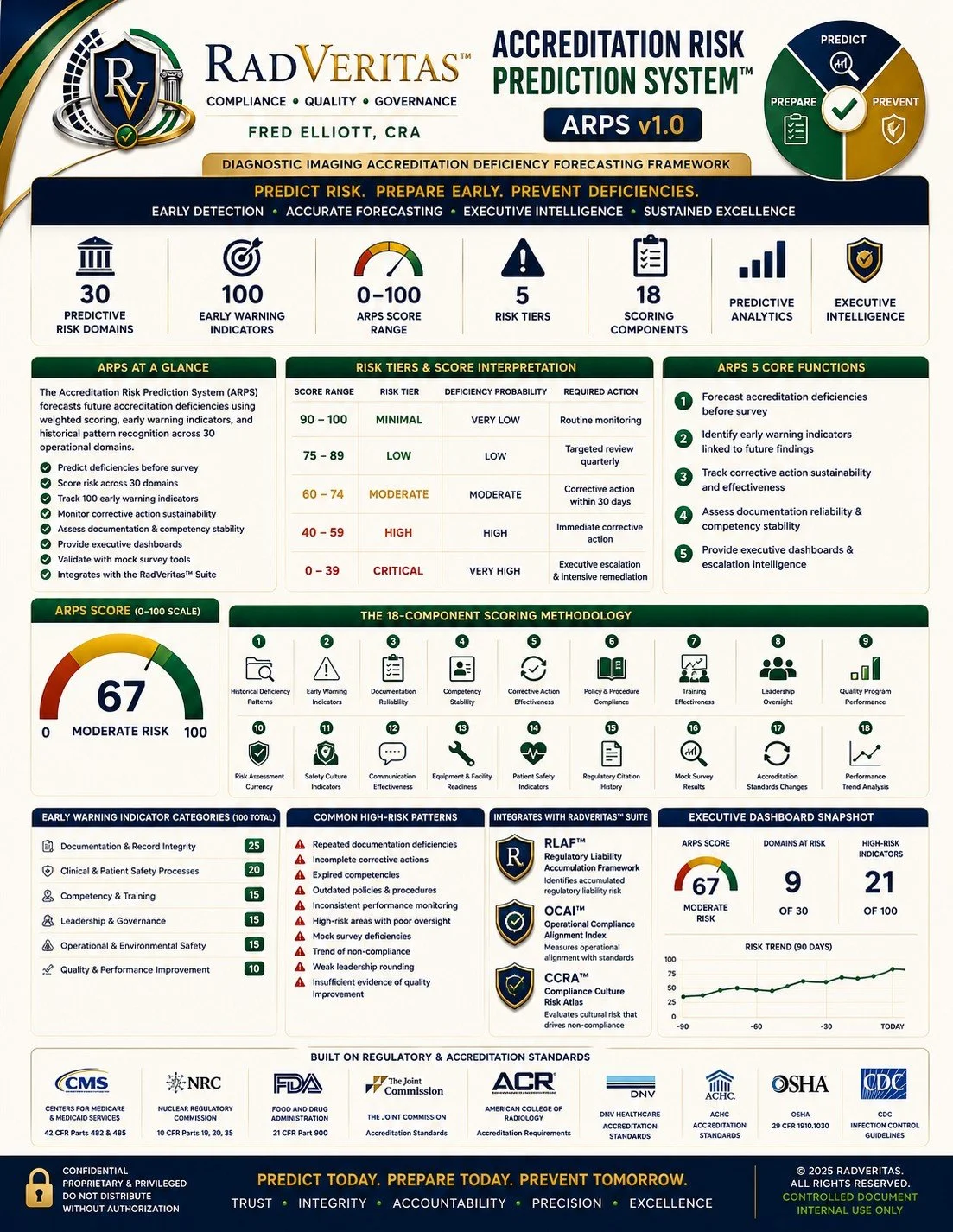
Know Where the Next Survey Finding Will Come From Before the Survey Team Does.
Most accreditation programs measure what happened yesterday.
The RadVeritas™ Accreditation Risk Prediction System™ (ARPS) is designed to predict what could happen tomorrow.
Built exclusively for Diagnostic Imaging leaders, ARPS uses predictive scoring, early warning indicators, and operational intelligence to identify the conditions that often lead to survey deficiencies long before an accreditation visit or regulatory inspection.
Instead of reacting to findings, your organization can prevent them.
Turn Accreditation Risk Into Actionable Intelligence
ARPS analyzes operational and compliance data across multiple domains to answer the questions every healthcare leader asks:
Where are we vulnerable?
What deficiencies are most likely to occur?
What should we fix first?
Are our corrective actions actually working?
The result is a practical forecasting system that helps organizations reduce uncertainty and improve readiness.
What the System Includes
✔ Predictive Accreditation Risk Scoring
✔ 30 Operational Risk Domains
✔ 100 Early Warning Indicators
✔ Five-Tier Risk Classification Model
✔ Executive Readiness Dashboards
✔ Corrective Action Sustainability Tracking
✔ Documentation and Competency Stability Assessment
✔ Mock Survey Intelligence Tools
✔ Performance Trend Analysis
✔ Integration with the RadVeritas™ Compliance Intelligence Suite
Key Risk Areas Evaluated
Documentation and Record Integrity
Clinical and Patient Safety Processes
Staff Competency and Training
Leadership Oversight and Governance
Operational and Environmental Safety
Quality Improvement Performance
Corrective Action Effectiveness
Policy and Procedure Compliance
Accreditation Standards Management
Survey Readiness Sustainability
The Difference Between Passing and Preparing
Many organizations discover weaknesses only after a survey team identifies them.
High-performing organizations identify those weaknesses themselves and correct them first.
The Accreditation Risk Prediction System™ helps you build that advantage by transforming hidden operational patterns into measurable intelligence and practical action.
Prepare With Confidence
If your organization is responsible for patient safety, accreditation success, regulatory compliance, and operational excellence, ARPS provides the insight needed to stay ahead of evolving expectations.
Predict Risk.
Prepare Early.
Prevent Deficiencies.
RadVeritas™
Compliance • Quality • Governance
Compliance Today. Excellence Every Day.

RadVeritas - Accreditation and Survey Readiness
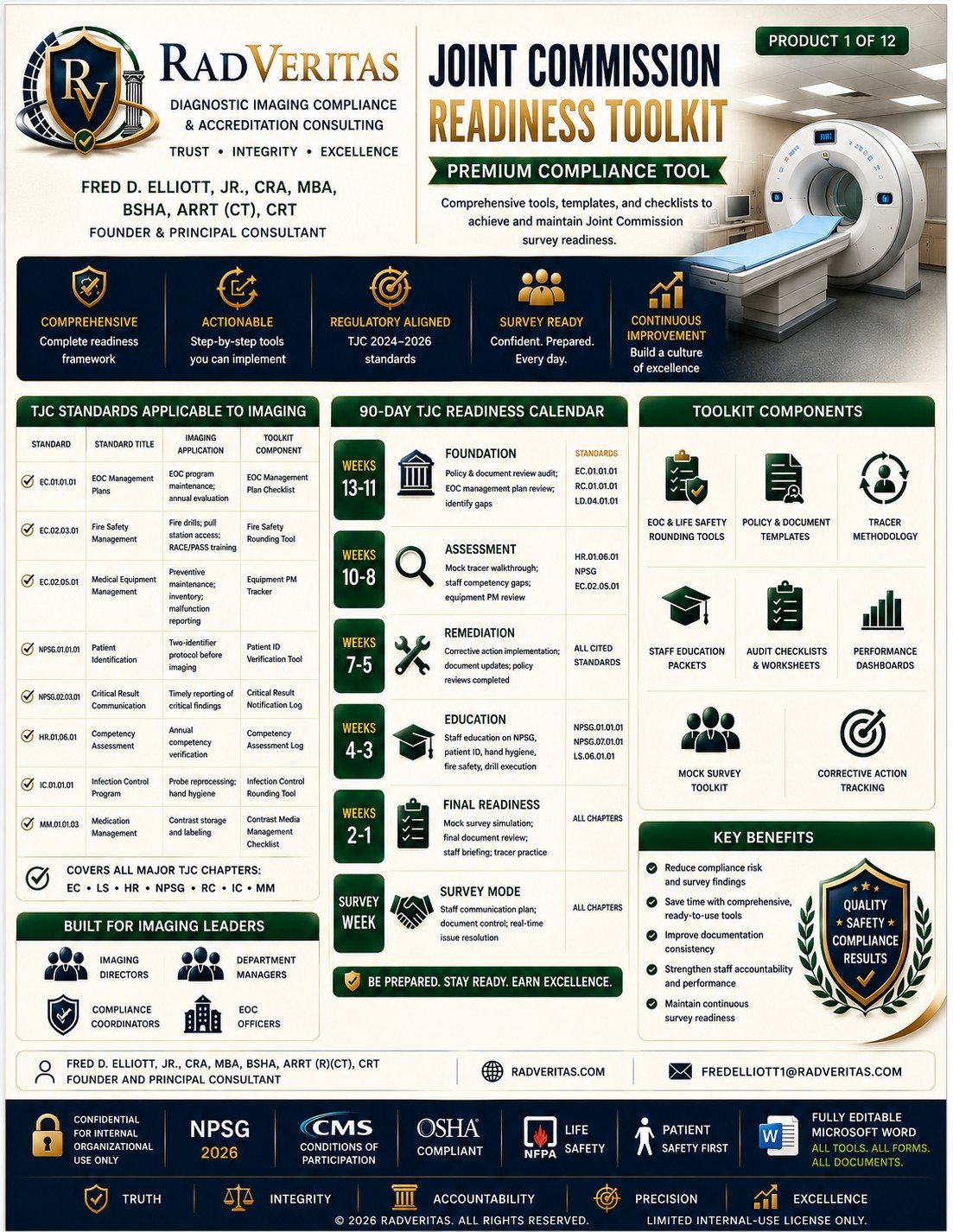
Summary
A comprehensive accreditation readiness system designed specifically for Diagnostic Imaging departments preparing for unannounced Joint Commission surveys. The toolkit translates complex Joint Commission standards into practical, department-level tools, checklists, tracer exercises, competency assessments, document audits, corrective action systems, and continuous readiness workflows. It provides a structured framework for maintaining survey readiness year-round rather than relying on last-minute preparation efforts.
Primary Value
Joint Commission survey readiness
Continuous accreditation preparedness
Mock tracer execution
Staff competency validation
Documentation readiness
Corrective action management
Ideal Users
Imaging Directors
Imaging Managers
Accreditation Coordinators
Compliance Officers
Environment of Care Leaders
Quality Improvement Specialists
Problem Solved
Many organizations struggle to maintain continuous readiness for unannounced surveys. Departments often rely on reactive preparation, resulting in documentation gaps, inconsistent staff knowledge, overdue corrective actions, and increased survey risk. This toolkit provides a structured, repeatable readiness process aligned directly with current Joint Commission standards and survey methodologies.
Key Components
90-Day Readiness Calendar
Department-Specific Tracer Question Bank
Environment of Care Rounding Checklist
Document Readiness Audit Tool
Staff Competency Verification Matrix
Corrective Action Tracking Log
Survey Preparation Framework
Regulatory Crosswalk to Joint Commission Standards
Executive Benefit
Provides leadership with a defensible readiness program that strengthens compliance, improves staff confidence during tracers, reduces survey findings, and supports a culture of continuous accreditation readiness.
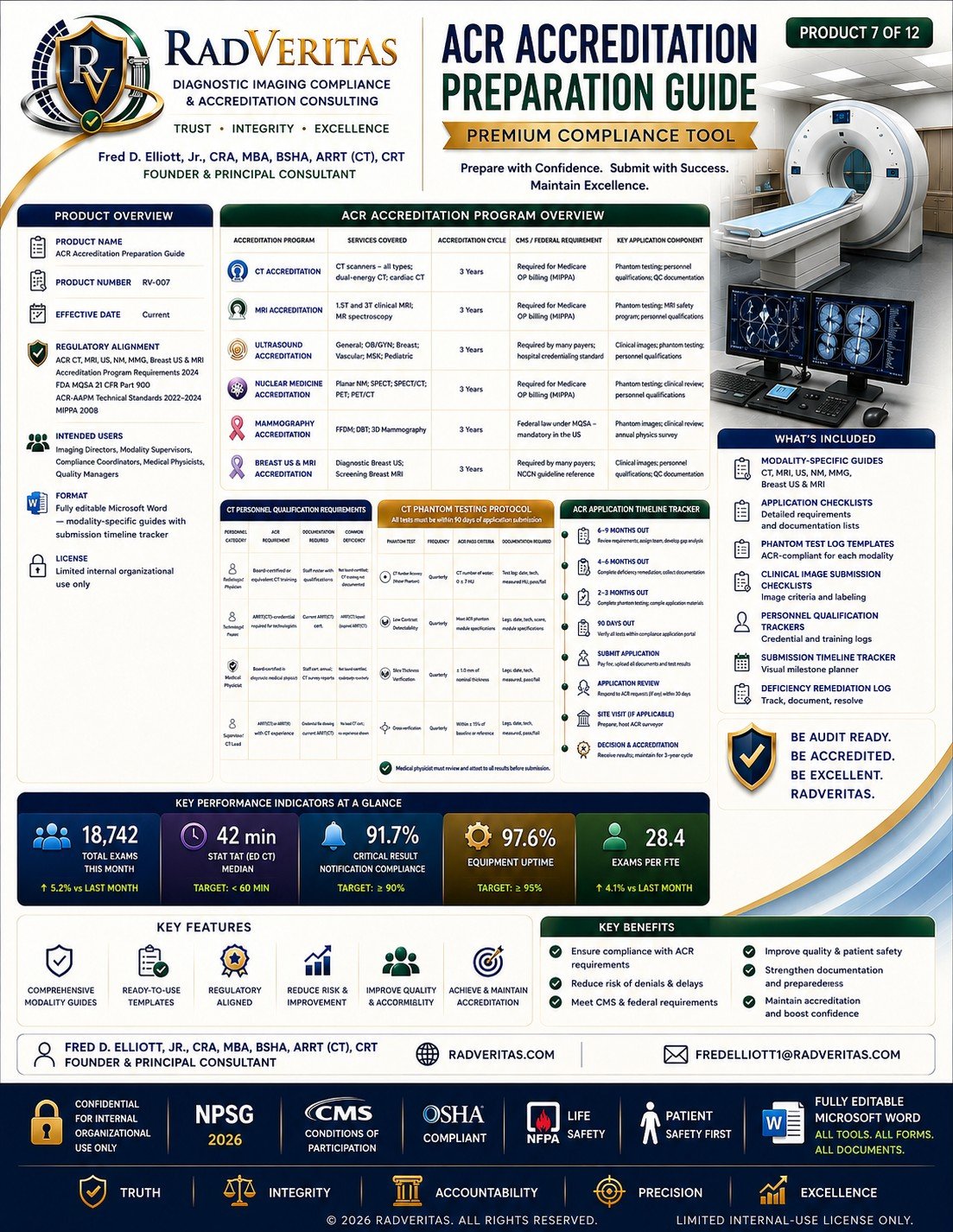
Summary
A modality-specific accreditation preparation resource designed to streamline ACR accreditation and reaccreditation activities. Includes personnel qualification requirements, phantom testing protocols, accreditation timelines, physicist requirements, image submission guidance, and common deficiency prevention strategies for CT, MRI, Ultrasound, Nuclear Medicine, PET, and Mammography.
Primary Value
Accreditation readiness
Deficiency prevention
Submission planning
Documentation organization
Accreditation cycle management
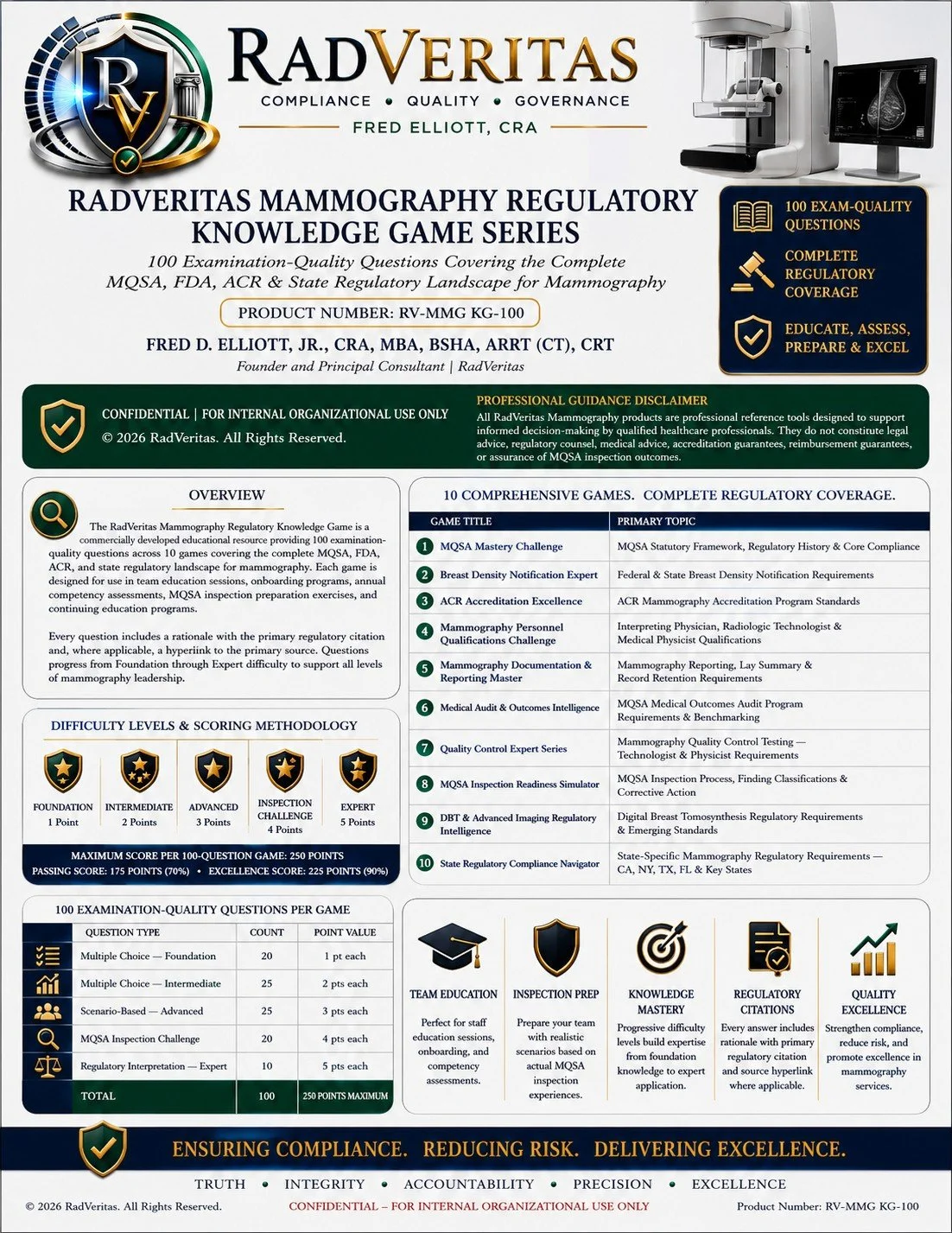
Master Mammography Compliance Before the Inspector Arrives
Most mammography compliance failures do not occur because organizations lack policies.
They occur because staff, leaders, physicians, supervisors, accreditation teams, and compliance professionals do not fully understand the regulations they are expected to follow.
The RadVeritas Mammography Regulatory Knowledge Game Series was developed to solve that problem.
Designed by healthcare leadership professionals with extensive expertise in diagnostic imaging operations, accreditation, compliance, quality improvement, and regulatory readiness, this advanced educational system transforms complex mammography regulations into an engaging, challenging, and highly effective learning experience.
Unlike generic competency assessments, this comprehensive regulatory intelligence platform contains 100 examination-quality questions organized across ten specialized regulatory domains covering the complete mammography compliance landscape.
Every question is supported by detailed rationales, primary source citations, regulatory references, and real-world compliance applications, allowing participants to understand not only the correct answer, but why it matters during inspections, accreditation reviews, audits, and daily operations.
Whether you are preparing for an MQSA inspection, strengthening annual competencies, onboarding new staff, conducting leadership development, or building a culture of compliance excellence, this system provides a powerful and practical solution.
What Makes This Different?
This is not another compliance quiz.
This is a structured mammography regulatory intelligence training system designed to challenge participants at progressively higher levels of expertise.
Questions progress from foundational regulatory concepts to advanced inspection scenarios, accreditation challenges, regulatory interpretation exercises, and executive-level compliance decision making.
Participants learn to think like inspectors, accreditation reviewers, quality leaders, and compliance professionals.
The result is deeper knowledge retention, stronger regulatory awareness, improved survey readiness, and greater organizational confidence.
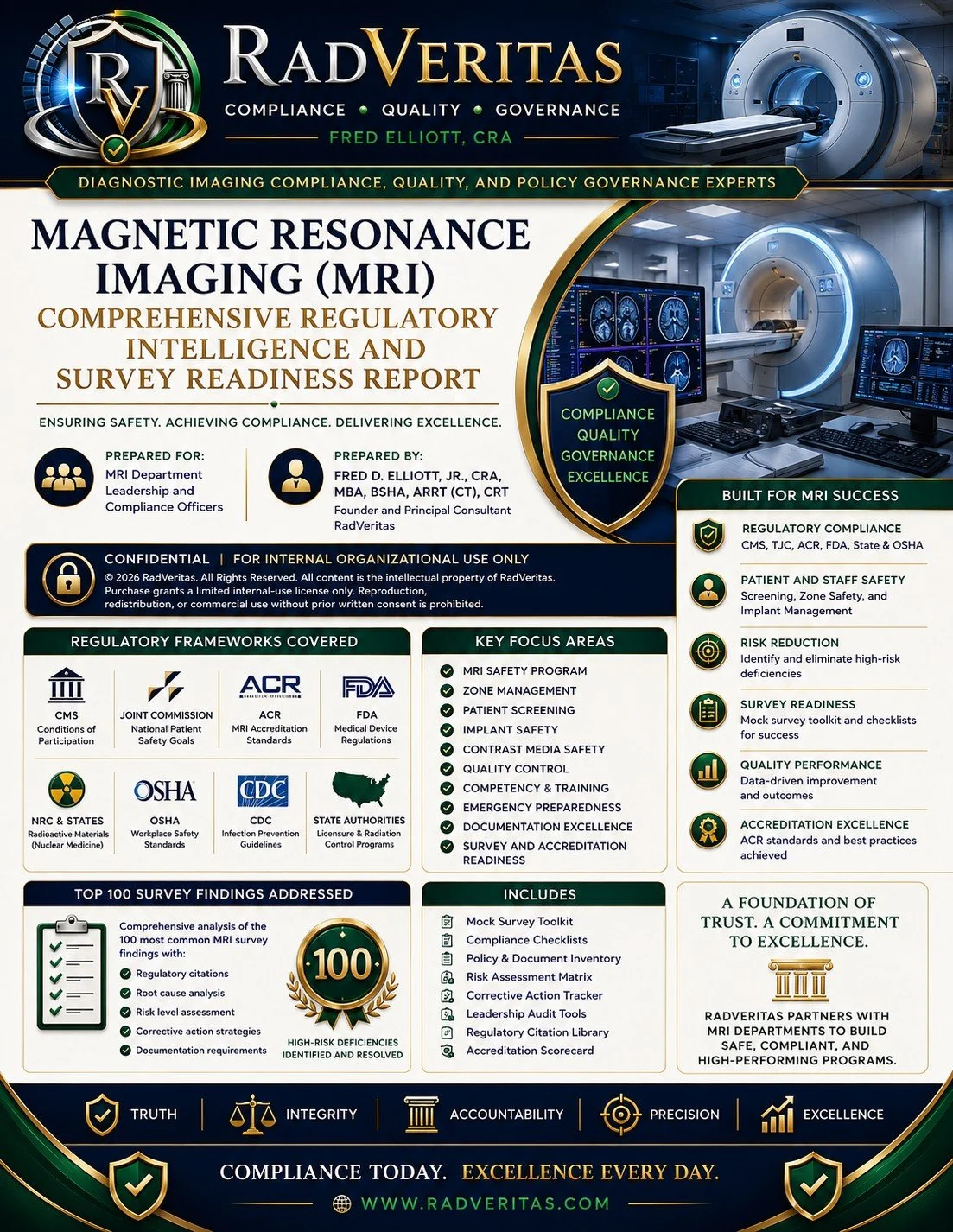
The Executive Guide to MRI Compliance, Safety, Accreditation, and Regulatory Excellence
Reduce Risk. Strengthen Compliance. Achieve Continuous Survey Readiness.
MRI departments operate in one of the most highly regulated and safety-sensitive environments in healthcare.
A single gap in MRI safety, patient screening, implant management, emergency preparedness, documentation, or accreditation readiness can expose an organization to significant regulatory findings, patient harm, operational disruption, reputational damage, and financial liability.
The challenge is not finding regulations.
The challenge is understanding which requirements truly matter, identifying hidden vulnerabilities before surveyors discover them, and building a sustainable framework that protects patients, staff, and the organization.
The RadVeritas Magnetic Resonance Imaging (MRI) Comprehensive Regulatory Intelligence and Survey Readiness Report was developed to provide imaging leaders, compliance professionals, accreditation teams, and healthcare executives with a practical, evidence-based roadmap for achieving MRI regulatory excellence.
Why This Report Matters
Most MRI compliance resources provide standards.
This report provides intelligence.
It analyzes the regulatory landscape, identifies high-risk areas commonly cited during inspections and surveys, and translates complex requirements into practical actions that strengthen compliance, improve patient safety, and support operational excellence.
Whether preparing for an accreditation survey, responding to regulatory concerns, or strengthening an MRI safety program, this report provides the insight needed to move from reactive compliance to proactive leadership.
Comprehensive Regulatory Intelligence Coverage
This report consolidates and analyzes regulatory and accreditation expectations from the organizations that influence MRI operations nationwide, including:
• Centers for Medicare & Medicaid Services (CMS)
• The Joint Commission (TJC)
• American College of Radiology (ACR)
• U.S. Food and Drug Administration (FDA)
• Occupational Safety and Health Administration (OSHA)
• State Licensing and Radiation Control Authorities
• Infection Prevention and Patient Safety Standards
• MRI Industry Best Practices and Accreditation Expectations
Instead of navigating thousands of pages of regulations independently, organizations gain a centralized intelligence resource designed specifically for MRI operations.
Critical MRI Risk Areas Addressed
MRI Safety Program Governance
Develop a comprehensive framework for MRI safety oversight, accountability, policy management, and leadership engagement.
MRI Zone Management
Strengthen control of Zones I through IV, access restrictions, signage, screening practices, and environmental safety protections.
Patient Screening and Implant Safety
Improve processes for identifying contraindications, implant evaluation, risk assessment, and patient protection.
Contrast Media Safety
Enhance screening, administration practices, emergency preparedness, and adverse event management.
Emergency Preparedness and Response
Evaluate readiness for code events, fire response, quench events, medical emergencies, and evacuation procedures.
Staff Competency and Training
Support compliance through competency validation, continuing education, role-specific training, and ongoing safety awareness.
Documentation and Survey Readiness
Strengthen documentation practices, policy governance, audit readiness, and accreditation preparation efforts.
Top 100 MRI Survey Findings Analyzed
One of the most valuable components of this report is an extensive review of the most common MRI survey and inspection deficiencies identified across healthcare organizations.
Each finding includes:
✔ Regulatory references
✔ Risk analysis
✔ Root cause considerations
✔ Corrective action guidance
✔ Documentation expectations
✔ Prevention strategies
This allows organizations to address vulnerabilities before they become citations.
Practical Tools Included
Designed for immediate operational use, the report includes:
• MRI Survey Readiness Toolkit
• Compliance Checklists
• Leadership Audit Tools
• Risk Assessment Frameworks
• Policy and Document Inventory Guidance
• Corrective Action Tracking Resources
• Accreditation Readiness Scorecards
• Regulatory Citation References
• Governance and Oversight Recommendations
Who Should Purchase This Report?
Ideal for:
• MRI Directors
• Radiology Administrators
• MRI Managers and Supervisors
• Accreditation Specialists
• Compliance Officers
• Patient Safety Leaders
• Quality Improvement Professionals
• Risk Management Teams
• Medical Directors
• Healthcare Executives
• MRI Safety Officers
• Imaging Consultants
The Cost of Being Unprepared
MRI-related regulatory deficiencies can result in accreditation findings, corrective action plans, patient safety events, operational interruptions, increased liability exposure, and loss of organizational confidence.
The organizations that consistently perform well during surveys share one common trait:
They prepare long before surveyors arrive.
This report helps organizations identify risk early, strengthen compliance programs, and build a culture of continuous readiness.
Built for MRI Success
The RadVeritas MRI Comprehensive Regulatory Intelligence and Survey Readiness Report was created to help healthcare organizations:
✓ Improve MRI safety
✓ Strengthen regulatory compliance
✓ Enhance patient protection
✓ Reduce organizational risk
✓ Improve survey outcomes
✓ Support accreditation readiness
✓ Strengthen governance oversight
✓ Drive measurable quality improvement
✓ Build sustainable compliance programs
✓ Achieve operational excellence
Deliverables
Digital Download Includes:
✔ Comprehensive MRI Regulatory Intelligence Review
✔ Survey Readiness Framework
✔ Top 100 MRI Survey Findings Analysis
✔ Compliance and Audit Tools
✔ Risk Assessment Resources
✔ Leadership Governance Guidance
✔ Accreditation Readiness Support Materials
✔ Immediate Access Upon Purchase
Compliance Today. Excellence Every Day.
Protect your patients. Strengthen your MRI program. Prepare with confidence.
Prepared By
Fred D. Elliott, Jr., CRA, MBA, BSHA, ARRT (CT), CRT
Founder and Principal Consultant
RadVeritas
Diagnostic Imaging Compliance, Quality, Governance, Accreditation, and Survey Readiness Experts
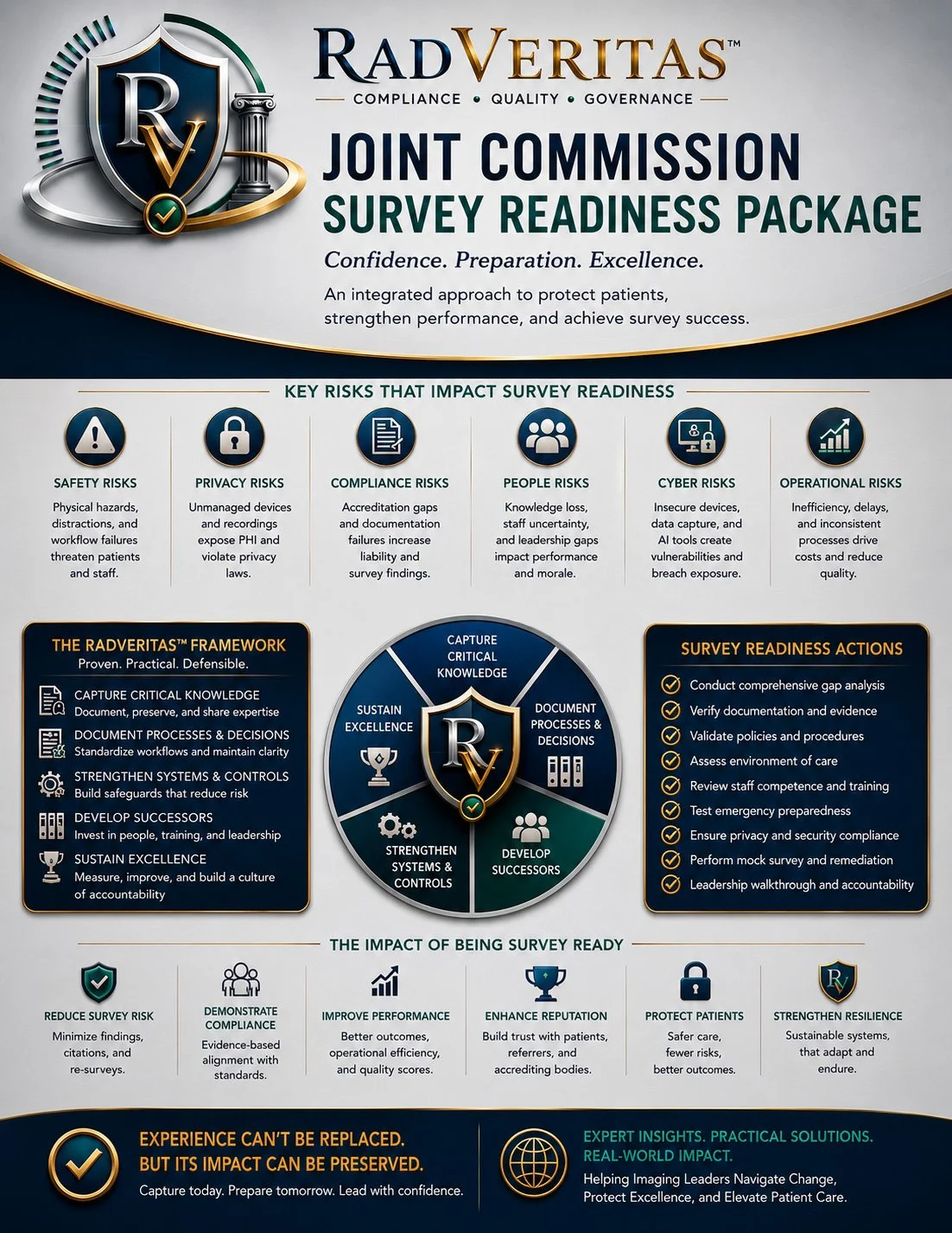
Joint Commission Survey Readiness Package™
Confidence. Preparation. Excellence.
Transform Survey Readiness from a Last-Minute Event into a Sustainable Organizational Advantage.
The most successful healthcare organizations do not prepare for a Joint Commission survey when surveyors arrive.
They build systems, accountability, documentation, and operational discipline that make survey readiness part of everyday practice.
The Joint Commission Survey Readiness Package™ from RadVeritas™ is a comprehensive Diagnostic Imaging accreditation readiness system designed to help healthcare organizations strengthen compliance, reduce risk, improve performance, and achieve sustained survey success.
Built around real-world regulatory expectations, operational realities, accreditation standards, and survey best practices, this package provides leaders with the tools, strategies, and actionable resources needed to identify vulnerabilities before surveyors do.
Why Survey Readiness Matters
Every Joint Commission survey evaluates more than policies and documentation.
Surveyors assess:
Patient safety practices
Leadership accountability
Staff competency
Regulatory compliance
Environment of Care
Infection prevention
Medication management
Privacy and security controls
Emergency preparedness
Operational effectiveness
Performance improvement activities
Organizations that rely on reactive preparation often discover weaknesses too late.
The Joint Commission Survey Readiness Package™ helps leaders proactively identify, prioritize, and address risks before they become survey findings, RFIs, citations, corrective actions, or follow-up surveys.
What's Included
Joint Commission Mock Survey Preparation Guide
A comprehensive step-by-step roadmap designed to help leaders prepare departments, staff, documentation, equipment, and processes before a Joint Commission survey.
Joint Commission Surveyor Checklist
A detailed surveyor-focused checklist modeled after common survey evaluation practices.
Modality-Specific Readiness Checklists
Targeted readiness tools for:
MRI
CT
Ultrasound
Nuclear Medicine
PET/CT
Interventional Radiology
Mammography
General Radiology
Fluoroscopy
Bone Densitometry (DEXA)
Lead Technologist and Supervisor Checklists
Designed specifically for modality leaders and frontline supervisors responsible for daily readiness activities.
Staff Checklists
Designed specifically for modality frontline staff.
Corrective Action Plan Toolkit
A structured framework for identifying, documenting, prioritizing, and resolving deficiencies.
Designed For
Ideal for:
Diagnostic Imaging Directors
Radiology Administrators
Accreditation Coordinators
Compliance Officers
Quality Improvement Leaders
Risk Management Professionals
Imaging Managers and Supervisors
Lead Technologists
Executive Healthcare Leaders
Patient Safety Teams
Regulatory Affairs Professionals
Built for Real-World Healthcare Operations
This package is designed to support organizations before, during, and after accreditation surveys.
Whether preparing for an upcoming Joint Commission survey, responding to previous findings, conducting internal readiness reviews, or building a long-term compliance strategy, the Joint Commission Survey Readiness Package™ provides the structure, tools, checklists, and executive guidance necessary to maintain continuous readiness and operational excellence.
Survey Readiness Is Not an Event. It Is a Culture.
Organizations that consistently perform well during accreditation surveys share one common characteristic:
They make readiness part of daily operations.
The Joint Commission Survey Readiness Package™ helps leaders create that culture by aligning people, processes, documentation, governance, accountability, and continuous improvement into a unified readiness strategy.
Be Ready Every Day. Not Just on Survey Day.
Reduce risk. Strengthen compliance. Protect patients. Improve performance.
RadVeritas™
Compliance • Quality • Governance
Expert Insights. Practical Solutions. Real-World Impact.
Helping Diagnostic Imaging Leaders Build Sustainable Survey Readiness, Strengthen Compliance, and Achieve Accreditation Excellence.
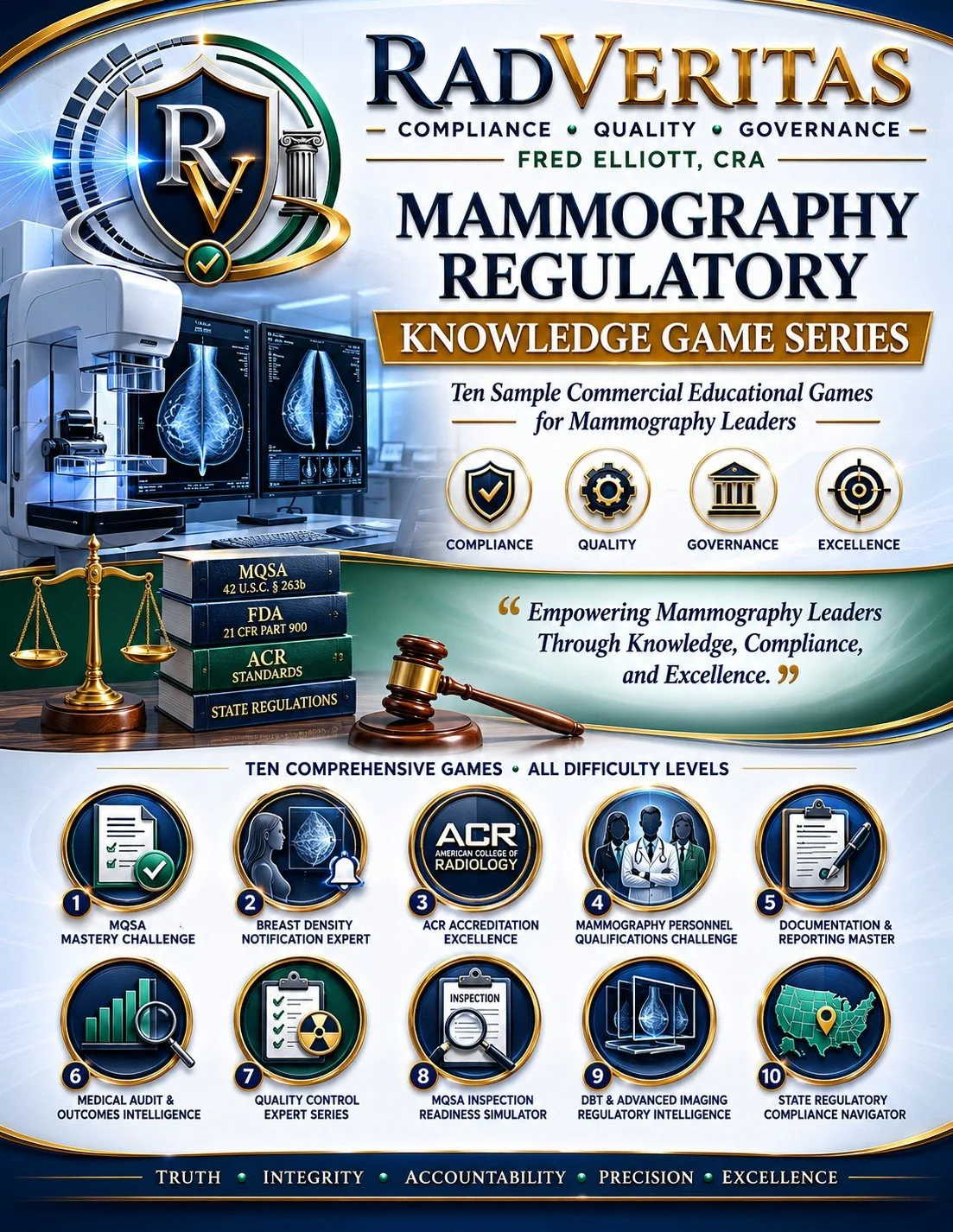
Master Mammography Compliance Before the Inspector Arrives
Most mammography compliance failures do not occur because organizations lack policies.
They occur because staff, leaders, physicians, supervisors, accreditation teams, and compliance professionals do not fully understand the regulations they are expected to follow.
The RadVeritas Mammography Regulatory Knowledge Game Series was developed to solve that problem.
Designed by healthcare leadership professionals with extensive expertise in diagnostic imaging operations, accreditation, compliance, quality improvement, and regulatory readiness, this advanced educational system transforms complex mammography regulations into an engaging, challenging, and highly effective learning experience.
Unlike generic competency assessments, this comprehensive regulatory intelligence platform contains 100 examination-quality questions organized across ten specialized regulatory domains covering the complete mammography compliance landscape.
Every question is supported by detailed rationales, primary source citations, regulatory references, and real-world compliance applications, allowing participants to understand not only the correct answer, but why it matters during inspections, accreditation reviews, audits, and daily operations.
Whether you are preparing for an MQSA inspection, strengthening annual competencies, onboarding new staff, conducting leadership development, or building a culture of compliance excellence, this system provides a powerful and practical solution.
What Makes This Different?
This is not another compliance quiz.
This is a structured mammography regulatory intelligence training system designed to challenge participants at progressively higher levels of expertise.
Questions progress from foundational regulatory concepts to advanced inspection scenarios, accreditation challenges, regulatory interpretation exercises, and executive-level compliance decision making.
Participants learn to think like inspectors, accreditation reviewers, quality leaders, and compliance professionals.
The result is deeper knowledge retention, stronger regulatory awareness, improved survey readiness, and greater organizational confidence.
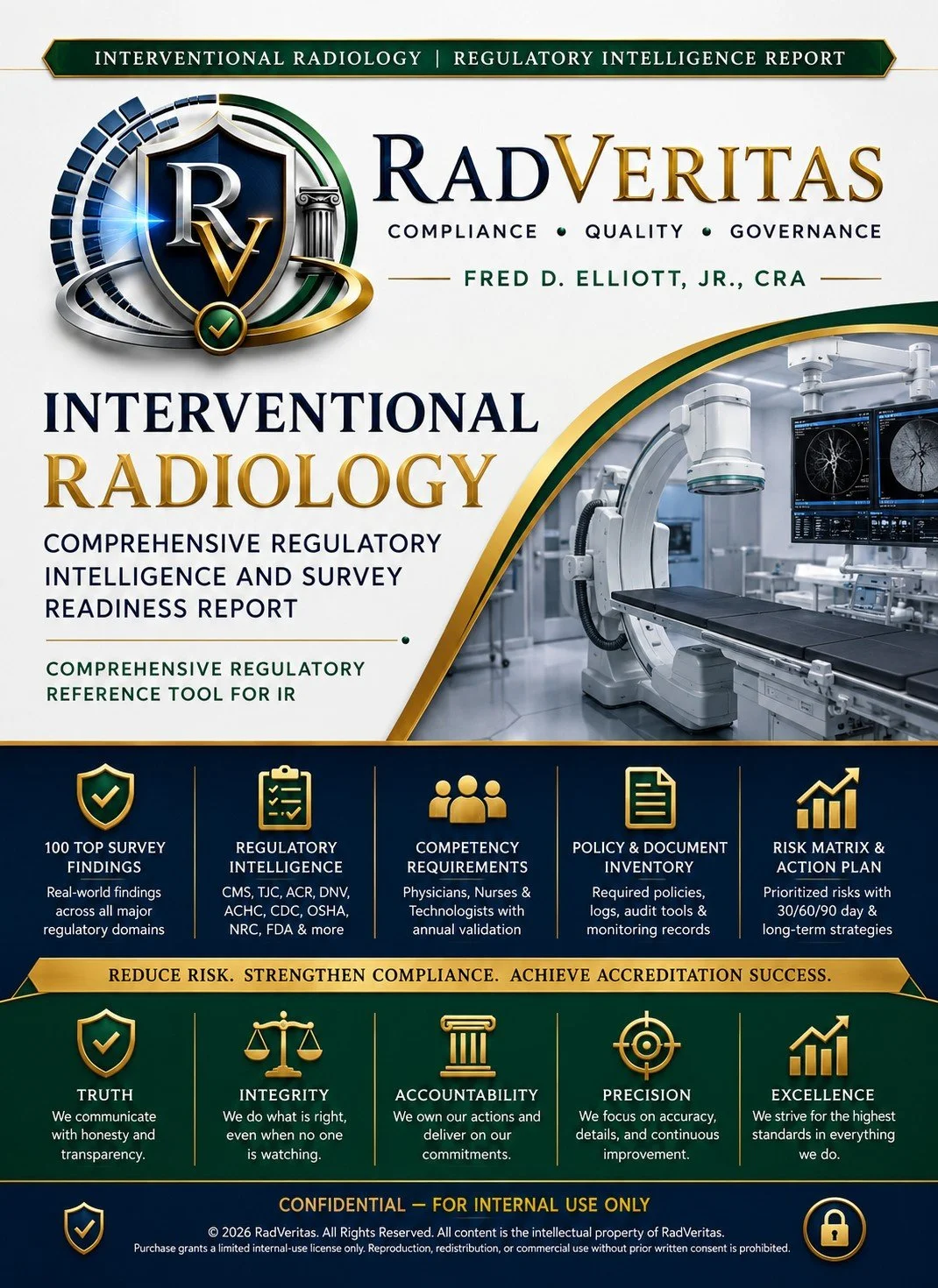
The Regulatory Roadmap Every Interventional Radiology Leader Needs
Interventional Radiology operates within one of the most highly scrutinized environments in healthcare.
A single compliance gap involving moderate sedation, radiation safety, infection prevention, credentialing, medication management, documentation, or procedural oversight can result in accreditation findings, regulatory citations, patient safety events, financial penalties, litigation exposure, or reputational damage.
The RadVeritas Interventional Radiology Comprehensive Regulatory Intelligence & Survey Readiness Report was developed to help healthcare leaders proactively identify risk, strengthen compliance infrastructure, improve survey readiness, and build a sustainable culture of operational excellence.
This executive-level reference consolidates the regulatory, accreditation, patient safety, quality, and governance requirements impacting Interventional Radiology into one comprehensive, practical, and actionable resource.
Stop Preparing for Surveys. Start Operating Survey-Ready Every Day.
Most organizations focus on compliance only when a survey is approaching.
High-performing organizations build compliance into daily operations.
This report provides a structured framework to help Interventional Radiology departments:
✔ Reduce regulatory risk
✔ Strengthen patient safety programs
✔ Improve accreditation readiness
✔ Identify compliance vulnerabilities before surveyors do
✔ Enhance physician, nursing, and technologist accountability
✔ Strengthen quality and peer review programs
✔ Build defensible documentation systems
✔ Establish long-term governance and operational oversight
What Makes This Report Different?
Unlike generic compliance guides, this report was designed specifically for Interventional Radiology operations.
The content aligns regulatory expectations from:
Centers for Medicare & Medicaid Services (CMS)
The Joint Commission (TJC)
American College of Radiology (ACR)
DNV Healthcare
Accreditation Commission for Health Care (ACHC)
Occupational Safety and Health Administration (OSHA)
Nuclear Regulatory Commission (NRC)
Food and Drug Administration (FDA)
Society of Interventional Radiology (SIR)
American Society of Anesthesiologists (ASA)
Association for Professionals in Infection Control and Epidemiology (APIC)
Association of periOperative Registered Nurses (AORN)
The result is a single-source intelligence platform for Interventional Radiology compliance, accreditation, quality, and patient safety.
Inside This Comprehensive Report
Top 100 Survey Findings
Discover the most frequently cited deficiencies identified across regulatory and accreditation surveys, including:
Moderate Sedation
Radiation Safety
Fluoroscopy Compliance
Infection Prevention
High-Level Disinfection
Medication Management
Credentialing & Privileging
Documentation Compliance
Environment of Care
Learn where organizations fail and how to avoid becoming the next finding.
Regulatory Intelligence Library
Gain a practical understanding of the regulations, standards, and governing bodies influencing Interventional Radiology operations.
High-Risk Deficiency Analysis
Identify vulnerabilities associated with:
Moderate Sedation
Informed Consent
Universal Protocol
Controlled Substances
Contrast Safety
Radiation Protection
Focus resources where risk is highest.
Policy & Document Inventory
Know exactly which policies, logs, audits, monitoring tools, and supporting documents surveyors expect to see.
Competency Requirements
Comprehensive competency frameworks for:
Interventional Radiologists
Registered Nurses
Radiologic Technologists
High-Risk Clinical Activities
Support annual validations and competency management programs.
Radiation Safety Program Guidance
Strengthen compliance related to:
ALARA Programs
Personnel Dosimetry
Fluoroscopy Operations
Radiation Monitoring
Radiation Safety Committees
High-Dose Event Management
Infection Prevention & Device Reprocessing
Detailed guidance for:
High-Level Disinfection
Sterile Processing
Device Reprocessing
HAI Prevention
Procedural Infection Control
Quality & Peer Review Infrastructure
Build sustainable systems for:
QAPI
Peer Review
Performance Monitoring
Complication Tracking
Quality Dashboards
Benchmarking Programs
Mock Survey Toolkit
Prepare physicians, nurses, technologists, leaders, and managers for real-world surveyor interviews and document requests.
Executive Action Planning
Includes structured:
30-Day Priorities
60-Day Priorities
90-Day Priorities
6-Month Goals
12-Month Goals
Transform findings into measurable operational improvement.
Included Executive Tools
The report includes downloadable operational tools and templates designed to accelerate implementation:
Regulatory Compliance Checklist
Survey Readiness Checklist
Leadership Audit Tool
Competency Validation Tracker
Policy Inventory Matrix
Mock Survey Question Bank
Regulatory Citation Library
Corrective Action Tracker
Risk Assessment Matrix
Accreditation Readiness Dashboard
These tools provide immediate operational value and can be integrated directly into existing compliance and quality programs.
Ideal For
Interventional Radiology Medical Directors
Imaging Administrators
Radiology Directors
Compliance Officers
Accreditation Specialists
Quality Leaders
Patient Safety Officers
Radiation Safety Officers
Nurse Leaders
Healthcare Executives
Survey Readiness Teams
Healthcare Consultants
The Business Case
Survey findings are expensive.
Patient safety events are costly.
Regulatory citations damage trust.
Accreditation deficiencies consume resources.
This report helps organizations identify vulnerabilities before they become findings, reduce operational risk, improve regulatory performance, and strengthen organizational resilience.
One prevented deficiency can generate a return far exceeding the cost of this resource.
Why RadVeritas
RadVeritas was founded on a simple principle:
Compliance should not be a reactive exercise. It should be an operational advantage.
Developed by Fred D. Elliott, Jr., CRA, MBA, BSHA, ARRT (CT), CRT, this report reflects more than three decades of diagnostic imaging leadership experience spanning accreditation, regulatory compliance, patient safety, quality improvement, operational governance, and healthcare administration.
Reduce Risk. Strengthen Compliance. Achieve Accreditation Success.
The Interventional Radiology Comprehensive Regulatory Intelligence & Survey Readiness Report provides the intelligence, structure, and practical tools necessary to help organizations navigate today's increasingly complex regulatory environment with confidence.
Comprehensive Regulatory Intelligence.
Practical Survey Readiness.
Operationally Defensible Compliance.
RadVeritas
Compliance. Quality. Governance.
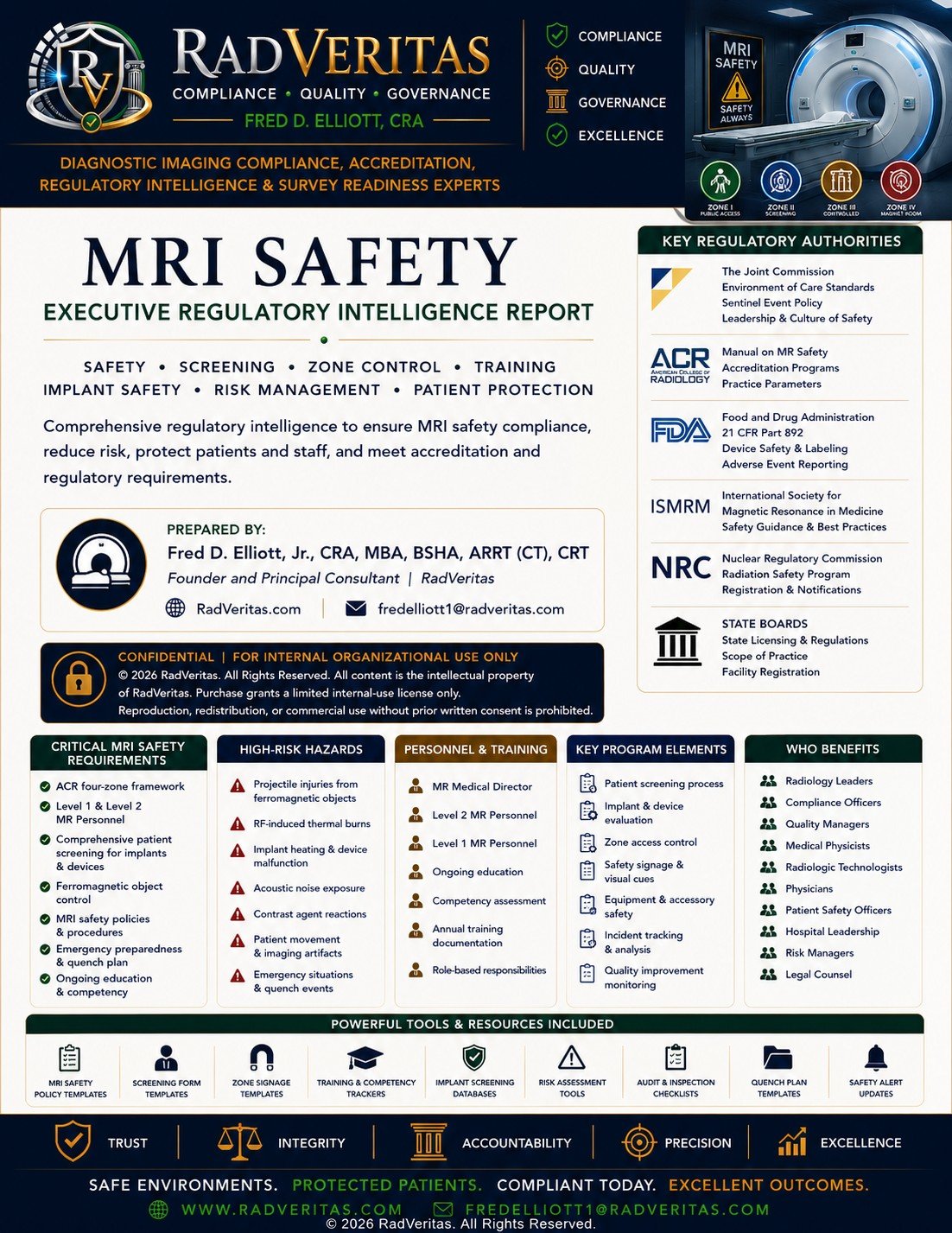
The Complete MRI Safety, Patient Protection, and Accreditation Readiness System for Healthcare Leaders
One MRI Safety Failure Can Become a Sentinel Event
A patient with an unidentified implant.
An oxygen cylinder entering the magnet room.
An unscreened individual crossing into a restricted zone.
A pacemaker scanned outside approved conditions.
In MRI, mistakes are rarely minor.
They can be immediate, catastrophic, and life-changing.
Unlike most healthcare risks, MRI hazards are invisible. Powerful magnetic fields, radiofrequency energy, cryogenic systems, implanted devices, and restricted access environments create a safety landscape that demands constant vigilance.
The RadVeritas MRI Safety Regulatory Intelligence Report provides healthcare leaders with a comprehensive roadmap for protecting patients, safeguarding staff, reducing organizational risk, and maintaining continuous accreditation readiness.
Built upon current American College of Radiology (ACR) MRI Safety guidance, The Joint Commission expectations, FDA regulations, and industry best practices, this report helps organizations transform MRI safety from a compliance obligation into an operational strength.
Why This Report Matters
MRI-related injuries continue to occur across healthcare despite decades of published safety guidance.
Most MRI safety events are preventable.
They occur because of:
Incomplete patient screening
Implant evaluation failures
Weak zone access controls
Inadequate staff training
Poor emergency preparedness
Lack of leadership oversight
Inconsistent safety practices
These vulnerabilities often remain hidden until an accreditation survey, patient injury, regulatory review, or sentinel event exposes them.
This report helps leaders identify and correct those risks before they become organizational liabilities.
What You'll Learn
MRI Safety Governance
Develop a comprehensive MRI safety program aligned with current ACR standards and industry expectations.
Zone Control and Access Management
Strengthen oversight of:
Zone I
Zone II
Zone III
Zone IV
Restricted Access Controls
Visitor Screening Processes
Implant and Device Evaluation
Build defensible processes for:
Pacemaker Assessment
Neurostimulator Evaluation
Metallic Implant Screening
MR Safe Determinations
MR Conditional Reviews
MR Unsafe Identification
Personnel Qualification and Training
Understand requirements related to:
Level 1 MR Personnel
Level 2 MR Personnel
MRI Safety Education
Annual Competency Validation
MRI Safety Governance
Emergency Preparedness
Strengthen readiness for:
Projectile Incidents
Quench Events
Medical Emergencies
Sedation Emergencies
Fire Response
Emergency Evacuation
The Hidden Risk Most Organizations Underestimate
Many organizations believe MRI safety is primarily the responsibility of MRI staff.
The reality is different.
MRI safety is an organizational responsibility.
A patient transported from the Emergency Department.
A vendor entering the MRI suite.
A nurse unfamiliar with zone restrictions.
A contractor carrying ferromagnetic equipment.
Any one of these can create a life-threatening situation.
Organizations with strong MRI safety cultures recognize that safety extends beyond the magnet room and requires leadership engagement, operational discipline, and continuous oversight.
Build a Culture That Prevents Catastrophic Events
The strongest MRI safety programs are not built around surveys.
They are built around prevention.
The RadVeritas MRI Safety Regulatory Intelligence Report provides healthcare leaders with the intelligence, governance framework, and operational strategies needed to strengthen patient safety, improve compliance, reduce risk, and sustain accreditation readiness.
Because when MRI safety fails, the consequences can be immediate.
When MRI safety succeeds, patients never see the risks that were prevented.
Protect the Patient.
Protect the Staff.
Protect the Organization.
Prepared By
Fred D. Elliott, Jr., CRA, MBA, BSHA, ARRT (CT), CRT
Founder and Principal Consultant
RadVeritas
Compliance • Quality • Governance
Building Safer MRI Programs Through Leadership, Preparedness, and Accountability.
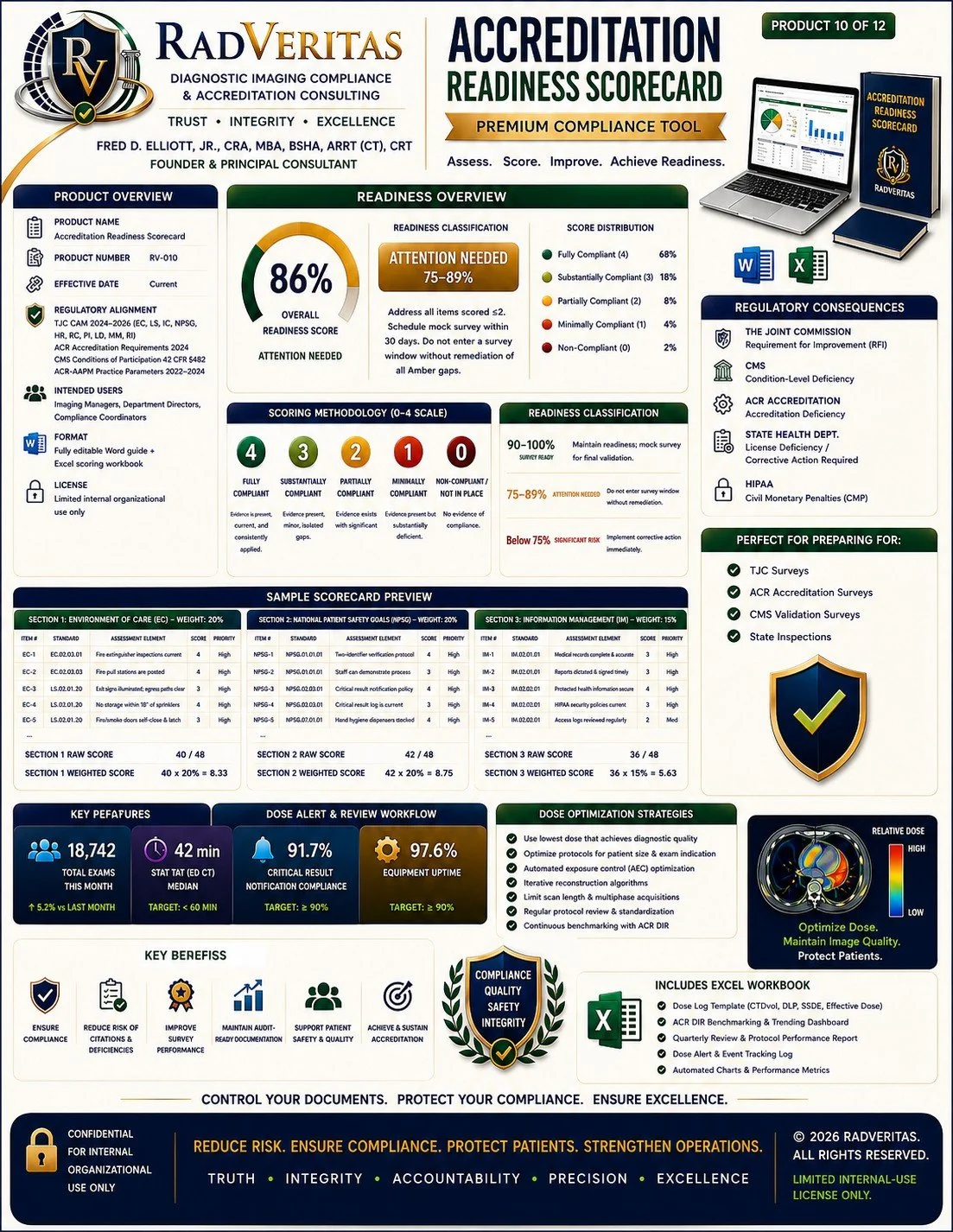
A weighted self-assessment and readiness scoring system that evaluates compliance across Environment of Care, National Patient Safety Goals, Human Resources, Infection Control, Policy Management, Radiation Safety, and ACR requirements. Produces objective readiness scores, gap analyses, corrective action priorities, and survey readiness classifications to support continuous accreditation preparedness.
Primary Value
Readiness assessment
Gap identification
Corrective action planning
Survey preparation
Continuous compliance monitoring
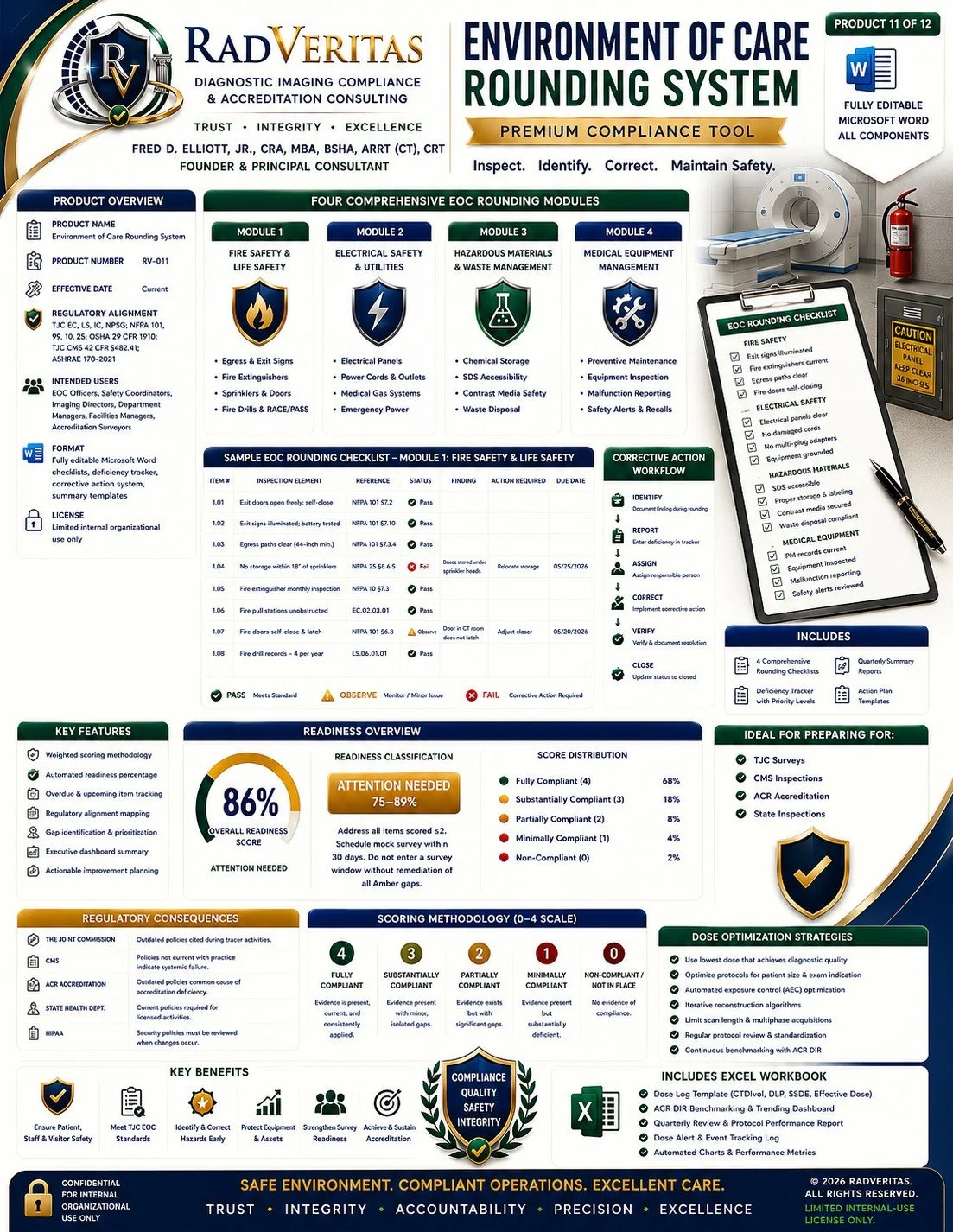
Summary
A comprehensive Environment of Care (EOC) inspection and compliance management system designed to support continuous readiness for accreditation surveys and regulatory inspections. The product provides structured monthly rounding tools, deficiency tracking systems, corrective action workflows, quarterly reporting templates, and regulatory crosswalks aligned with Environment of Care, Life Safety, Infection Control, Utilities, Fire Safety, and Radiation Safety requirements. It converts EOC rounding from a reactive inspection activity into a measurable, documented, and defensible compliance program.
Primary Value
Continuous survey readiness
Environment of Care compliance
Life Safety compliance
Deficiency tracking and remediation
Documentation standardization
Leadership oversight and accountability
Ideal Users
Imaging Directors
Accreditation Coordinators
Safety Officers
Facilities Managers
Compliance Leaders
Department Managers
Problem Solved
Many organizations perform EOC rounds inconsistently, document findings poorly, and lack a formal corrective action process. This system provides a structured framework to identify, track, assign, resolve, and report EOC deficiencies before they become survey findings.
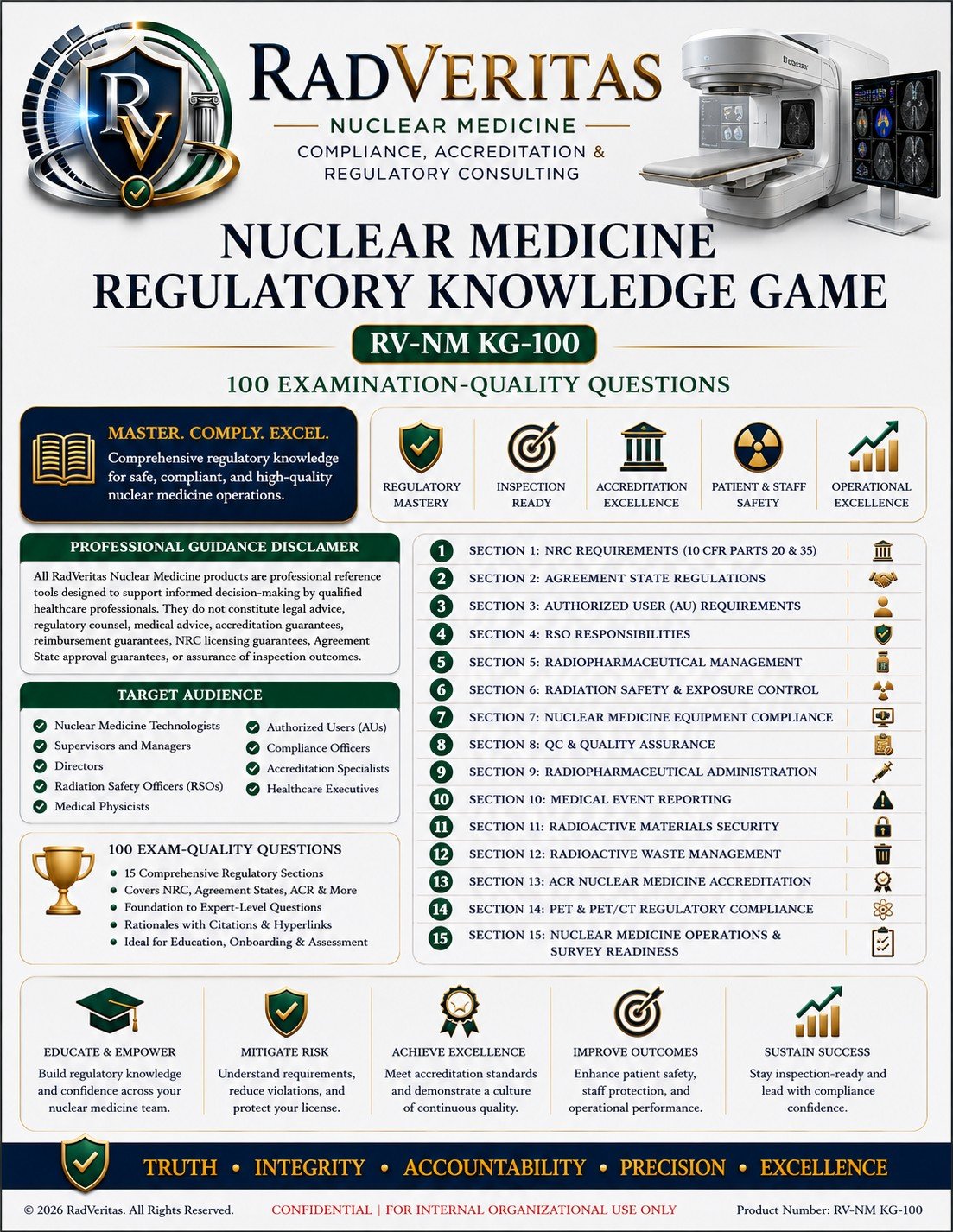
Turn Regulatory Compliance into Organizational Strength
The Ultimate Nuclear Medicine Compliance Training and Competency Assessment Solution
Every Nuclear Medicine department faces the same challenge:
How do you ensure your staff truly understands the regulations that govern radioactive materials, radiation safety, radiopharmaceutical administration, accreditation requirements, and survey readiness before a regulator, accreditor, or auditor identifies a deficiency?
The RadVeritas Nuclear Medicine Regulatory Knowledge Game (RV-NM KG-100) was created to answer that challenge.
Designed by imaging leadership professionals and regulatory experts, this comprehensive educational resource transforms complex Nuclear Medicine regulations into an engaging, examination-quality learning experience that improves knowledge retention, strengthens compliance readiness, and promotes operational excellence.
Whether your organization is preparing for an NRC inspection, Agreement State review, ACR accreditation survey, radiation safety audit, or competency assessment program, the RV-NM KG-100 helps ensure your team is prepared.
Why This Product Matters
Regulatory deficiencies can lead to:
• Increased organizational risk
• Costly corrective action plans
• Survey findings and citations
• Accreditation vulnerabilities
• Radiation safety concerns
• Staff competency gaps
• Reduced organizational confidence
The RV-NM KG-100 helps organizations proactively identify and address these vulnerabilities before they become operational problems.
This is not another generic quiz.
This is a strategic compliance education tool built specifically for Nuclear Medicine professionals.
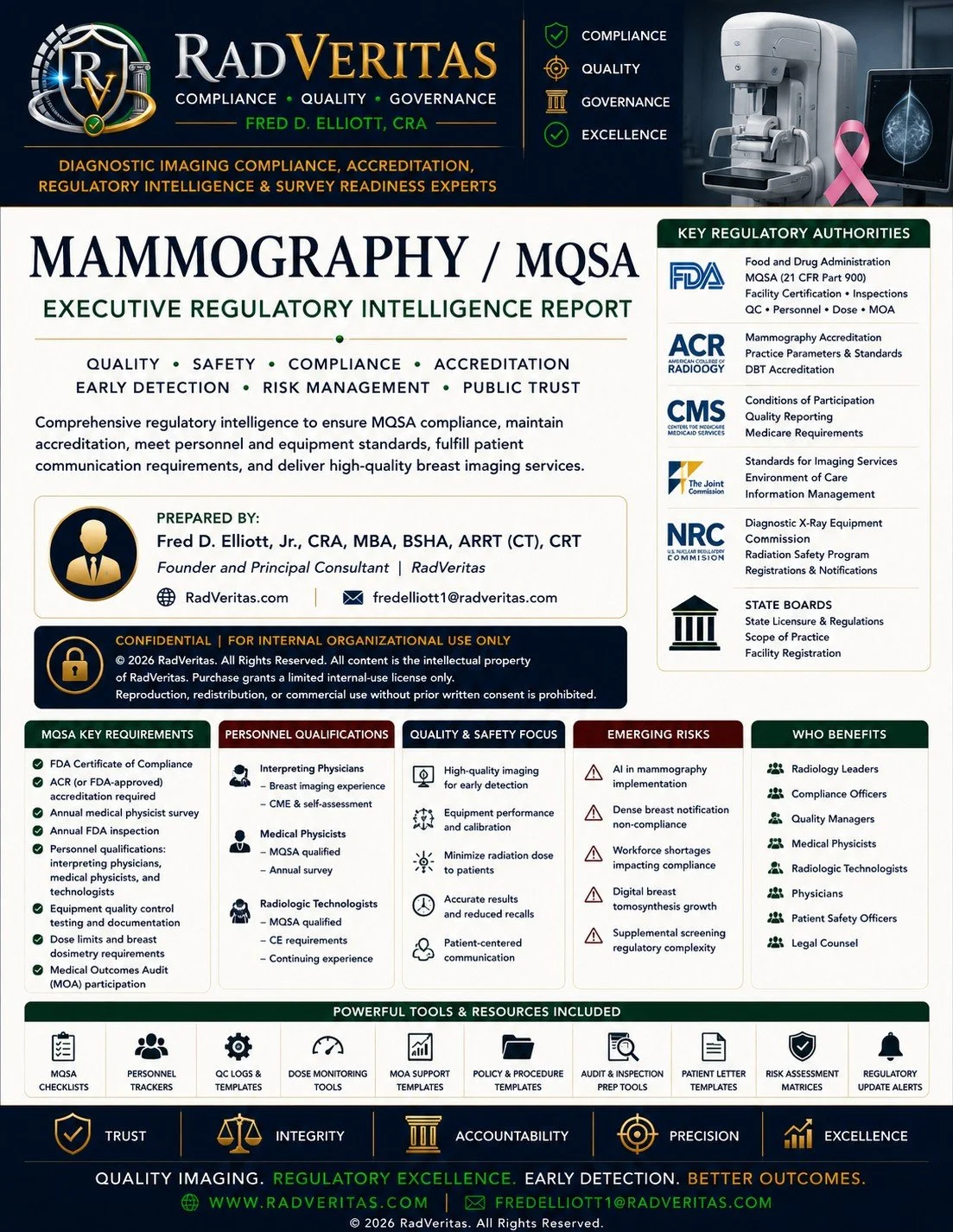
The Complete Compliance, Accreditation, Quality, and Survey Readiness System for Breast Imaging Leaders
One Compliance Failure Can Shut Down an Entire Mammography Program
No imaging modality faces more regulatory scrutiny than Mammography.
Every mammography facility in the United States operates under the Mammography Quality Standards Act (MQSA), one of the most prescriptive and actively enforced regulatory frameworks in healthcare.
An expired certificate.
A missed physicist survey.
A personnel qualification lapse.
A missing dense breast notification.
Any one of these can trigger FDA enforcement action, accreditation loss, public reporting, civil penalties, and suspension of mammography services.
The RadVeritas Mammography / MQSA Regulatory Intelligence Report provides healthcare leaders with a comprehensive framework for maintaining certification, protecting accreditation, ensuring patient safety, and building a continuously survey-ready breast imaging program.
Why This Report Matters
Breast imaging is more than a regulatory obligation.
It is a life-saving service.
Every quality failure creates the potential for delayed cancer detection, patient harm, regulatory action, and reputational damage.
The organizations that consistently succeed are not those that prepare for inspections once a year.
They are the organizations that maintain readiness every day.
This report helps leaders identify vulnerabilities before they become findings.
What You'll Learn
MQSA Compliance and Certification
Understand the federal requirements governing:
MQSA Certification
FDA Inspections
Accreditation Maintenance
Personnel Qualifications
Quality Control Programs
Medical Outcomes Audits
Patient Notification Requirements
Personnel Qualification Management
Strengthen oversight of:
Interpreting Physicians
Mammography Technologists
Medical Physicists
Continuing Education
Continuing Experience Requirements
Digital Breast Tomosynthesis (DBT) Training
Quality Control and Equipment Compliance
Develop effective systems for:
Weekly Quality Control Testing
Phantom Image Evaluation
Compression Testing
Artifact Monitoring
Physicist Surveys
Dose Monitoring
Corrective Action Documentation
Dense Breast Notification Compliance
Navigate evolving federal and state requirements involving:
Patient Lay Summary Letters
Dense Breast Notifications
Communication Timeliness
Documentation Requirements
Medical Outcomes Audits
Build effective pathology correlation and performance improvement processes that support regulatory compliance and patient safety.
Key Areas Covered
✓ MQSA Certification Requirements
✓ FDA Inspection Readiness
✓ ACR Mammography Accreditation
✓ Digital Breast Tomosynthesis Compliance
✓ Personnel Qualification Tracking
✓ Medical Physicist Survey Requirements
✓ Quality Control Program Management
✓ Dense Breast Notification Compliance
✓ Medical Outcomes Audits
✓ Patient Communication Standards
✓ Leadership Accountability
✓ Survey Readiness and Risk Reduction
Powerful Tools Included
✔ MQSA Compliance Assessments
✔ Accreditation Readiness Checklists
✔ Personnel Qualification Tracking Systems
✔ Risk Assessment Matrices
✔ Quality Control Audit Tools
✔ Survey Readiness Dashboards
✔ Gap Analysis Frameworks
✔ Corrective Action Plans
✔ Executive Action Roadmaps
✔ Policy and Procedure Reviews
✔ Compliance Monitoring Tools
✔ Leadership Accountability Assessments
Designed For
Breast Imaging Directors
Mammography Managers
Radiology Administrators
Compliance Officers
Accreditation Specialists
Medical Physicists
Interpreting Physicians
Quality Leaders
Patient Safety Officers
Hospital Executives
Healthcare Consultants
The Cost of Non-Compliance
Most imaging deficiencies result in corrective action plans.
MQSA deficiencies can result in loss of certification.
A single overlooked requirement can lead to:
FDA Enforcement Action
Accreditation Risk
Public Disclosure of Deficiencies
Service Interruption
Revenue Loss
Increased Liability Exposure
Patient Safety Concerns
The consequences extend far beyond a survey finding.
Protect Your Certification. Protect Your Patients.
The RadVeritas Mammography / MQSA Regulatory Intelligence Report provides healthcare leaders with the intelligence, tools, and governance strategies needed to maintain certification, strengthen quality, improve patient safety, and sustain accreditation readiness.
Because in Mammography, compliance is not simply a regulatory requirement.
It is a commitment to every patient who trusts your organization to detect cancer when it matters most.
Protect Certification.
Strengthen Quality.
Save Lives.
Prepared By
Fred D. Elliott, Jr., CRA, MBA, BSHA, ARRT (CT), CRT
Founder and Principal Consultant
RadVeritas
Compliance • Quality • Governance
Turning MQSA Compliance Into Operational Excellence.
REGULATORY COMPLIANCE AND PATIENT SAFETY
CONTRAST MEDIA SAFETY AND MANAGEMENT
The Complete Patient Safety, Medication Management, and Regulatory Readiness System for Diagnostic Imaging Leaders
One Preventable Contrast Event Can Change Everything
A severe contrast reaction.
An undetected kidney impairment.
An extravasation injury.
A missed allergy history.
A delayed emergency response.
These events occur every day in healthcare organizations across the country, and many are entirely preventable.
Contrast media are among the most frequently administered medications in Diagnostic Imaging. Yet many organizations underestimate the regulatory, clinical, operational, and legal risks associated with their use.
The RadVeritas Contrast Media Safety and Management Regulatory Intelligence Report provides healthcare leaders with a comprehensive roadmap for protecting patients, strengthening compliance, reducing liability, and building a safer contrast administration program.
Built upon current CMS Conditions of Participation, The Joint Commission Medication Management standards, FDA requirements, and the American College of Radiology Manual on Contrast Media, this report transforms complex regulatory expectations into practical operational solutions.
Why This Report Matters
Every contrast administration carries risk.
Whether administering iodinated contrast for CT, gadolinium-based contrast for MRI, or contrast agents used in fluoroscopy and advanced imaging procedures, organizations are expected to maintain systems that protect patients before, during, and after administration.
Regulators, surveyors, accreditors, attorneys, and patients increasingly expect organizations to demonstrate:
Effective patient screening
Renal function assessment
Allergy identification
Emergency preparedness
Adverse reaction management
Personnel competency
Documentation integrity
Continuous quality oversight
This report helps leaders identify vulnerabilities before they become patient safety events, survey findings, or legal exposure.
What You'll Learn
Contrast Media Safety Governance
Build a structured framework for safe contrast administration across all imaging modalities.
Patient Screening and Risk Assessment
Strengthen processes for:
Renal Function Assessment
Contrast Allergy Screening
Pregnancy Assessment
Medication Review
NSF Risk Identification
High-Risk Patient Stratification
Emergency Preparedness
Develop effective systems for:
Contrast Reaction Response
Anaphylaxis Management
Emergency Medication Availability
Staff Competency Validation
Simulation Training Programs
Regulatory Compliance
Navigate requirements from:
CMS
The Joint Commission
ACR
FDA
State Licensing Agencies
Documentation and Audit Readiness
Improve compliance related to:
Contrast Administration Records
Adverse Event Reporting
Extravasation Documentation
Medication Management Standards
Quality Improvement Monitoring
Key Areas Covered
✓ Contrast Media Safety Programs
✓ Iodinated Contrast Management
✓ Gadolinium-Based Contrast Agent Safety
✓ Nephrogenic Systemic Fibrosis Prevention
✓ Contrast-Induced Kidney Injury Risk Reduction
✓ Extravasation Prevention and Response
✓ Emergency Medication Readiness
✓ Personnel Training and Competency
✓ Medication Management Compliance
✓ Adverse Reaction Reporting
✓ Accreditation Readiness
✓ Leadership Accountability
Powerful Tools Included
✔ Contrast Safety Assessments
✔ Regulatory Risk Analysis Tools
✔ Survey Readiness Checklists
✔ Gap Analysis Frameworks
✔ Corrective Action Plans
✔ Executive Dashboards
✔ Emergency Response Readiness Evaluations
✔ Personnel Competency Tracking Systems
✔ Policy and Procedure Assessment Tools
✔ Risk Scoring Matrices
✔ Leadership Accountability Reviews
✔ Executive Action Roadmaps
Designed For
Imaging Directors
Radiology Administrators
CT Leaders
MRI Leaders
Interventional Radiology Leaders
Quality Improvement Professionals
Patient Safety Officers
Compliance Officers
Accreditation Specialists
Nursing Leaders
Medical Directors
Healthcare Consultants
The Hidden Risk Most Organizations Miss
Most contrast-related failures are not caused by a lack of policy.
They are caused by inconsistent execution.
A screening question that was never asked.
A kidney function result that was never reviewed.
An emergency medication that expired unnoticed.
A staff member who never received annual competency validation.
These seemingly small gaps can create significant patient safety and regulatory consequences.
The organizations that consistently perform well are those that build contrast safety into everyday operations, not just accreditation preparation.
Protect Patients. Reduce Risk. Lead With Confidence.
The RadVeritas Contrast Media Safety and Management Regulatory Intelligence Report provides the intelligence, tools, and governance framework needed to strengthen patient safety, improve regulatory compliance, reduce liability exposure, and support operational excellence.
Because contrast safety is more than a clinical responsibility.
It is a leadership responsibility.
Protect the Patient.
Protect the Organization.
Protect the Mission.
Prepared By
Fred D. Elliott, Jr., CRA, MBA, BSHA, ARRT (CT), CRT
Founder and Principal Consultant
RadVeritas
Compliance • Quality • Governance
Turning Contrast Media Safety Into Operational Excellence.
Master the ACR Accreditation Process with Confidence.
Whether you are preparing for your first ACR accreditation or managing a renewal, this comprehensive RadVeritas™ guide provides a practical, step-by-step roadmap to help your imaging department achieve and maintain accreditation success. Designed specifically for diagnostic imaging leaders, it transforms a complex process into a structured, easy-to-follow workflow that reduces uncertainty, strengthens compliance, and improves survey readiness.
From application planning and image submission to physicist testing, documentation requirements, quality control, and final accreditation decisions, this guide explains every stage of the process using clear, actionable guidance based on recognized accreditation standards and industry best practices.
What You'll Learn
Complete ACR accreditation and reaccreditation workflow
Required documentation and quality control requirements
Clinical image selection and submission strategies
Medical physicist testing and equipment evaluation
Common accreditation pitfalls and how to avoid them
Proven survey readiness and compliance practices
Practical leadership tools for managing accreditation from start to finish
Who Should Read This Guide
Imaging Directors
Radiology Administrators
Accreditation Coordinators
Compliance Officers
Quality Managers
Modality Supervisors
Healthcare Executives responsible for imaging services
Why Choose This Guide?
Step-by-step accreditation roadmap
Practical checklists and implementation guidance
Designed for real-world imaging operations
Helps reduce accreditation delays and deficiencies
Supports continuous regulatory compliance and operational excellence
Lead your next ACR accreditation with greater confidence, stronger preparation, and a proven framework for success.
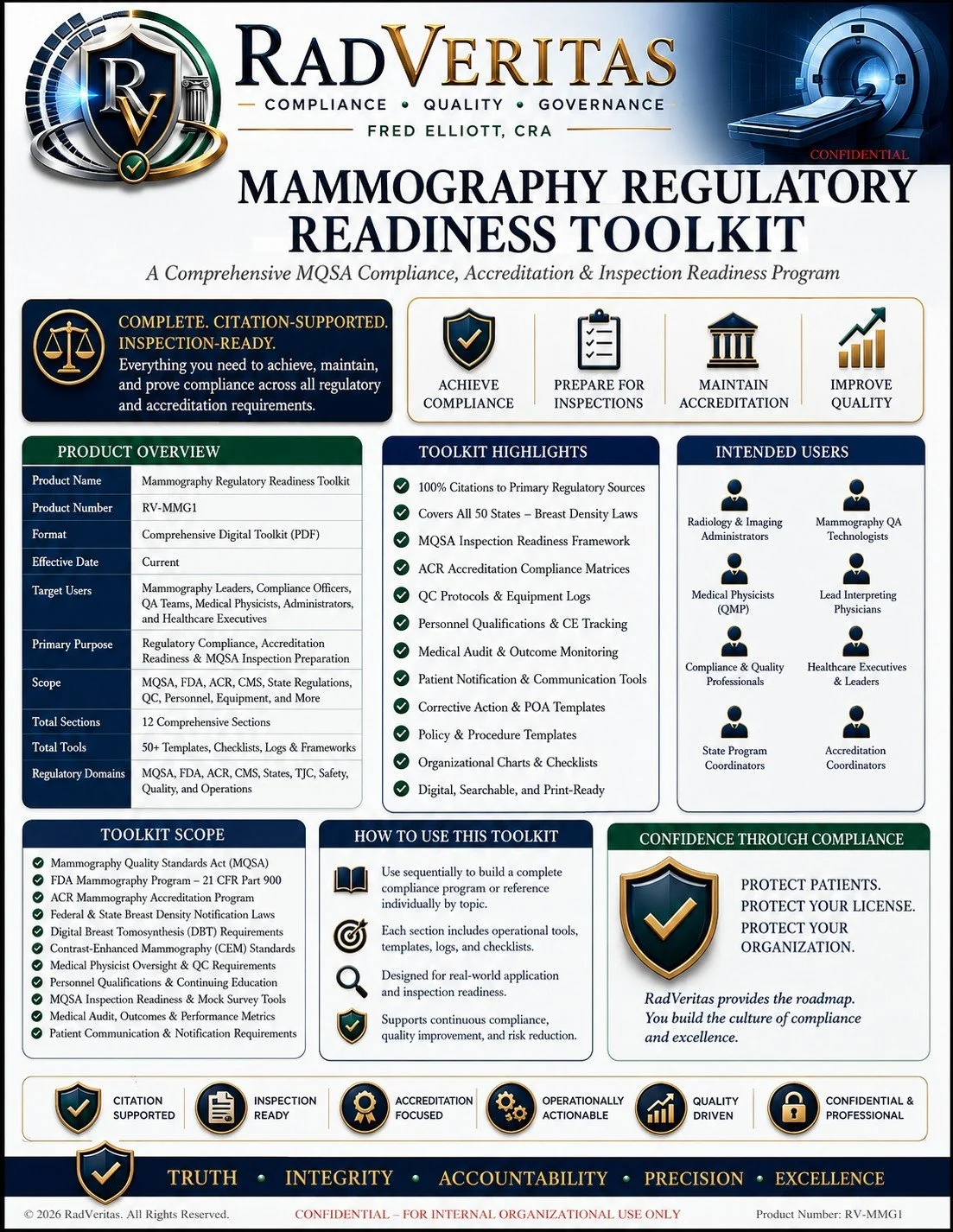
Master Mammography Compliance Before Regulators Find the Gap
Every mammography leader knows a single overlooked requirement can trigger citations, corrective action plans, accreditation findings, reimbursement risk, and potential loss of certification authority. The challenge is not knowing the regulations exist. The challenge is managing hundreds of requirements spread across multiple agencies, standards, and accreditation programs.
The RadVeritas Mammography Regulatory Compliance Toolkit was created to solve that problem.
Built specifically for mammography directors, breast center administrators, compliance professionals, quality leaders, and accreditation teams, this comprehensive compliance system consolidates MQSA, FDA, ACR, CMS, Joint Commission, MIPPA, HIPAA, AAPM, and state regulatory requirements into a single executive-level reference resource.
This is not another checklist.
This is a complete regulatory intelligence platform containing eight comprehensive compliance matrices and ninety-eight detailed compliance requirements designed to help organizations identify gaps, validate compliance, organize documentation, and maintain perpetual survey readiness.
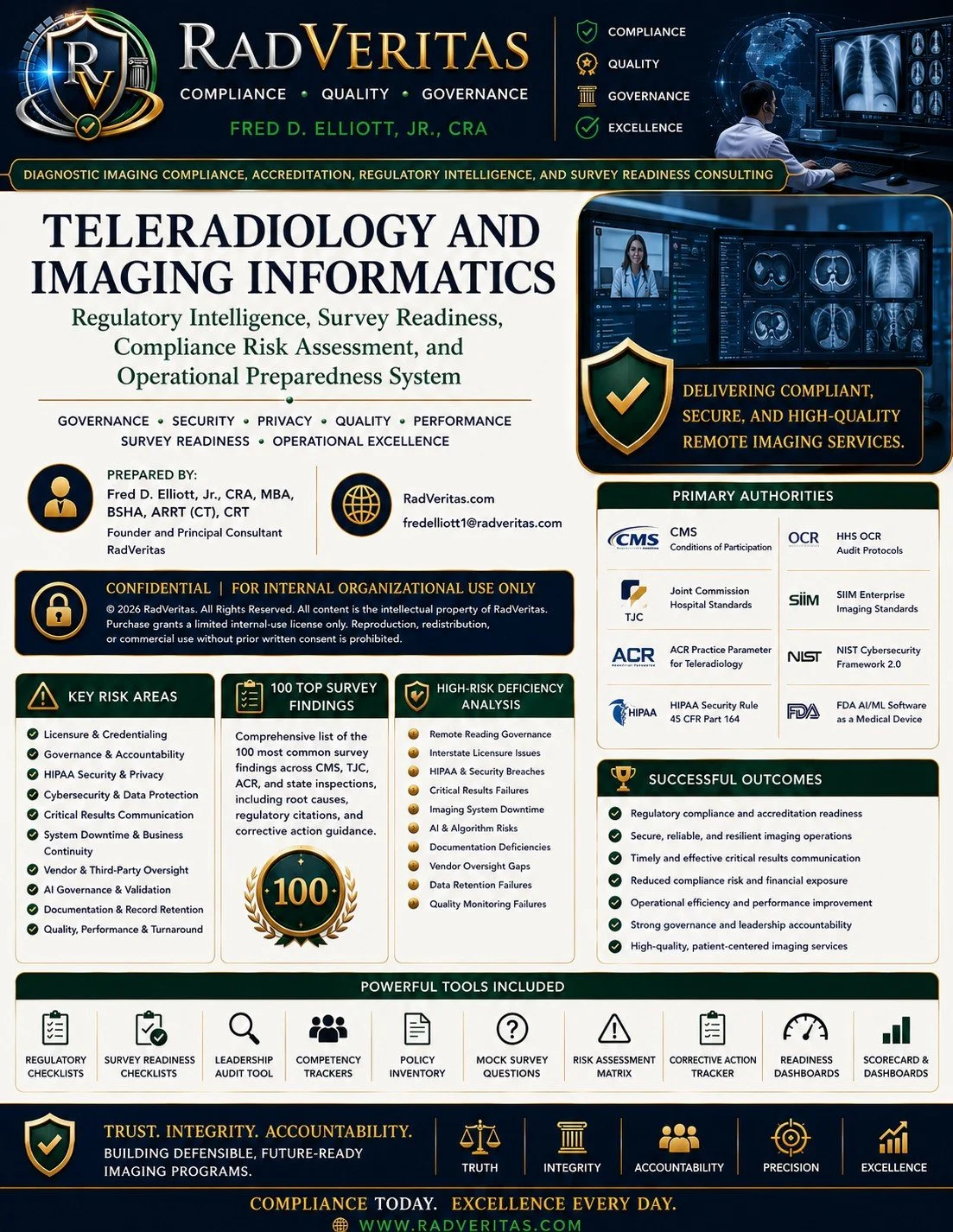
The Complete Compliance and Governance Solution for Modern Teleradiology and Enterprise Imaging Operations
Delivering Compliant, Secure, and High-Quality Remote Imaging Services
Teleradiology and Imaging Informatics have become mission-critical components of healthcare delivery.
As imaging organizations expand remote interpretation services, cloud-based imaging platforms, artificial intelligence applications, enterprise imaging systems, and multi-state reading operations, regulatory complexity has increased dramatically.
Healthcare organizations now face heightened scrutiny related to cybersecurity, HIPAA compliance, artificial intelligence governance, credentialing, critical results communication, business continuity, vendor oversight, data retention, imaging interoperability, and operational resilience.
The challenge is no longer simply reading images remotely.
The challenge is ensuring every component of the remote imaging ecosystem remains compliant, secure, defensible, and survey-ready.
The RadVeritas Teleradiology and Imaging Informatics Regulatory Intelligence, Survey Readiness, Compliance Risk Assessment, and Operational Preparedness System was developed to help imaging leaders proactively identify vulnerabilities, strengthen governance, reduce compliance risk, and build resilient remote imaging operations capable of withstanding regulatory scrutiny and operational disruption.
Why This Resource Matters
Remote imaging operations create risks that do not exist in traditional imaging environments.
A single breakdown involving:
Critical result communication
Multi-state licensure compliance
Cybersecurity protection
HIPAA safeguards
AI governance
Vendor oversight
Data retention
System downtime
Credentialing verification
Disaster recovery
can result in regulatory citations, patient safety events, financial penalties, litigation exposure, accreditation deficiencies, and reputational harm.
The organizations that succeed are those that identify risk before it becomes a finding.
Built Around the Authorities That Govern Remote Imaging
This comprehensive intelligence system aligns operational expectations with guidance and requirements from:
Centers for Medicare & Medicaid Services (CMS)
The Joint Commission (TJC)
American College of Radiology (ACR)
U.S. Department of Health and Human Services Office for Civil Rights (OCR)
HIPAA Security Rule
National Institute of Standards and Technology (NIST Cybersecurity Framework 2.0)
Society for Imaging Informatics in Medicine (SIIM)
FDA Artificial Intelligence and Software as a Medical Device Guidance
Rather than navigating multiple regulatory sources independently, leaders receive a centralized compliance and governance roadmap designed specifically for remote imaging environments.
Critical Risk Areas Identified
Licensure and Credentialing
Ensure radiologists, physicians, and imaging professionals maintain proper licensure, privileges, credentialing, and regulatory compliance across multiple states and jurisdictions.
Governance and Accountability
Establish leadership structures, oversight committees, performance monitoring systems, and executive accountability programs.
HIPAA Security and Privacy
Strengthen compliance with privacy regulations, protected health information safeguards, access controls, and breach prevention strategies.
Cybersecurity and Data Protection
Address ransomware threats, network security vulnerabilities, cloud storage protections, user authentication controls, and system resilience.
Critical Results Communication
Reduce patient safety risk by strengthening communication workflows, escalation procedures, and documentation requirements.
System Downtime and Business Continuity
Prepare for technology failures, disaster recovery events, vendor disruptions, and operational interruptions.
Vendor and Third-Party Oversight
Improve governance over cloud providers, AI vendors, teleradiology contractors, and technology partners.
Artificial Intelligence Governance and Validation
Develop defensible oversight structures for AI-assisted workflows, algorithm validation, monitoring, bias assessment, and regulatory compliance.
Documentation and Data Retention
Ensure compliance with retention requirements, audit trails, access logs, image storage expectations, and legal discovery obligations.
Quality, Performance, and Turnaround Times
Strengthen operational monitoring, service-level agreements, peer review processes, performance metrics, and quality management programs.
Top 100 Survey Findings Included
One of the most valuable features of this system is a comprehensive analysis of the 100 most frequently identified deficiencies affecting teleradiology and enterprise imaging operations.
Each finding includes:
✔ Root cause analysis
✔ Regulatory references
✔ Risk categorization
✔ Corrective action recommendations
✔ Documentation requirements
✔ Prevention strategies
This enables organizations to proactively address vulnerabilities before regulators, accreditors, auditors, or patients identify them.
High-Risk Deficiency Analysis
The report specifically evaluates:
Remote Reading Governance Failures
Interstate Licensure Compliance Issues
HIPAA and Security Breaches
Critical Result Communication Deficiencies
Imaging System Downtime Events
Artificial Intelligence Oversight Failures
Documentation and Audit Deficiencies
Vendor Governance Weaknesses
Data Retention Violations
Quality Monitoring Failures
These areas consistently represent some of the greatest sources of operational and regulatory exposure in remote imaging environments.
Expected Outcomes
Organizations implementing this system can expect to:
✓ Improve regulatory compliance readiness
✓ Strengthen cybersecurity and privacy protections
✓ Enhance operational resilience
✓ Reduce compliance risk exposure
✓ Improve critical results communication
✓ Strengthen vendor governance
✓ Improve quality monitoring programs
✓ Increase leadership accountability
✓ Support accreditation success
✓ Build sustainable, future-ready imaging operations
The RadVeritas Difference
Most organizations focus on technology.
RadVeritas focuses on governance.
Technology alone does not create compliance.
Strong leadership, structured oversight, defensible policies, measurable accountability, and operational discipline create compliance.
This system was built to help organizations establish those foundations while preparing for the future of imaging services.
Future-Proof Your Imaging Enterprise
Remote imaging is no longer optional.
Artificial intelligence is no longer emerging.
Cybersecurity threats are no longer theoretical.
Organizations that thrive will be those that establish compliant, resilient, secure, and scalable imaging operations before regulatory expectations catch up with them.
The RadVeritas Teleradiology and Imaging Informatics Regulatory Intelligence System provides the roadmap.
Product Category:
Regulatory Intelligence | Compliance Governance | Survey Readiness | Enterprise Imaging Operations
Best For:
Hospitals | Health Systems | Teleradiology Providers | Enterprise Imaging Networks | Imaging Informatics Programs | Healthcare Technology Organizations
Prepared By:
Fred D. Elliott, Jr., CRA, MBA, BSHA, ARRT (CT), CRT
Founder and Principal Consultant
RadVeritas
Compliance • Quality • Governance
Compliance Today. Excellence Every Day.
Volume I–IV Enterprise Compliance System
The Most Comprehensive Cardiac Imaging Compliance and Survey Readiness Resource Ever Developed
Cardiac Imaging programs operate within one of the most highly scrutinized healthcare environments today.
Organizations must simultaneously manage regulatory requirements, accreditation standards, radiation safety obligations, quality assurance programs, clinical competency expectations, operational performance metrics, and patient safety initiatives while remaining continuously prepared for inspections, surveys, audits, and leadership reviews.
The Cardiac Imaging Regulatory Survey, Inspection, Accreditation, Compliance, Safety, Quality, and Operations Reference Manual™ Volume I–IV was developed to serve as a comprehensive enterprise-level compliance, governance, and operational excellence system for modern cardiac imaging programs.
Designed for hospitals, health systems, ambulatory imaging centers, cardiology service lines, and executive healthcare leaders, this four-volume reference system transforms fragmented compliance efforts into a unified readiness framework built for sustained excellence.
One Comprehensive System. Four Powerful Volumes.
Unlike traditional manuals that focus on a single topic, this integrated reference system provides a complete operational roadmap for building, maintaining, measuring, and improving cardiac imaging compliance programs.
The series combines regulatory intelligence, accreditation readiness, operational governance, quality management, leadership accountability, workforce development, and performance improvement into one centralized resource.
What's Included
Annual Education Matrix
Establish and maintain a structured competency and education program for technologists, nurses, physicians, supervisors, managers, and support staff.
Ensure training requirements remain aligned with regulatory, accreditation, quality, and safety expectations.
Survey Readiness Checklists
Prepare for inspections, surveys, audits, tracers, and leadership reviews with comprehensive readiness tools designed to identify vulnerabilities before regulators do.
Audit Tools
Evaluate compliance performance through structured assessments covering documentation, operations, quality programs, safety practices, competency validation, and governance activities.
Corrective Action Planning Framework
Move beyond findings and citations with practical corrective action methodologies designed to identify root causes, assign accountability, monitor progress, and sustain improvement.
Executive Dashboards
Transform compliance data into actionable intelligence through leadership-focused performance monitoring and operational readiness metrics.
Comprehensive Glossary
Improve organizational consistency through standardized definitions, terminology, regulatory references, and operational language.
Regulatory Source Library
Access a centralized repository of authoritative regulatory, accreditation, safety, quality, and industry reference materials supporting defensible compliance decision-making.
Comprehensive Areas of Coverage
The manual addresses critical components of cardiac imaging operations, including:
✔ Regulatory Compliance
✔ Accreditation Readiness
✔ Cardiac Imaging Governance
✔ Quality Assurance Programs
✔ Patient Safety Initiatives
✔ Radiation Safety Compliance
✔ Workforce Competency Management
✔ Performance Improvement Programs
✔ Risk Assessment and Mitigation
✔ Policy and Procedure Governance
✔ Operational Readiness
✔ Executive Leadership Oversight
✔ Inspection and Survey Preparation
✔ Corrective Action Management
✔ Continuous Readiness Strategies
Why Organizations Invest in This Resource
Strengthen Compliance
Align operations with evolving federal, state, accreditation, and industry requirements.
Improve Survey Outcomes
Build a continuous readiness culture that reduces findings and strengthens survey performance.
Reduce Organizational Risk
Identify vulnerabilities before they become citations, deficiencies, operational failures, or patient safety concerns.
Enhance Leadership Visibility
Provide executives with meaningful dashboards, metrics, and actionable performance intelligence.
Standardize Operations
Create consistency across departments, facilities, and service lines through structured governance and accountability.
Support Continuous Improvement
Develop sustainable systems that drive quality, safety, performance, and operational excellence.
Built for Continuous Readiness
Most organizations prepare for surveys periodically.
High-performing organizations build systems that remain ready every day.
The Cardiac Imaging Regulatory Survey, Inspection, Accreditation, Compliance, Safety, Quality, and Operations Reference Manual™ Volume I–IV provides the structure, intelligence, tools, and governance framework necessary to support continuous readiness across every aspect of cardiac imaging operations.
More Than a Manual. A Complete Compliance and Operations Management System.
Whether preparing for accreditation, strengthening governance, improving quality performance, reducing risk, or building a culture of accountability, this four-volume enterprise resource provides the guidance and tools needed to achieve measurable results.
Compliance Today. Excellence Every Day.™
Cardiac Imaging Regulatory Survey, Inspection, Accreditation, Compliance, Safety, Quality, and Operations Reference Manual™
Volume I–IV Enterprise Compliance System
Survey Readiness • Audit Tools • Corrective Action Planning • Executive Dashboards • Education Management • Regulatory Intelligence
RadVeritas™
Compliance • Quality • Governance
Expert Insights. Practical Solutions. Real-World Impact.
Helping Cardiac Imaging Leaders Strengthen Compliance, Improve Quality, Reduce Risk, and Achieve Sustainable Operational Excellence.

RadVeritas - Regulatory Compliance and Patient Safety
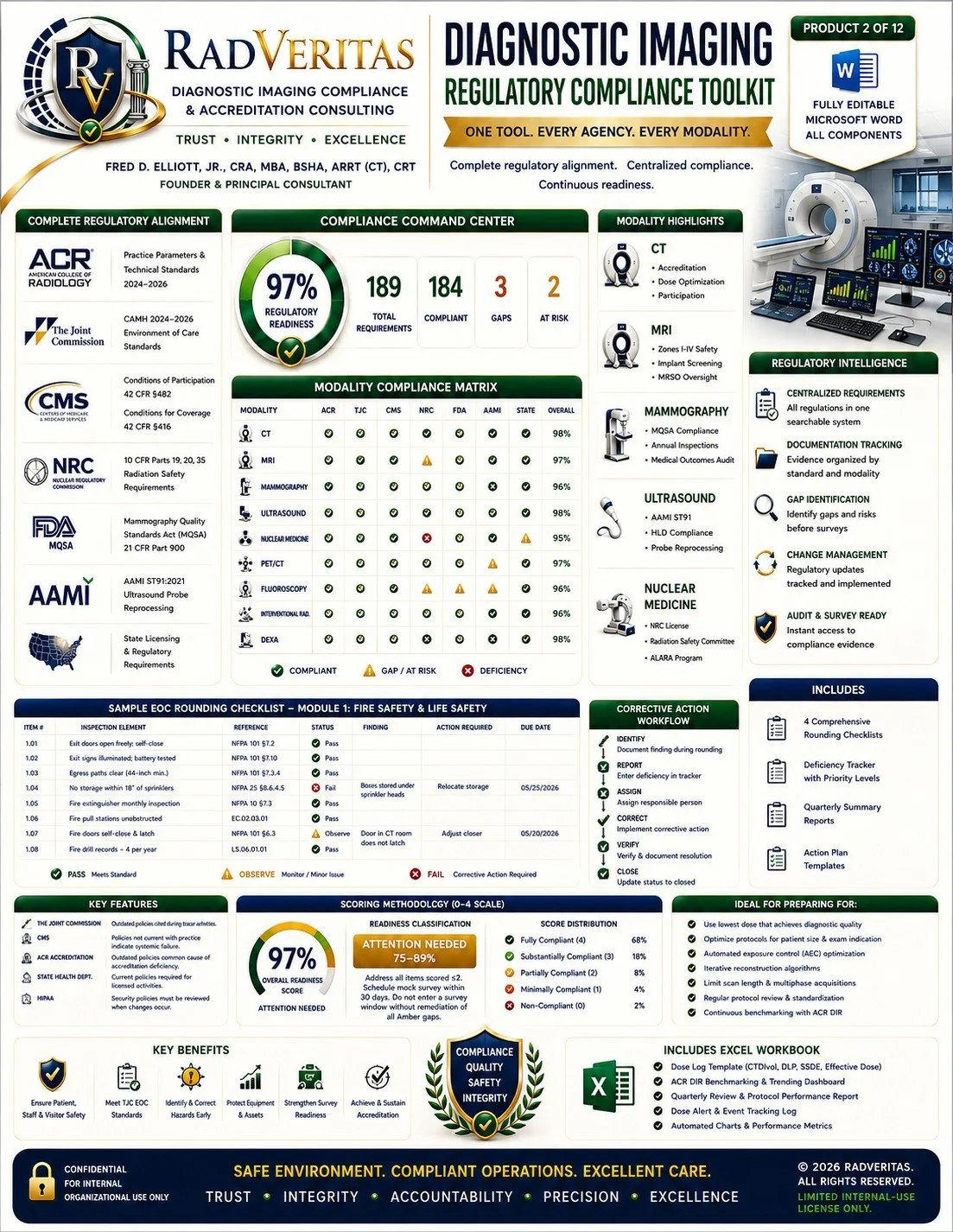
Summary
A comprehensive regulatory reference system that consolidates diagnostic imaging compliance requirements across multiple regulatory and accreditation agencies into a single modality-specific toolkit. The product provides compliance matrices, evidence requirements, regulatory dashboards, change tracking tools, and reference guides for CT, MRI, Mammography, Ultrasound, Nuclear Medicine, PET/CT, Fluoroscopy, Interventional Radiology, and DEXA. Designed to help imaging leaders identify compliance gaps, monitor readiness, and maintain regulatory documentation.
Primary Value
Regulatory gap identification
Compliance monitoring
Accreditation preparation
Documentation management
Executive oversight
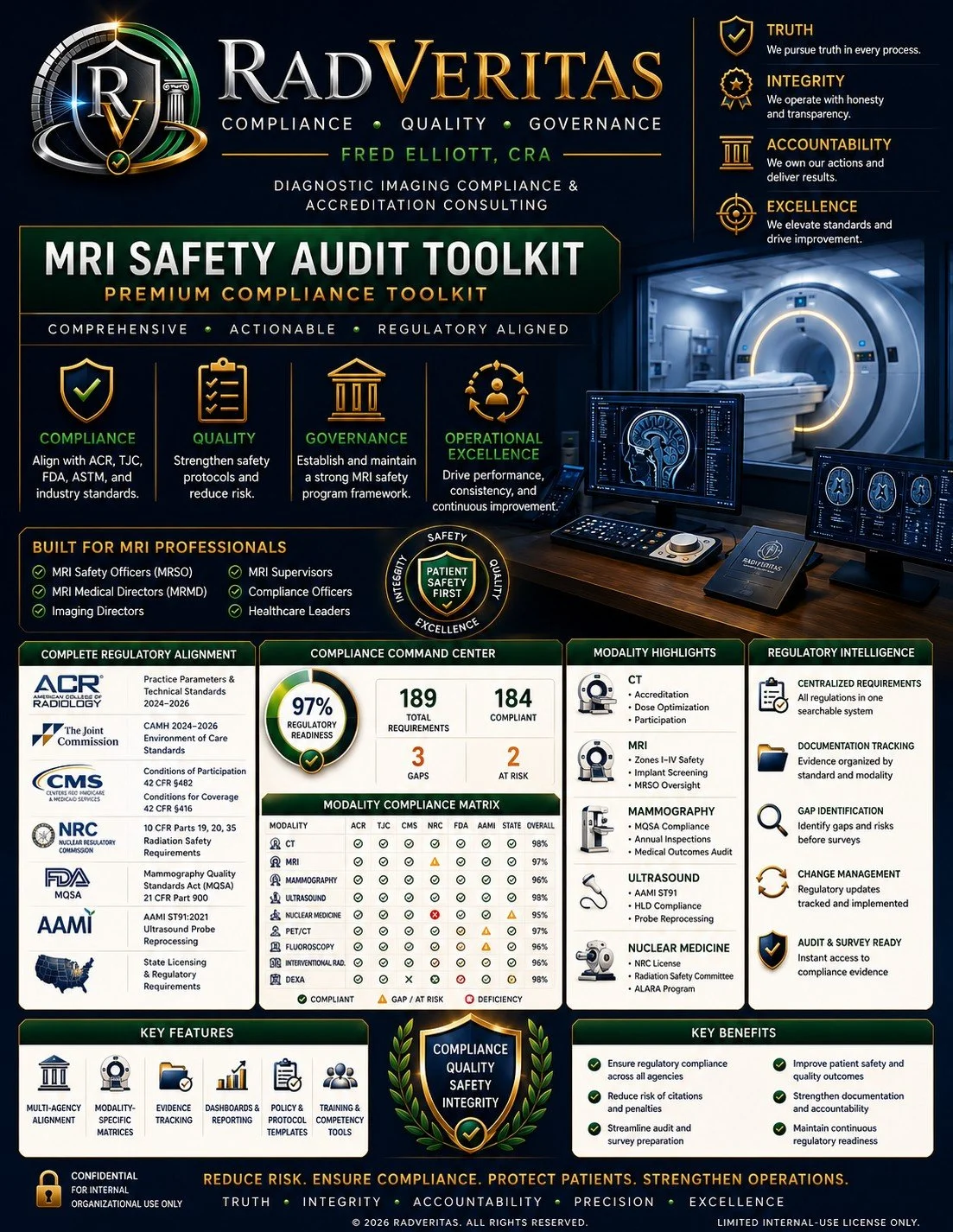
Summary
A complete MRI safety program toolkit that operationalizes current MRI safety standards into practical audit tools, screening instruments, safety assessments, and documentation systems. Includes MRI zone management, Level I and Level II personnel requirements, implant screening protocols, patient screening questionnaires, annual MRI safety audits, and incident reporting tools. Supports compliance with current MRI safety standards and accreditation expectations.
Primary Value
MRI safety program management
ACR MRI safety compliance
Risk reduction
Patient screening standardization
Annual MRI safety audits
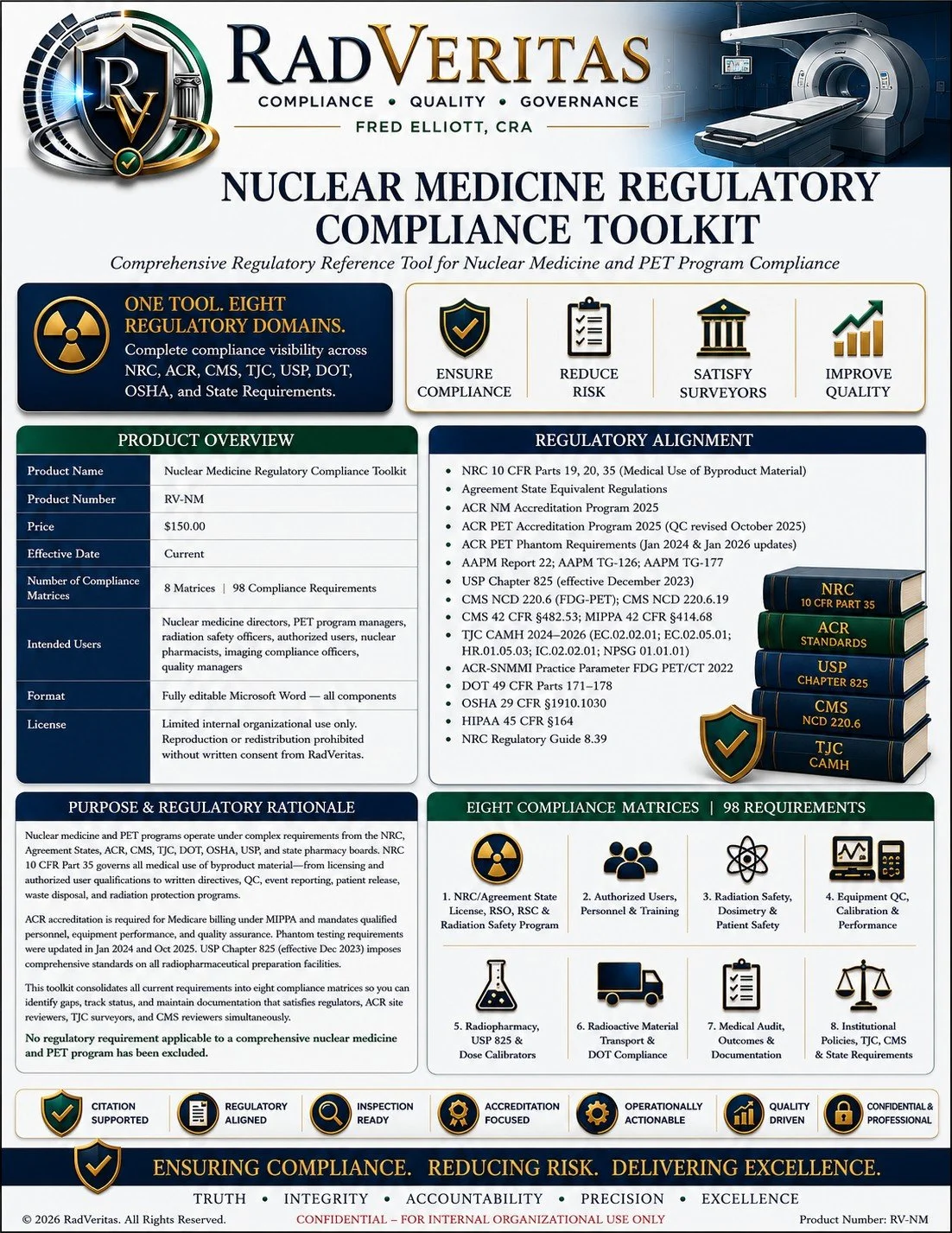
The Definitive Compliance Framework for Nuclear Medicine, PET/CT, Radiopharmaceutical Therapy, and Radiation Safety Programs
One Regulatory Gap Can Jeopardize Your License, Accreditation, Reimbursement, and Reputation
Nuclear medicine is one of the most heavily regulated specialties in healthcare.
A single compliance failure can trigger NRC enforcement actions, Agreement State citations, accreditation deficiencies, reimbursement risk, corrective action plans, or significant patient safety concerns.
Yet most organizations manage compliance using disconnected policies, outdated spreadsheets, scattered regulations, and reactive audit preparation.
The RadVeritas Nuclear Medicine Regulatory Compliance Toolkit was developed to change that.
This comprehensive compliance system consolidates the full spectrum of Nuclear Regulatory Commission (NRC), Agreement State, ACR, CMS, USP, OSHA, DOT, HIPAA, and Joint Commission requirements into one operationally focused resource designed to help organizations establish, evaluate, defend, and continuously improve their nuclear medicine and PET programs.
Built for Organizations That Cannot Afford a Compliance Failure
Whether your organization performs:
Nuclear Medicine Imaging
SPECT
SPECT/CT
PET/CT
FDG-PET Oncology
Thyroid Uptake and Therapy
Lu-177 DOTATATE Therapy
Ra-223 Therapy
Radiopharmaceutical Compounding
Advanced Molecular Imaging
This toolkit provides a structured compliance roadmap from radioactive material licensing through patient release and waste disposal.
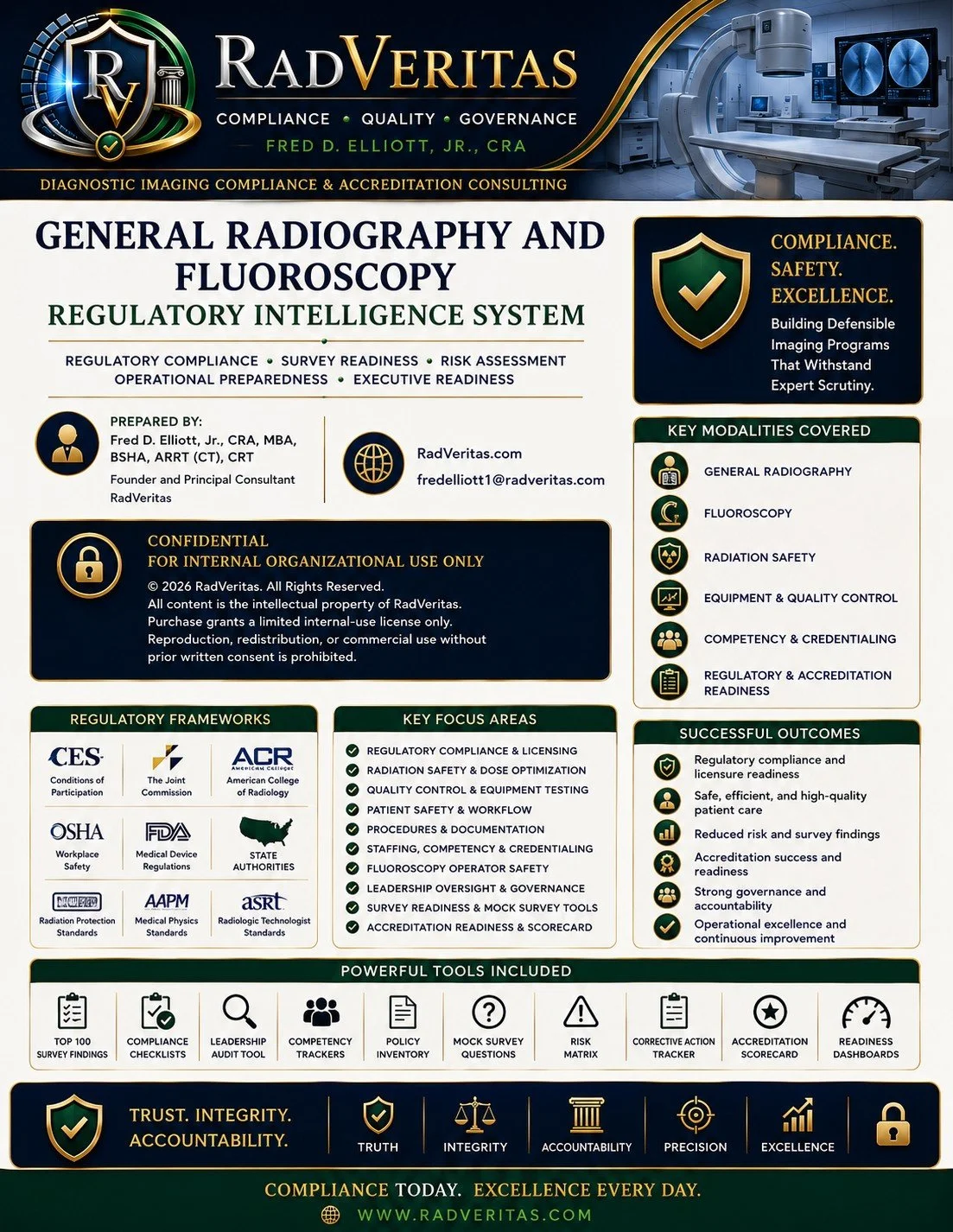
The Complete Compliance, Survey Readiness, and Risk Management Solution for General Radiography and Fluoroscopy Programs
Compliance. Safety. Excellence.
General Radiography and Fluoroscopy services represent the operational backbone of diagnostic imaging.
They also represent one of the most frequently surveyed, regulated, and scrutinized areas within healthcare.
From radiation safety and fluoroscopy operations to equipment performance, competency validation, documentation management, accreditation readiness, and patient safety, leaders must navigate a complex network of federal regulations, accreditation standards, state requirements, and operational expectations.
The challenge is not finding regulations.
The challenge is understanding what regulators expect, identifying hidden vulnerabilities before surveyors discover them, and building a program capable of consistently delivering safe, compliant, and high-quality care.
The RadVeritas General Radiography and Fluoroscopy Regulatory Intelligence System was developed to help healthcare organizations accomplish exactly that.
This comprehensive intelligence resource provides a practical roadmap for regulatory compliance, operational preparedness, accreditation success, risk reduction, and leadership accountability across General Radiography and Fluoroscopy services.
Why This Resource Matters
Regulatory expectations continue to expand.
Surveyors increasingly focus on:
Radiation safety programs
Fluoroscopy operator requirements
Equipment testing and quality control
Patient safety initiatives
Documentation practices
Competency validation
Accreditation readiness
Leadership oversight
Quality improvement programs
Governance accountability
A single deficiency can result in:
Regulatory citations
Accreditation findings
Corrective action plans
Increased organizational risk
Patient safety concerns
Operational disruption
Financial penalties
The organizations that consistently achieve successful survey outcomes are not the organizations that prepare at the last minute.
They are the organizations that operate in a constant state of readiness.
Comprehensive Regulatory Coverage
The Regulatory Intelligence System synthesizes expectations from the agencies and organizations that govern imaging services nationwide, including:
Centers for Medicare & Medicaid Services (CMS)
The Joint Commission (TJC)
American College of Radiology (ACR)
Occupational Safety and Health Administration (OSHA)
U.S. Food and Drug Administration (FDA)
State Radiation Control Programs
National Council on Radiation Protection and Measurements (NCRP)
American Association of Physicists in Medicine (AAPM)
American Society of Radiologic Technologists (ASRT)
This centralized intelligence resource allows leaders to quickly understand requirements and focus on what matters most.
Key Modalities Covered
General Radiography
Strengthen compliance across routine radiographic operations, patient identification, image quality, equipment performance, and regulatory documentation.
Fluoroscopy
Address high-risk operational requirements involving fluoroscopic procedures, operator qualifications, radiation monitoring, patient dose management, and procedural safety.
Radiation Safety
Enhance radiation protection programs that support patients, physicians, technologists, and staff.
Equipment and Quality Control
Ensure compliance with equipment testing requirements, preventive maintenance programs, physicist evaluations, and quality assurance expectations.
Competency and Credentialing
Support defensible staff qualification, orientation, competency validation, continuing education, and performance monitoring programs.
Accreditation and Regulatory Readiness
Build sustainable systems that prepare organizations for surveys, inspections, and accreditation reviews.
Critical Focus Areas
Regulatory Compliance and Licensing
Understand the regulatory requirements that directly impact imaging operations and organizational compliance.
Radiation Safety and Dose Optimization
Strengthen patient protection through effective radiation monitoring, exposure reduction strategies, and compliance oversight.
Quality Control and Equipment Performance
Develop reliable testing, monitoring, maintenance, and documentation systems that support accreditation readiness.
Patient Safety and Workflow Management
Improve operational consistency, reduce risk, and enhance the patient experience.
Procedure and Documentation Management
Ensure records, logs, policies, and supporting documentation can withstand regulatory scrutiny.
Leadership Governance
Create accountability structures that support long-term compliance and operational excellence.
Survey Readiness Programs
Prepare departments for accreditation surveys, regulatory inspections, and executive reviews with confidence.
Expected Outcomes
Organizations utilizing this intelligence system can expect to:
✓ Improve regulatory compliance
✓ Strengthen licensure readiness
✓ Enhance patient safety
✓ Reduce survey findings
✓ Improve accreditation performance
✓ Strengthen governance accountability
✓ Increase operational consistency
✓ Improve staff competency oversight
✓ Support continuous quality improvement
✓ Reduce organizational risk
The RadVeritas Difference
Most compliance resources tell you what regulations say.
RadVeritas helps you understand what regulators expect.
Every section is designed to translate complex regulatory requirements into practical operational guidance that leaders can immediately implement.
The result is a stronger, safer, more defensible imaging program capable of withstanding expert scrutiny, regulatory inspections, accreditation reviews, and executive oversight.
Build a Program That Is Ready Every Day
Survey readiness is not an event.
Compliance is not a project.
Operational excellence is not an accident.
The RadVeritas General Radiography and Fluoroscopy Regulatory Intelligence System provides the intelligence, tools, and strategic guidance needed to strengthen compliance, improve patient safety, reduce risk, and support long-term success.
Product Category:
Regulatory Intelligence, Compliance, and Survey Readiness System
Best For:
Hospitals | Health Systems | Outpatient Imaging Centers | Ambulatory Care Facilities | Healthcare Consultants | Accreditation Teams
Prepared By:
Fred D. Elliott, Jr., CRA, MBA, BSHA, ARRT (CT), CRT
Founder and Principal Consultant
RadVeritas
Compliance • Quality • Governance
Compliance Today. Excellence Every Day.
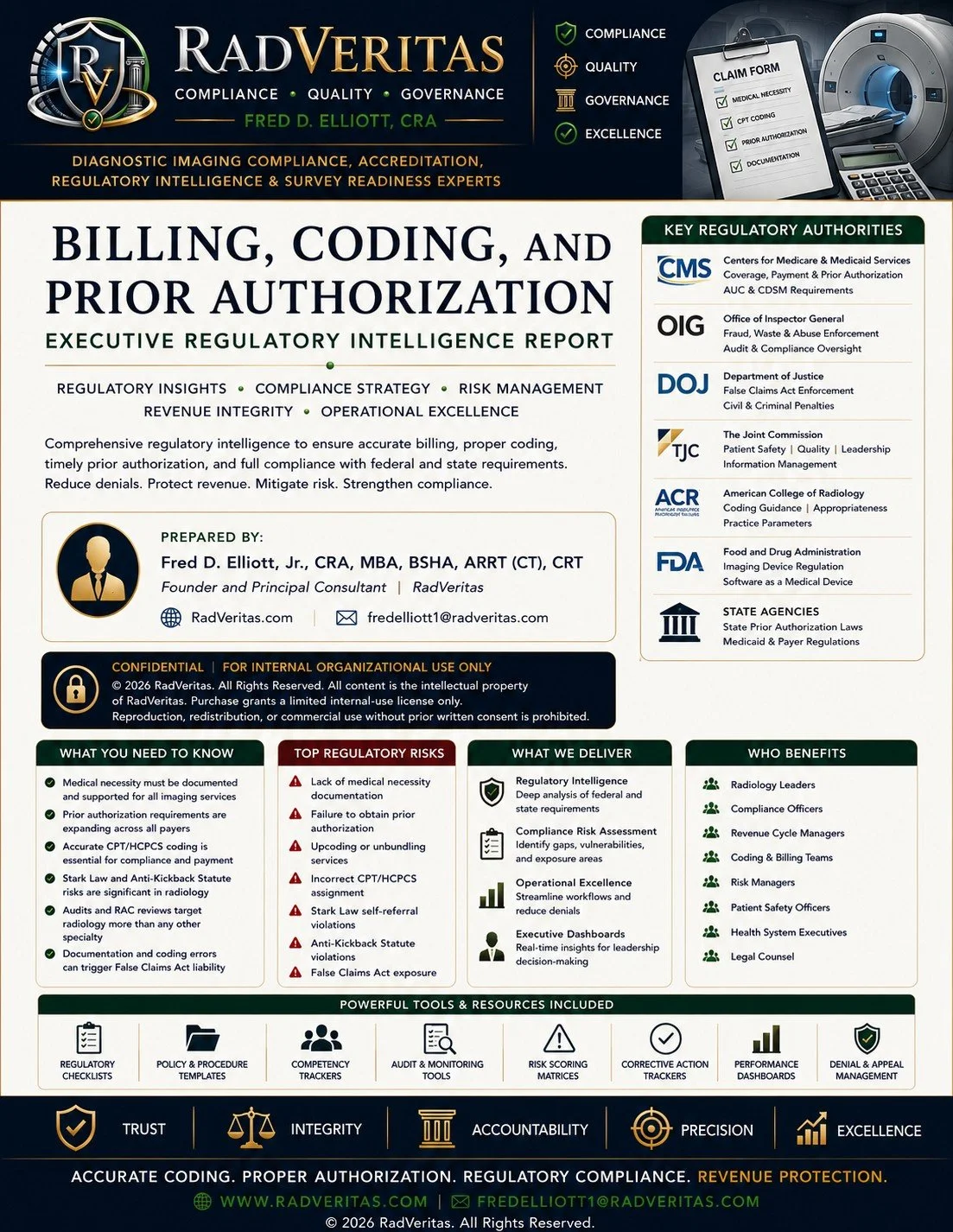
The Complete Revenue Integrity, Compliance, and Audit Readiness System for Diagnostic Imaging Leaders
Every Claim Submitted Carries Regulatory Risk
One missing authorization.
One unsupported diagnosis code.
One incorrect CPT code.
One overlooked physician financial arrangement.
Any of these can trigger denied claims, repayment demands, government audits, False Claims Act investigations, financial penalties, and reputational damage.
In today's healthcare environment, billing compliance is no longer just a revenue cycle responsibility.
It is an executive leadership responsibility.
The RadVeritas Billing, Coding, and Prior Authorization Regulatory Intelligence Report provides healthcare leaders with a comprehensive roadmap for protecting revenue, strengthening compliance, reducing audit exposure, and building a defensible billing integrity program.
Built from current CMS regulations, False Claims Act requirements, Stark Law provisions, Anti-Kickback Statute enforcement guidance, Medicare Advantage rules, prior authorization requirements, and payer compliance expectations, this report helps organizations navigate one of the highest-risk areas in Diagnostic Imaging.
Why This Report Matters
Diagnostic Imaging remains one of the most heavily audited specialties in healthcare.
Federal agencies, commercial payers, Medicare Advantage plans, Recovery Audit Contractors, and private auditors continue to focus on:
Medical Necessity
Prior Authorization Compliance
CPT Coding Accuracy
Documentation Integrity
Stark Law Compliance
Anti-Kickback Statute Risk
Appropriate Use Criteria Compliance
Revenue Integrity Controls
A single systemic error can impact thousands of claims before it is detected.
This report helps leaders identify vulnerabilities before auditors, regulators, or whistleblowers discover them.
What You'll Learn
Billing Compliance Governance
Develop a structured compliance framework that aligns operational workflows with federal and payer requirements.
Medical Necessity Management
Strengthen processes supporting:
CMS National Coverage Determinations (NCDs)
Local Coverage Determinations (LCDs)
ICD-10 Documentation
Ordering Provider Documentation
Clinical Justification Standards
CPT and Coding Compliance
Reduce coding risk through improved oversight of:
Diagnostic Imaging Coding
Interventional Radiology Coding
Nuclear Medicine Coding
Technical and Professional Components
Modifier Usage
Charge Master Accuracy
Prior Authorization Excellence
Build stronger authorization workflows for:
Medicare Advantage Plans
Commercial Insurance
Radiology Benefit Managers
Advanced Imaging Services
Appeal and Denial Management
Financial Arrangement Compliance
Understand risks involving:
Stark Law
Anti-Kickback Statute
Physician Relationships
Referral Arrangements
Professional Service Agreements
Equipment Leasing Structures
The Hidden Threat to Revenue
Most organizations focus on increasing volume.
The most successful organizations focus on protecting the revenue they already earn.
Revenue loss often occurs quietly through:
Preventable denials
Missing authorizations
Unsupported medical necessity
Coding inaccuracies
Documentation gaps
Compliance deficiencies
Many of these issues remain hidden until a payer audit, government investigation, or whistleblower complaint exposes them.
By then, the financial consequences can be substantial.
Protect Revenue. Reduce Risk. Strengthen Compliance.
The RadVeritas Billing, Coding, and Prior Authorization Regulatory Intelligence Report provides the tools, intelligence, and governance strategies needed to strengthen revenue integrity, improve reimbursement performance, reduce audit exposure, and support long-term compliance success.
Whether you oversee a hospital imaging department, outpatient imaging center, enterprise radiology program, or multi-site healthcare system, this report helps transform billing compliance from a reactive function into a strategic advantage.
Protect Every Claim.
Defend Every Dollar.
Lead With Confidence.
Prepared By
Fred D. Elliott, Jr., CRA, MBA, BSHA, ARRT (CT), CRT
Founder and Principal Consultant
RadVeritas
Compliance • Quality • Governance
Turning Revenue Integrity Into Operational Excellence.
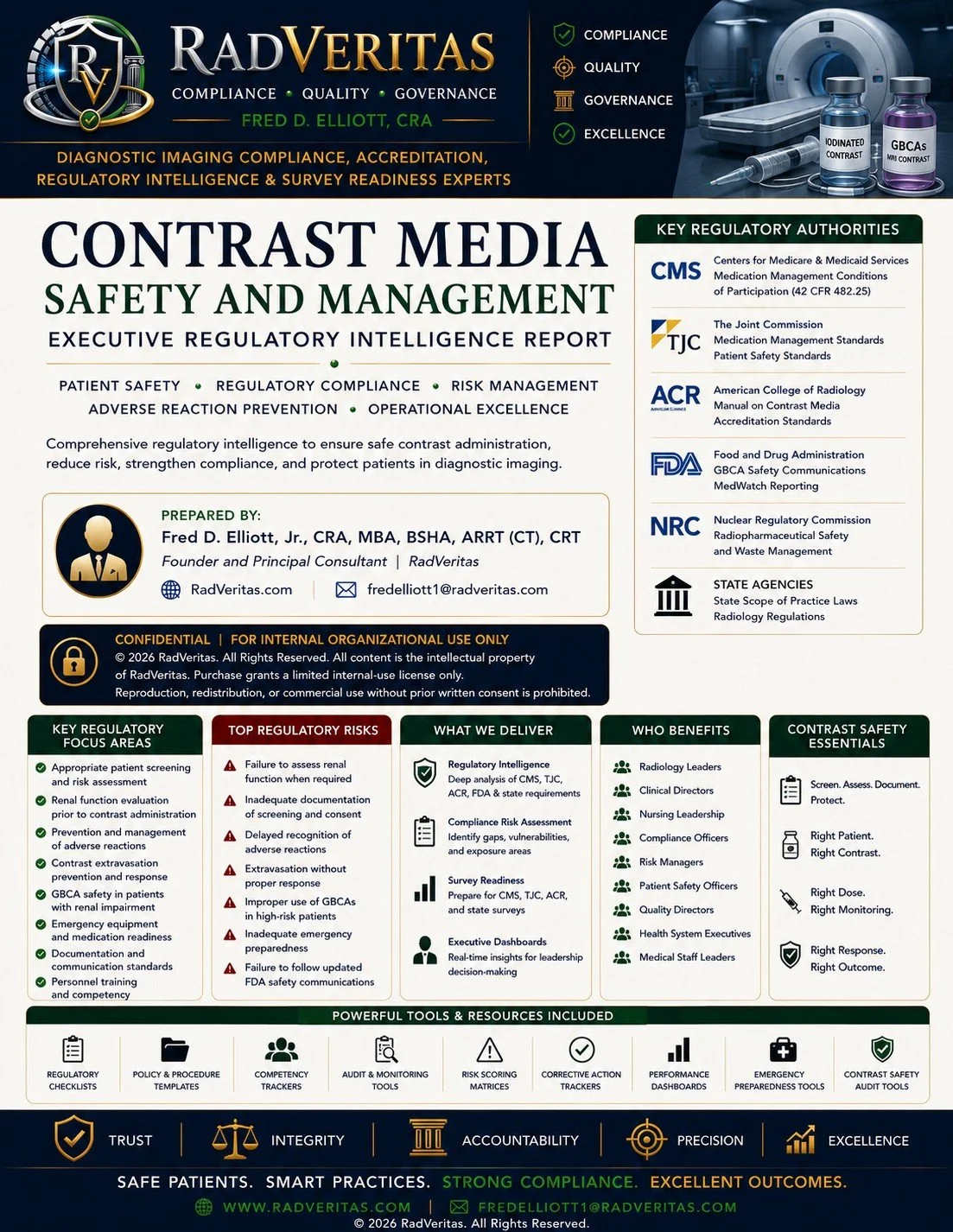
The Complete Patient Safety, Medication Management, and Regulatory Readiness System for Diagnostic Imaging Leaders
One Preventable Contrast Event Can Change Everything
A severe contrast reaction.
An undetected kidney impairment.
An extravasation injury.
A missed allergy history.
A delayed emergency response.
These events occur every day in healthcare organizations across the country, and many are entirely preventable.
Contrast media are among the most frequently administered medications in Diagnostic Imaging. Yet many organizations underestimate the regulatory, clinical, operational, and legal risks associated with their use.
The RadVeritas Contrast Media Safety and Management Regulatory Intelligence Report provides healthcare leaders with a comprehensive roadmap for protecting patients, strengthening compliance, reducing liability, and building a safer contrast administration program.
Built upon current CMS Conditions of Participation, The Joint Commission Medication Management standards, FDA requirements, and the American College of Radiology Manual on Contrast Media, this report transforms complex regulatory expectations into practical operational solutions.
Why This Report Matters
Every contrast administration carries risk.
Whether administering iodinated contrast for CT, gadolinium-based contrast for MRI, or contrast agents used in fluoroscopy and advanced imaging procedures, organizations are expected to maintain systems that protect patients before, during, and after administration.
Regulators, surveyors, accreditors, attorneys, and patients increasingly expect organizations to demonstrate:
Effective patient screening
Renal function assessment
Allergy identification
Emergency preparedness
Adverse reaction management
Personnel competency
Documentation integrity
Continuous quality oversight
This report helps leaders identify vulnerabilities before they become patient safety events, survey findings, or legal exposure.
What You'll Learn
Contrast Media Safety Governance
Build a structured framework for safe contrast administration across all imaging modalities.
Patient Screening and Risk Assessment
Strengthen processes for:
Renal Function Assessment
Contrast Allergy Screening
Pregnancy Assessment
Medication Review
NSF Risk Identification
High-Risk Patient Stratification
Emergency Preparedness
Develop effective systems for:
Contrast Reaction Response
Anaphylaxis Management
Emergency Medication Availability
Staff Competency Validation
Simulation Training Programs
Regulatory Compliance
Navigate requirements from:
CMS
The Joint Commission
ACR
FDA
State Licensing Agencies
Documentation and Audit Readiness
Improve compliance related to:
Contrast Administration Records
Adverse Event Reporting
Extravasation Documentation
Medication Management Standards
Quality Improvement Monitoring
The Hidden Risk Most Organizations Miss
Most contrast-related failures are not caused by a lack of policy.
They are caused by inconsistent execution.
A screening question that was never asked.
A kidney function result that was never reviewed.
An emergency medication that expired unnoticed.
A staff member who never received annual competency validation.
These seemingly small gaps can create significant patient safety and regulatory consequences.
The organizations that consistently perform well are those that build contrast safety into everyday operations, not just accreditation preparation.
Protect Patients. Reduce Risk. Lead With Confidence.
The RadVeritas Contrast Media Safety and Management Regulatory Intelligence Report provides the intelligence, tools, and governance framework needed to strengthen patient safety, improve regulatory compliance, reduce liability exposure, and support operational excellence.
Because contrast safety is more than a clinical responsibility.
It is a leadership responsibility.
Protect the Patient.
Protect the Organization.
Protect the Mission.
Prepared By
Fred D. Elliott, Jr., CRA, MBA, BSHA, ARRT (CT), CRT
Founder and Principal Consultant
RadVeritas
Compliance • Quality • Governance
Turning Contrast Media Safety Into Operational Excellence.

Master California Compliance Before Surveyors Arrive
The Definitive California Regulatory Intelligence Resource for Diagnostic Imaging Leaders
California operates within one of the most complex and highly regulated healthcare environments in the United States.
Diagnostic Imaging leaders are expected to navigate an extensive network of state regulations, licensing requirements, inspection standards, accreditation expectations, radiation safety requirements, quality assurance obligations, and federal compliance mandates. Missing a single requirement can result in citations, corrective action plans, operational disruptions, financial penalties, or accreditation risk.
The California Diagnostic Imaging Regulatory Survey, Inspection, and Accreditation Manual™ from RadVeritas™ was developed to serve as a centralized, implementation-focused compliance resource for Diagnostic Imaging departments seeking to achieve and maintain regulatory excellence.
Whether preparing for a California Department of Public Health inspection, accreditation survey, licensing review, radiation safety assessment, or internal compliance audit, this manual provides the guidance, tools, and intelligence necessary to confidently navigate California's regulatory landscape.
Why California Imaging Leaders Need This Resource
Regulatory oversight in California continues to evolve.
Healthcare organizations face increasing scrutiny from state regulators, accreditation organizations, radiation control agencies, and federal oversight bodies.
Success requires more than understanding regulations.
It requires understanding how those regulations are interpreted, implemented, documented, monitored, and defended during inspections and surveys.
This manual helps leaders transform regulatory requirements into operational readiness.
What Makes This Manual Different
Unlike generic compliance references, this resource was designed specifically for Diagnostic Imaging operations.
It combines regulatory intelligence, accreditation readiness, operational guidance, risk management strategies, and survey preparation tools into a single comprehensive framework.
The result is a practical resource that helps organizations move beyond compliance uncertainty and toward sustainable readiness.
Comprehensive Areas of Coverage
California Regulatory Requirements
Navigate California-specific Diagnostic Imaging regulations with confidence and clarity.
Survey and Inspection Readiness
Prepare effectively for state surveys, inspections, audits, and regulatory reviews.
Accreditation Alignment
Understand how California requirements intersect with Joint Commission, CMS, ACR, FDA, and other accreditation and regulatory expectations.
Radiation Safety Compliance
Strengthen radiation protection programs, quality assurance activities, personnel monitoring, and regulatory oversight.
Operational Compliance Management
Create consistent processes, documentation standards, and accountability structures across imaging operations.
Risk Identification and Reduction
Proactively identify compliance gaps before they become deficiencies, citations, or corrective actions.
The Cost of Being Unprepared
Survey findings rarely occur because organizations lack good intentions.
They occur because requirements were misunderstood, documentation was incomplete, processes were inconsistent, or risks were not identified early enough.
The California Diagnostic Imaging Regulatory Survey, Inspection, and Accreditation Manual™ helps organizations strengthen readiness before deficiencies become citations and before vulnerabilities become organizational risk.
Built for Leaders Who Refuse to Be Surprised
Successful compliance programs do not rely on assumptions.
They rely on preparation, structure, accountability, and reliable regulatory intelligence.
This manual was created to help Diagnostic Imaging leaders build stronger systems, improve readiness, protect patients, and achieve sustained compliance success throughout California's demanding regulatory environment.
Confidence. Preparation. Excellence.
Reduce risk. Strengthen compliance. Improve performance.
California Diagnostic Imaging Regulatory Survey, Inspection, and Accreditation Manual™
Your roadmap to California regulatory readiness, inspection preparedness, and accreditation excellence.
RadVeritas™
Compliance • Quality • Governance
Expert Insights. Practical Solutions. Real-World Impact.
Helping Diagnostic Imaging Leaders Navigate Regulatory Complexity, Strengthen Compliance, and Achieve Operational Excellence.
The Comprehensive Enterprise Resource for Pediatric Imaging Excellence
Because Every Child Deserves Imaging Care Built on Safety, Precision, Quality, and Trust.
Pediatric imaging is fundamentally different from adult imaging.
Children require specialized imaging protocols, enhanced radiation protection strategies, child-centered care environments, age-specific quality standards, highly trained staff, and rigorous regulatory oversight.
The Pediatric Imaging Physics, Quality Control, Regulatory Compliance, Accreditation, Safety, Quality, and Operations Reference Manual™ was developed to help children's hospitals, pediatric imaging centers, academic medical centers, integrated health systems, and diagnostic imaging leaders navigate the unique challenges of pediatric imaging while maintaining the highest standards of safety, compliance, and operational excellence.
This comprehensive reference system consolidates pediatric imaging physics, quality assurance, accreditation readiness, radiation dose optimization, regulatory compliance, governance, patient safety, and operational best practices into a single enterprise resource.
Why Pediatric Imaging Requires Specialized Oversight
Children are more sensitive to ionizing radiation, often require modified imaging protocols, and depend upon healthcare organizations to deliver safe, accurate, and compassionate imaging services.
Regulatory agencies, accreditation organizations, medical physicists, radiologists, technologists, and healthcare leaders must work together to ensure:
Radiation exposure is optimized
Pediatric protocols are properly maintained
Quality assurance programs remain effective
Equipment performance meets pediatric standards
Regulatory requirements are continuously satisfied
Patient and family experiences remain positive
Clinical outcomes support safe and effective care
Failure in any of these areas can impact patient safety, compliance, accreditation status, and organizational reputation.
What Makes This Manual Different
Unlike traditional imaging references that focus exclusively on equipment performance or accreditation requirements, this manual integrates every major component of pediatric imaging program success.
The framework is built around eight critical pillars:
Pediatric Safety
Protect children through age-appropriate imaging practices, radiation protection strategies, patient identification safeguards, and pediatric-specific risk reduction programs.
Radiation Dose Optimization
Support ALARA principles through pediatric protocol management, dose monitoring, dose reduction techniques, and physics oversight.
Child-Friendly Imaging Environment
Create safer and more supportive imaging experiences through communication strategies, comfort measures, patient-centered workflows, and family engagement.
Accreditation Readiness
Prepare for ACR, CMS, Joint Commission, state regulatory inspections, and pediatric-specific accreditation expectations.
Expert Governance
Strengthen accountability through leadership oversight, committee structures, performance monitoring, and governance frameworks.
Quality and Performance
Build sustainable quality systems that support continuous monitoring, corrective action planning, and operational excellence.
Compliance and Security
Align imaging operations with federal regulations, accreditation standards, privacy requirements, cybersecurity safeguards, and organizational policies.
Patient-Centered Care
Promote safe, compassionate, and effective imaging experiences for every pediatric patient and family.
Comprehensive Areas of Coverage
Pediatric Imaging Physics
Equipment performance standards
Acceptance testing
Annual physics evaluations
Performance monitoring
Pediatric imaging optimization
Radiation Safety and Dose Management
ALARA implementation
Pediatric CT dose optimization
Fluoroscopy dose reduction
Radiation monitoring programs
Radiation safety committee oversight
Quality Control and Quality Assurance
Equipment quality control programs
Image quality assessments
Corrective action processes
Performance improvement initiatives
Continuous quality monitoring
Accreditation and Regulatory Compliance
American College of Radiology (ACR)
Centers for Medicare & Medicaid Services (CMS)
Joint Commission standards
State regulatory requirements
Pediatric imaging best practices
Pediatric Operational Excellence
Workflow optimization
Staffing considerations
Competency management
Documentation standards
Performance metrics
Governance and Leadership
Accountability structures
Compliance oversight
Risk management programs
Executive reporting
Continuous readiness strategies
Organizational Benefits
Strengthen Pediatric Safety
Support child-focused imaging practices designed to reduce risk and improve outcomes.
Optimize Radiation Protection
Implement evidence-based dose management programs that support ALARA principles and pediatric best practices.
Improve Accreditation Readiness
Maintain continuous readiness for accreditation surveys, inspections, and regulatory reviews.
Enhance Quality and Performance
Establish measurable quality systems that drive consistency, accountability, and excellence.
Reduce Compliance Risk
Identify vulnerabilities before they become deficiencies, citations, or patient safety events.
Improve Family Experience
Create safer, more compassionate, and more effective imaging environments for pediatric patients and caregivers.
Support Leadership Decision-Making
Provide leaders with actionable guidance, governance tools, and performance frameworks to strengthen organizational oversight.
Built for Real-World Pediatric Imaging Programs
Whether supporting a dedicated children's hospital, pediatric specialty center, academic medical center, or integrated healthcare system, this manual provides the structure, guidance, and operational intelligence necessary to manage pediatric imaging programs with confidence.
From imaging physics and radiation safety to accreditation readiness and patient-centered care, every section is designed to help organizations build sustainable systems that protect children while supporting regulatory and operational excellence.
Every Child. Every Time. Every Image.
Pediatric imaging demands more than compliance.
It demands vigilance, expertise, accountability, and a relentless commitment to safety.
The Pediatric Imaging Physics, Quality Control, Regulatory Compliance, Accreditation, Safety, Quality, and Operations Reference Manual™ provides the roadmap to achieve and sustain that standard.
Protect Children. Strengthen Compliance. Elevate Quality.
Reduce risk. Improve performance. Enhance safety. Achieve excellence.
RadVeritas™
Compliance • Quality • Governance
Expert Insights. Practical Solutions. Real-World Impact.
Helping Children's Hospitals, Pediatric Imaging Centers, and Healthcare Leaders Build Safer Imaging Programs, Strengthen Regulatory Readiness, and Deliver Exceptional Pediatric Care Through Excellence in Physics, Quality, Safety, and Governance.
Volumes 1-7
The Definitive California Regulatory Intelligence System for Every Healthcare Organization Operating Radiation-Producing Equipment
California has one of the most complex regulatory environments governing radiation-producing equipment in the United States. Healthcare organizations must navigate overlapping state regulations, licensing requirements, registration deadlines, inspections, accreditation standards, and operational expectations while maintaining uninterrupted patient care.
The California Radiation-Producing Equipment Regulatory Compliance, Registration, Inspection, Licensing, Survey Readiness, Safety, Quality, and Operations Reference Manual™ is the most comprehensive California-focused reference system developed for diagnostic imaging leaders, compliance professionals, radiation safety officers, healthcare executives, and regulatory specialists.
Spanning seven integrated volumes, this enterprise reference system transforms complex regulatory requirements into practical guidance, standardized workflows, executive tools, and actionable compliance strategies that support continuous readiness across the entire equipment lifecycle.
Why This Manual Matters
Every healthcare organization operating radiation-producing equipment is responsible for maintaining compliance with a wide range of California regulatory requirements that govern equipment registration, licensing, inspections, quality assurance, radiation safety, operational performance, and documentation.
Missing a deadline, overlooking a regulatory requirement, or failing an inspection can result in:
Regulatory citations
Civil penalties
Delayed facility openings
Equipment downtime
Licensing issues
Accreditation findings
Patient safety concerns
Financial losses
Reputational damage
This reference manual provides the structure, intelligence, and tools needed to proactively manage regulatory obligations and reduce organizational risk.
The Most Comprehensive California Regulatory Resource Available
Unlike general imaging references or national compliance manuals, this publication is designed specifically around California's regulatory environment.
It integrates state-specific requirements with applicable federal regulations, accreditation expectations, and operational best practices into a single enterprise compliance system.
From new facility planning to equipment retirement, every phase of the equipment lifecycle is addressed through practical guidance, standardized processes, and executive-level governance strategies.
What You'll Learn
California Regulatory Framework
Understand the agencies, regulations, licensing pathways, inspection authorities, and compliance expectations governing radiation-producing equipment throughout California.
Equipment Registration and Licensing
Navigate registration requirements, licensing processes, permit management, amendments, ownership changes, relocations, and equipment lifecycle documentation.
Inspection and Survey Readiness
Prepare for state inspections, accreditation surveys, and regulatory reviews with structured readiness frameworks, audit tools, documentation standards, and leadership guidance.
Radiation Safety and Quality Programs
Strengthen radiation protection, quality assurance, performance monitoring, ALARA programs, documentation, and continuous quality improvement.
Operational Excellence
Standardize policies, procedures, governance structures, and operational controls that support long-term compliance and organizational resilience.
Executive Compliance Governance
Develop sustainable leadership systems that align regulatory oversight, risk management, accountability, education, and performance improvement.
Seven Integrated Volumes
This enterprise reference system includes seven comprehensive volumes covering the complete regulatory lifecycle.
Volume 1: Foundations and Regulatory Authorities
Comprehensive overview of California regulatory agencies, governing statutes, regulatory frameworks, organizational responsibilities, and compliance fundamentals.
Volume 2: Registration and Licensing
Equipment registration requirements, licensing processes, amendments, ownership changes, relocations, permit management, and regulatory documentation.
Volume 3: Equipment Lifecycle Management
Planning, procurement, installation, acceptance testing, operation, maintenance, modifications, replacement, retirement, and decommissioning.
Volume 4: Inspection and Survey Readiness
State inspections, accreditation preparation, audit methodologies, documentation requirements, survey response strategies, and executive readiness planning.
Volume 5: Safety, Quality, and Performance
Radiation safety, quality assurance, performance monitoring, operational excellence, equipment reliability, and patient safety initiatives.
Volume 6: Compliance Intelligence and Risk Management
Regulatory monitoring, gap analysis, corrective action planning, executive dashboards, risk assessments, and continuous improvement strategies.
Volume 7: Operational Resources and Reference Library
Master registration calendars, inspection readiness command center, checklists, templates, glossary, regulatory crosswalks, reference documents, and implementation tools.
Key Features
✔ California-specific regulatory guidance
✔ Registration and licensing requirements
✔ Equipment lifecycle management
✔ Facility opening and closure checklists
✔ Inspection readiness frameworks
✔ Survey preparation tools
✔ Executive compliance dashboards
✔ Regulatory calendars and deadline tracking
✔ Operational checklists and templates
✔ Corrective action planning resources
✔ Quality assurance guidance
✔ Radiation safety program support
✔ Governance and leadership strategies
✔ Risk assessment methodologies
✔ Documentation standards
✔ Regulatory reference library
Designed For
Ideal for:
Radiology Directors
Diagnostic Imaging Administrators
Compliance Officers
Radiation Safety Officers
Medical Physicists
Quality Improvement Leaders
Accreditation Coordinators
Biomedical Engineering Managers
Imaging Operations Managers
Hospital Executives
Ambulatory Imaging Center Leaders
Healthcare Consultants
Regulatory Affairs Professionals
State Inspection Preparation Teams
Organizational Benefits
Simplify Regulatory Compliance
Navigate California's complex regulatory environment with confidence using a centralized, structured reference system.
Improve Inspection Readiness
Prepare proactively for state inspections, licensing reviews, and accreditation surveys through standardized workflows and comprehensive readiness tools.
Reduce Organizational Risk
Identify compliance gaps early, strengthen governance, and minimize the likelihood of citations, penalties, and operational disruptions.
Standardize Operations
Establish consistent policies, procedures, documentation practices, and quality systems across every imaging location.
Protect Patients and Staff
Support safe imaging practices through stronger radiation safety programs, quality assurance processes, and operational oversight.
Strengthen Executive Decision-Making
Leverage practical tools, dashboards, and compliance intelligence to guide strategic planning and continuous improvement.
Built for Hospitals, Health Systems, and Imaging Centers
Whether opening a new imaging facility, expanding services, replacing equipment, preparing for a regulatory inspection, or building an enterprise compliance program, this seven-volume reference system provides the practical guidance and operational tools needed to manage California's regulatory requirements with confidence.
Designed for hospitals, academic medical centers, ambulatory surgery centers, outpatient imaging facilities, physician practices, and integrated health systems, it serves as a comprehensive resource for organizations committed to sustained regulatory excellence.
Compliance Is Not a Project. It Is a Continuous Operational Discipline.
The highest-performing imaging organizations do not wait for inspections to assess compliance. They build systems that embed regulatory readiness into daily operations.
The California Radiation-Producing Equipment Regulatory Compliance, Registration, Inspection, Licensing, Survey Readiness, Safety, Quality, and Operations Reference Manual™ provides the framework, intelligence, and leadership tools needed to create a culture of continuous compliance, operational excellence, and patient safety.
Build a Stronger Compliance Program. Strengthen Every Imaging Operation.
Navigate California regulations with confidence. Reduce risk. Improve performance. Prepare for every inspection.
RadVeritas™
Compliance • Quality • Governance
Compliance Today. Excellence Every Day.
Expert Insights. Practical Solutions. Real-World Impact.
Helping Healthcare Organizations Build Sustainable Regulatory Compliance, Strengthen Survey Readiness, Improve Operational Performance, and Protect Patients Across the Complete Lifecycle of Radiation-Producing Equipment.
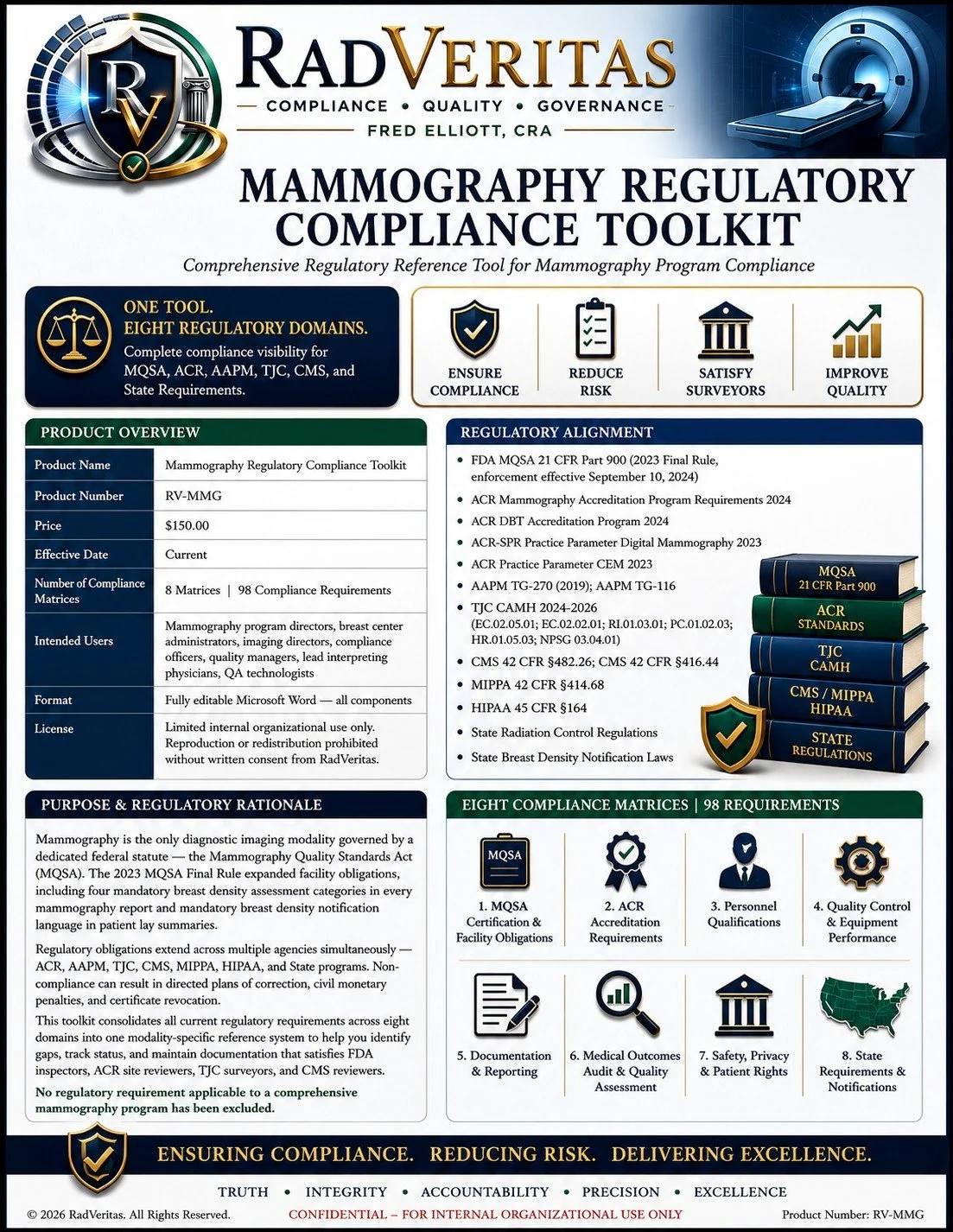
The Ultimate Mammography Compliance, Accreditation, and Inspection Readiness System
One MQSA Deficiency Can Put Your Entire Mammography Program at Risk
Mammography is unlike any other imaging modality.
It is the only diagnostic imaging service governed by a dedicated federal law, subject to mandatory FDA inspections, accreditation requirements, Medicare reimbursement conditions, and an expanding network of state breast density notification regulations.
A missed requirement can lead to corrective action plans, accreditation deficiencies, reimbursement interruptions, civil penalties, or even suspension of your authority to perform mammography.
Most organizations rely on disconnected spreadsheets, outdated checklists, fragmented policies, and reactive inspection preparation.
The RadVeritas Mammography Regulatory Compliance Toolkit was developed to eliminate that risk.
This executive-level compliance system consolidates every major mammography regulatory requirement into a single, organized, actionable framework that allows healthcare organizations to assess compliance, identify gaps, track corrective actions, and maintain continuous inspection readiness.
Built Specifically for Today's Mammography Regulatory Environment
The regulatory landscape changed dramatically following implementation of the FDA's 2023 MQSA Final Rule.
Organizations must now navigate:
• FDA MQSA requirements and annual inspections
• Mandatory breast density reporting requirements
• Breast density patient notification regulations
• ACR Mammography Accreditation requirements
• ACR Digital Breast Tomosynthesis Accreditation standards
• CMS Conditions of Participation
• MIPPA reimbursement requirements
• Joint Commission standards
• HIPAA privacy requirements
• State radiation control regulations
• State breast density notification laws
• Contrast-Enhanced Mammography requirements
• Emerging AI mammography compliance expectations
The challenge is no longer understanding a single regulation.
The challenge is managing them all simultaneously.
This toolkit solves that problem.
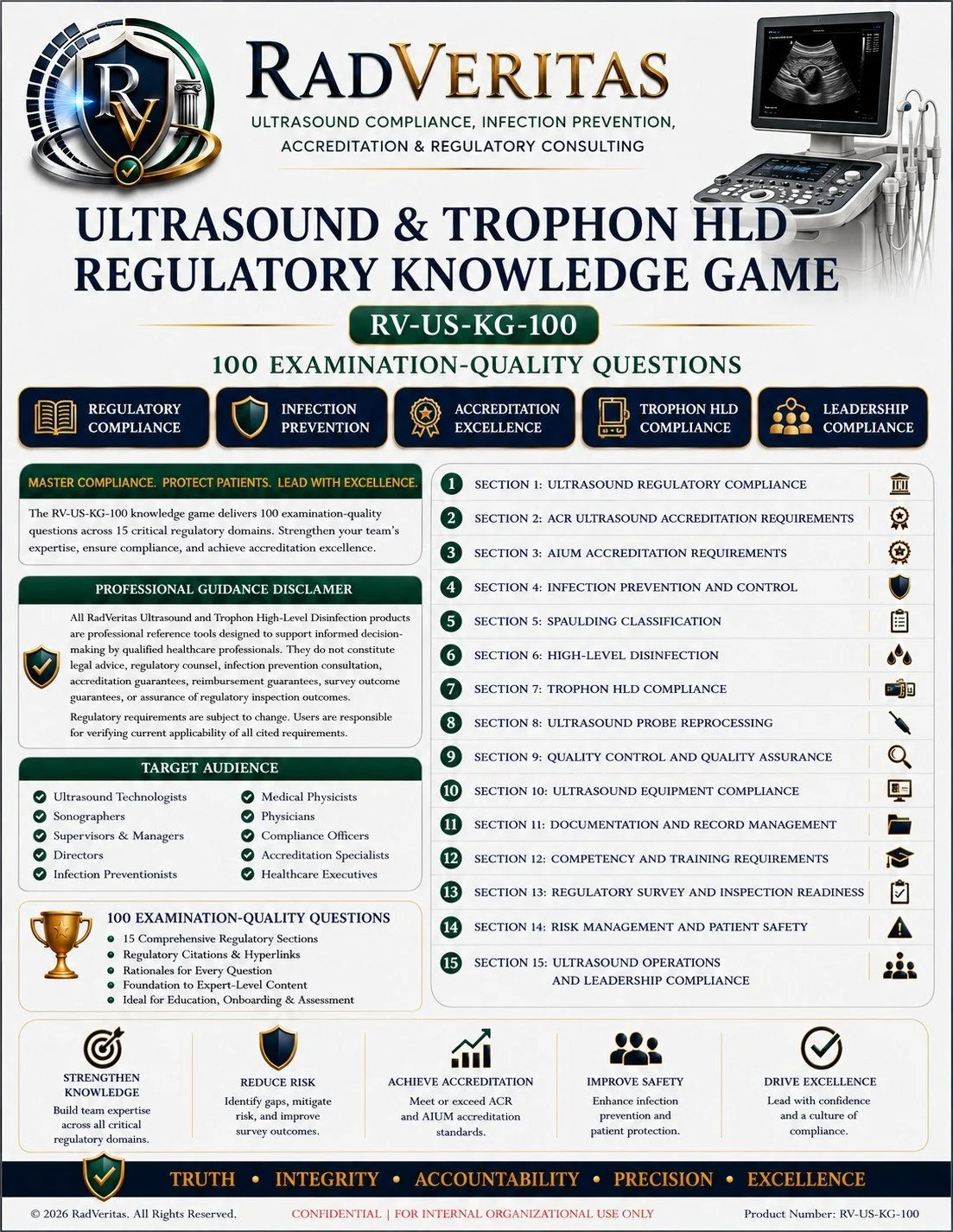
Master Compliance. Protect Patients. Lead With Excellence.
The Ultimate Ultrasound Compliance, Accreditation, and Infection Prevention Training Solution
In today's healthcare environment, ultrasound leaders face increasing pressure to maintain regulatory compliance, prevent healthcare-associated infections, achieve accreditation excellence, and prepare staff for regulatory surveys and inspections. The consequences of noncompliance can include accreditation deficiencies, infection control findings, patient safety events, operational disruptions, financial penalties, and reputational risk.
The RadVeritas Ultrasound & Trophon HLD Regulatory Knowledge Game (RV-US-KG-100) was developed to help healthcare organizations transform regulatory education into a powerful, engaging, and measurable learning experience.
Containing 100 examination-quality questions across 15 critical regulatory and operational domains, this comprehensive knowledge game challenges participants to apply real-world compliance principles while strengthening their understanding of ultrasound regulations, accreditation standards, infection prevention requirements, and high-level disinfection practices.
Whether used for onboarding, annual competencies, accreditation preparation, leadership development, staff education, department meetings, or survey readiness initiatives, this resource helps organizations build confident, knowledgeable, and survey-ready teams.
What Makes This Product Different?
Unlike generic quizzes or basic competency assessments, the RV-US-KG-100 was designed using the same regulatory concepts, accreditation standards, infection prevention principles, and operational expectations that ultrasound departments encounter during real-world inspections, accreditation reviews, and compliance audits.
Participants are challenged across areas including:
Ultrasound Regulatory Compliance
ACR Ultrasound Accreditation Requirements
AIUM Accreditation Requirements
Infection Prevention and Control
Spaulding Classification
High-Level Disinfection Requirements
Trophon HLD Compliance
Ultrasound Probe Reprocessing
Quality Control and Quality Assurance
Ultrasound Equipment Compliance
Documentation and Record Management
Competency and Training Requirements
Survey and Inspection Readiness
Risk Management and Patient Safety
Ultrasound Leadership and Operational Compliance
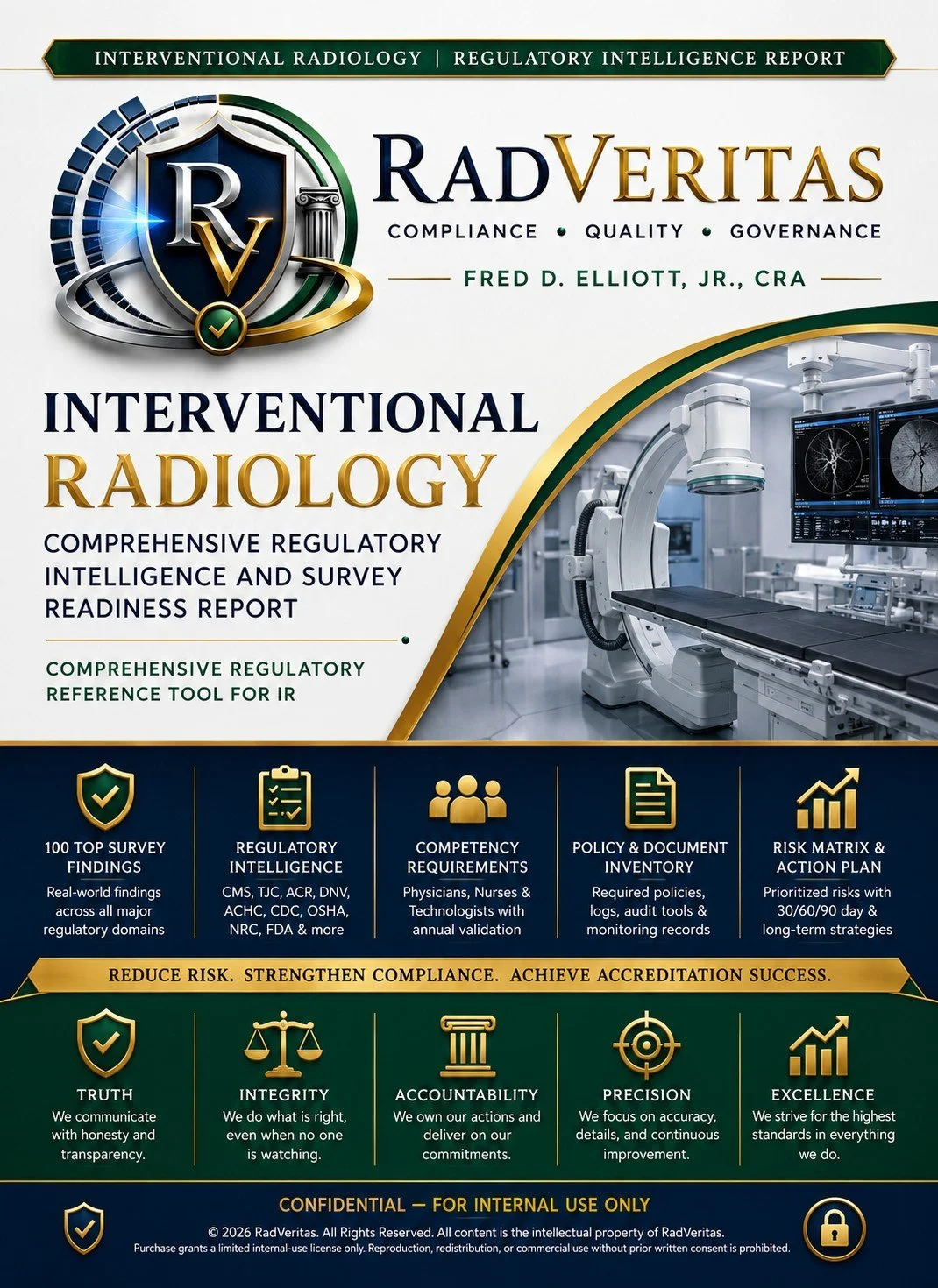
The Complete Compliance, Patient Safety, Radiation Safety, Sedation, and Survey Readiness System for Interventional Radiology Leaders
One overlooked compliance gap can place an entire Interventional Radiology program at risk.
Regulators, accreditors, surveyors, and attorneys are increasingly scrutinizing Interventional Radiology programs because of the unique risks associated with invasive procedures, moderate sedation, radiation exposure, controlled substances, sterile technique, device reprocessing, and patient safety.
The RadVeritas Interventional Radiology Regulatory Intelligence Report was developed to help healthcare leaders identify regulatory vulnerabilities before they become citations, adverse events, accreditation findings, or costly corrective action plans.
Built from current CMS Conditions of Participation, Joint Commission standards, ACR requirements, OSHA regulations, CDC infection prevention guidance, FDA regulations, NRC radiation safety requirements, and Society of Interventional Radiology standards, this comprehensive intelligence resource provides a practical roadmap for building and sustaining a survey-ready Interventional Radiology program.
WHAT MAKES THIS RESOURCE DIFFERENT?
This is not another regulatory summary.
It is a comprehensive operational intelligence system designed specifically for Interventional Radiology leaders who are responsible for compliance, accreditation, patient safety, procedural governance, quality improvement, and organizational risk reduction.
Inside this report you will discover:
• Comprehensive review of Interventional Radiology regulatory requirements
• Top 100 survey findings most frequently cited during inspections
• High-risk deficiency analysis with mitigation strategies
• Moderate sedation compliance framework
• Radiation safety and fluoroscopy governance guidance
• Infection prevention and device reprocessing requirements
• Controlled substance management standards
• Credentialing and privileging oversight tools
• Quality improvement and peer review systems
• Mock survey questions and readiness assessments
• Leadership audit tools and executive scorecards
• Competency validation and tracking systems
• Corrective action planning resources
• Risk prioritization matrices
• Accreditation readiness dashboards
• Regulatory citation library with source references
KEY RISK DOMAINS COVERED
✓ Moderate Sedation Programs
✓ Universal Protocol and Time-Out Compliance
✓ Informed Consent Requirements
✓ Controlled Substance Accountability
✓ Radiation Safety Programs
✓ Fluoroscopy Compliance
✓ Infection Prevention and High-Level Disinfection
✓ Device Reprocessing and Sterile Processing
✓ Contrast Agent Safety
✓ Credentialing and Privileging
✓ Competency Validation
✓ Quality Assessment and Performance Improvement
✓ Peer Review Programs
✓ Environment of Care
✓ Emergency Preparedness
✓ Artificial Intelligence Governance
✓ Accreditation Readiness
WHO SHOULD USE THIS RESOURCE?
• Interventional Radiology Directors
• Imaging Administrators
• Radiology Executives
• IR Medical Directors
• Interventional Radiologists
• Nurse Managers
• Radiation Safety Officers
• Medical Physicists
• Compliance Officers
• Accreditation Specialists
• Quality Improvement Leaders
• Healthcare Consultants
• Hospital Executives
WHY THIS REPORT MATTERS
Interventional Radiology operates within one of the most heavily regulated environments in healthcare.
A single deficiency involving sedation, radiation exposure, medication management, infection prevention, physician privileging, or procedural safety can trigger survey findings, regulatory scrutiny, patient harm, financial penalties, litigation exposure, or accreditation challenges.
This report helps organizations proactively identify risk, strengthen compliance infrastructure, improve patient safety, and create a sustainable culture of operational excellence.
SURVEY READY. PROCEDURE READY. LEADERSHIP READY.
Prepared By
Fred D. Elliott, Jr., CRA, MBA, BSHA, ARRT (CT), CRT
Founder and Principal Consultant
RadVeritas
Transforming Regulatory Requirements Into Operational Excellence.
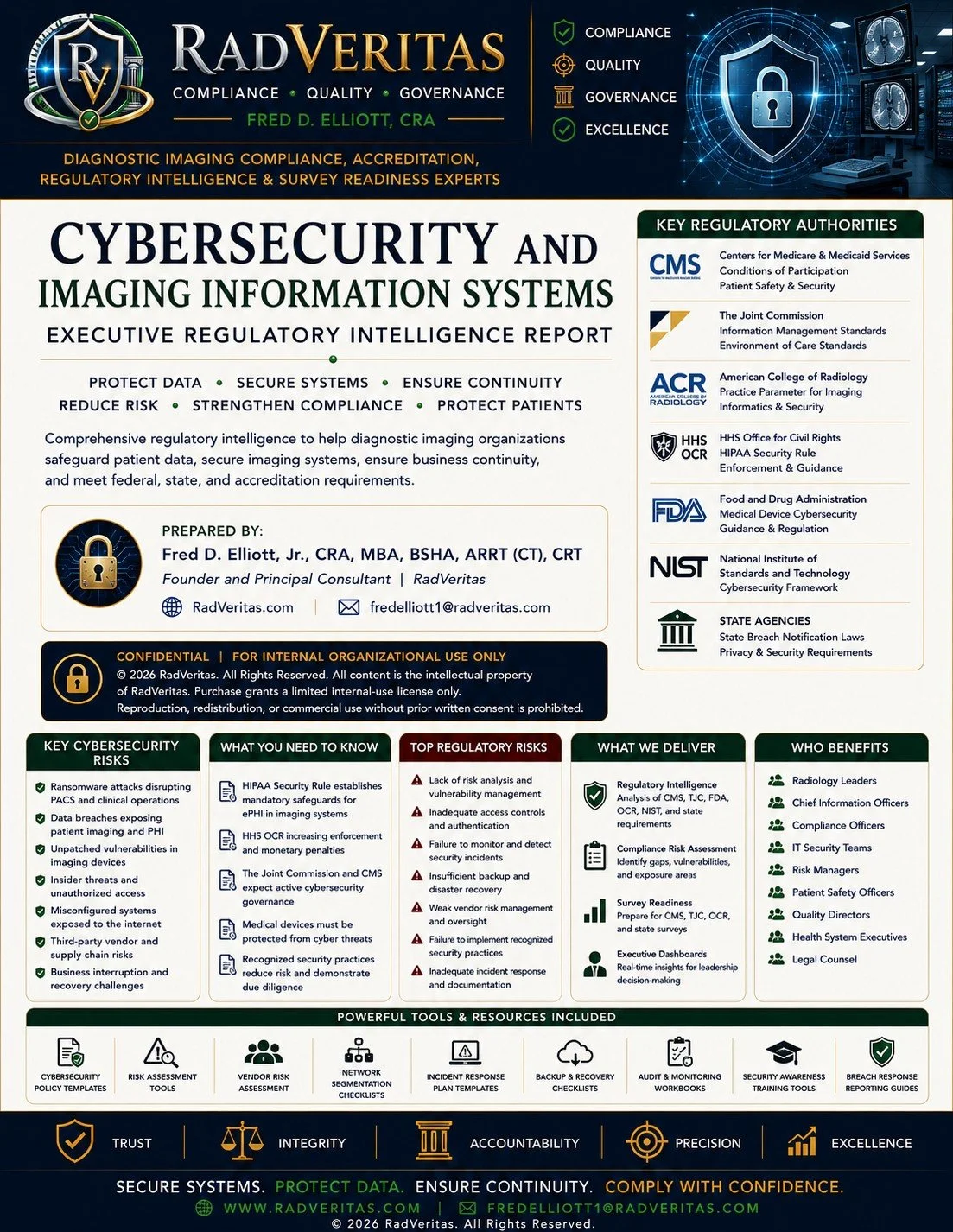
The Executive Guide to Protecting Imaging Operations, Patient Data, and Organizational Reputation
One Cyberattack Can Shut Down an Entire Imaging Department
Diagnostic Imaging has become one of the most attractive targets for cybercriminals.
Every CT scanner, MRI system, PACS archive, RIS platform, cloud imaging solution, teleradiology connection, and imaging workstation creates a potential entry point into your organization.
The consequences can be devastating.
A ransomware attack can halt imaging operations. A PACS breach can expose millions of patient records. A cybersecurity failure can trigger regulatory investigations, financial penalties, accreditation concerns, and patient safety events.
The question is no longer whether healthcare organizations will be targeted.
The question is whether they are prepared.
The RadVeritas Cybersecurity and Imaging Information Systems Regulatory Intelligence Report provides healthcare leaders with a comprehensive roadmap for protecting imaging systems, strengthening regulatory compliance, reducing cybersecurity risk, and building resilient imaging operations.
Why This Report Matters
Cybersecurity is no longer just an IT responsibility.
It is a patient safety, compliance, operational continuity, and leadership responsibility.
Healthcare regulators, accreditors, and government agencies increasingly expect organizations to demonstrate active cybersecurity governance, particularly within high-risk environments such as Diagnostic Imaging.
This report helps leaders identify vulnerabilities before attackers, regulators, or auditors discover them.
What You'll Learn
Imaging Cybersecurity Governance
Develop a structured cybersecurity program designed specifically for Diagnostic Imaging environments.
HIPAA Security Compliance
Understand requirements involving:
Administrative Safeguards
Physical Safeguards
Technical Safeguards
Risk Assessments
Access Controls
Encryption Standards
Breach Response Requirements
PACS and RIS Security
Strengthen protection of:
PACS Archives
RIS Platforms
DICOM Networks
Teleradiology Connections
Cloud Imaging Environments
Image Sharing Platforms
Ransomware Preparedness
Learn how to reduce operational disruption through:
Network Segmentation
Backup Strategies
Recovery Planning
Incident Response Programs
Downtime Procedures
Medical Device Cybersecurity
Address vulnerabilities affecting:
CT Systems
MRI Systems
Ultrasound Equipment
Nuclear Medicine Systems
Fluoroscopy Platforms
Legacy Imaging Equipment
Vendor and Third-Party Risk
Improve oversight of:
Cloud Vendors
PACS Vendors
Teleradiology Providers
AI Vendors
Business Associate Agreements
Security Contract Requirements
The Hidden Cost of Cybersecurity Failure
Many organizations believe cybersecurity is a technology issue.
In reality, it is an operational survival issue.
A single ransomware attack can delay patient care, disrupt imaging services, compromise protected health information, trigger regulatory investigations, and create significant financial loss.
Organizations that prepare before an incident recover faster, protect patients more effectively, and reduce regulatory exposure.
Build a Resilient Imaging Enterprise
Cyber threats continue to evolve.
Regulatory expectations continue to increase.
Patient expectations continue to rise.
The RadVeritas Cybersecurity and Imaging Information Systems Regulatory Intelligence Report provides healthcare leaders with the knowledge, governance framework, and operational strategies needed to protect their imaging enterprise in an increasingly connected world.
Protect the Data.
Protect the Operations.
Protect the Patients.
Prepared By
Fred D. Elliott, Jr., CRA, MBA, BSHA, ARRT (CT), CRT
Founder and Principal Consultant
RadVeritas
Compliance • Quality • Governance
Securing Diagnostic Imaging Through Leadership, Compliance, and Preparedness.
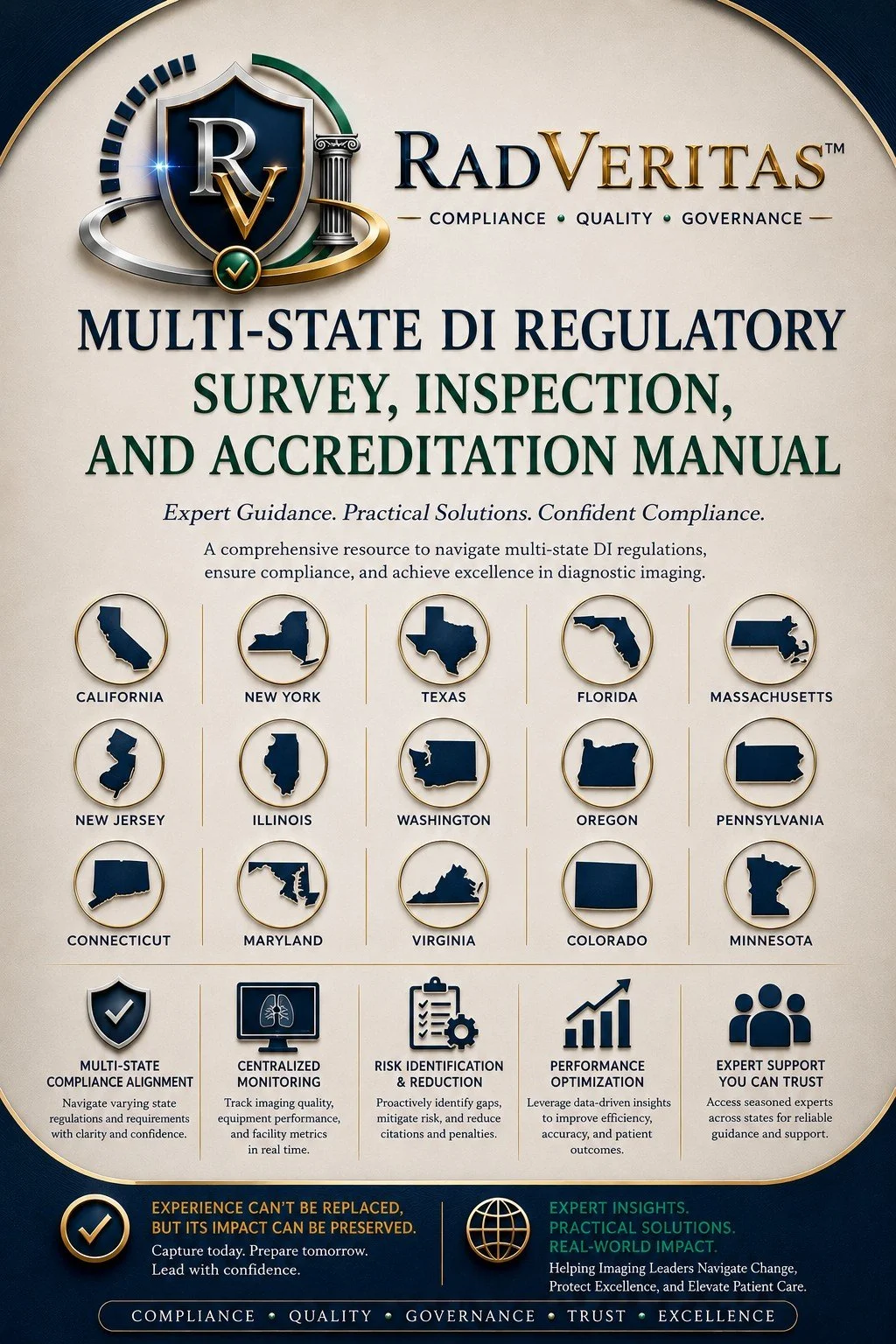
One Resource. Multiple States. Complete Regulatory Intelligence.
Navigate Complex Multi-State Compliance Requirements with Confidence.
Managing Diagnostic Imaging compliance across multiple states can be one of the most challenging responsibilities facing healthcare leaders today.
Regulatory requirements vary significantly from state to state. Survey expectations differ. Licensing requirements evolve. Accreditation standards change. Documentation expectations expand. Enforcement priorities shift.
Organizations operating across multiple jurisdictions often struggle to maintain consistency while ensuring compliance with federal regulations, state laws, accreditation standards, and industry best practices.
The Multi-State Diagnostic Imaging Regulatory Survey, Inspection, and Accreditation Manual™ from RadVeritas™ was developed to help imaging leaders eliminate uncertainty, strengthen governance, and create a standardized approach to regulatory compliance across multiple locations and jurisdictions.
Designed for healthcare executives, Diagnostic Imaging leaders, compliance professionals, accreditation specialists, and quality teams, this comprehensive reference manual delivers practical guidance for navigating some of the most highly regulated imaging environments in the United States.
Why This Manual Matters
Every state has unique regulatory requirements that can impact:
Licensing and certification
Radiation safety programs
Equipment registration requirements
Personnel qualifications
Quality control programs
Inspection readiness
Accreditation compliance
Medical physics requirements
Documentation standards
Patient safety expectations
Failure to understand these differences can result in:
Regulatory citations
Accreditation deficiencies
Corrective action plans
Financial penalties
Delayed operations
Reputational damage
Increased organizational risk
This manual helps leaders proactively identify and manage those risks before regulators do.
Coverage of High-Regulation States
The manual includes comprehensive regulatory intelligence and compliance guidance for:
✔ California
✔ New York
✔ Texas
✔ Florida
✔ Massachusetts
✔ New Jersey
✔ Illinois
✔ Washington
✔ Oregon
✔ Pennsylvania
✔ Connecticut
✔ Maryland
✔ Virginia
✔ Colorado
✔ Minnesota
In addition to federal regulatory requirements that affect Diagnostic Imaging operations nationwide.
Built for Real-World Healthcare Operations
Unlike generic regulatory summaries, this manual focuses on operational application.
Every section is designed to help leaders understand not only what regulations require, but how to implement practical compliance strategies that withstand inspections, surveys, and expert scrutiny.
Whether your organization operates in one state or fifteen, this resource provides the structure, intelligence, and guidance necessary to strengthen compliance, reduce risk, and support operational excellence.
The Cost of Non-Compliance Is Too High to Operate on Assumptions.
Regulations change.
Survey expectations evolve.
Inspection standards become more complex.
Organizations that rely on fragmented information place themselves at unnecessary risk.
The Multi-State Diagnostic Imaging Regulatory Survey, Inspection, and Accreditation Manual™ provides the clarity, consistency, and regulatory intelligence needed to stay ahead of change and maintain confidence across every facility, every modality, and every jurisdiction.
Lead with Confidence. Operate with Consistency. Prepare for Success.
Reduce risk. Strengthen compliance. Improve performance.
RadVeritas™
Compliance • Quality • Governance
Expert Insights. Practical Solutions. Real-World Impact.
Helping Diagnostic Imaging Leaders Navigate Multi-State Regulatory Complexity, Achieve Survey Readiness, and Build Sustainable Compliance Excellence.
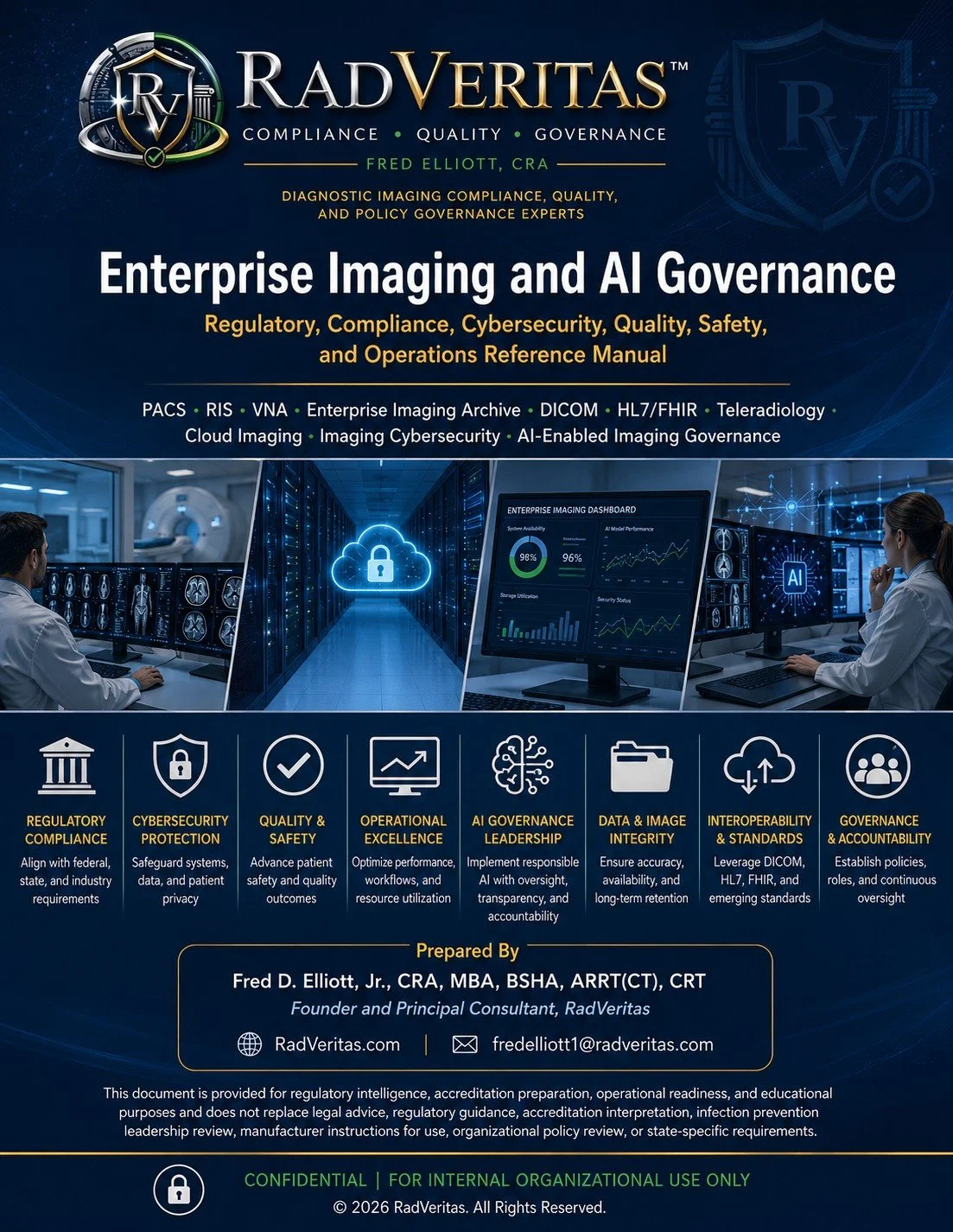
The Definitive Governance Framework for Enterprise Imaging, Artificial Intelligence, Cybersecurity, and Regulatory Compliance
Transform Enterprise Imaging Governance into a Strategic Organizational Advantage
Healthcare organizations are rapidly expanding the use of Enterprise Imaging, Artificial Intelligence, Cloud Technologies, Data Exchange Platforms, and Advanced Analytics.
At the same time, regulatory expectations, cybersecurity threats, privacy obligations, interoperability requirements, and governance responsibilities continue to evolve at an unprecedented pace.
Without a comprehensive governance framework, organizations face increasing risks related to patient privacy, cybersecurity incidents, data integrity failures, regulatory violations, AI misuse, operational disruption, and accreditation deficiencies.
The Enterprise Imaging and AI Governance Regulatory, Compliance, Cybersecurity, Quality, Safety, and Operations Reference Manual™ was developed to provide healthcare leaders with a centralized, enterprise-level roadmap for governing imaging technology, clinical data, artificial intelligence, cybersecurity, operational performance, and regulatory compliance across the imaging ecosystem.
This comprehensive reference manual bridges the gap between technology, compliance, governance, patient safety, and operational excellence.
Why Enterprise Imaging Governance Matters
Enterprise Imaging is no longer limited to PACS.
Today's imaging ecosystem includes:
PACS
RIS
Vendor Neutral Archives (VNA)
Enterprise Imaging Archives
DICOM Infrastructure
HL7 and FHIR Integration
Cloud Imaging Platforms
Teleradiology Networks
Artificial Intelligence Applications
Imaging Analytics
Cybersecurity Controls
Enterprise Data Governance
As systems become more interconnected, governance failures can create enterprise-wide consequences affecting patient care, privacy, security, operations, accreditation, and organizational reputation.
Organizations must proactively establish governance structures that ensure accountability, transparency, compliance, and long-term sustainability.
Comprehensive Areas of Coverage
Enterprise Imaging Governance
Establish governance structures that align technology, operations, compliance, clinical practice, and organizational strategy.
Artificial Intelligence Governance
Implement responsible AI oversight frameworks that support transparency, accountability, validation, monitoring, risk management, and ethical deployment.
Regulatory Compliance
Navigate federal, state, accreditation, privacy, cybersecurity, and healthcare information management requirements with confidence.
Cybersecurity Protection
Strengthen defenses against ransomware, unauthorized access, data breaches, insider threats, and emerging cyber risks.
Data and Image Integrity
Protect the accuracy, reliability, availability, retention, and long-term accessibility of imaging data and clinical information.
Interoperability and Standards
Align enterprise imaging environments with DICOM, HL7, FHIR, IHE, and emerging healthcare data exchange standards.
Quality and Patient Safety
Integrate governance principles that support patient safety, clinical quality, performance improvement, and risk reduction.
Operational Excellence
Optimize workflows, resource utilization, technology investments, and enterprise performance through effective governance.
What Makes This Manual Different
Unlike traditional technology references that focus exclusively on systems and infrastructure, this manual integrates:
✔ Enterprise Imaging Governance
✔ Artificial Intelligence Oversight
✔ Regulatory Compliance
✔ Cybersecurity Governance
✔ Data Privacy and Protection
✔ Interoperability Standards
✔ Risk Management
✔ Operational Excellence
✔ Quality and Patient Safety
✔ Executive Accountability
Into one comprehensive governance framework.
Key Governance Domains Covered
Regulatory Compliance
Align imaging programs with applicable federal, state, accreditation, privacy, and cybersecurity requirements.
Cybersecurity Protection
Develop resilient security programs that protect imaging infrastructure, patient information, and organizational assets.
Quality and Safety
Strengthen patient-centered governance models that support clinical excellence and operational reliability.
Operational Excellence
Improve system performance, workflow efficiency, and technology utilization across the enterprise.
AI Governance Leadership
Establish responsible oversight mechanisms for AI-enabled imaging technologies and decision-support systems.
Data and Image Integrity
Protect the lifecycle of imaging information from acquisition through long-term retention and retrieval.
Interoperability and Standards
Support seamless information exchange across healthcare systems, vendors, and care environments.
Governance and Accountability
Create sustainable governance structures that define ownership, decision-making authority, risk oversight, and organizational accountability.
Organizational Benefits
Strengthen Regulatory Compliance
Maintain alignment with evolving healthcare, privacy, cybersecurity, and AI governance requirements.
Reduce Enterprise Risk
Identify vulnerabilities before they become compliance failures, cybersecurity incidents, or operational disruptions.
Improve Cybersecurity Readiness
Protect critical imaging infrastructure and sensitive patient information.
Enhance Data Integrity
Ensure reliable, accurate, accessible, and trustworthy clinical imaging data.
Support Responsible AI Adoption
Implement governance structures that encourage innovation while maintaining safety and accountability.
Improve Operational Performance
Optimize technology investments, workflows, resource utilization, and organizational efficiency.
Build Sustainable Governance
Create scalable governance systems capable of adapting to future regulatory, technological, and operational changes.
More Than a Technology Manual
This manual serves as an executive-level governance resource designed to help organizations manage the growing intersection of imaging technology, artificial intelligence, cybersecurity, compliance, privacy, quality, safety, and operations.
Whether implementing enterprise imaging initiatives, deploying AI solutions, strengthening cybersecurity programs, preparing for accreditation reviews, or building long-term governance strategies, this resource provides the structure, intelligence, and practical guidance necessary to lead with confidence.
Governance Is the Foundation of Sustainable Innovation
Technology alone does not create excellence.
Strong governance creates excellence.
The Enterprise Imaging and AI Governance Regulatory, Compliance, Cybersecurity, Quality, Safety, and Operations Reference Manual™ provides the framework needed to ensure innovation remains secure, compliant, accountable, and aligned with organizational objectives.
Lead the Future of Enterprise Imaging with Confidence
Strengthen governance. Protect patient data. Reduce risk. Enable innovation. Improve performance.
RadVeritas™
Compliance • Quality • Governance
Expert Insights. Practical Solutions. Real-World Impact.
Helping Healthcare Organizations Build Secure, Compliant, AI-Enabled Enterprise Imaging Programs That Support Patient Safety, Operational Excellence, and Long-Term Organizational Success.
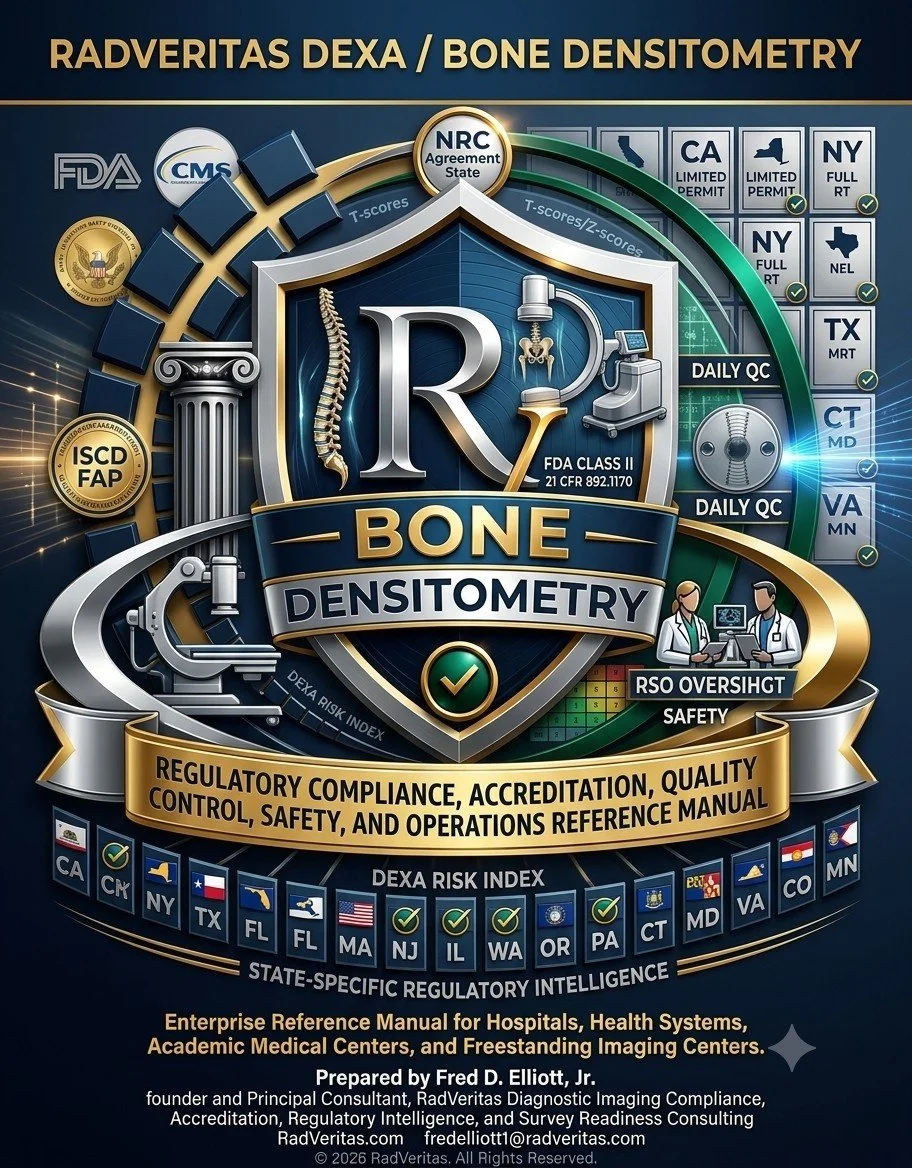
The Definitive Compliance and Quality Resource for Bone Densitometry Programs
Strengthen Compliance. Optimize Quality. Protect Patients. Build Survey Readiness.
Bone densitometry has become an essential component of osteoporosis prevention, diagnosis, treatment monitoring, and fracture risk assessment. Yet behind every accurate DEXA examination is a complex network of regulatory requirements, quality control procedures, equipment performance standards, technologist competency expectations, medical oversight, and accreditation obligations.
The DEXA / Bone Densitometry Regulatory Compliance, Accreditation, Quality Control, Safety, and Operations Reference Manual™ provides healthcare organizations with a comprehensive enterprise framework for managing every aspect of a high-performing bone densitometry program.
Designed for hospitals, outpatient imaging centers, orthopedic practices, endocrinology clinics, women's health centers, academic medical centers, and integrated healthcare systems, this manual brings regulatory intelligence, operational guidance, and quality management together into one authoritative reference.
Why Bone Densitometry Programs Require Specialized Oversight
Bone densitometry programs operate within a highly regulated clinical environment where imaging accuracy directly influences diagnosis, treatment decisions, reimbursement, and long-term patient outcomes.
Successful programs require far more than performing DEXA examinations.
Healthcare organizations must maintain:
Regulatory compliance
Equipment quality control
Daily performance verification
Radiation safety oversight
Medical supervision
Accreditation readiness
Technologist competency
Documentation integrity
State licensing compliance
Continuous quality improvement
Without a structured governance program, organizations increase their exposure to accreditation findings, regulatory citations, inconsistent imaging quality, reimbursement challenges, and patient safety risks.
What Makes This Manual Different
Unlike traditional DEXA textbooks or equipment manuals, this resource focuses on the complete operational management of a Bone Densitometry program.
The manual integrates regulatory compliance, accreditation standards, quality assurance, imaging physics, operational workflows, leadership accountability, and state-specific regulatory intelligence into one enterprise-ready solution.
The framework is built around six critical pillars of program excellence.
Regulatory Compliance
Navigate federal, state, and accreditation requirements with confidence while maintaining continuous operational readiness.
Accreditation Readiness
Prepare for accreditation surveys, inspections, and quality reviews through standardized documentation, performance monitoring, and evidence-based compliance.
Quality Control and Equipment Performance
Establish robust quality assurance programs that support equipment accuracy, image consistency, and reliable clinical interpretation.
Radiation Safety
Strengthen radiation protection practices through ALARA principles, safety oversight, quality monitoring, and regulatory compliance.
Operational Excellence
Standardize workflows, documentation, staffing, competency validation, and performance improvement across the entire DEXA program.
State Regulatory Intelligence
Understand licensing, certification, technologist qualification requirements, and regulatory differences across multiple jurisdictions through integrated state-specific guidance.
Comprehensive Areas of Coverage
Bone Densitometry Regulatory Compliance
Maintain compliance with applicable federal, state, and professional standards governing bone densitometry operations.
Accreditation and Survey Readiness
Prepare for inspections and accreditation reviews through organized documentation, standardized procedures, and continuous readiness strategies.
Quality Control Programs
Implement daily, weekly, monthly, quarterly, and annual quality control procedures that support equipment performance and clinical accuracy.
Imaging Physics and Equipment Performance
Monitor equipment calibration, precision assessment, phantom testing, preventive maintenance, and ongoing system performance.
Radiation Safety
Support safe imaging practices through radiation protection principles, exposure optimization, equipment monitoring, and regulatory oversight.
Documentation Excellence
Strengthen reporting consistency, policy management, quality records, audit trails, and regulatory documentation.
Medical Oversight
Support physician leadership, medical supervision, clinical interpretation standards, and interdisciplinary collaboration.
Operational Management
Improve staffing, competency validation, workflow efficiency, productivity, and continuous performance improvement.
State-Specific Regulatory Intelligence
One of the distinguishing features of this manual is its integration of multi-state regulatory guidance.
The manual includes state-specific intelligence addressing topics such as:
Technologist licensing requirements
Limited permit regulations
Certification expectations
Scope-of-practice requirements
Radiation control regulations
Inspection considerations
State-specific compliance variations
This allows organizations operating across multiple states to develop standardized compliance programs while addressing jurisdiction-specific requirements.
Built for Modern Bone Densitometry Programs
Whether launching a new DEXA service, strengthening an existing quality program, preparing for accreditation, or managing a multi-site imaging enterprise, this manual provides the guidance necessary to build sustainable, high-performing Bone Densitometry operations.
Every chapter is designed to support organizations in developing standardized systems that improve compliance, enhance quality, protect patients, and simplify program management.
Excellence Begins with Consistent Standards
The most successful Bone Densitometry programs do not rely on individual expertise alone.
They rely on standardized processes, continuous quality improvement, regulatory intelligence, and strong operational governance.
The DEXA / Bone Densitometry Regulatory Compliance, Accreditation, Quality Control, Safety, and Operations Reference Manual™ provides the framework needed to achieve and sustain that level of excellence.
Build Stronger DEXA Programs. Reduce Risk. Improve Patient Care.
Strengthen compliance. Optimize quality. Enhance safety. Achieve operational excellence.
RadVeritas™
Compliance • Quality • Governance
Expert Insights. Practical Solutions. Real-World Impact.
Helping Hospitals, Imaging Centers, Academic Medical Centers, and Healthcare Leaders Build High-Performing Bone Densitometry Programs Through Regulatory Intelligence, Quality Assurance, Accreditation Readiness, and Operational Excellence.
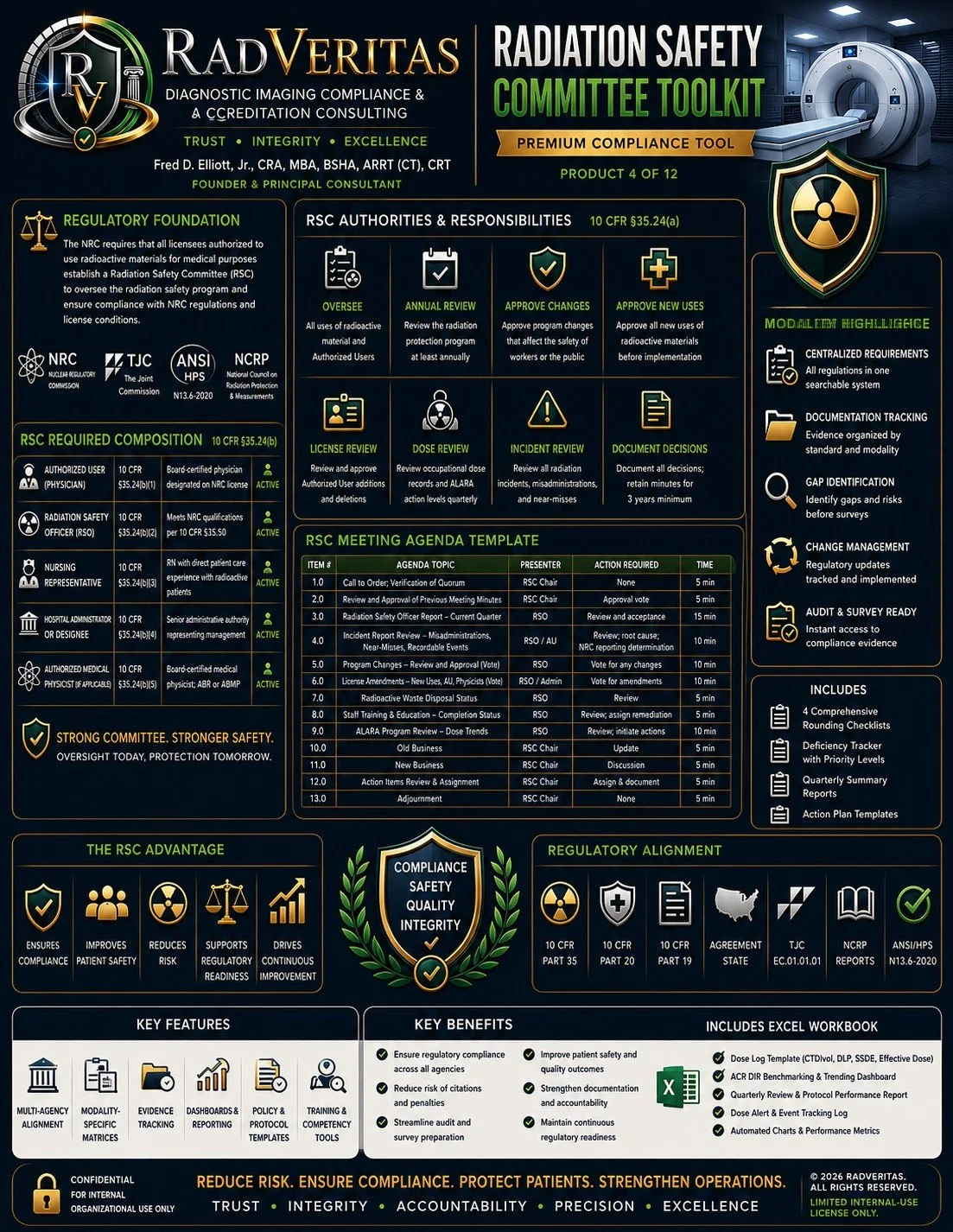
Summary
A governance and compliance toolkit designed to support Radiation Safety Committees and Radiation Safety Officers in managing radioactive materials programs. Includes committee structure requirements, meeting agendas, quarterly radiation safety reporting, occupational dose monitoring, radioactive material inventory tracking, annual program reviews, and license condition monitoring. Supports NRC and Agreement State compliance programs.
Primary Value
Radiation safety governance
NRC compliance
Committee management
Dose monitoring
License oversight
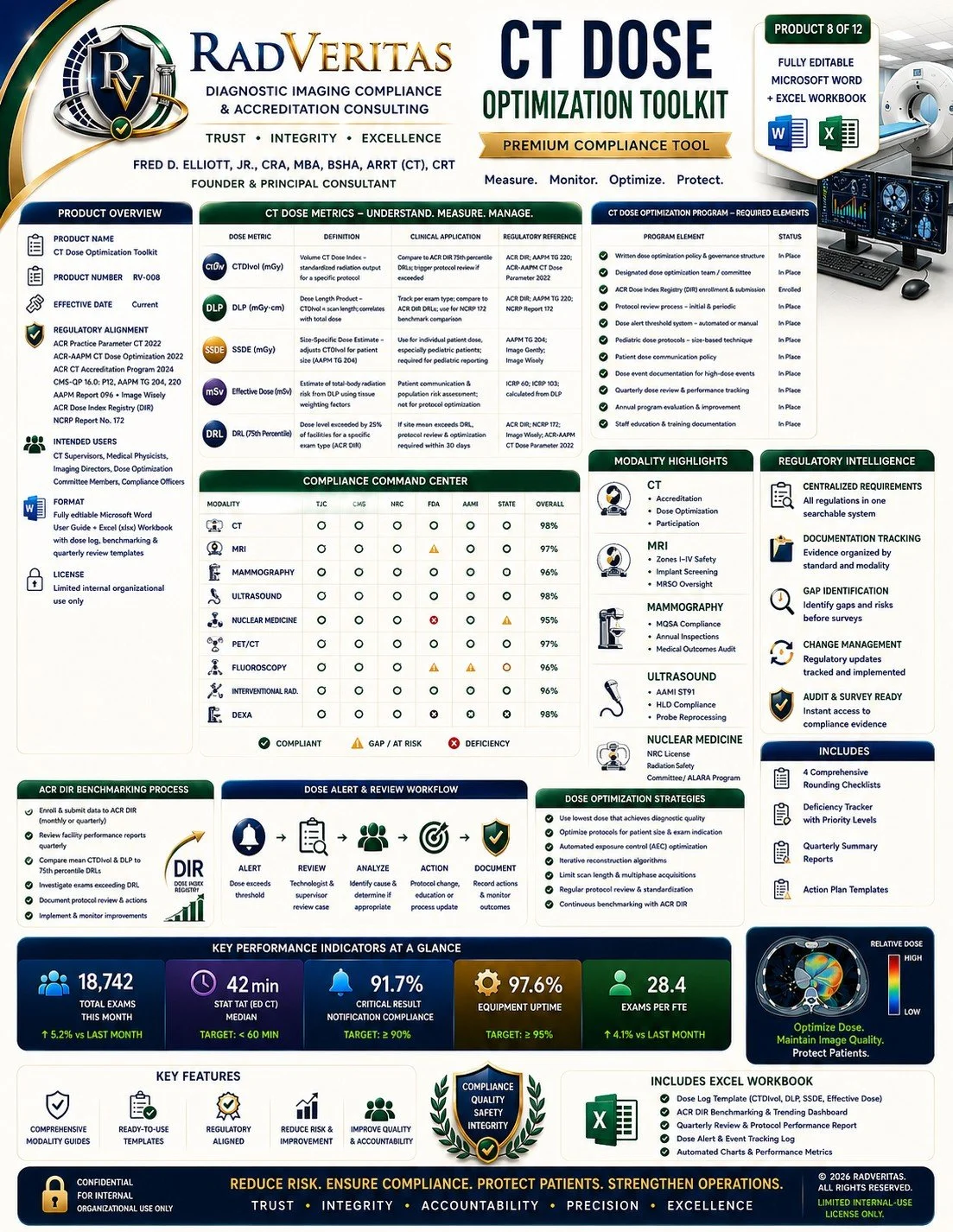
Summary
A comprehensive CT radiation dose management program that provides governance structures, protocol review systems, benchmarking tools, dose monitoring processes, ACR Dose Index Registry integration guidance, pediatric dose management frameworks, and committee review templates. Supports optimization of patient radiation exposure while maintaining diagnostic image quality.
Primary Value
CT dose optimization
Radiation safety
ACR compliance
Protocol management
Dose benchmarking
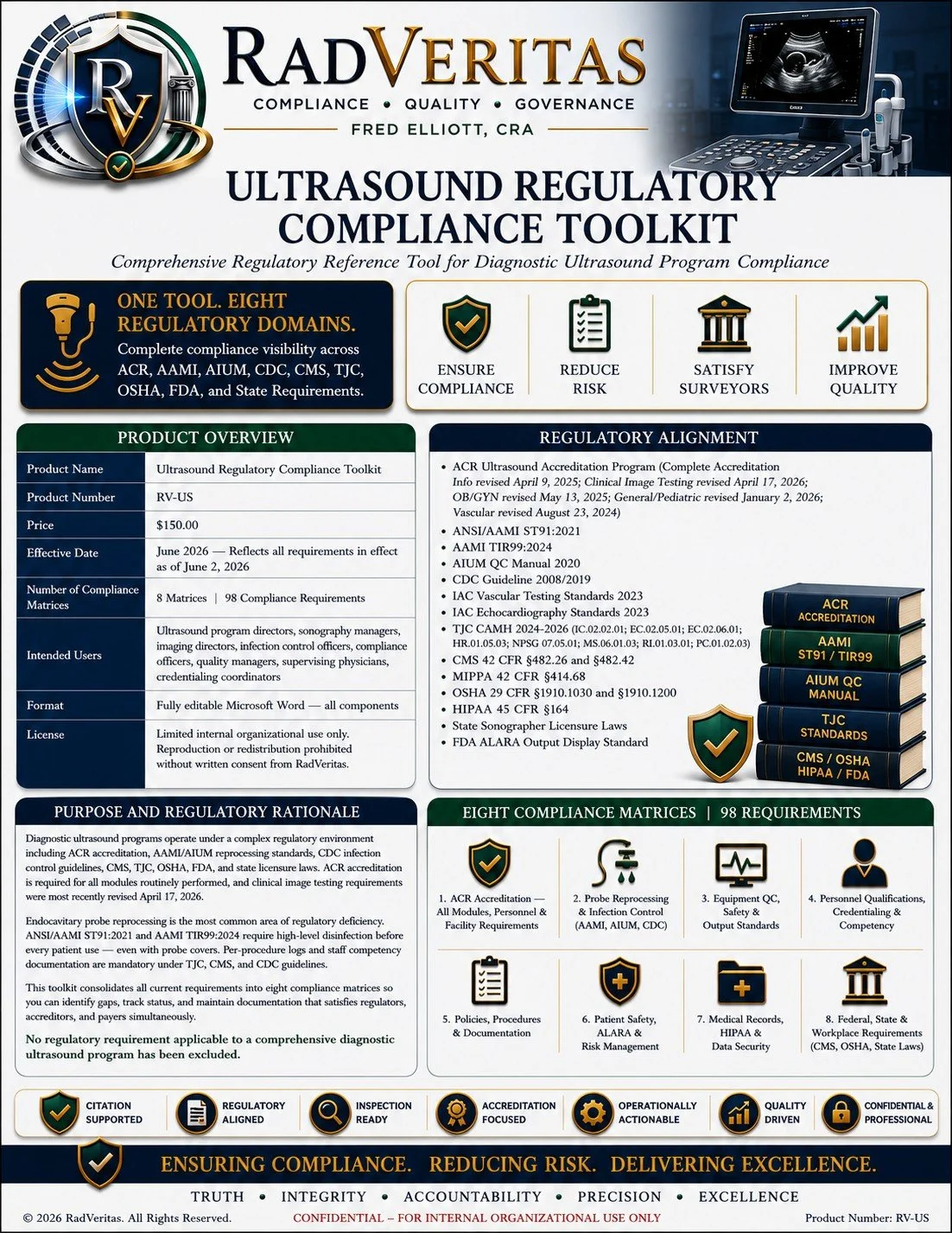
The Compliance Resource Every Ultrasound Program Needs Before Surveyors Arrive
Regulatory compliance in ultrasound is no longer limited to accreditation paperwork and annual quality control reviews.
Today's ultrasound leaders must navigate a growing network of accreditation standards, infection prevention requirements, probe reprocessing regulations, CMS Conditions of Participation, Joint Commission expectations, state licensure laws, HIPAA requirements, and specialty-specific practice standards. A single overlooked requirement can expose an organization to accreditation findings, reimbursement risk, patient safety concerns, and regulatory scrutiny.
The RadVeritas Ultrasound Regulatory Compliance Toolkit (RV-US) was developed to help healthcare organizations confidently manage these challenges through a comprehensive, audit-ready compliance framework covering every major operational, clinical, technical, and regulatory component of a modern ultrasound program.
Stop Guessing. Start Verifying.
Most ultrasound departments operate with compliance information scattered across accreditation manuals, regulatory websites, manufacturer instructions, infection control policies, and internal procedures.
The RV-US consolidates these requirements into a single comprehensive compliance reference tool, allowing leaders to quickly identify gaps, verify compliance, prepare for surveys, and strengthen operational performance. The toolkit incorporates current requirements from ACR, CMS, The Joint Commission, OSHA, HIPAA, AIUM, AAMI, CDC, FDA, IAC, MIPPA, and state regulatory agencies.
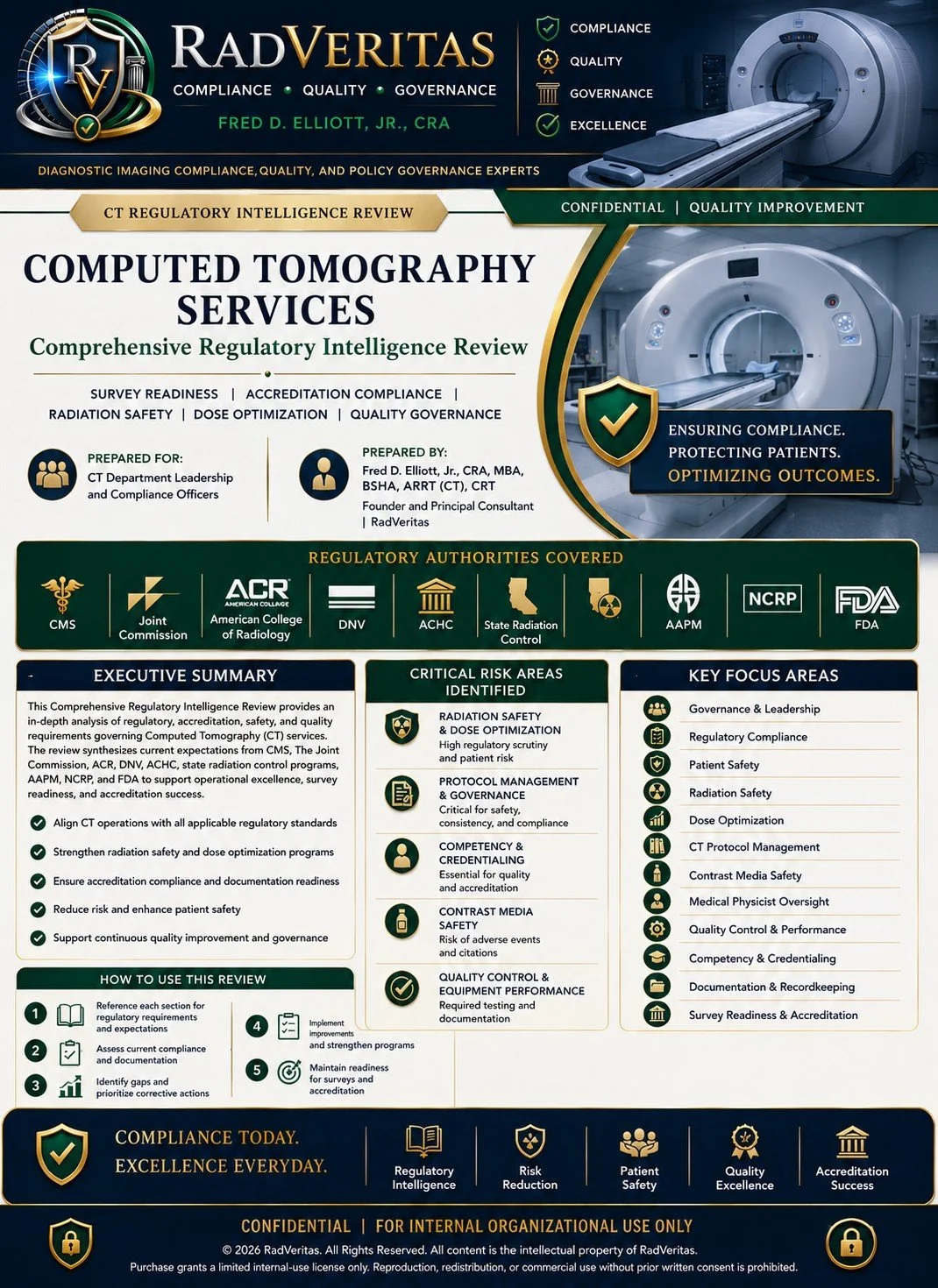
The Complete Compliance, Accreditation, Radiation Safety, and Survey Readiness System for Computed Tomography Leaders
One survey finding can expose years of unseen risk.
Most CT departments believe they are compliant until a surveyor, accreditor, regulator, patient safety event, or dose investigation proves otherwise.
The RadVeritas CT Regulatory Intelligence Review was developed to help CT leaders identify vulnerabilities before they become deficiencies, strengthen compliance before it becomes a citation, and prepare for inspections with confidence.
Built from current CMS, Joint Commission, ACR, DNV, ACHC, FDA, AAPM, NCRP, and state regulatory requirements, this comprehensive intelligence system provides a detailed roadmap for managing every major compliance, accreditation, patient safety, radiation safety, dose optimization, quality, and governance requirement affecting modern CT operations.
What Makes This Resource Different?
This is not a summary of regulations.
It is an executive-level operational intelligence system designed specifically for CT leaders, Medical Directors, Compliance Officers, Radiation Safety Officers, Medical Physicists, Quality Professionals, and Accreditation Teams.
Inside this resource, you will find:
• Comprehensive review of 50 high-risk CT regulatory domains
• Top 100 CT survey findings ranked by regulatory impact
• Complete CT document inventory expected during surveys
• CT accreditation and survey readiness framework
• CT dose optimization and radiation safety guidance
• CT protocol governance and committee requirements
• Contrast safety and emergency preparedness standards
• AI governance requirements for CT operations
• Leadership audit tools and risk assessment matrices
• Mock survey toolkit with realistic surveyor questions
• Competency validation systems
• Corrective action trackers
• Executive dashboards and readiness scorecards
• Regulatory citation library with authoritative references
Key Areas Covered
✓ CT Accreditation Readiness
✓ CMS Conditions of Participation
✓ Joint Commission Standards
✓ ACR CT Accreditation Requirements
✓ Radiation Safety Programs
✓ CT Dose Optimization
✓ Medical Physicist Oversight
✓ Contrast Media Safety
✓ Infection Prevention
✓ Patient Safety
✓ Quality Control Programs
✓ Competency Validation
✓ Artificial Intelligence Governance
✓ Quality and Performance Improvement
✓ Survey Preparation and Response
Who Should Purchase This Resource?
• CT Directors
• Imaging Administrators
• Radiology Leaders
• Medical Directors
• Medical Physicists
• Radiation Safety Officers
• Compliance Professionals
• Accreditation Specialists
• Quality Improvement Leaders
• Healthcare Consultants
• Hospital Executives
The Cost of Being Unprepared
Survey deficiencies rarely occur because organizations lack good people.
They occur because critical gaps remain hidden until regulators, surveyors, or adverse events expose them.
This intelligence review helps uncover those gaps before they become citations, corrective action plans, accreditation challenges, financial penalties, or patient safety risks.
Designed for organizations that refuse to leave compliance, accreditation, and patient safety to chance.
Survey Ready. Regulatory Ready. Leadership Ready.
Prepared by
Fred D. Elliott, Jr., CRA, MBA, BSHA, ARRT (CT), CRT
Founder and Principal Consultant
RadVeritas
Compliance Today. Excellence Every Day.
This product positions well as a premium regulatory intelligence resource because it combines accreditation readiness, operational governance, patient safety, radiation safety, AI governance, and executive leadership tools into a single CT-focused system. Based on comparable healthcare compliance products and consulting deliverables, it supports a premium pricing strategy rather than a simple white paper.
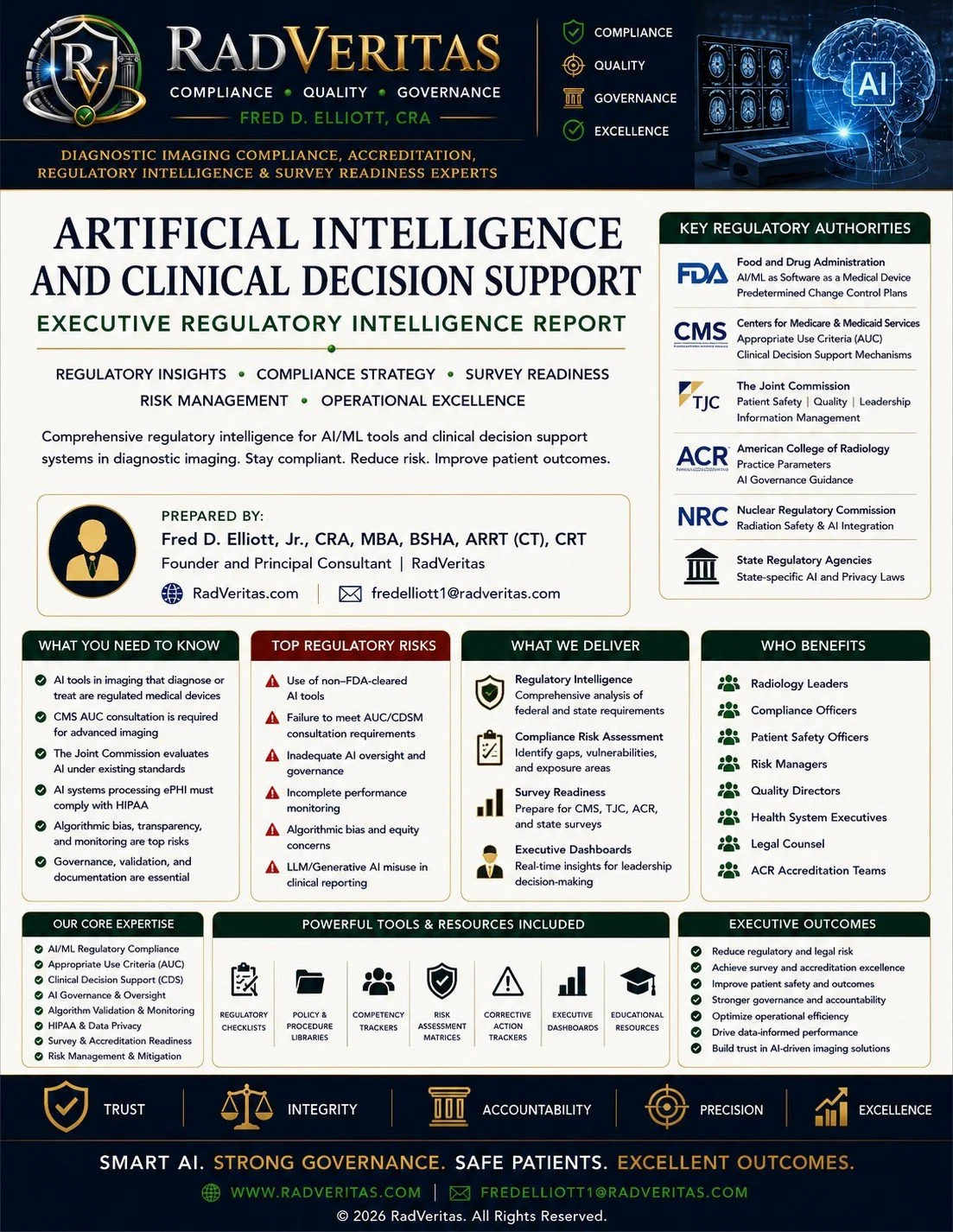
The Executive Guide to AI Governance, Compliance, Patient Safety, and Regulatory Readiness
Artificial Intelligence Is Transforming Healthcare. Is Your Organization Ready?
Artificial Intelligence is rapidly becoming one of the most disruptive forces in Diagnostic Imaging.
From automated image analysis and workflow prioritization to clinical decision support, report generation, dose optimization, and predictive analytics, AI is changing how healthcare organizations operate.
Yet with innovation comes risk.
Regulators, accreditors, attorneys, and healthcare leaders are increasingly focused on a critical question:
Who is governing the AI?
The RadVeritas Artificial Intelligence and Clinical Decision Support Regulatory Intelligence Report provides healthcare leaders with a comprehensive roadmap for safely implementing, governing, monitoring, and maintaining compliance for AI technologies used in Diagnostic Imaging and clinical decision-making environments.
Why This Report Matters
Many organizations have already deployed AI tools.
Few have implemented the governance systems necessary to manage them.
Without proper oversight, organizations face significant risks related to:
FDA compliance
CMS reimbursement requirements
HIPAA violations
Algorithmic bias
Patient safety events
Clinical decision-making errors
Accreditation findings
Vendor oversight failures
Generative AI misuse
Legal and liability exposure
The organizations that succeed with AI will not be those that adopt it first.
They will be the organizations that govern it best.
What You'll Learn
Artificial Intelligence Governance
Develop a structured governance framework that aligns innovation with compliance, safety, accountability, and organizational oversight.
FDA Compliance for AI
Understand requirements governing:
Software as a Medical Device (SaMD)
FDA-cleared AI tools
Predetermined Change Control Plans (PCCP)
Post-market monitoring obligations
Clinical deployment requirements
Clinical Decision Support Compliance
Navigate CMS requirements involving:
Appropriate Use Criteria (AUC)
Clinical Decision Support Mechanisms (CDSM)
Advanced imaging ordering requirements
Medicare documentation expectations
Generative AI and Large Language Models
Address emerging risks associated with:
AI-generated clinical content
Report drafting tools
Hallucinations and reliability concerns
Human oversight requirements
Clinical validation processes
HIPAA and Data Privacy
Strengthen oversight of:
AI vendors
Business Associate Agreements
Data security
Protected health information
Cybersecurity safeguards
Algorithmic Bias and Health Equity
Evaluate and monitor AI systems for potential bias, fairness concerns, and population-specific performance differences.
The Hidden Risk of AI Adoption
Most organizations focus on what AI can do.
Few focus on what AI can expose.
An AI tool without FDA clearance.
A vendor without a Business Associate Agreement.
A report generated by an unvalidated language model.
An algorithm that performs differently across patient populations.
Any one of these can create regulatory, financial, operational, and patient safety consequences.
This report helps leaders identify those risks before they become organizational liabilities.
Future-Proof Your Imaging Enterprise
Artificial Intelligence is not a future issue.
It is a current leadership responsibility.
Organizations that establish strong governance now will be positioned to adapt, innovate, and thrive as regulations evolve and technology advances.
Those that fail to do so may find themselves responding to problems that could have been prevented.
The RadVeritas Artificial Intelligence and Clinical Decision Support Regulatory Intelligence Report provides the framework to lead confidently in an AI-driven healthcare environment.
Innovation Requires Governance.
Governance Protects Patients.
Leadership Drives Success.
Prepared By
Fred D. Elliott, Jr., CRA, MBA, BSHA, ARRT (CT), CRT
Founder and Principal Consultant
RadVeritas
Compliance • Quality • Governance
Guiding Healthcare Leaders Through the Future of Diagnostic Imaging.
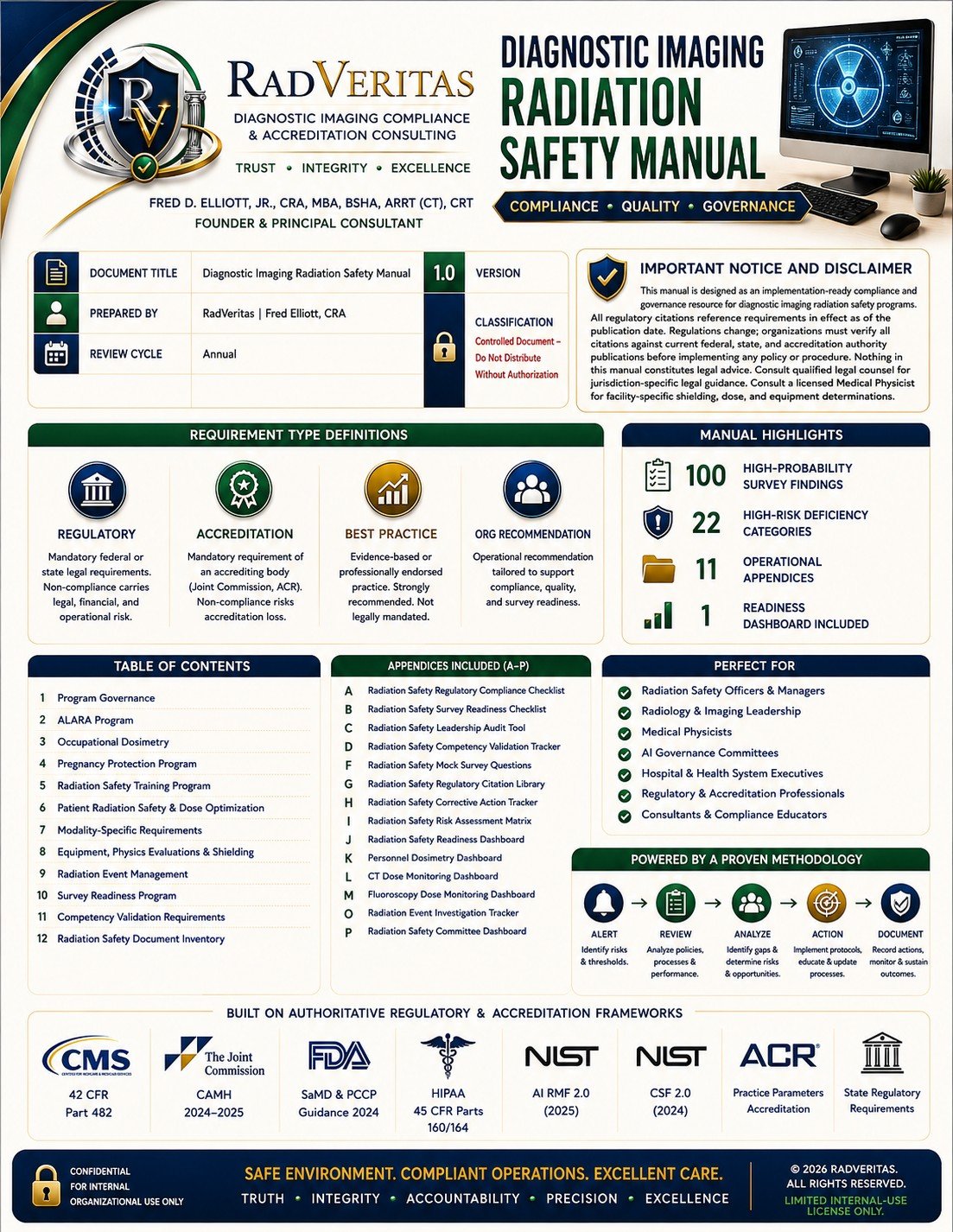
The Complete Radiation Safety Governance, Compliance, and Survey Readiness Manual for Diagnostic Imaging Leaders
Radiation Safety Is Not Just a Requirement. It Is a Leadership Responsibility.
Every day, Diagnostic Imaging professionals make decisions that affect patient safety, employee protection, regulatory compliance, and organizational risk.
A missed dosimeter review.
An outdated shielding evaluation.
An incomplete pregnancy policy.
A lapse in fluoroscopy oversight.
A missing competency record.
Any one of these can expose an organization to regulatory citations, accreditation findings, legal liability, and preventable patient or staff harm.
The RadVeritas Diagnostic Imaging Radiation Safety Manual was developed to help healthcare organizations build and maintain a comprehensive radiation safety program that stands up to regulatory scrutiny and supports a culture of safety.
Built from current federal regulations, accreditation standards, and industry best practices, this implementation-ready manual transforms complex requirements into practical operational guidance.
Why This Manual Matters
Radiation safety expectations continue to evolve.
Surveyors increasingly examine not only whether policies exist, but whether organizations can demonstrate effective implementation, leadership oversight, staff competency, and continuous performance improvement.
Many organizations discover weaknesses only when an inspection, accreditation survey, or radiation event uncovers them.
This manual helps leaders identify and address those vulnerabilities before they become findings.
What You'll Find Inside
Comprehensive Radiation Safety Governance
Build a structured program that supports safe, compliant imaging operations across multiple modalities.
ALARA Program Development
Strengthen systems designed to reduce unnecessary radiation exposure for patients, staff, and the public.
Personnel Monitoring and Dosimetry
Establish effective processes for:
Occupational Exposure Monitoring
Dosimeter Management
Exposure Investigations
Employee Education
Record Retention
Patient Dose Safety
Support safe imaging practices through:
Dose Optimization
Fluoroscopy Safety
CT Dose Management
Pregnancy Screening
Pediatric Radiation Protection
Event Management and Survey Readiness
Develop practical systems for:
Radiation Incident Reporting
Corrective Action Planning
Internal Audits
Regulatory Documentation
Accreditation Preparation
The Difference Between Passing and Preparing
Many organizations prepare for surveys.
High-performing organizations prepare every day.
The strongest radiation safety programs are built on consistent governance, documented accountability, validated competency, and continuous monitoring.
That is the philosophy behind the RadVeritas Diagnostic Imaging Radiation Safety Manual.
It provides the framework needed to transform radiation safety from a regulatory obligation into a strategic operational advantage.
Build a Safer, Stronger Imaging Program
Whether you are launching a new radiation safety program, modernizing existing policies, preparing for accreditation, or strengthening organizational governance, this manual provides the tools and guidance needed to move forward with confidence.
Because radiation safety is not simply about meeting standards.
It is about protecting people.
Protect Patients.
Protect Staff.
Protect Your Organization.
Prepared By
Fred D. Elliott, Jr., CRA, MBA, BSHA, ARRT (CT), CRT
Founder and Principal Consultant
RadVeritas™
Compliance • Quality • Governance
Safe Environment. Compliant Operations. Excellent Care.
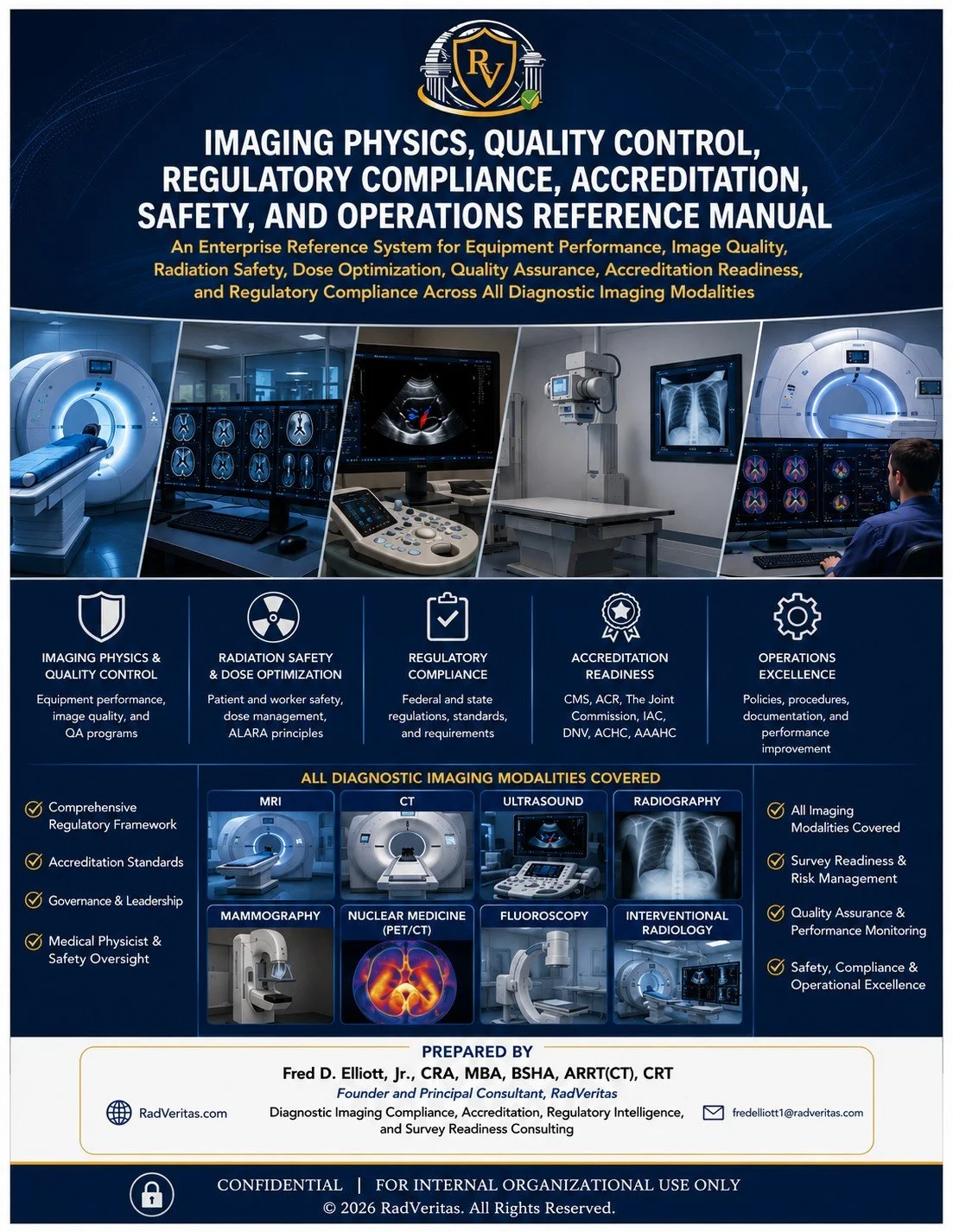
One Comprehensive Resource Covering Every Major Diagnostic Imaging Modality
Modern Diagnostic Imaging programs operate in an environment where equipment performance, image quality, radiation safety, accreditation compliance, medical physics oversight, regulatory requirements, and operational excellence are inseparably connected.
A single failure in physics testing, quality control monitoring, dose management, documentation, accreditation preparation, or regulatory compliance can create significant patient safety, operational, financial, and organizational risk.
The Imaging Physics, Quality Control, Regulatory Compliance, Accreditation, Safety, and Operations Reference Manual™ was developed to serve as a comprehensive enterprise reference system supporting imaging leaders, medical physicists, accreditation coordinators, quality professionals, and healthcare executives responsible for maintaining high-performing diagnostic imaging programs.
Designed as a practical implementation guide rather than a theoretical reference, this manual provides a centralized framework for managing compliance, quality, safety, performance, and survey readiness across all major imaging modalities.
Why Imaging Physics Matters
Imaging Physics serves as the foundation for:
Image quality
Equipment performance
Patient safety
Radiation dose optimization
Accreditation success
Regulatory compliance
Operational reliability
Clinical confidence
Organizations that treat physics oversight as an annual inspection requirement often miss opportunities to improve performance, identify risks, and strengthen readiness.
Organizations that integrate physics into everyday operations create safer, more reliable, and more defensible imaging programs.
Comprehensive Areas of Coverage
Imaging Physics and Quality Control
Establish structured quality control programs that support equipment reliability, image quality, regulatory compliance, and accreditation readiness.
Radiation Safety and Dose Optimization
Strengthen patient and worker protection through effective radiation safety practices, dose monitoring, ALARA implementation, and performance improvement initiatives.
Regulatory Compliance
Navigate complex federal, state, accreditation, and industry requirements with confidence and consistency.
Accreditation Readiness
Align imaging operations with standards from:
CMS
ACR
The Joint Commission
IAC
DNV
ACHC
AAAHC
State Regulatory Agencies
Operational Excellence
Integrate policies, procedures, documentation, performance monitoring, and governance systems that support sustainable readiness.
All Diagnostic Imaging Modalities Covered
The manual provides modality-specific guidance for:
Magnetic Resonance Imaging (MRI)
Safety programs, quality assurance, equipment performance, accreditation readiness, and regulatory requirements.
Computed Tomography (CT)
Dose optimization, image quality, accreditation standards, protocol management, and performance monitoring.
Ultrasound
Quality assurance, accreditation requirements, equipment testing, documentation, and operational oversight.
General Radiography
Quality control programs, radiation safety, image quality assessment, and compliance monitoring.
Mammography
MQSA compliance, quality assurance, medical physics oversight, accreditation readiness, and performance management.
Nuclear Medicine and PET/CT
Radiopharmaceutical safety, equipment performance, quality control, accreditation standards, and regulatory compliance.
Fluoroscopy
Dose management, quality assurance, patient safety, equipment oversight, and regulatory readiness.
Interventional Radiology
Complex imaging environments requiring integrated safety, quality, operational, and accreditation frameworks.
What Makes This Manual Different
Unlike traditional physics references focused solely on testing requirements, this resource integrates:
✔ Imaging Physics
✔ Quality Control
✔ Regulatory Compliance
✔ Accreditation Standards
✔ Radiation Safety
✔ Governance and Leadership
✔ Operational Readiness
✔ Risk Management
✔ Performance Improvement
✔ Survey Preparation
Into one unified operational framework.
What's Included
Comprehensive Regulatory Framework
Understand how physics, quality control, safety, and accreditation requirements intersect across multiple regulatory environments.
Accreditation Standards Crosswalks
Simplify preparation for accreditation reviews through structured alignment with major accrediting organizations.
Governance and Leadership Guidance
Provide leaders with tools to strengthen oversight, accountability, and continuous compliance.
Medical Physicist Oversight Resources
Support collaborative partnerships between physics professionals, operational leaders, and quality teams.
Quality Assurance Programs
Build sustainable systems that continuously monitor performance and identify opportunities for improvement.
Survey Readiness and Risk Management Tools
Prepare for inspections, audits, and accreditation surveys with confidence.
Organizational Benefits
Strengthen Regulatory Compliance
Maintain alignment with evolving regulatory and accreditation requirements.
Improve Accreditation Performance
Reduce deficiencies and improve survey outcomes through proactive readiness.
Enhance Patient Safety
Support safer imaging environments through effective quality and safety programs.
Optimize Equipment Performance
Improve reliability, consistency, and operational efficiency.
Reduce Organizational Risk
Identify and address vulnerabilities before they become citations or patient safety concerns.
Build a Culture of Excellence
Create sustainable systems that support continuous quality improvement and operational success.
More Than a Physics Manual
This resource serves as a complete operational reference system designed to support the full lifecycle of Diagnostic Imaging compliance, accreditation readiness, quality management, safety oversight, and performance excellence.
Whether preparing for an accreditation survey, strengthening a quality program, improving radiation safety, or enhancing leadership oversight, this manual provides the structure, intelligence, and practical guidance needed to achieve measurable results.
Physics. Quality. Compliance. Excellence.
Imaging Physics, Quality Control, Regulatory Compliance, Accreditation, Safety, and Operations Reference Manual™
An Enterprise Reference System for Equipment Performance, Image Quality, Radiation Safety, Dose Optimization, Accreditation Readiness, and Regulatory Compliance Across All Diagnostic Imaging Modalities.
RadVeritas™
Compliance • Quality • Governance
Expert Insights. Practical Solutions. Real-World Impact.
Helping Imaging Leaders Strengthen Physics Programs, Improve Quality, Enhance Safety, Reduce Risk, and Achieve Sustainable Regulatory and Accreditation Excellence.
The Definitive Enterprise Resource for Radiation Oncology Compliance, Accreditation, Medical Physics, Patient Safety, and Operational Excellence
A Comprehensive Regulatory Intelligence and Operational Readiness System for Modern Radiation Oncology Programs
Radiation Oncology is one of the most highly regulated, technologically complex, and patient safety-sensitive specialties in healthcare.
Success requires more than exceptional clinical care.
It requires rigorous regulatory compliance, medical physics oversight, radiation safety management, accreditation readiness, quality assurance, performance monitoring, leadership accountability, and operational discipline.
The Radiation Oncology Regulatory Compliance, Accreditation, Safety, Quality, Physics, and Operations Reference Manual™ was developed to provide healthcare organizations with a comprehensive enterprise framework for managing the regulatory, accreditation, safety, quality, and operational requirements that define high-performing Radiation Oncology programs.
Designed for hospitals, academic medical centers, integrated health systems, cancer centers, and freestanding radiation therapy facilities, this manual serves as a centralized reference for maintaining continuous readiness, reducing organizational risk, and supporting exceptional patient outcomes.
Why Radiation Oncology Programs Require Specialized Oversight
Radiation Oncology programs operate within a highly regulated environment involving:
Complex treatment technologies
Radiation-producing equipment
Medical physics oversight
Radiation safety requirements
Treatment planning systems
Quality assurance programs
Accreditation standards
Federal and state regulations
Patient safety obligations
Clinical performance expectations
A single compliance gap, documentation failure, quality assurance deficiency, or operational breakdown can result in:
Regulatory citations
Accreditation findings
Patient safety events
Financial penalties
Treatment interruptions
Reputational damage
Increased liability exposure
Organizations that excel in Radiation Oncology establish systems that identify risks before regulators, surveyors, or adverse events do.
What Makes This Manual Different
Unlike traditional regulatory references or accreditation guides, this manual integrates every major component of Radiation Oncology program oversight into a single enterprise resource.
The framework is built around six critical pillars of excellence:
Treatment Planning Excellence
Support accurate treatment planning, clinical decision-making, workflow standardization, and treatment quality.
Medical Physics Oversight
Strengthen physics program governance, equipment performance monitoring, quality control activities, and independent verification processes.
Quality Assurance and Equipment Performance
Implement comprehensive QA systems that ensure treatment accuracy, equipment reliability, and regulatory compliance.
Radiation Safety and Protection
Promote patient, staff, and public safety through effective radiation protection programs and regulatory oversight.
Regulatory Compliance
Maintain alignment with federal, state, accreditation, licensing, and operational requirements.
Risk Management and Survey Readiness
Build sustainable systems that support accreditation success, operational resilience, and continuous readiness.
Comprehensive Areas of Coverage
Radiation Oncology Regulatory Compliance
Navigate requirements from:
Centers for Medicare & Medicaid Services (CMS)
Nuclear Regulatory Commission (NRC)
Food and Drug Administration (FDA)
Occupational Safety and Health Administration (OSHA)
State Radiation Control Programs
State Licensing Agencies
State Departments of Health
Accreditation Readiness
Support continuous readiness for:
Joint Commission Accreditation
American College of Radiology (ACR)
Radiation Oncology Practice Accreditation (ROPA)
ASTRO Accreditation Program for Excellence (APEx)
American College of Radiation Oncology (ACRO)
State and Federal Inspections
Medical Physics Program Management
Annual equipment evaluations
Acceptance testing
Commissioning oversight
Quality control programs
Performance monitoring
Independent verification processes
Physics documentation standards
Radiation Safety Programs
Radiation safety governance
Radiation protection practices
Regulatory reporting requirements
Exposure monitoring
Staff training and competency
Radiation safety committee oversight
Quality and Performance Improvement
Quality management programs
Performance indicators
Event review processes
Corrective action planning
Continuous improvement initiatives
Operational performance monitoring
Operations and Leadership
Governance structures
Leadership accountability
Staffing models
Workflow optimization
Competency management
Policy and procedure oversight
Organizational readiness programs
Organizational Benefits
Strengthen Regulatory Compliance
Maintain continuous alignment with federal, state, accreditation, and operational requirements.
Improve Accreditation Readiness
Prepare for surveys, inspections, and accreditation reviews with confidence.
Enhance Patient Safety
Support safe, accurate, and consistent treatment delivery through robust oversight systems.
Reduce Organizational Risk
Identify vulnerabilities before they become deficiencies, citations, or adverse events.
Improve Quality Outcomes
Implement evidence-based quality assurance programs that drive measurable improvement.
Support Medical Physics Excellence
Strengthen oversight of treatment systems, equipment performance, and quality control activities.
Optimize Operational Performance
Improve efficiency, accountability, documentation integrity, and program sustainability.
Built for Real-World Radiation Oncology Operations
Whether launching a new program, preparing for accreditation, responding to regulatory findings, strengthening medical physics oversight, or building a culture of continuous readiness, this manual provides the tools, guidance, and operational intelligence necessary to lead with confidence.
Every section is designed to help organizations create highly reliable Radiation Oncology programs capable of delivering safe, compliant, efficient, and patient-centered care.
Excellence in Radiation Oncology Is Built on Systems, Not Luck
The highest-performing Radiation Oncology programs do not rely on individual expertise alone.
They rely on strong governance, rigorous quality systems, effective oversight, and a culture of accountability.
The Radiation Oncology Regulatory Compliance, Accreditation, Safety, Quality, Physics, and Operations Reference Manual™ provides the framework necessary to achieve and sustain that standard.
Strengthen Compliance. Improve Safety. Achieve Excellence.
Reduce risk. Enhance readiness. Protect patients. Elevate performance.
RadVeritas™
Compliance • Quality • Governance
Expert Insights. Practical Solutions. Real-World Impact.
Helping Radiation Oncology Programs Build Sustainable Compliance Systems, Strengthen Medical Physics Oversight, Achieve Accreditation Success, and Deliver Exceptional Patient Care Through Safety, Quality, and Operational Excellence.
Enterprise Compliance, Quality Assurance, Radiation Safety, Accreditation, and Survey Readiness Reference Manual
Master the regulatory standards that govern radiopharmaceutical preparation, compounding, dispensing, and repackaging with one comprehensive reference designed specifically for healthcare leaders. The USP General Chapter <825> Radiopharmaceuticals Reference Manual transforms complex regulatory requirements into practical guidance that supports compliance, strengthens patient safety, and prepares your organization for accreditation and regulatory inspections.
Developed by diagnostic imaging compliance expert Fred D. Elliott, Jr., CRA, this executive-level manual brings together the essential requirements of USP General Chapter <825> into a single, easy-to-use resource for Nuclear Medicine, PET/CT, Pharmacy, Radiation Safety, Quality, and Imaging Leadership teams.
Whether you are implementing a new USP <825> program, updating departmental policies, preparing for an inspection, or strengthening enterprise governance, this manual provides the tools and regulatory insight needed to confidently manage one of the most highly regulated areas of diagnostic imaging.
What You'll Learn
USP General Chapter <825> requirements explained in clear, practical language.
Standards for radiopharmaceutical preparation, compounding, dispensing, and repackaging.
Radiation safety and quality assurance best practices.
Operational guidance for accreditation and regulatory readiness.
Documentation expectations that support survey success.
Practical compliance strategies that can be implemented immediately.
Ideal For
Nuclear Medicine Technologists
PET/CT Technologists
Nuclear Pharmacists
Imaging Directors and Managers
Radiation Safety Officers
Quality and Compliance Professionals
Accreditation Coordinators
Healthcare Executives
Regulatory and Survey Readiness Teams
Why Professionals Choose This Manual
Executive-level regulatory guidance in one comprehensive resource.
Simplifies complex USP <825> requirements into actionable steps.
Supports accreditation, inspection readiness, and continuous compliance.
Designed to improve patient safety, operational consistency, and regulatory confidence.
An invaluable reference for daily operations, policy development, staff education, and leadership decision-making.
Build a stronger compliance program. Reduce regulatory risk. Strengthen patient safety. Prepare with confidence using the RadVeritas™ USP General Chapter <825> Radiopharmaceuticals Reference Manual.
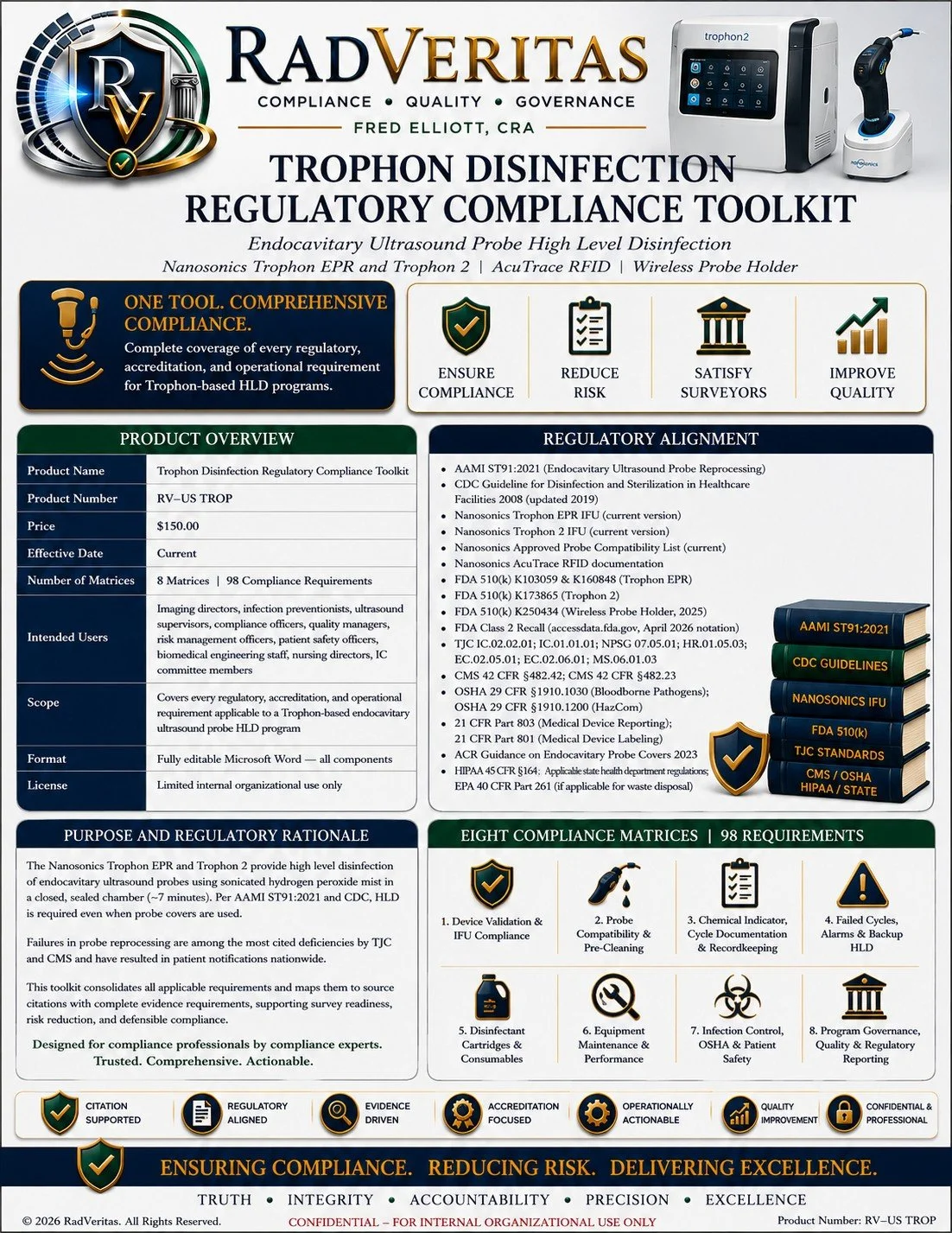
Endocavitary Ultrasound Probe High-Level Disinfection Compliance System
Eliminate One of Healthcare's Most Frequently Cited Infection Control Risks
Endocavitary ultrasound probe reprocessing failures continue to trigger Joint Commission findings, CMS deficiencies, patient notification events, infection control investigations, and significant organizational liability.
Most facilities believe they are compliant.
Many discover otherwise when surveyors arrive.
The RadVeritas Trophon Disinfection Regulatory Compliance Toolkit provides a comprehensive regulatory framework designed to help healthcare organizations build, validate, and defend a fully compliant Trophon-based high-level disinfection program. Developed specifically for Nanosonics Trophon EPR, Trophon 2, AcuTrace RFID, and Wireless Probe Holder environments, this toolkit consolidates every major regulatory, accreditation, operational, infection prevention, and documentation requirement into a single survey-ready resource.
Why This Toolkit Matters
A single missed step in probe reprocessing can create:
Immediate infection prevention concerns
Joint Commission citations
CMS deficiencies
Patient notification events
Lookback investigations
Regulatory reporting obligations
Significant legal exposure
This toolkit was designed to prevent those failures before they occur.
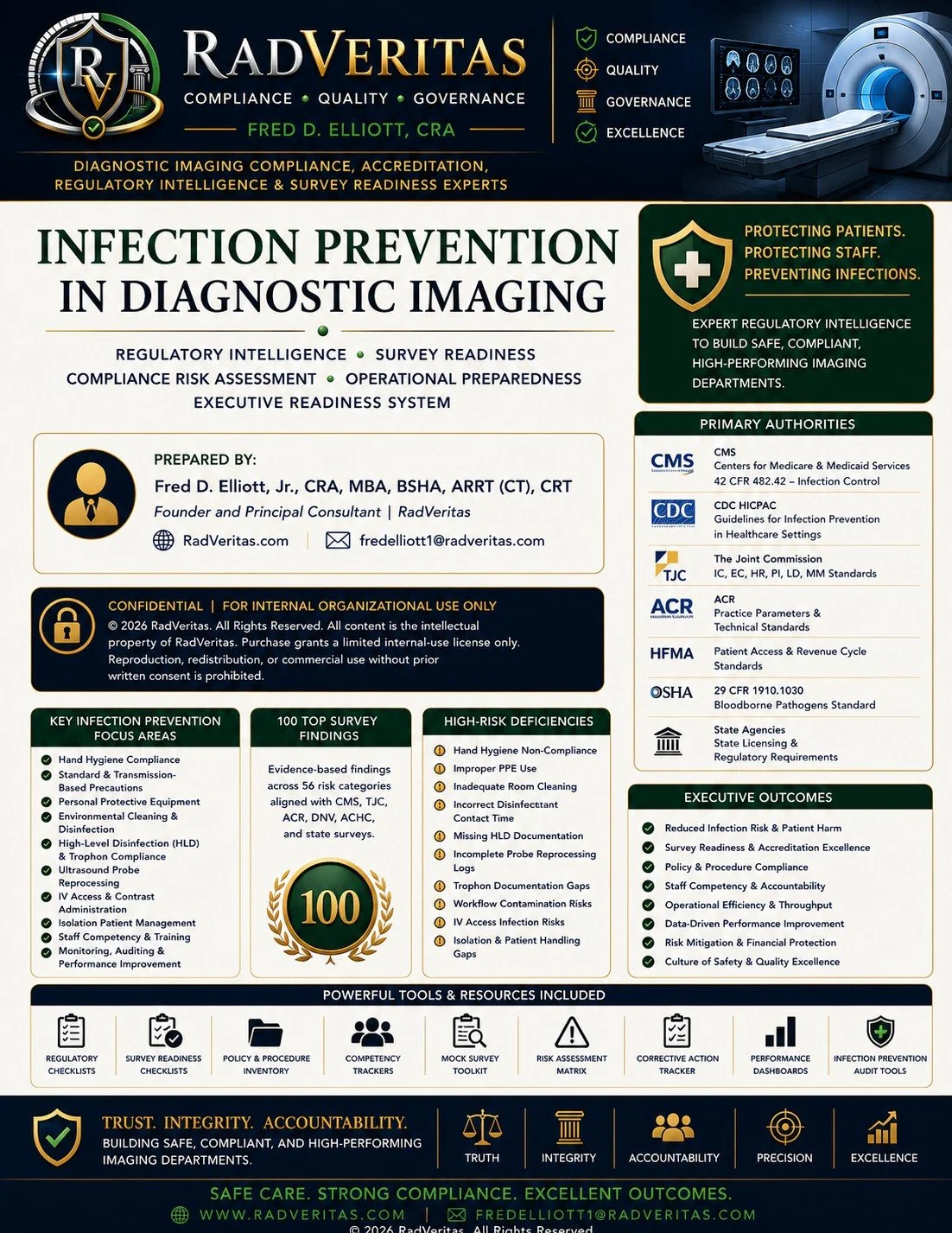
Protect Patients. Protect Staff. Prevent Infections.
The Comprehensive Infection Prevention Intelligence System for Diagnostic Imaging Leaders
Infection prevention is no longer just a clinical responsibility. It is a regulatory, accreditation, patient safety, and organizational risk imperative.
A single breakdown in hand hygiene, equipment disinfection, ultrasound probe reprocessing, Trophon compliance, environmental cleaning, PPE use, or documentation can place patients, staff, accreditation status, and organizational reputation at risk.
The RadVeritas Infection Prevention in Diagnostic Imaging Intelligence System provides healthcare leaders with the regulatory intelligence, survey readiness tools, risk assessments, and operational guidance needed to build safer, more compliant imaging departments.
Why This Resource Matters
Surveyors, regulators, and accreditation organizations increasingly scrutinize infection prevention practices across all imaging modalities.
The organizations that consistently succeed are not those that react to deficiencies. They are the organizations that identify risk before it becomes a finding.
This intelligence system helps leaders answer critical questions:
Are we truly compliant?
Could we pass an infection prevention survey today?
Where are our greatest vulnerabilities?
What should we fix first?
How do we reduce infection-related risk?
What You'll Learn
Infection Prevention Focus Areas
Hand Hygiene Compliance
Standard and Transmission-Based Precautions
Personal Protective Equipment (PPE)
Environmental Cleaning and Disinfection
High-Level Disinfection (HLD)
Trophon Compliance
Ultrasound Probe Reprocessing
IV Access and Contrast Administration
Isolation Patient Management
Staff Competency and Training
Auditing, Monitoring, and Performance Improvement
Built Around Regulatory Expectations
This resource aligns with requirements and guidance from:
CMS Infection Control Standards
CDC and HICPAC Guidelines
The Joint Commission
American College of Radiology (ACR)
OSHA Bloodborne Pathogens Standards
State Regulatory Agencies
Accreditation and Survey Readiness Requirements
Top 100 Infection Prevention Survey Findings
Gain access to the most common infection prevention deficiencies identified during healthcare surveys and inspections.
Topics include:
Hand Hygiene Failures
Improper PPE Use
Inadequate Environmental Cleaning
Disinfection Process Breakdowns
Missing HLD Documentation
Ultrasound Probe Reprocessing Deficiencies
Trophon Compliance Gaps
Workflow Contamination Risks
IV Access Infection Risks
Isolation Procedure Deficiencies
Each finding includes risk considerations, survey implications, and corrective action guidance.
The Cost of One Infection Prevention Failure
One missed disinfection step.
One improperly reprocessed probe.
One undocumented HLD cycle.
One preventable healthcare-associated infection.
The consequences can extend far beyond a survey finding.
The RadVeritas Infection Prevention in Diagnostic Imaging Intelligence System helps organizations identify vulnerabilities early, strengthen compliance, and build sustainable infection prevention programs that withstand regulatory scrutiny.
Safe Care. Strong Compliance. Excellent Outcomes.
Prepared By
Fred D. Elliott, Jr., CRA, MBA, BSHA, ARRT (CT), CRT
Founder and Principal Consultant
RadVeritas
Compliance • Quality • Governance
Protecting Patients. Protecting Staff. Preventing Infections.
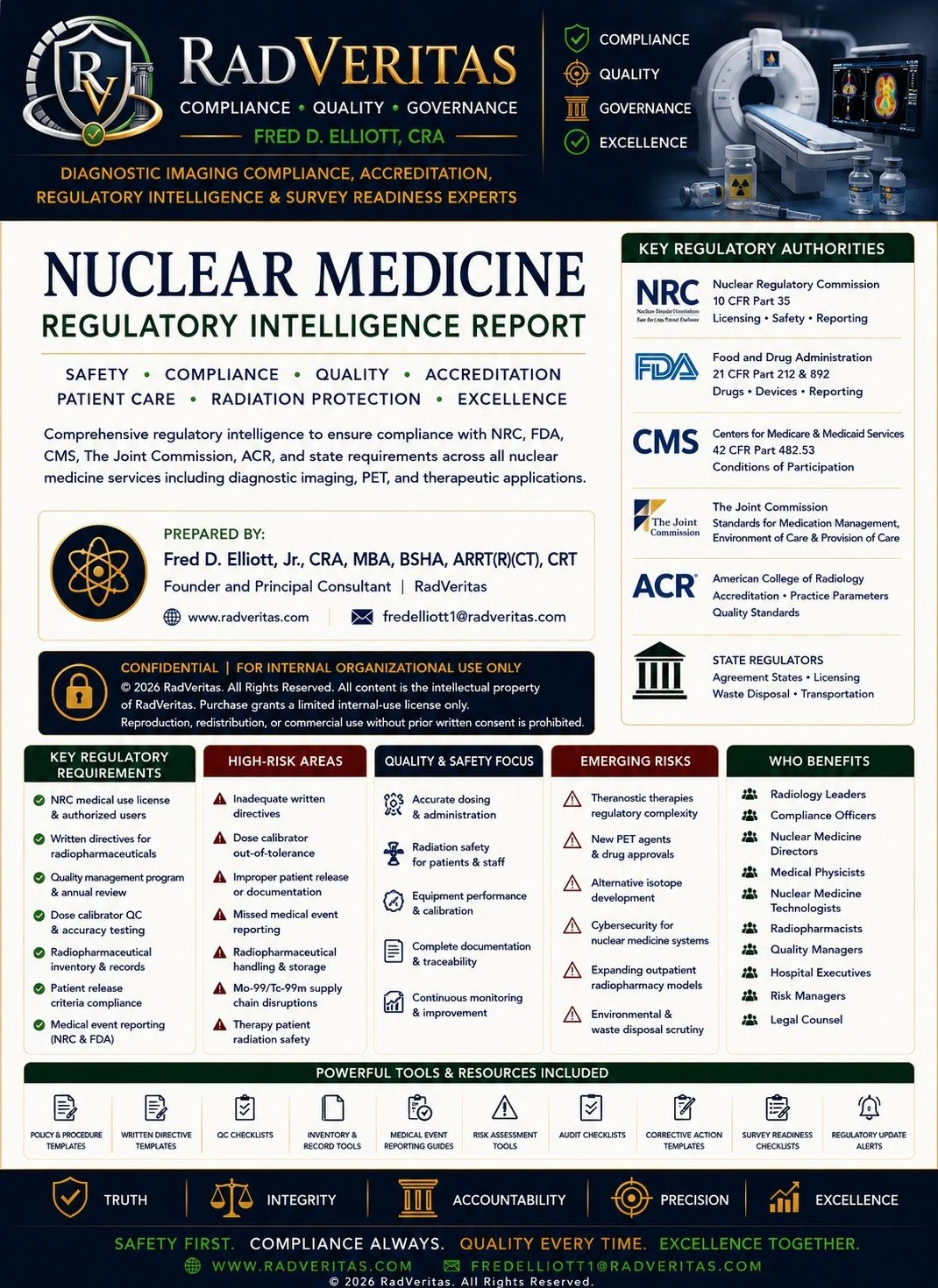
The Complete Compliance, Radiation Safety, Theranostics, and Survey Readiness System for Nuclear Medicine Leaders
One Missed Requirement Can Become a Federal Regulatory Event
Nuclear Medicine is unlike any other Diagnostic Imaging specialty.
Every procedure involves the administration of radioactive material directly to a patient. Every dose carries regulatory obligations. Every administration requires strict oversight. Every error has the potential to trigger federal reporting requirements, regulatory investigations, accreditation findings, and patient safety concerns.
The stakes are higher.
The oversight is greater.
The margin for error is smaller.
The RadVeritas Nuclear Medicine Regulatory Intelligence Report was developed to help healthcare leaders navigate one of the most highly regulated environments in modern healthcare.
Built upon current Nuclear Regulatory Commission (NRC), CMS, FDA, The Joint Commission, ACR, Department of Transportation (DOT), and state regulatory requirements, this comprehensive intelligence system provides a practical roadmap for building and sustaining a compliant, survey-ready, and high-performing Nuclear Medicine program.
Why This Report Matters
Regulatory expectations continue to evolve.
Theranostic therapies continue to expand.
New PET agents continue to enter the market.
Federal oversight continues to intensify.
Many organizations remain vulnerable because they underestimate the complexity of Nuclear Medicine compliance until a survey, inspection, medical event, or licensing review reveals critical deficiencies.
This report helps leaders identify those vulnerabilities before regulators do.
What You'll Learn
NRC Licensing and Compliance
Understand the federal requirements governing:
NRC Licenses
Agreement State Licenses
Authorized Users
Radiation Safety Programs
Radioactive Material Handling
Radioactive Waste Management
Medical Event Prevention and Reporting
Learn how to identify, investigate, document, and report medical events in accordance with NRC requirements.
Written Directive Compliance
Develop processes that ensure written directives are completed accurately and consistently before required administrations.
Radiation Safety Governance
Strengthen oversight of:
Radiation Safety Committees
Radiation Safety Officers
Personnel Monitoring Programs
Contamination Control
Area Monitoring
Patient Release Processes
Theranostic Therapy Compliance
Address emerging requirements involving:
Lutetium-177 Therapies
PSMA Therapies
PRRT Programs
Therapeutic Radiopharmaceuticals
License Amendments
Specialized Patient Management
PET and Radiopharmaceutical Oversight
Navigate FDA requirements related to:
PET Drug Production
Radiopharmaceutical Quality
cGMP Standards
Adverse Event Reporting
New PET Tracers
The Hidden Risk Most Organizations Miss
Many organizations focus on performing the procedure.
Few focus on managing the regulatory framework behind the procedure.
A missing written directive.
An expired Authorized User designation.
An unrecognized medical event.
An incomplete dose calibrator quality control record.
A missing patient release instruction.
Any one of these can result in significant regulatory consequences.
The organizations that consistently perform well during inspections are not the ones that scramble before surveys.
They are the ones that build compliance into daily operations.
Prepare for the Future of Nuclear Medicine
As theranostic therapies expand and regulatory expectations increase, healthcare leaders must ensure their Nuclear Medicine programs are prepared for both current and emerging requirements.
The RadVeritas Nuclear Medicine Regulatory Intelligence Report provides the framework needed to strengthen compliance, improve patient safety, reduce regulatory risk, and support operational excellence.
Protect Patients.
Strengthen Compliance.
Lead With Confidence.
Prepared By
Fred D. Elliott, Jr., CRA, MBA, BSHA, ARRT (CT), CRT
Founder and Principal Consultant
RadVeritas
Compliance • Quality • Governance
Turning Regulatory Complexity Into Operational Excellence.
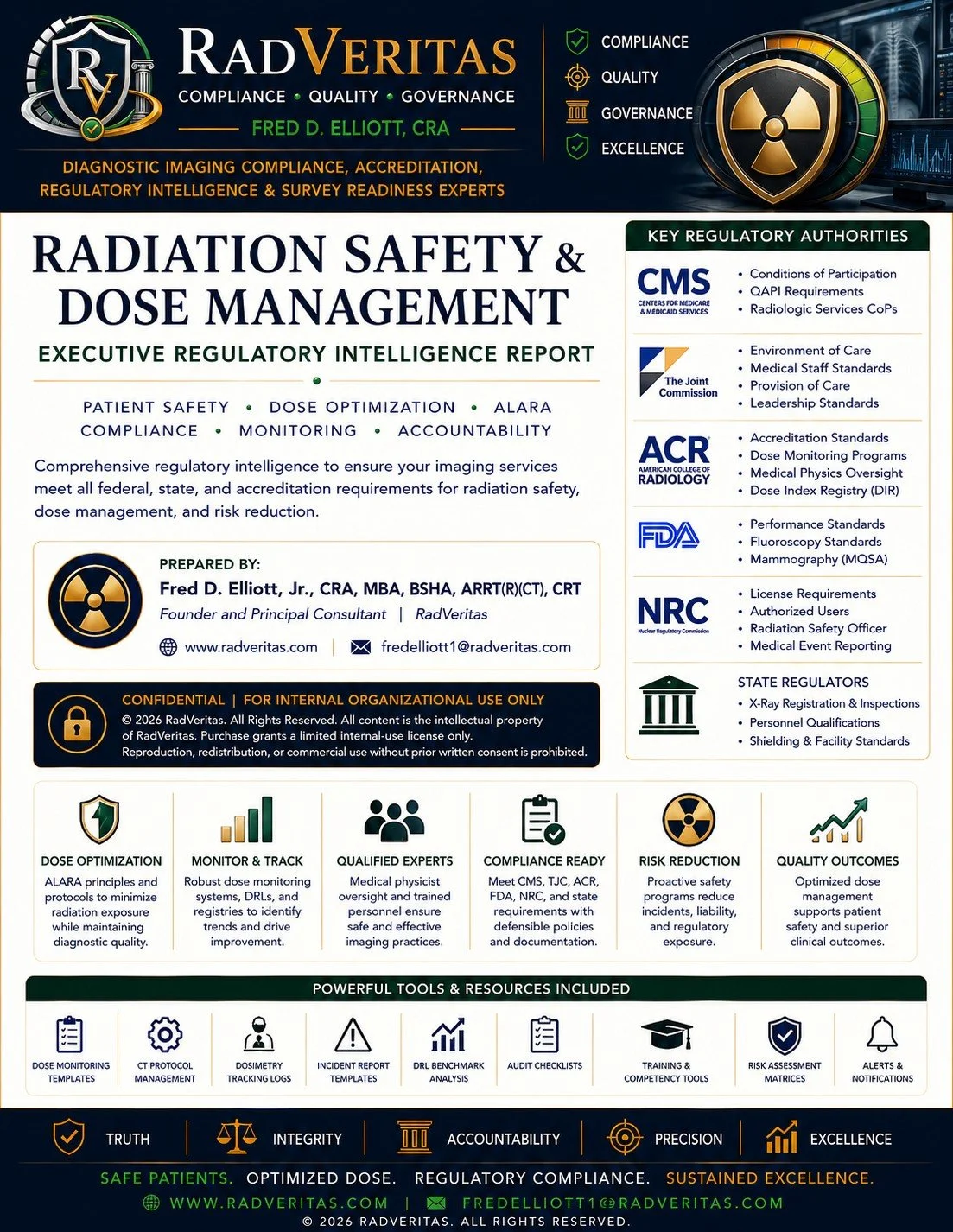
The Complete Radiation Protection, Regulatory Compliance, and Patient Safety Intelligence System for Healthcare Leaders
Every Radiation Exposure Carries Responsibility
Every CT scan.
Every fluoroscopic procedure.
Every nuclear medicine study.
Every interventional case.
Each examination exposes patients and staff to ionizing radiation and places organizations under increasing regulatory scrutiny.
The challenge is no longer simply producing quality images.
The challenge is producing those images safely, consistently, and defensibly while demonstrating compliance with evolving regulatory and accreditation expectations.
The RadVeritas Radiation Safety and Dose Management Regulatory Intelligence Report provides healthcare leaders with a comprehensive framework for reducing risk, optimizing radiation dose, strengthening compliance, and protecting patients, staff, and organizations.
Built upon current CMS Conditions of Participation, The Joint Commission standards, ACR accreditation requirements, FDA regulations, NRC requirements, OSHA expectations, and state regulatory frameworks, this report transforms complex radiation safety requirements into practical operational solutions.
Why This Report Matters
Radiation safety is no longer solely a departmental responsibility.
It is an organizational obligation.
Regulators, accreditors, attorneys, and patients increasingly expect healthcare organizations to demonstrate:
Effective dose management
Active radiation safety oversight
Continuous quality improvement
Medical physicist involvement
Personnel competency
Regulatory compliance
Leadership accountability
Organizations that fail to maintain effective radiation safety programs expose themselves to:
Regulatory citations
Accreditation findings
Financial penalties
Civil litigation
Reputational damage
Patient safety events
This report helps leaders identify vulnerabilities before regulators, surveyors, or adverse events expose them.
What You'll Learn
Radiation Safety Governance
Build a comprehensive radiation safety program that aligns with federal, state, and accreditation expectations.
Dose Optimization and ALARA
Strengthen compliance with:
ALARA Principles
Dose Optimization Programs
Diagnostic Reference Levels
CT Dose Monitoring
Fluoroscopy Dose Tracking
Pediatric Dose Reduction Strategies
Regulatory Compliance
Navigate requirements from:
CMS
The Joint Commission
ACR
FDA
NRC
OSHA
State Regulatory Agencies
Radiation Monitoring and Oversight
Develop stronger systems for:
Personnel Dosimetry
Dose Trending
Incident Reporting
Radiation Safety Committees
Medical Physicist Reviews
Performance Monitoring
Leadership Accountability
Understand executive responsibilities related to:
Governance Oversight
Resource Allocation
Survey Readiness
Compliance Monitoring
Quality Improvement
Risk Reduction
The Hidden Risk Most Organizations Miss
Many organizations focus on equipment performance.
The most successful organizations focus on governance.
The greatest radiation safety failures rarely occur because equipment malfunctioned.
They occur because:
Dose monitoring was inconsistent
Protocols were outdated
Training was incomplete
Oversight was insufficient
Documentation was lacking
Leadership visibility was limited
These vulnerabilities often remain hidden until a survey, audit, injury, or regulatory review uncovers them.
By then, the consequences can be substantial.
Protect Patients. Protect Staff. Protect the Organization.
The RadVeritas Radiation Safety and Dose Management Regulatory Intelligence Report provides healthcare leaders with the intelligence, tools, and governance strategies needed to strengthen radiation protection programs, improve compliance, reduce liability exposure, and support operational excellence.
Because radiation safety is not simply about meeting regulations.
It is about protecting every patient, every employee, and every organization entrusted with their care.
Reduce Risk.
Optimize Dose.
Lead With Confidence.
Prepared By
Fred D. Elliott, Jr., CRA, MBA, BSHA, ARRT (CT), CRT
Founder and Principal Consultant
RadVeritas
Compliance • Quality • Governance
Turning Radiation Safety Into Organizational Excellence.
Transform MQSA Compliance from a Regulatory Obligation into a Strategic Advantage
The Complete Compliance, Quality, and Performance Intelligence Platform for Mammography Programs
MQSA compliance is no longer just about passing inspections.
Today's mammography leaders must simultaneously manage regulatory requirements, quality standards, physician performance metrics, equipment oversight, personnel qualifications, audit activities, documentation integrity, patient outcomes, and accreditation readiness.
A single compliance gap can result in citations, corrective actions, operational disruption, reputational damage, and increased organizational risk.
The MQSA Mammography Compliance Intelligence System™ from RadVeritas™ was developed to help imaging organizations move beyond reactive compliance and establish a proactive, intelligence-driven approach to mammography quality, regulatory readiness, and operational excellence.
Designed specifically for mammography facilities, breast imaging centers, hospitals, health systems, and compliance leaders, this comprehensive framework centralizes critical compliance activities into a single integrated management system.
Why MQSA Compliance Requires More Than Checklists
Most organizations focus on preparing for inspections.
High-performing organizations build systems that remain inspection-ready every day.
The MQSA Mammography Compliance Intelligence System™ helps organizations create sustainable compliance by integrating:
Regulatory oversight
Quality assurance
Performance monitoring
Risk management
Accreditation readiness
Operational governance
Continuous improvement
The result is greater confidence, reduced risk, and stronger patient outcomes.
What Makes This System Different
Unlike traditional compliance manuals or static regulatory guides, this system functions as an operational intelligence framework designed to support daily decision-making, ongoing monitoring, and long-term readiness.
It provides leaders with the tools necessary to identify compliance vulnerabilities before they become findings.
Core System Objectives
Ensure Compliance
Maintain alignment with MQSA requirements, FDA expectations, accreditation standards, and organizational policies.
Monitor Performance
Track imaging quality, equipment performance, physician outcomes, technologist qualifications, audit metrics, and facility readiness.
Reduce Risk
Identify gaps early, implement corrective actions, and minimize the likelihood of citations, deficiencies, and regulatory exposure.
Drive Quality
Support accurate imaging, timely follow-up, early detection, and continuous quality improvement initiatives.
Enhance Efficiency
Centralize compliance activities, streamline documentation processes, improve accountability, and reduce administrative burden.
What's Included
MQSA Regulatory Intelligence Library
Comprehensive guidance aligned with current MQSA regulations, FDA inspection expectations, and mammography compliance requirements.
Inspection Readiness Framework
Prepare confidently for:
FDA MQSA inspections
Accreditation reviews
State inspections
Internal audits
Executive compliance reviews
Built for Leaders Who Want More Than Compliance
Passing an inspection is important.
Building a mammography program that consistently demonstrates quality, accountability, operational excellence, and regulatory confidence is even more important.
The MQSA Mammography Compliance Intelligence System™ provides the structure, intelligence, monitoring tools, and leadership framework necessary to achieve both.
Inspection Ready. Quality Focused. Intelligence Driven.
Reduce risk. Strengthen compliance. Improve performance.
MQSA Mammography Compliance Intelligence System™
The complete framework for mammography compliance, quality assurance, regulatory readiness, and operational excellence.
RadVeritas™
Compliance • Quality • Governance
Expert Insights. Practical Solutions. Real-World Impact.
Helping Mammography Leaders Strengthen Compliance, Improve Quality, Reduce Risk, and Achieve Sustainable MQSA Excellence.
The Definitive Enterprise Governance Framework for Point-of-Care Ultrasound
Transform Point-of-Care Ultrasound from a Clinical Tool into a Governed, Defensible, Enterprise-Wide Program.
Point-of-Care Ultrasound (POCUS) continues to expand rapidly across healthcare organizations.
From emergency departments and critical care units to cardiology, hospital medicine, ambulatory care, procedural services, and specialty practices, POCUS is reshaping clinical decision-making and patient care.
Yet many organizations struggle with a critical challenge:
Who governs the program?
Without standardized oversight, organizations face increasing risks related to credentialing, competency validation, image retention, regulatory compliance, documentation integrity, quality assurance, patient safety, reimbursement, and enterprise imaging integration.
The POCUS Governance, Regulatory Compliance, Quality, Safety, Credentialing, Enterprise Imaging, and Operations Reference Manual™ provides healthcare leaders with a comprehensive enterprise governance framework designed to establish consistency, accountability, compliance, and operational excellence across the entire POCUS ecosystem.
Why POCUS Governance Matters
The success of a POCUS program depends on far more than ultrasound equipment and clinical expertise.
Sustainable programs require:
Enterprise governance structures
Credentialing and privileging standards
Competency validation programs
Quality assurance oversight
Regulatory compliance monitoring
Documentation standards
Enterprise imaging integration
Image retention policies
Performance measurement systems
Leadership accountability
Without these foundational elements, organizations expose themselves to regulatory findings, accreditation deficiencies, liability concerns, inconsistent clinical practices, and patient safety risks.
The most successful healthcare organizations treat POCUS as an enterprise program, not a departmental initiative.
What Makes This Manual Different
Unlike traditional POCUS resources focused primarily on scanning techniques or clinical applications, this manual focuses on the governance systems that support long-term program success.
The framework integrates six critical pillars of enterprise POCUS oversight.
Enterprise Governance
Establish centralized leadership, accountability structures, multidisciplinary oversight committees, and system-wide governance standards.
Regulatory Compliance
Align POCUS programs with CMS, Joint Commission, FDA, HIPAA, OSHA, CDC, state regulatory requirements, and organizational policies.
Credentialing Excellence
Develop defensible credentialing, privileging, competency validation, and recredentialing programs across specialties and practice settings.
Quality and Safety Accountability
Implement performance monitoring, peer review, quality assurance, risk management, and patient safety oversight processes.
Enterprise Imaging Integration
Support image capture, storage, retention, retrieval, PACS integration, VNA integration, audit trails, and documentation integrity.
Patient-Centered Care
Promote evidence-based imaging practices that improve diagnostic accuracy, support clinical decision-making, and enhance patient outcomes.
Comprehensive Areas of Coverage
POCUS Governance Structure
Governance committees
Leadership responsibilities
Program oversight models
Policy development
Enterprise accountability frameworks
Credentialing and Privileging
Initial privileging standards
Competency validation
Recredentialing requirements
Specialty-specific oversight
Scope-of-practice management
Regulatory and Accreditation Compliance
CMS requirements
Joint Commission standards
HIPAA compliance
FDA considerations
State regulatory requirements
Quality Assurance Programs
Image review processes
Peer review systems
Quality indicators
Corrective action planning
Continuous performance improvement
Enterprise Imaging Management
PACS integration
VNA integration
Image retention requirements
Documentation standards
Audit trail management
Risk Management and Patient Safety
Clinical governance
Error reduction strategies
Documentation integrity
Patient identification safeguards
Safety monitoring programs
Clinical Specialties Supported
The manual supports enterprise-wide POCUS implementation across multiple clinical environments, including:
Critical Care
Bedside assessments, procedural guidance, and hemodynamic evaluation.
Emergency Medicine
Rapid diagnostic support, triage decision-making, and emergency interventions.
Cardiology
Cardiac function assessment, structural evaluation, and cardiovascular imaging applications.
Hospital Medicine
Point-of-care diagnostics supporting inpatient care and clinical management.
Ambulatory Care
Outpatient imaging support and specialty practice applications.
Procedural Services
Ultrasound-guided interventions and procedural safety programs.
Organizational Benefits
Establish Enterprise Oversight
Create a unified governance model across departments, facilities, and specialties.
Strengthen Regulatory Compliance
Maintain alignment with regulatory, accreditation, privacy, and documentation requirements.
Improve Credentialing Defensibility
Standardize competency validation and privileging processes across the organization.
Enhance Quality and Safety
Develop measurable quality assurance programs that support patient safety and clinical excellence.
Optimize Enterprise Imaging Integration
Ensure images are captured, stored, retained, and managed according to best practices and regulatory expectations.
Reduce Organizational Risk
Identify vulnerabilities before they become survey findings, liability events, or patient safety concerns.
Support Clinical Excellence
Promote consistent, evidence-based imaging practices that improve diagnostic confidence and patient outcomes.
Built for Real-World Healthcare Operations
Whether establishing a new POCUS program, expanding enterprise-wide adoption, preparing for accreditation reviews, or strengthening governance infrastructure, this manual provides the strategic framework necessary to guide sustainable success.
Every chapter is designed to help organizations build defensible, compliant, scalable, and high-performing POCUS programs that support both operational objectives and exceptional patient care.
Governance Creates Sustainability
Technology enables POCUS.
Governance sustains POCUS.
The POCUS Governance, Regulatory Compliance, Quality, Safety, Credentialing, Enterprise Imaging, and Operations Reference Manual™ provides the roadmap healthcare leaders need to transform fragmented ultrasound practices into coordinated, accountable, enterprise-wide programs.
Build Stronger Programs. Reduce Risk. Improve Patient Care.
Strengthen governance. Validate competency. Improve compliance. Enhance quality.
RadVeritas™
Compliance • Quality • Governance
Expert Insights. Practical Solutions. Real-World Impact.
Helping Healthcare Organizations Establish Enterprise POCUS Governance, Strengthen Credentialing and Compliance Programs, Integrate Enterprise Imaging, and Deliver Safer, Higher-Quality Patient Care Across the Continuum.

The Complete Expectant Parent Guide to Your Mid-Pregnancy Anatomy Scan
Confidence Begins with Understanding.
Your baby's anatomy ultrasound is one of the most important milestones of pregnancy. It is often the first opportunity to see your baby's growth in remarkable detail while providing your healthcare team with critical information about fetal development, the placenta, amniotic fluid, and your pregnancy's overall progress.
Understanding Your Baby's Anatomy Ultrasound™ is a comprehensive patient education guide designed to help expectant parents understand exactly what happens during the anatomy scan, why it matters, what sonographers are evaluating, and how the results contribute to a healthy pregnancy.
Whether this is your first pregnancy or your fifth, this guide transforms medical terminology into clear, reassuring, and evidence-based information you can trust.
Why Every Expectant Parent Should Read This Guide
For many families, the anatomy ultrasound is both exciting and emotional. It is also one of the most comprehensive diagnostic imaging examinations performed during pregnancy.
Many parents arrive with questions such as:
What is an anatomy ultrasound?
Why is it performed around 20 weeks?
What body parts are being examined?
Can everything be seen during one appointment?
Why might I need to return for additional images?
What do the measurements mean?
Will I learn my baby's sex?
What happens if something unexpected is found?
This guide provides straightforward answers to these questions and many more, helping reduce uncertainty while preparing you for your appointment.
What You'll Learn
Understanding the Anatomy Scan
Discover the purpose of the mid-pregnancy ultrasound and how it supports your prenatal care by evaluating your baby's growth and development.
What the Sonographer Examines
Learn how healthcare professionals carefully evaluate major organs and body systems, including the:
Brain
Face
Spine
Heart
Abdomen
Kidneys
Bladder
Arms and hands
Legs and feet
Placenta
Umbilical cord
Amniotic fluid
Preparing for Your Appointment
Know what to expect before, during, and after your examination, including preparation instructions, appointment timing, and practical tips for a smooth visit.
Understanding Your Results
Gain insight into how ultrasound findings are interpreted, why some images may need to be repeated, and what follow-up recommendations may mean.
Frequently Asked Questions
Receive clear, patient-friendly answers to common concerns about fetal movement, image quality, scan duration, fetal position, repeat examinations, and more.
Designed for Expectant Parents
This guide was written specifically for:
First-time parents
Growing families
Expectant mothers
Partners and support persons
Grandparents
Family caregivers
Childbirth educators
Prenatal care practices
Women's imaging centers
Obstetric and maternal-fetal medicine clinics
No medical background is required.
Why Families Trust This Guide
Unlike brief appointment handouts or internet searches that often provide incomplete or conflicting information, this publication presents a complete educational experience in one easy-to-understand resource.
Every chapter is designed to help you:
✔ Understand the purpose of your anatomy ultrasound
✔ Know what to expect before your appointment
✔ Learn why certain images are important
✔ Better understand your healthcare team's recommendations
✔ Reduce anxiety through clear, factual explanations
✔ Feel more prepared and confident throughout your pregnancy
Key Features
Trusted Information
Evidence-based educational content presented in clear, patient-friendly language.
Comprehensive Coverage
A complete guide that follows your anatomy ultrasound journey from preparation through results.
Empowering Education
Understand your baby's development and participate more confidently in your prenatal care.
Supportive Guidance
Compassionate explanations that help reduce uncertainty and answer common questions.
Relevant and Practical
Focused on the real questions expectant parents ask before, during, and after their anatomy ultrasound.
Perfect For
Obstetric practices
Maternal-fetal medicine clinics
Diagnostic imaging centers
Women's health centers
Hospital patient education programs
Childbirth education classes
Community health organizations
Expectant parents seeking trusted information
Give Yourself the Confidence of Understanding
Knowledge can make one of pregnancy's most memorable milestones even more meaningful.
Understanding Your Baby's Anatomy Ultrasound™ provides the clarity, reassurance, and practical information every expectant parent deserves before, during, and after this important examination.
Because informed parents ask better questions, feel more confident, and become stronger partners in their prenatal care.
See More. Understand More. Feel More Confident.
Prepare for your anatomy ultrasound with trusted guidance from RadVeritas™, where diagnostic imaging expertise meets patient-centered education.
RadVeritas™
Diagnostic Imaging Compliance, Accreditation, and Patient Education
Helping Patients Understand Diagnostic Imaging With Confidence, Clarity, and Trust.
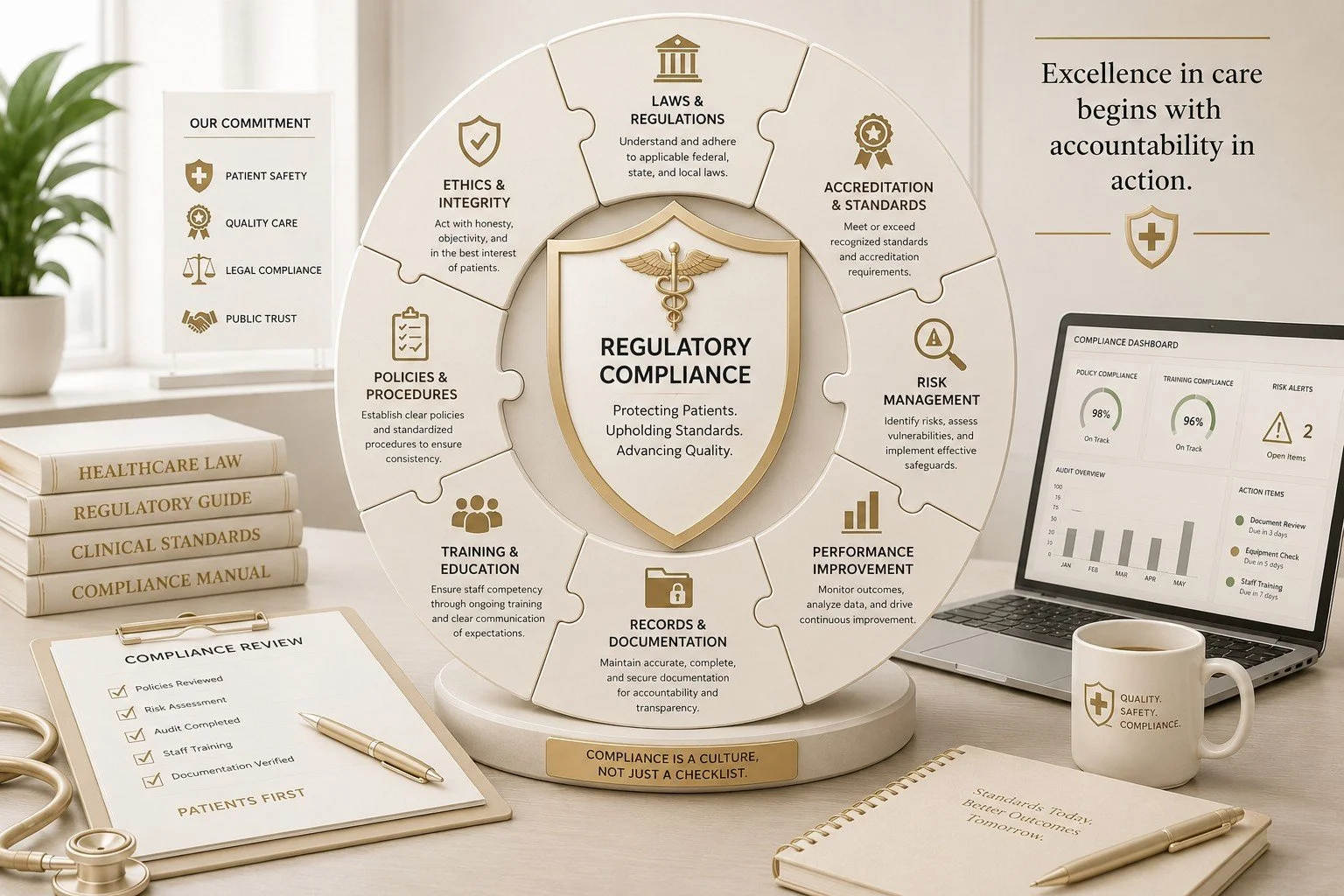
RadVeratis - Operational Performance and Analytics
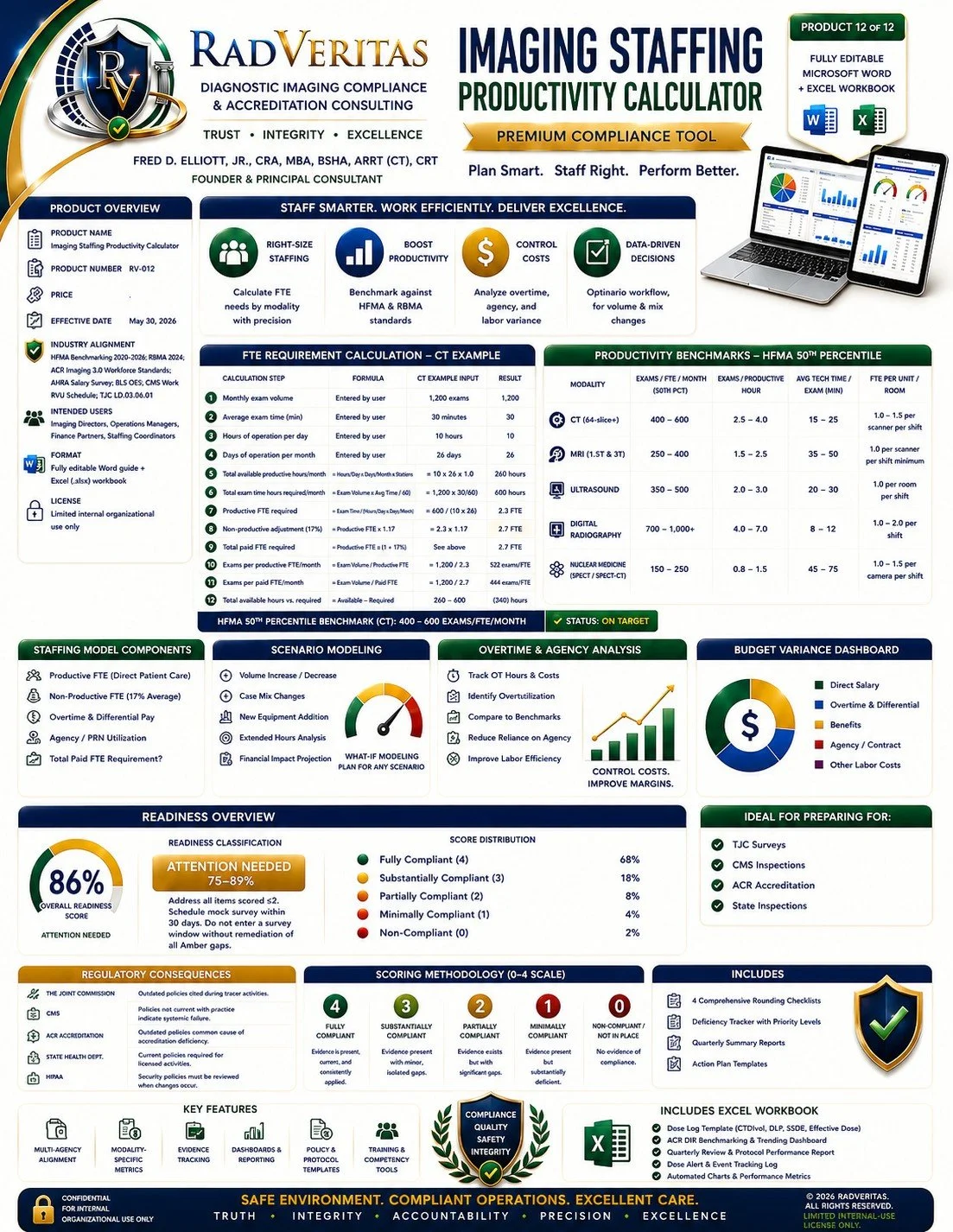
Summary
A workforce planning, productivity benchmarking, labor management, and financial justification system designed specifically for Diagnostic Imaging operations. The product includes formula-driven staffing calculations, productivity benchmarks, overtime analysis tools, workforce scenario modeling, budget variance analysis, and executive-level financial justification templates. It helps leaders determine the appropriate staffing levels needed to support operational demand while controlling labor costs and improving productivity.
Primary Value
Staffing optimization
Productivity benchmarking
Overtime reduction
Workforce planning
Budget development
Executive staffing justification
Ideal Users
Imaging Directors
Finance Partners
Operations Managers
Service Line Leaders
Staffing Coordinators
Department Administrators
Problem Solved
Many imaging departments rely on historical staffing models rather than data-driven workforce planning. This calculator provides objective staffing requirements based on exam volume, productivity expectations, operational hours, modality benchmarks, overtime utilization, and labor costs, allowing leaders to make defensible staffing decisions.
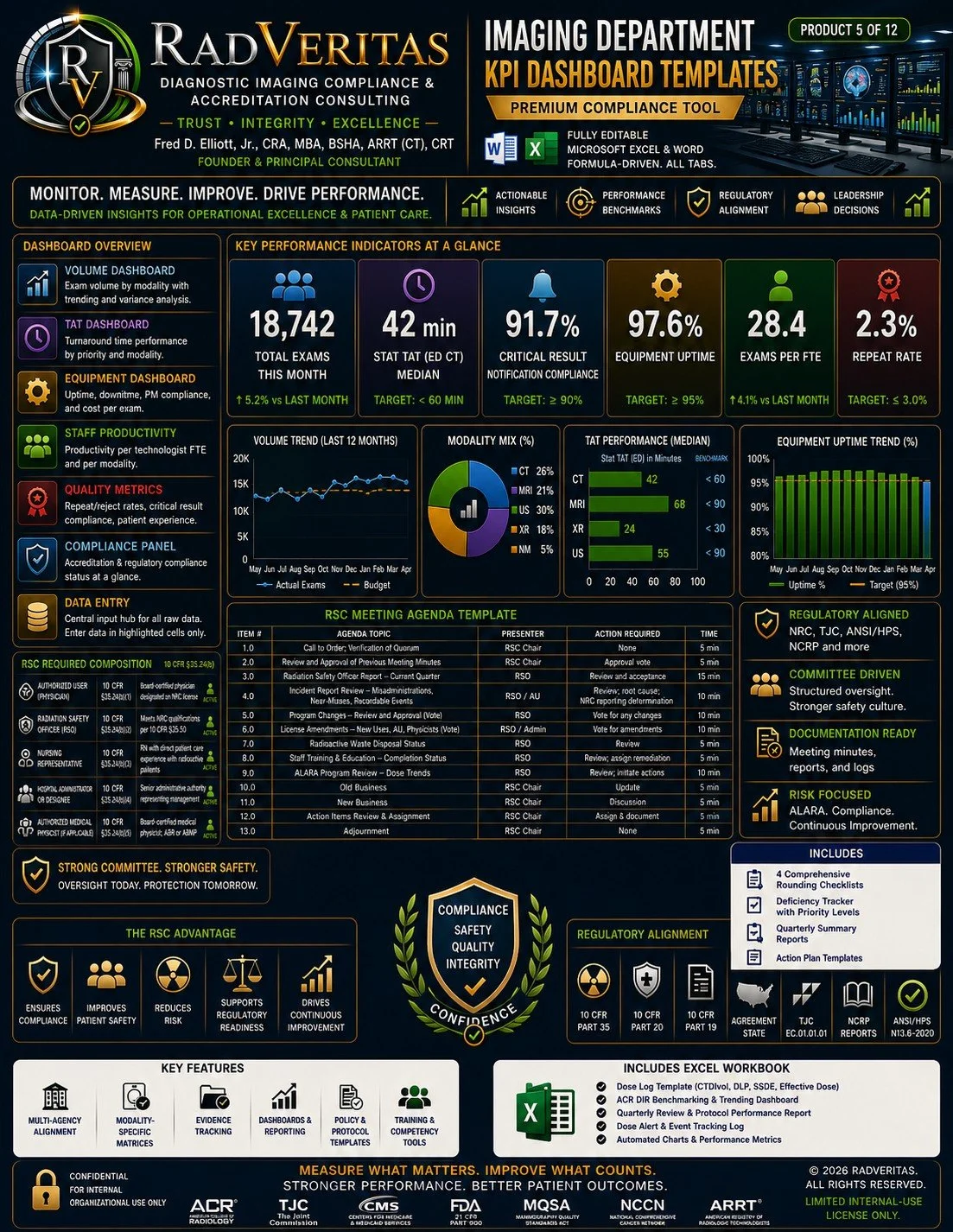
Summary
A formula-driven performance management system providing executive dashboards and benchmarking tools for imaging operations. Includes volume, turnaround time, equipment utilization, productivity, quality, compliance, and financial performance indicators. Provides industry benchmarks, reporting templates, and executive performance scorecards to support operational decision-making and leadership reporting.
Primary Value
Executive reporting
Performance benchmarking
Productivity management
Quality monitoring
Operational analytics
RadVeratis - Leadership Development and Governance
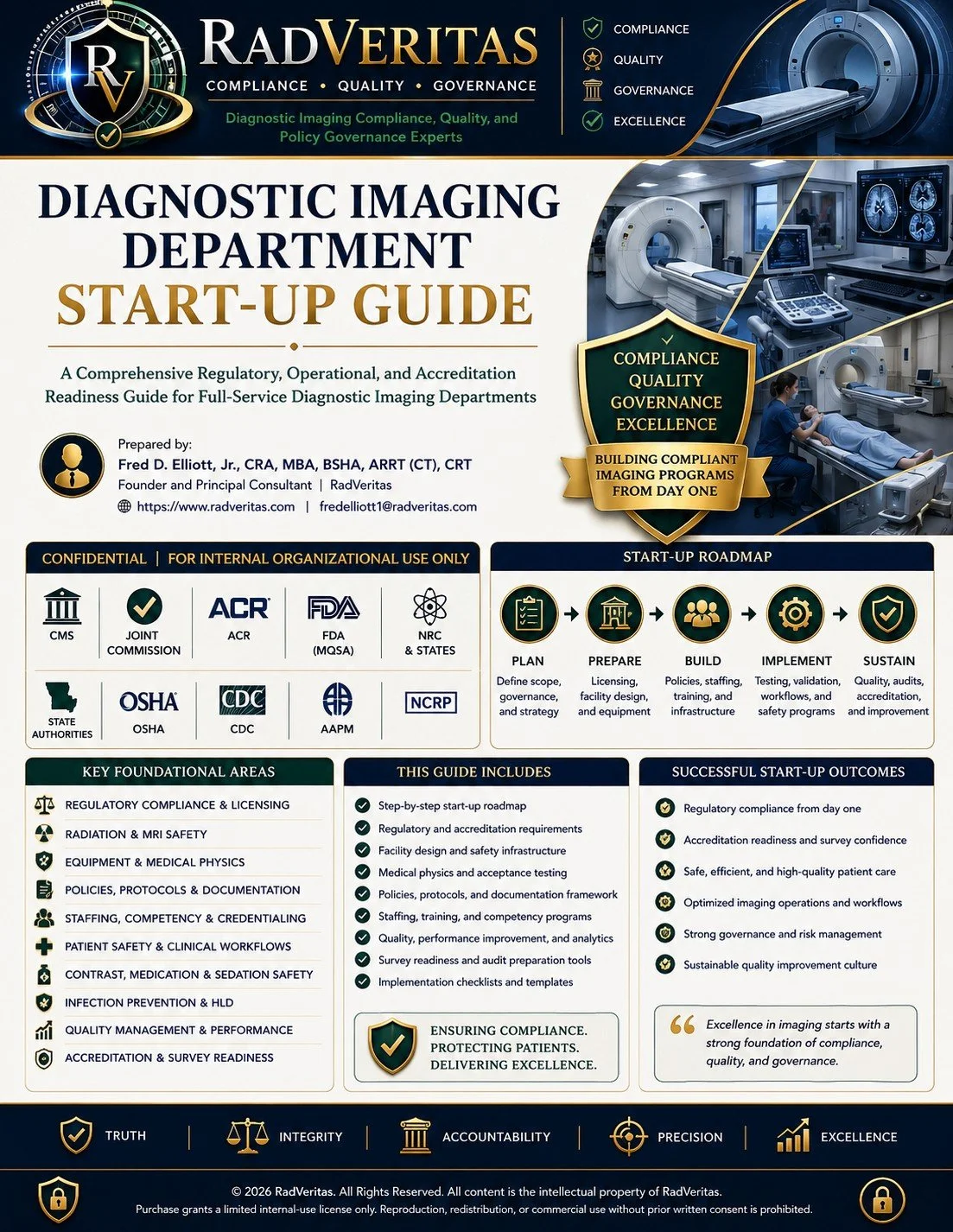
The Complete Blueprint for Building a Compliant, Accredited, and High-Performing Diagnostic Imaging Department From the Ground Up
If You Had to Build an Imaging Department Tomorrow, Would You Know Every Step Required to Open Safely, Legally, and Successfully?
Launching a Diagnostic Imaging department is one of the most complex projects in healthcare.
Before the first patient is scheduled, organizations must navigate regulatory requirements, accreditation standards, facility design, radiation safety programs, medical physics testing, equipment procurement, staffing plans, competency validation, infection prevention protocols, quality management systems, operational workflows, and governance structures.
Missing even one critical requirement can delay opening, increase costs, create compliance vulnerabilities, jeopardize accreditation eligibility, and expose patients and staff to unnecessary risk.
The RadVeritas Diagnostic Imaging Department Start-Up Guide was developed to eliminate uncertainty and provide healthcare leaders with a step-by-step roadmap for planning, building, implementing, and sustaining a fully operational, survey-ready Diagnostic Imaging program.
This comprehensive guide transforms a highly complex process into a structured, practical, and executable framework designed specifically for hospitals, outpatient imaging centers, Independent Diagnostic Testing Facilities (IDTFs), health systems, and imaging entrepreneurs.
Best For:
Hospitals | Imaging Centers | IDTFs | Health Systems | Consultants | Healthcare Entrepreneurs
Prepared By:
Fred D. Elliott, Jr., CRA, MBA, BSHA, ARRT (CT), CRT
Founder and Principal Consultant
RadVeritas
Compliance • Quality • Governance
Building Compliant Imaging Programs From Day One.
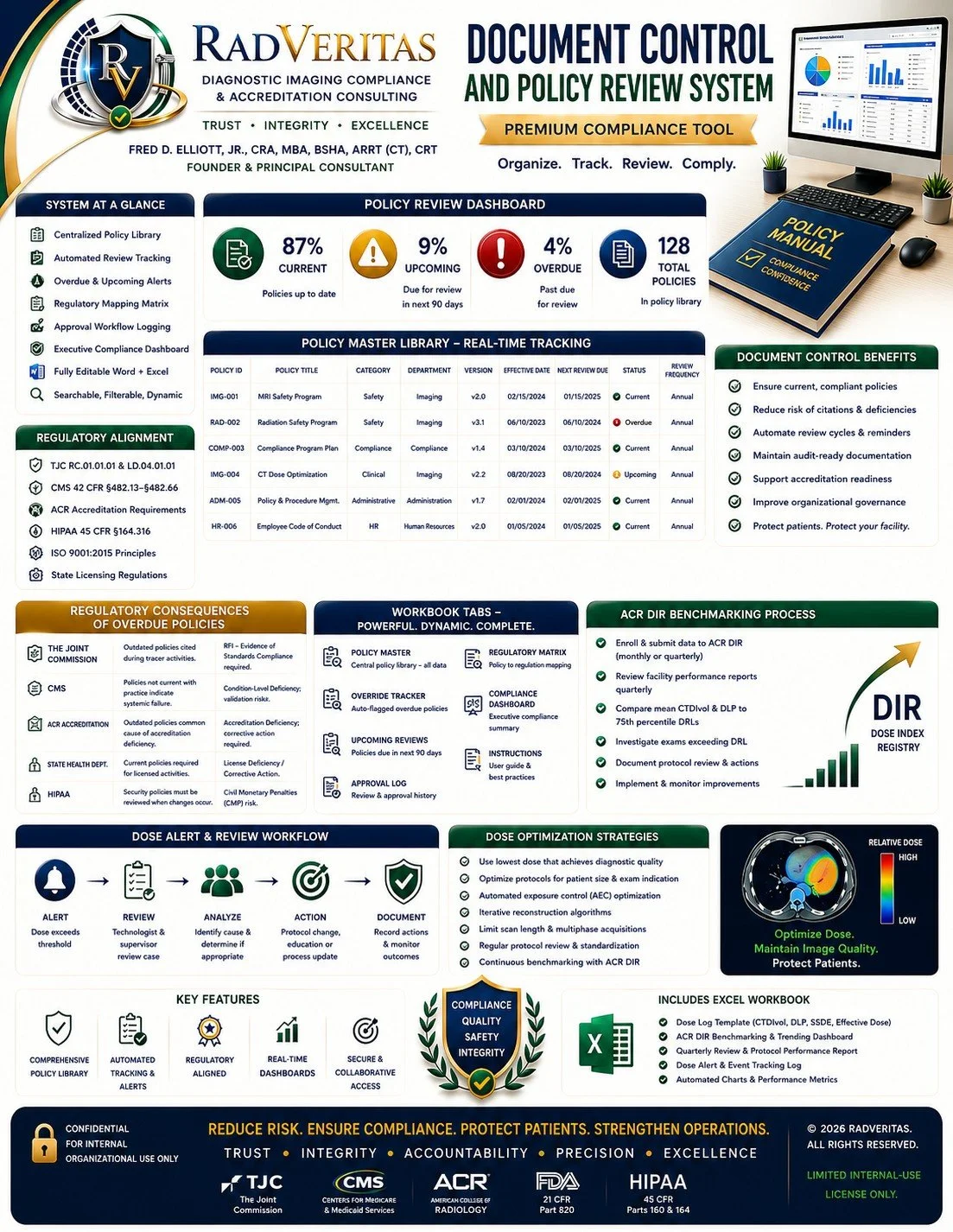
Summary
A dynamic policy governance and document control system designed to manage policy inventories, review cycles, regulatory alignment, approval tracking, and accreditation readiness. Includes policy master libraries, overdue policy tracking, regulatory matrices, executive dashboards, and structured review workflows. Supports continuous policy compliance and survey readiness.
Primary Value
Policy governance
Document control
Survey readiness
Regulatory alignment
Compliance oversight
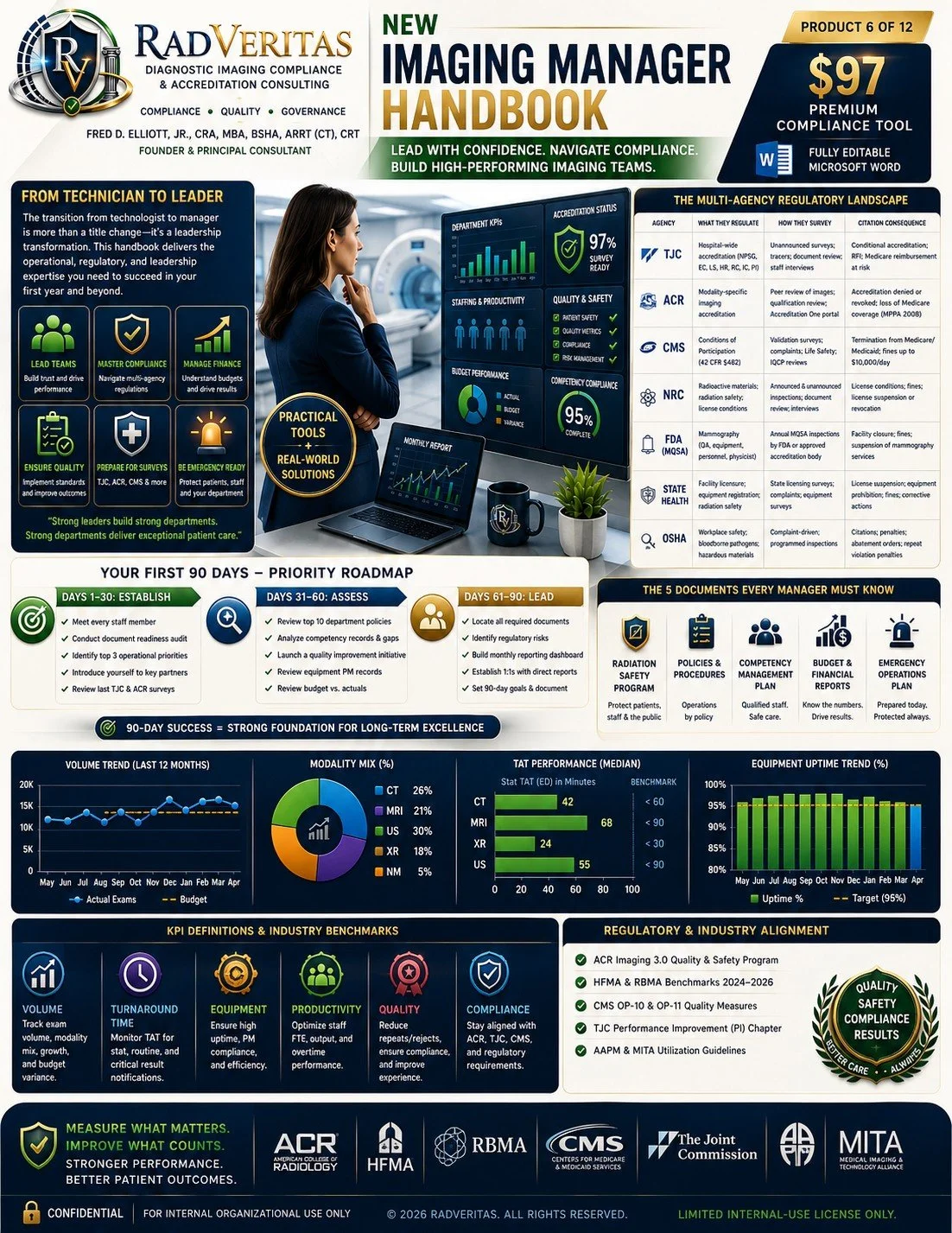
The Leadership Guide Every New Imaging Manager Wishes They Had on Day One
Technical expertise may earn a promotion.
Leadership expertise determines long-term success.
Most new imaging managers are promoted because they are exceptional technologists. Yet few receive formal training in leadership, regulatory compliance, staffing, budgeting, accreditation, human resources, survey readiness, or operational management.
The result is predictable.
New managers often find themselves responsible for millions of dollars in equipment, regulatory compliance, patient safety, staffing decisions, accreditation readiness, and departmental performance with little practical guidance on how to succeed.
The RadVeritas New Imaging Manager Handbook was created to change that.
Built specifically for Diagnostic Imaging leaders, this comprehensive handbook provides a structured roadmap for navigating the critical first year of management with confidence, clarity, and competence.
FROM TECHNICAL EXPERT TO EFFECTIVE LEADER
Whether you have recently been promoted into management or are preparing for a future leadership role, this handbook provides the practical knowledge needed to successfully lead imaging operations in today's highly regulated healthcare environment.
WHY THIS HANDBOOK IS DIFFERENT
Most leadership development occurs through trial and error.
This handbook provides the operational, regulatory, and leadership knowledge that experienced imaging executives have spent years learning in the field.
Developed from decades of Diagnostic Imaging leadership experience, it serves as a practical reference guide for navigating the challenges that every imaging manager will eventually face.
YOUR FIRST YEAR AS A MANAGER MATTERS
The habits, systems, and leadership practices established during your first year often determine your long-term success.
This handbook helps new leaders avoid common mistakes, accelerate their development, strengthen regulatory awareness, and build the confidence required to lead high-performing imaging departments.
LEAD WITH CONFIDENCE.
MANAGE WITH PURPOSE.
SUCCEED WITH CLARITY.
Prepared by
Fred D. Elliott, Jr., CRA, MBA, BSHA, ARRT (CT), CRT
Founder and Principal Consultant
RadVeritas
Compliance Today. Excellence Every Day.

Twenty Proprietary Frameworks. One Mission. Transforming Diagnostic Imaging Compliance Into Measurable Performance.
Most healthcare organizations rely on regulations to tell them what is required.
High-performing organizations rely on intelligence to determine what comes next.
The RadVeritas™ Intellectual Property Portfolio is a collection of twenty proprietary compliance intelligence frameworks developed exclusively for Diagnostic Imaging leaders seeking a strategic advantage in regulatory compliance, accreditation readiness, operational performance, governance, and risk reduction.
Built from decades of real-world healthcare leadership experience, these frameworks move beyond traditional compliance models by identifying hidden vulnerabilities, measuring organizational readiness, forecasting regulatory risk, and creating actionable pathways to operational excellence.
What Makes RadVeritas Different?
The healthcare industry has no shortage of regulations, standards, audits, and survey requirements.
What organizations often lack is a structured methodology for transforming those requirements into measurable, sustainable performance.
The RadVeritas Intellectual Property Portfolio was developed to bridge that gap.
Each framework is designed to help leaders answer critical questions:
Where are our greatest compliance vulnerabilities?
What risks are accumulating beneath the surface?
Are we truly prepared for regulatory scrutiny?
What should we prioritize first?
How do we measure compliance maturity?
What indicators predict future survey findings?
How do we create lasting accountability?
These proprietary systems provide the intelligence needed to move from reactive compliance to proactive leadership.
The 20 Proprietary RadVeritas™ Frameworks
The portfolio includes twenty exclusive methodologies designed specifically for Diagnostic Imaging environments:
Regulatory Liability Accumulation Framework™
Operational Compliance Alignment Index™
Compliance Culture Risk Atlas™
Accreditation Risk Prediction System™
Compliance Intelligence Command Center™
AI Governance Preparedness Index™
Imaging Governance Excellence Matrix™
Compliance Continuity Architecture™
Hidden Compliance Vulnerability Analysis™
Regulatory Intelligence Radar™
Compliance Liability Exposure Model™
Hidden Risk Intelligence Framework™
Compliance Early Warning System™
Regulatory Exposure Quotient™
Compliance Climate Index™
Readiness Sustainability Index™
Organizational Alignment Framework™
Imaging Compliance Maturity Model™
Integrated Compliance Ecosystem™
Executive Compliance Scorecard™
Designed to Deliver Measurable Results
These frameworks are engineered to help organizations:
Reduce Risk Exposure
Identify, quantify, prioritize, and mitigate compliance vulnerabilities before they become survey findings, citations, or patient safety concerns.
Improve Regulatory Readiness
Strengthen preparedness for CMS, Joint Commission, ACR, DNV, ACHC, state inspections, and internal compliance audits.
Enhance Operational Performance
Align regulatory requirements with daily operations to improve consistency, accountability, efficiency, and quality.
Strengthen Governance
Provide leadership teams with objective metrics, dashboards, and oversight tools that support informed decision-making.
Improve Accreditation Outcomes
Build sustainable systems that support continuous readiness rather than temporary survey preparation.
Built on Four Strategic Pillars
Compliance Intelligence
Transform regulations into actionable leadership insights.
Risk Reduction
Identify vulnerabilities before they become organizational liabilities.
Governance Excellence
Create accountability structures that support sustainable compliance.
Performance Optimization
Connect compliance efforts to measurable operational outcomes.
Who Should Use These Frameworks?
The RadVeritas Intellectual Property Portfolio is designed for:
Diagnostic Imaging Directors
Radiology Administrators
Compliance Officers
Accreditation Leaders
Patient Safety Officers
Quality Professionals
Imaging Service Line Executives
Healthcare Consultants
Hospital Leadership Teams
Governance Committees
A Competitive Advantage You Cannot Find Anywhere Else
These methodologies were developed exclusively by RadVeritas and are not available through accreditation organizations, consulting firms, regulatory agencies, or industry associations.
They represent a unique body of intellectual property created to help healthcare leaders understand not only where they stand today, but where future compliance, accreditation, operational, and governance risks are likely to emerge.
This is more than a collection of frameworks.
It is a comprehensive compliance intelligence system designed to help organizations see what others miss, prepare for what others overlook, and achieve results that withstand regulatory scrutiny.
Lead With Intelligence. Govern With Confidence. Perform With Excellence.
The RadVeritas™ Intellectual Property Portfolio provides healthcare leaders with proprietary tools, measurable methodologies, and executive-level intelligence designed to strengthen compliance, reduce risk, improve performance, and build high-reliability Diagnostic Imaging organizations.
Twenty Proprietary Frameworks.
Unlimited Strategic Possibilities.
Exclusive to RadVeritas™.
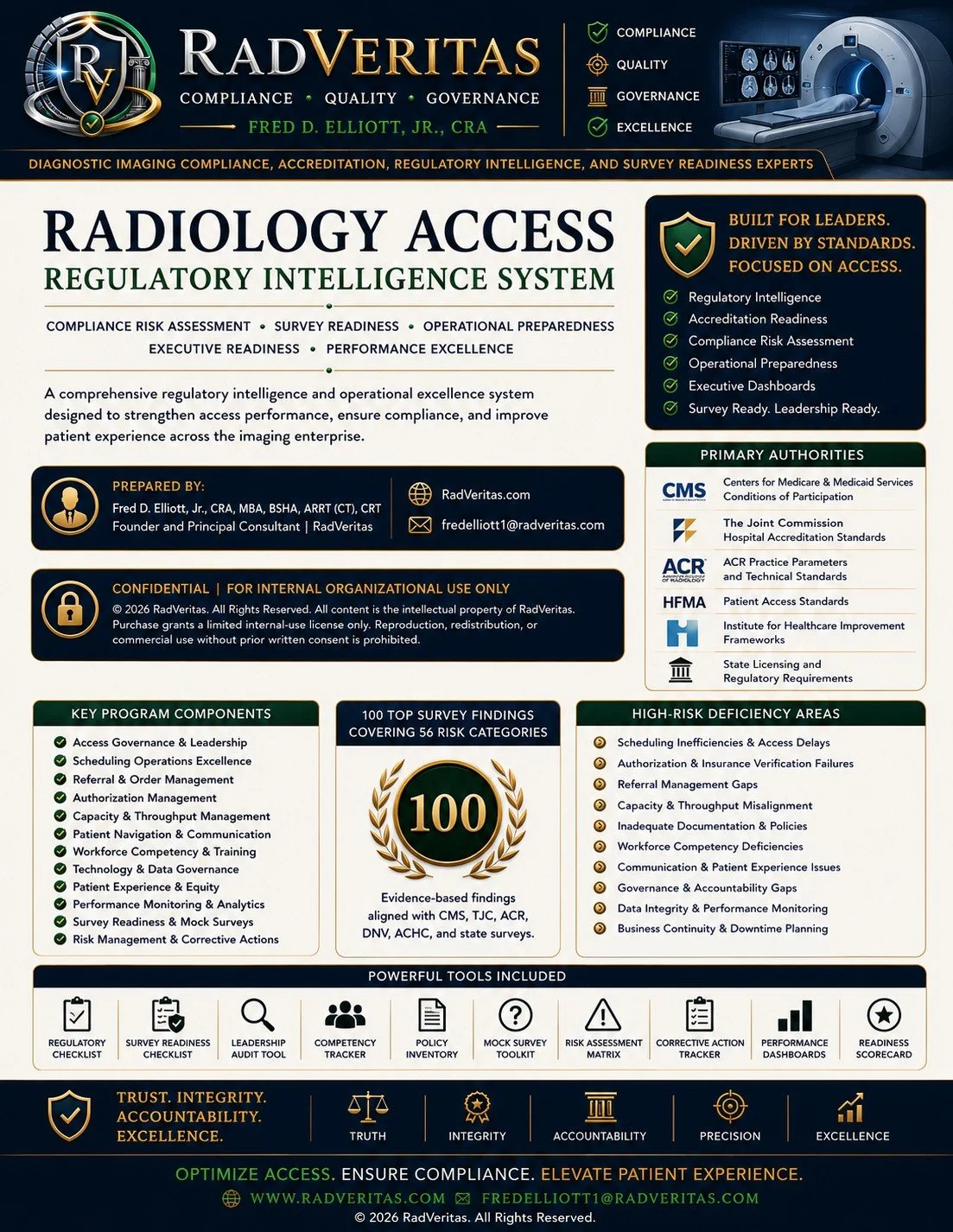
Optimize Access. Ensure Compliance. Elevate the Patient Experience.
The Complete Compliance and Operational Excellence Solution for Diagnostic Imaging Access Programs
Access is the front door to every imaging service.
When scheduling delays, authorization barriers, referral management failures, communication breakdowns, or capacity constraints occur, patient care suffers, operational performance declines, and compliance risks increase.
The RadVeritas Radiology Access Regulatory Intelligence System provides imaging leaders with the intelligence, tools, and operational strategies needed to strengthen access performance, improve patient experience, enhance compliance, and build a survey-ready access program.
Why This Resource Matters
Radiology Access teams face increasing pressure to:
Improve patient access
Reduce scheduling delays
Manage authorization requirements
Optimize throughput
Improve patient satisfaction
Maintain regulatory compliance
Support accreditation readiness
A single breakdown in access operations can create downstream effects across the entire imaging enterprise.
The organizations that succeed are those that proactively identify risk, improve workflows, and build systems designed for sustainable performance.
What You'll Learn
Access Governance and Leadership
Build accountability structures that support compliance, performance, and operational excellence.
Scheduling Operations Excellence
Improve scheduling efficiency, reduce delays, and maximize resource utilization.
Referral and Order Management
Strengthen workflows that support timely, accurate, and compliant patient scheduling.
Authorization Management
Reduce denials, delays, and revenue leakage through effective authorization processes.
Capacity and Throughput Management
Align resources, staffing, and scheduling templates to improve patient access and operational performance.
Patient Navigation and Communication
Enhance the patient experience through effective communication, coordination, and service recovery strategies.
Performance Analytics and Monitoring
Develop meaningful dashboards, metrics, and performance indicators that drive improvement.
Built Around Regulatory Expectations
This intelligence system incorporates guidance and expectations from:
Centers for Medicare & Medicaid Services (CMS)
The Joint Commission (TJC)
American College of Radiology (ACR)
Healthcare Financial Management Association (HFMA)
Institute for Healthcare Improvement (IHI)
State Regulatory and Licensing Agencies
Top 100 Access-Related Survey Findings
Review the most common deficiencies affecting Radiology Access operations, including:
Scheduling Delays
Authorization Failures
Referral Management Gaps
Capacity and Throughput Constraints
Documentation Deficiencies
Workforce Competency Issues
Communication Breakdowns
Governance and Accountability Gaps
Data Integrity Concerns
Business Continuity Planning Deficiencies
Each finding includes risk implications, regulatory considerations, and practical corrective action guidance.
Expected Outcomes
Organizations using this system can:
✓ Improve patient access and scheduling performance
✓ Reduce authorization and referral delays
✓ Strengthen compliance readiness
✓ Improve patient satisfaction
✓ Enhance operational efficiency
✓ Increase leadership accountability
✓ Reduce regulatory risk
✓ Improve throughput and capacity utilization
✓ Strengthen survey readiness
✓ Build a culture of continuous improvement
The Hidden Cost of Poor Access
Every delayed appointment, missed authorization, scheduling error, and communication failure impacts more than operational performance.
It affects patients.
It affects quality.
It affects revenue.
It affects organizational reputation.
The RadVeritas Radiology Access Regulatory Intelligence System helps organizations identify vulnerabilities, strengthen performance, and create a patient-centered access program capable of meeting today's regulatory and operational demands.
Built for Leaders. Driven by Standards. Focused on Access.
Prepared By
Fred D. Elliott, Jr., CRA, MBA, BSHA, ARRT (CT), CRT
Founder and Principal Consultant
RadVeritas
Compliance • Quality • Governance
Optimize Access. Ensure Compliance. Elevate the Patient Experience.
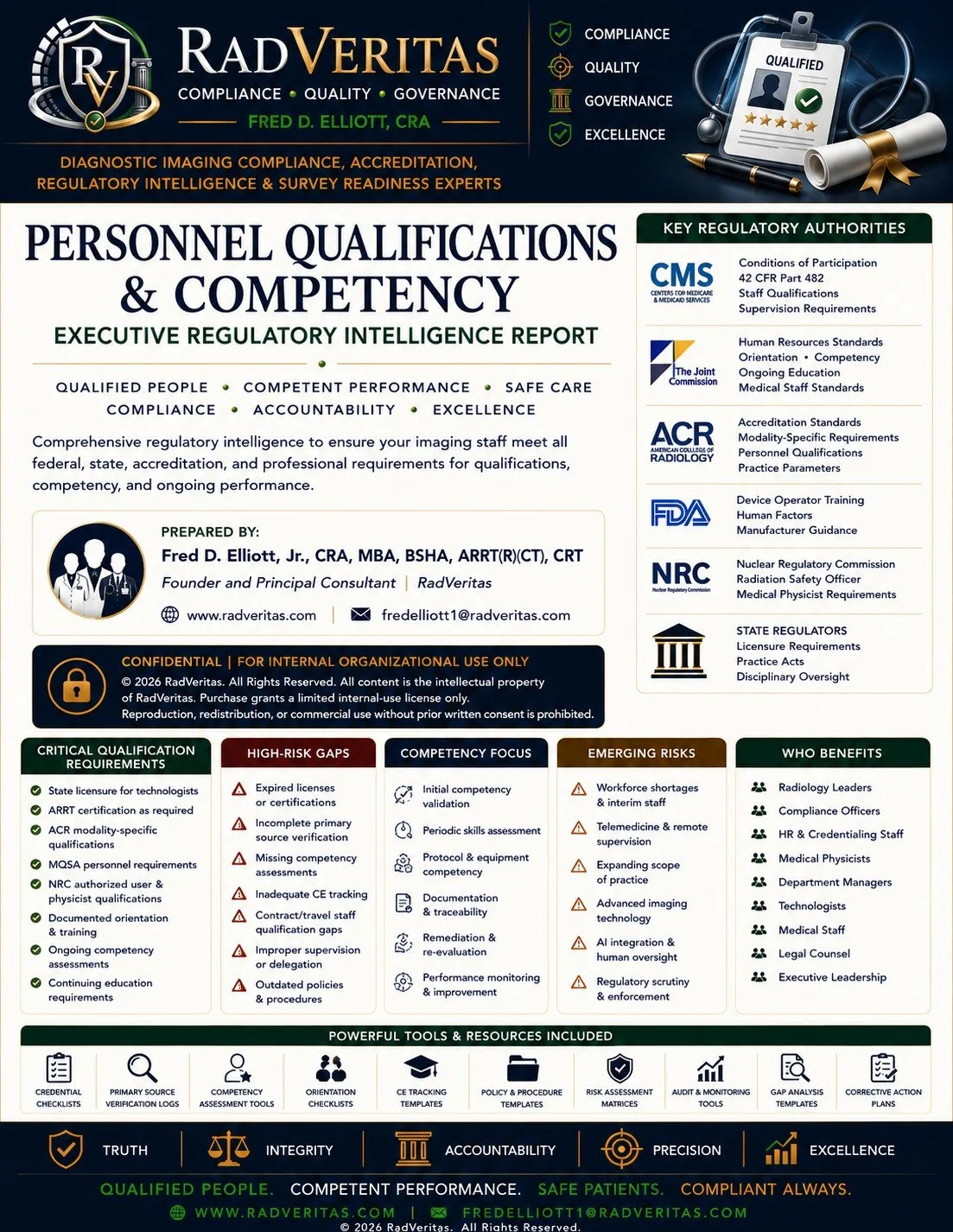
The Complete Workforce Compliance, Credentialing, and Competency Management System for Diagnostic Imaging Leaders
Your Compliance Program Is Only As Strong As The People Who Operate It
Every imaging department depends on qualified professionals to deliver safe, compliant, and high-quality patient care.
Yet one expired license.
One missing competency assessment.
One unverified travel technologist.
One physician practicing outside approved privileges.
Can expose an organization to regulatory findings, accreditation deficiencies, legal liability, reimbursement risk, and patient safety concerns.
The RadVeritas Personnel Qualifications and Competency Regulatory Intelligence Report was developed to help healthcare leaders build, monitor, and sustain a defensible workforce compliance program across every Diagnostic Imaging service line.
Built from current CMS Conditions of Participation, The Joint Commission Human Resources standards, ACR accreditation requirements, MQSA regulations, NRC requirements, and state licensure laws, this comprehensive intelligence report provides a practical framework for workforce governance, credential management, competency validation, and survey readiness.
Why This Report Matters
Most healthcare leaders assume personnel qualifications are being managed appropriately.
Surveyors assume nothing.
Personnel qualification deficiencies remain among the most frequently cited findings during regulatory inspections, accreditation reviews, credentialing audits, and compliance investigations.
The consequences can be severe:
Accreditation findings
CMS deficiencies
MQSA enforcement actions
NRC violations
Loss of reimbursement
Patient safety risks
Increased legal exposure
Organizational reputation damage
This report helps leaders identify vulnerabilities before they become regulatory findings.
What You'll Learn
Workforce Compliance Governance
Develop a structured system for monitoring qualifications, certifications, licenses, privileges, and competency requirements across all imaging disciplines.
Credential Verification and Tracking
Strengthen oversight of:
State Licensure
ARRT Credentials
ARDMS Certifications
NMTCB Certifications
Medical Staff Privileges
MQSA Requirements
NRC Authorized User Status
Competency Management
Create defensible processes for:
New Employee Orientation
Annual Competency Assessments
Modality-Specific Validation
Continuing Education Tracking
Skills Verification
Remediation Programs
Physician Qualification Oversight
Understand requirements governing:
Interpreting Physicians
Procedural Privileges
MQSA Physicians
Authorized Users
Medical Physicists
Specialty Certifications
Travel and Contract Workforce Governance
Address growing compliance risks associated with:
Agency Personnel
Contract Technologists
Temporary Staffing
Cross-State Licensure
Credential Verification
The Hidden Risk Most Organizations Overlook
A qualification lapse rarely announces itself.
It often remains invisible until a surveyor reviews a personnel file, a regulator requests documentation, or a patient safety event triggers a deeper investigation.
An expired state license.
A missing competency assessment.
An unverified travel technologist.
An Authorized User no longer listed on a radioactive materials license.
These are not administrative oversights.
They are compliance failures with potentially significant consequences.
Organizations that proactively manage workforce qualifications reduce risk, improve survey performance, strengthen accountability, and protect patients.
Build a Workforce That Can Withstand Scrutiny
Technology can support compliance.
Policies can define expectations.
But qualified people remain the foundation of every successful Diagnostic Imaging program.
The RadVeritas Personnel Qualifications and Competency Regulatory Intelligence Report provides healthcare leaders with the tools, governance strategies, and operational framework needed to build a workforce compliance program that stands up to regulatory scrutiny and supports long-term operational excellence.
Qualified Staff.
Defensible Compliance.
Safer Patient Care.
Prepared By
Fred D. Elliott, Jr., CRA, MBA, BSHA, ARRT (CT), CRT
Founder and Principal Consultant
RadVeritas
Compliance • Quality • Governance
Building Stronger Imaging Organizations Through Workforce Excellence.
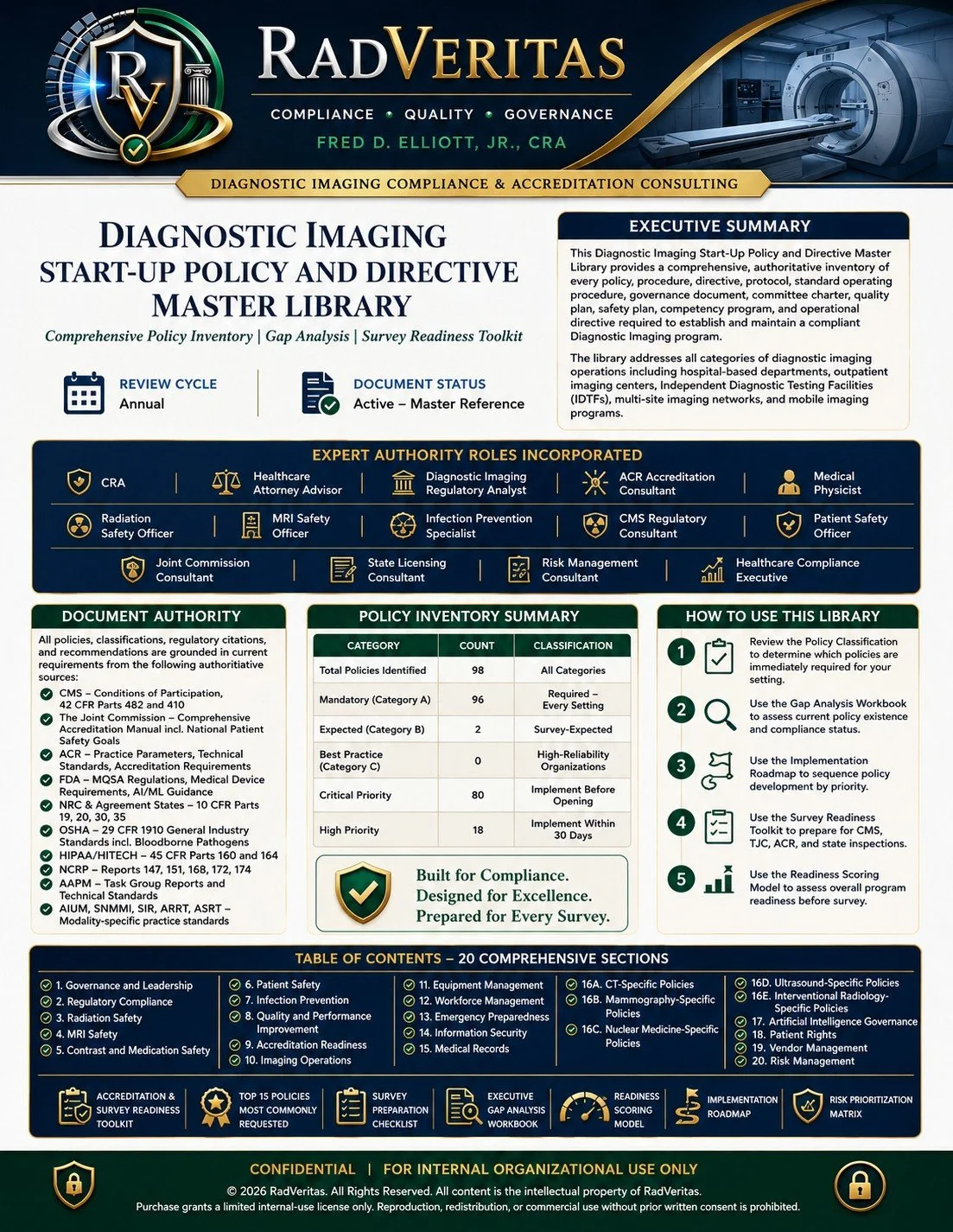
The Complete Blueprint for Building a Survey-Ready Diagnostic Imaging Program From Day One
Launch Faster. Reduce Risk. Build Compliance Into the Foundation.
Starting a Diagnostic Imaging department is one of the most complex undertakings in healthcare.
Before the first patient is scheduled, leaders must establish governance structures, regulatory compliance programs, safety systems, operational policies, accreditation readiness processes, competency programs, emergency preparedness plans, quality management frameworks, and hundreds of supporting documents required by regulators, accrediting organizations, and healthcare governing bodies.
Most organizations spend months, and often years, creating these documents independently.
The RadVeritas Diagnostic Imaging Start-Up Policy & Directive Master Library eliminates that burden by providing a comprehensive policy inventory, implementation roadmap, compliance framework, and survey-readiness system designed specifically for Diagnostic Imaging operations.
Whether establishing a new hospital imaging department, outpatient imaging center, Independent Diagnostic Testing Facility (IDTF), multi-site imaging network, or mobile imaging service, this resource provides the structure required to build a compliant, accreditation-ready imaging enterprise from the ground up.
Everything You Need Before Opening Your Doors
This is more than a policy library.
It is a complete Diagnostic Imaging operational foundation.
The library provides a comprehensive inventory of policies, procedures, directives, governance documents, committee structures, quality plans, safety programs, competency requirements, operational standards, and implementation priorities required to establish and maintain a compliant imaging program.
Instead of wondering what regulators expect, you will know exactly what must be in place.
Why Organizations Invest in This Resource
Regulatory Requirements Continue to Expand
Healthcare organizations face increasing oversight from:
Centers for Medicare & Medicaid Services (CMS)
The Joint Commission (TJC)
American College of Radiology (ACR)
State Licensing Agencies
FDA
OSHA
HIPAA/HITECH
NRC
AIUM
SNMMI
SIIM
Specialty Accreditation Organizations
Failure to establish the proper policy infrastructure can result in:
Delayed operational launch
Accreditation deficiencies
Regulatory citations
Reimbursement vulnerabilities
Patient safety risks
Operational inefficiencies
Increased legal exposure
This library helps prevent those failures before they occur.
What's Included
Comprehensive Policy Inventory
A structured framework containing:
98 Total Policies Identified
96 Mandatory Policies Required for Most Imaging Operations
Critical and High-Priority Implementation Classifications
Survey-Expected Policy Requirements
Governance and Oversight Frameworks
The content is organized according to regulatory importance and implementation priority, allowing leaders to focus on the most critical requirements first.
20 Comprehensive Operational Sections
Governance & Leadership
Establish organizational accountability, committee structures, and leadership oversight.
Regulatory Compliance
Build systems that support compliance with federal, state, accreditation, and specialty requirements.
Radiation Safety
Create a comprehensive radiation protection infrastructure.
MRI Safety
Implement MRI governance, screening, access control, emergency preparedness, and safety oversight programs.
Contrast & Medication Safety
Address administration, monitoring, documentation, and emergency response requirements.
Patient Safety
Develop policies that support safe imaging practices and risk reduction.
Infection Prevention
Implement infection control programs aligned with healthcare standards.
Quality & Performance Improvement
Establish meaningful quality metrics, dashboards, audits, and improvement initiatives.
Accreditation Readiness
Prepare for ACR, CMS, TJC, and state inspections.
Imaging Operations
Create operational consistency across all imaging modalities.
Equipment Management
Support lifecycle management, maintenance, testing, and documentation.
Workforce Management
Develop staffing, competency, education, and performance oversight systems.
Emergency Preparedness
Build imaging-specific emergency response capabilities.
Information Security
Address HIPAA, cybersecurity, and data governance requirements.
Medical Records
Strengthen documentation, retention, and disclosure processes.
Modality-Specific Policy Libraries
Includes dedicated policy inventories for:
Computed Tomography (CT)
Mammography
Nuclear Medicine
Ultrasound
Interventional Radiology
Artificial Intelligence Governance
Address emerging AI oversight, validation, ethics, and implementation requirements.
Patient Rights
Support informed consent, privacy, communication, and patient-centered care.
Vendor Management
Establish oversight of contracted services and vendor relationships.
Risk Management
Create enterprise-level risk identification, mitigation, and monitoring systems.
Included Executive Tools
Executive Gap Analysis Workbook
Quickly identify missing policies, implementation gaps, and compliance vulnerabilities.
Survey Readiness Toolkit
Prepare for accreditation surveys, regulatory inspections, and licensing reviews.
Readiness Scoring Model
Measure program readiness and prioritize improvement activities.
Policy Implementation Roadmap
Provides a structured sequence for policy deployment and operational development.
Risk Prioritization Matrix
Focus leadership attention on the areas presenting the greatest organizational exposure.
Accreditation Preparation Resources
Support readiness for CMS, TJC, ACR, state, and specialty accreditation reviews.
Built by Experts. Designed for Real-World Operations.
This library incorporates expertise spanning:
Certified Radiology Administration
Healthcare Regulatory Compliance
Accreditation Readiness
Radiation Safety
MRI Safety
Infection Prevention
Patient Safety
Medical Physics
Healthcare Law
Risk Management
Quality Improvement
Operational Governance
Every section was designed to help organizations implement practical, defensible, and survey-ready systems.
Ideal For
Hospital Imaging Departments
Outpatient Imaging Centers
Independent Diagnostic Testing Facilities (IDTFs)
Health Systems
Multi-Site Imaging Networks
Mobile Imaging Programs
Imaging Start-Ups
Radiology Administrators
Compliance Officers
Accreditation Specialists
Healthcare Consultants
Executive Leadership Teams
The Business Case
Most organizations spend thousands of hours building policies individually.
Many still overlook critical requirements.
This library provides a proven framework that dramatically reduces development time, accelerates implementation, strengthens compliance infrastructure, and improves readiness across every imaging modality.
One missed regulatory requirement can create significant financial and operational consequences.
One comprehensive framework can help prevent them.
Build Your Imaging Program With Confidence
Whether launching a new Diagnostic Imaging department, rebuilding an existing compliance program, preparing for accreditation, or standardizing operations across multiple facilities, the RadVeritas Diagnostic Imaging Start-Up Policy & Directive Master Library provides the roadmap.
Comprehensive Policy Inventory.
Executive Gap Analysis.
Accreditation Readiness.
Operational Excellence.
Product Number: RV-DI-PL
Diagnostic Imaging Start-Up Policy & Directive Master Library
Built for Compliance. Designed for Excellence. Prepared for Every Survey.
RadVeritas
Compliance • Quality • Governance
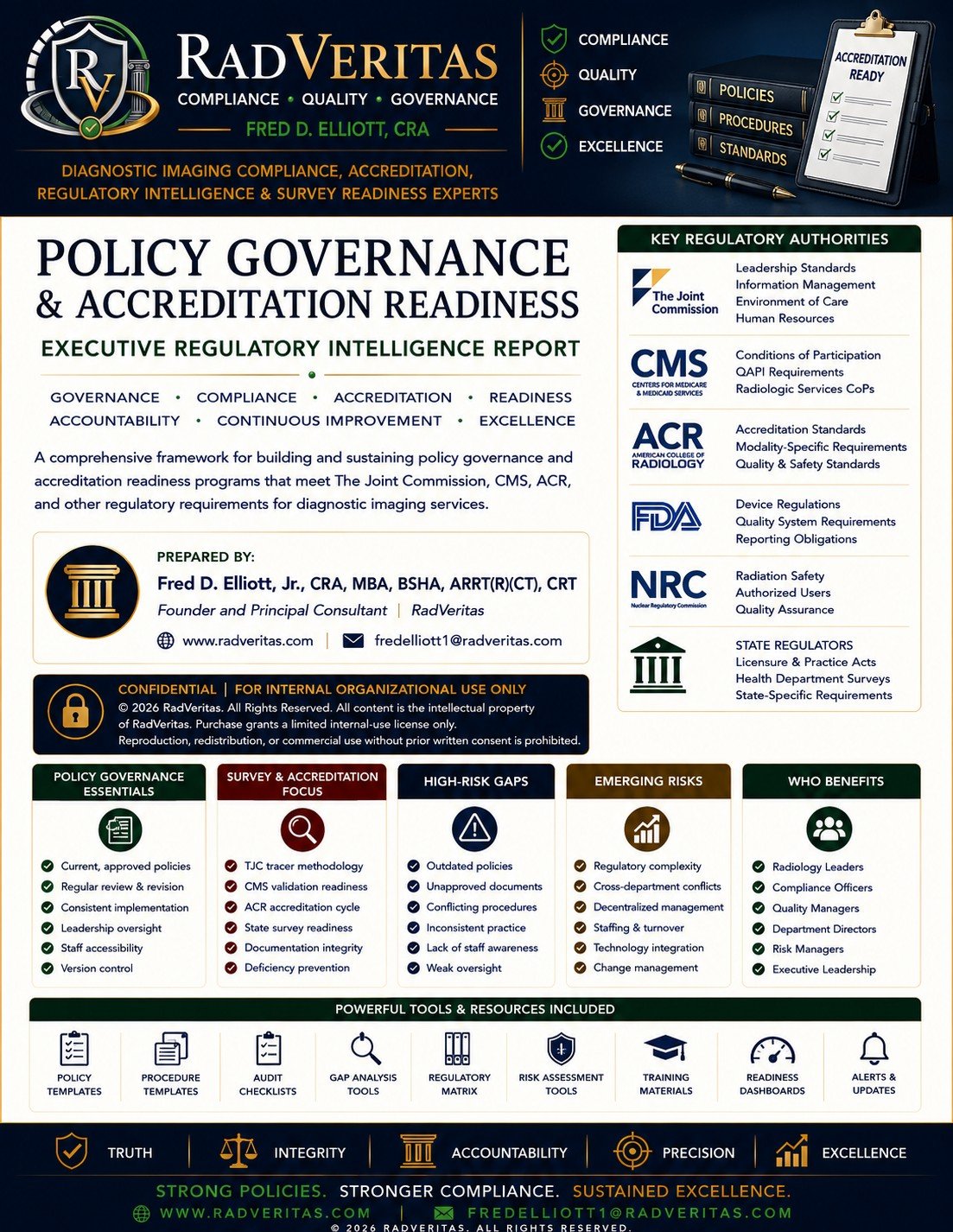
The Foundation of Every Successful Compliance Program
Strong Policies Don't Create Compliance. Strong Governance Does.
Most organizations focus on individual compliance requirements.
The highest-performing organizations focus on the system that governs them all.
When surveyors arrive, they do not simply evaluate whether a policy exists. They evaluate whether leadership has created a governance structure capable of sustaining compliance, managing risk, responding to regulatory change, and maintaining accreditation readiness year-round.
The RadVeritas Policy Governance and Accreditation Readiness Intelligence Report provides healthcare leaders with a comprehensive framework for building, evaluating, and strengthening the governance infrastructure that supports long-term compliance success.
Why This Report Matters
Many accreditation findings are not caused by a lack of effort.
They are caused by:
Outdated policies
Inconsistent policy implementation
Missing regulatory requirements
Weak oversight structures
Poor staff awareness
Inadequate audit processes
Gaps between written policy and actual practice
These weaknesses often remain hidden until a survey, audit, complaint investigation, or patient safety event exposes them.
This report helps organizations identify and correct those vulnerabilities before regulators do.
What You'll Learn
Policy Governance Fundamentals
Build a sustainable framework for policy development, review, approval, implementation, monitoring, and revision.
Accreditation Readiness Systems
Create a culture of continuous readiness rather than last-minute survey preparation.
Leadership Accountability
Understand executive responsibilities for compliance oversight, policy management, and accreditation performance.
Regulatory Intelligence
Navigate requirements from:
CMS
The Joint Commission
ACR
FDA
NRC
State Regulatory Agencies
QAPI Integration
Strengthen quality oversight by integrating policy governance into organizational performance improvement programs.
Regulatory Change Management
Develop processes that ensure regulatory updates are translated into policy revisions and operational implementation.
Why Organizations Purchase This Report
Organizations that consistently perform well during surveys have one thing in common:
They do not prepare for compliance.
They operate in compliance.
This report helps leaders build the governance systems, accountability structures, monitoring processes, and policy management frameworks necessary to sustain compliance every day, not just during survey season.
The Hidden Risk Most Organizations Miss
A survey finding is rarely the real problem.
The real problem is the governance failure that allowed the finding to occur.
The RadVeritas Policy Governance and Accreditation Readiness Intelligence Report helps organizations identify those failures before they impact accreditation status, regulatory standing, patient safety, or organizational reputation.
Governance Drives Compliance.
Compliance Sustains Accreditation.
Accreditation Protects the Organization.
Prepared By
Fred D. Elliott, Jr., CRA, MBA, BSHA, ARRT (CT), CRT
Founder and Principal Consultant
RadVeritas
Compliance • Quality • Governance
Building Survey-Ready Organizations Through Strong Governance.
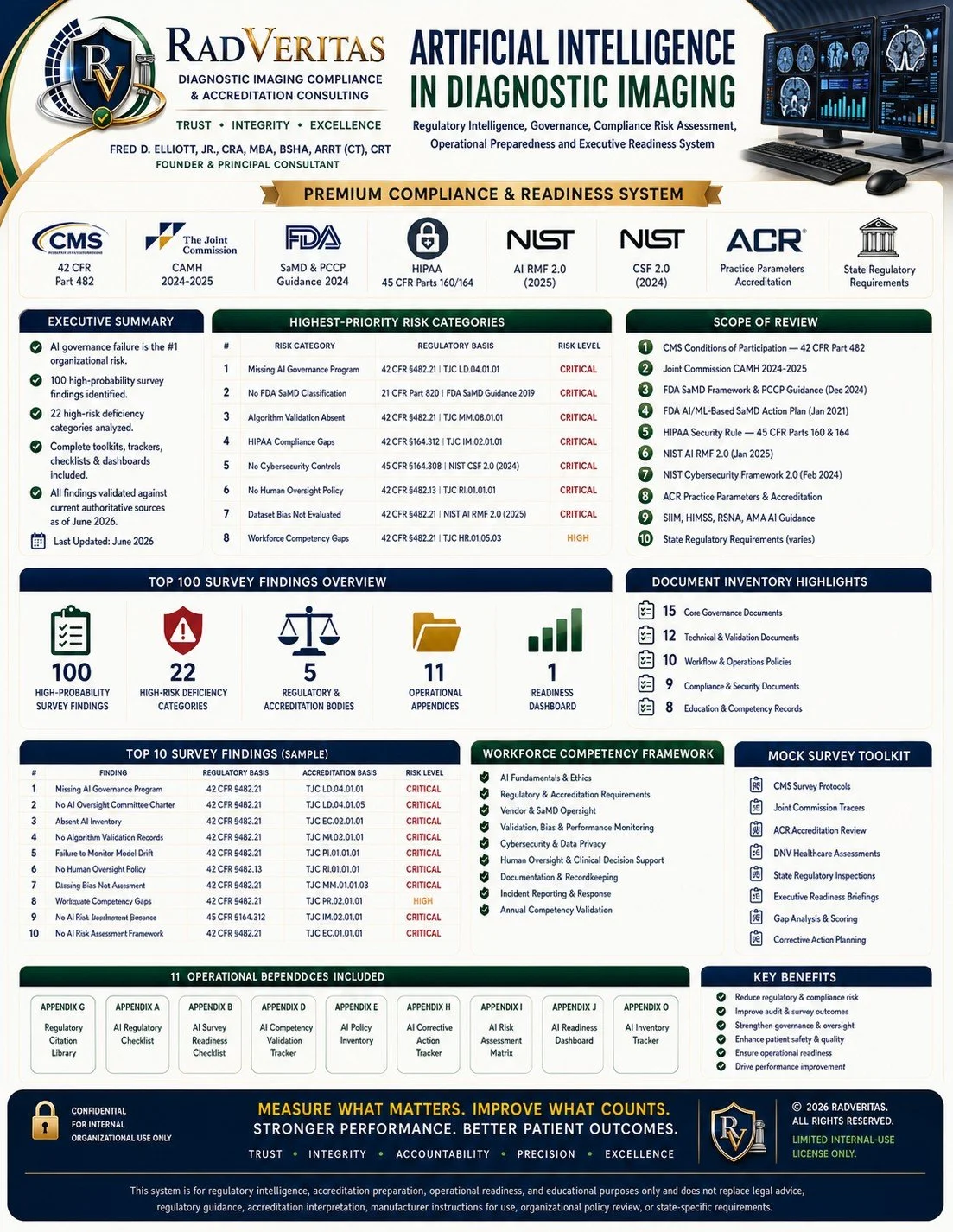
The Complete AI Governance, Regulatory Compliance, and Executive Readiness System for Healthcare Leaders
The Future of Imaging Will Be Driven by Artificial Intelligence. The Future of Compliance Will Be Driven by Governance.
Artificial Intelligence is transforming Diagnostic Imaging faster than any technology in decades.
AI can accelerate workflows, improve detection, reduce administrative burden, and create new opportunities for patient care.
It can also create new regulatory risks, cybersecurity vulnerabilities, legal liabilities, accreditation challenges, and governance failures.
Many healthcare organizations are adopting AI without a complete understanding of the compliance responsibilities that come with it.
The RadVeritas Artificial Intelligence in Diagnostic Imaging Regulatory Intelligence System was created to help healthcare leaders build, govern, validate, and sustain AI programs that are safe, compliant, and prepared for regulatory scrutiny.
Built upon current CMS Conditions of Participation, The Joint Commission standards, FDA Software as a Medical Device (SaMD) guidance, HIPAA Security Rule requirements, NIST AI Risk Management Framework, NIST Cybersecurity Framework, ACR Practice Parameters, and emerging industry standards, this executive intelligence system provides a practical roadmap for responsible AI adoption.
Why This System Matters
Artificial Intelligence introduces risks that traditional compliance programs were never designed to manage.
Questions healthcare leaders must now answer include:
Who is responsible for AI oversight?
How are algorithms validated?
How is model drift identified?
What happens if AI makes an incorrect recommendation?
How is patient data protected?
Are AI decisions transparent and explainable?
Are we prepared for regulatory review?
Organizations that cannot answer these questions may face significant operational, regulatory, financial, and reputational consequences.
This system helps leaders identify those risks before they become liabilities.
What You'll Learn
AI Governance and Executive Oversight
Develop a structured governance model that supports safe and accountable AI implementation.
Regulatory and Accreditation Readiness
Navigate evolving expectations from:
CMS
The Joint Commission
FDA
HIPAA
NIST
ACR
State Regulatory Agencies
AI Validation and Performance Monitoring
Strengthen oversight of:
Algorithm Validation
Bias Assessment
Model Performance
Clinical Accuracy
Ongoing Monitoring
Human Oversight
Cybersecurity and Data Protection
Build safeguards for:
Protected Health Information
AI Data Security
Vendor Risk Management
Third-Party Platforms
Cybersecurity Controls
Incident Response
Workforce Competency
Prepare staff through structured education in:
AI Fundamentals
Ethical AI Use
Regulatory Expectations
Clinical Decision Support
Documentation Standards
Annual Competency Validation
The Hidden Risk Most Organizations Do Not See
The greatest AI threat is not the technology itself.
It is the absence of governance.
An undocumented algorithm.
A vendor system that was never validated.
A model that slowly drifts from expected performance.
A clinical decision that cannot be explained.
A workforce that trusts AI without understanding its limitations.
These risks often remain invisible until a survey, audit, cybersecurity event, legal action, or patient safety incident exposes them.
The organizations that succeed will not simply implement Artificial Intelligence.
They will govern it.
Build an AI Program That Inspires Confidence
Artificial Intelligence has the potential to reshape Diagnostic Imaging.
Success will belong to organizations that combine innovation with accountability, technology with transparency, and automation with responsible oversight.
The RadVeritas Artificial Intelligence in Diagnostic Imaging Regulatory Intelligence System provides healthcare leaders with the intelligence, tools, and governance strategies needed to reduce risk, strengthen compliance, improve operational readiness, and lead the next generation of imaging safely and responsibly.
Govern Artificial Intelligence.
Protect Patients.
Lead the Future of Imaging.
Prepared By
Fred D. Elliott, Jr., CRA, MBA, BSHA, ARRT (CT), CRT
Founder and Principal Consultant
RadVeritas™
Compliance • Quality • Governance
Intelligent Governance for the Future of Diagnostic Imaging.
RadVeritas - Imaging Staff Survey Readiness Prep Packages
Advance Your Expertise. Strengthen Compliance. Lead with Confidence.
Interventional Radiology is one of the most highly regulated and clinically complex specialties in healthcare. Every procedure demands technical precision, patient safety, regulatory knowledge, and seamless collaboration across multidisciplinary teams.
The RadVeritas™ Interventional Radiology Technologist Survey Readiness and Regulatory Compliance Examination Package was developed to help technologists and imaging leaders meet those challenges with confidence.
Featuring 200 examination-quality questions across 10 critical clinical and regulatory domains, this comprehensive package is designed to strengthen competency, support survey readiness, and reinforce the standards that define high-performing Interventional Radiology programs.
More Than an Examination Resource
This is not a simple test bank.
It is a professional education and workforce development system built to help departments prepare for accreditation reviews, regulatory inspections, competency validations, and continuous quality improvement initiatives.
Developed from real-world Diagnostic Imaging leadership experience, this package helps organizations move from reactive compliance to proactive excellence.
Core Areas of Focus
Patient Safety
Promote safe practices that protect patients throughout the Interventional Radiology continuum.
Regulatory Compliance
Build a strong understanding of the standards governing modern IR operations.
Radiation Safety
Strengthen knowledge of radiation protection principles and dose management.
Clinical Interventional Practice
Enhance critical thinking in complex procedural and workflow environments.
Infection Prevention
Reinforce evidence-based practices that reduce procedural and environmental risks.
Documentation and Quality
Support accurate documentation and defensible quality management processes.
Healthcare Technology
Improve understanding of the technology that drives safe and efficient IR services.
Leadership and Professional Practice
Develop accountability, communication, and operational excellence.
Medication and Sedation Safety
Promote safe handling, monitoring, and patient management practices.
Supply Chain and Operational Integrity
Strengthen the systems that support uninterrupted, compliant patient care.
What You'll Receive
✔ 200 Examination-Quality Questions
✔ 10 Clinical and Regulatory Knowledge Domains
✔ Survey Readiness Education
✔ Regulatory Compliance Review
✔ Radiation Safety Concepts
✔ Infection Prevention Principles
✔ Medication and Sedation Safety Content
✔ Documentation and Quality Improvement Focus
✔ Competency Validation Resource
✔ Professional Development and Leadership Support
Designed For
Interventional Radiology Technologists
Lead IR Technologists
Imaging Supervisors
Imaging Managers and Directors
Clinical Educators
Compliance Officers
Quality Improvement Teams
Accreditation Specialists
Healthcare Executives
Hospital and Outpatient IR Programs
Built for Real-World Healthcare Challenges
Regulatory expectations continue to evolve. Accreditation standards continue to expand. Operational pressures continue to grow.
The organizations that perform best are the ones that prepare before the survey, strengthen competency before deficiencies occur, and build systems that support consistent excellence.
This examination package helps organizations:
Improve survey readiness
Validate workforce competency
Strengthen regulatory compliance
Enhance patient and staff safety
Reduce operational risk
Support accreditation success
Foster a culture of accountability and excellence
Prepare With Purpose. Perform With Excellence.
Whether you are educating a new technologist, validating annual competencies, or preparing an entire department for regulatory review, the RadVeritas™ Interventional Radiology Technologist Examination Package provides a practical and defensible framework for success.
Because the best Interventional Radiology programs are not built by chance.
They are built through preparation, knowledge, and a commitment to excellence.
Build Expertise. Demonstrate Competence. Lead With Confidence.
Invest in a resource designed to help your team meet today's expectations and prepare for tomorrow's challenges.
RadVeritas™
Compliance • Quality • Governance
Truth. Integrity. Accountability. Precision. Excellence.
Build Expertise. Achieve Compliance. Prepare for Every Survey.
Nuclear Medicine is a specialty where precision, radiation safety, regulatory compliance, and patient care must work together flawlessly. Technologists are expected to navigate complex clinical procedures while meeting the expectations of accreditation organizations, regulatory agencies, and healthcare leaders.
The RadVeritas™ Nuclear Medicine Technologist Examination Preparation Package was created to help professionals develop the knowledge and confidence required to succeed in this demanding environment.
Featuring 200 examination-quality, scenario-driven questions, this comprehensive learning system is designed to strengthen competency, support survey readiness, and promote operational excellence across Nuclear Medicine services.
More Than a Question Bank
This is not a traditional study guide.
It is a professional education and competency validation resource built to help Nuclear Medicine departments prepare for regulatory inspections, accreditation surveys, annual education requirements, and workforce development initiatives.
Developed from real-world Diagnostic Imaging leadership experience, this package transforms regulatory expectations into practical, job-ready knowledge.
What Makes This Package Different
200 Examination-Quality Questions
Domain-based and scenario-driven content designed to reinforce critical thinking and decision-making.
Detailed Teaching Rationales
Comprehensive explanations that strengthen understanding and improve long-term knowledge retention.
Active Regulatory Citations
Content aligned with authoritative standards and linked to official regulatory guidance.
Survey Readiness Focus
Prepare for CMS, Joint Commission, ACR, and NRC inspections with confidence.
Competency and Audit Tools
Support annual competency validation, performance monitoring, and quality improvement programs.
Core Learning Areas
Patient Safety
Promote safe imaging practices and exceptional patient care.
Regulatory Compliance
Build a strong understanding of the standards governing Nuclear Medicine operations.
Radiation Safety
Strengthen knowledge of radiation protection, exposure reduction, and regulatory requirements.
Quality Assurance
Support consistent quality management and operational reliability.
Performance Improvement
Identify opportunities to strengthen workflow, compliance, and clinical outcomes.
Professional Excellence
Develop the leadership and technical knowledge expected of high-performing imaging professionals.
Operational Integrity
Create sustainable systems that support long-term accreditation and survey success.
Aligned With Industry Standards
The examination package supports education and readiness efforts related to:
ACR Accreditation
Joint Commission Standards
CMS Conditions of Participation
FDA Requirements
HIPAA Compliance
Patient Safety Initiatives
Nuclear Medicine Regulatory Expectations
What's Included
✔ 200 Scenario-Based Examination Questions
✔ Detailed Rationales and Teaching Points
✔ Regulatory and Accreditation Review
✔ Radiation Safety Education
✔ Survey Readiness Preparation
✔ Competency Validation Resource
✔ Audit and Performance Tools
✔ Quality Improvement Support
✔ Professional Development Framework
✔ Annual Education and Training Resource
Designed For
Nuclear Medicine Technologists
Lead Nuclear Medicine Technologists
PET/CT Technologists
Imaging Supervisors
Imaging Managers and Directors
Clinical Educators
Compliance Officers
Accreditation Specialists
Quality Improvement Teams
Healthcare Organizations Preparing for Survey
Prepare Before the Survey Begins
The most successful imaging departments do not wait for an inspection to identify weaknesses.
They build knowledgeable teams, validate competency, and create systems that support continuous compliance and operational excellence.
The RadVeritas™ Nuclear Medicine Technologist Examination Preparation Package helps organizations reduce risk, strengthen performance, and build a culture of readiness that stands up to expert scrutiny.
Invest in Knowledge. Strengthen Performance. Deliver Excellence.
Whether you are preparing an individual technologist or supporting an enterprise-wide education initiative, this examination package provides the practical tools needed to build confidence and achieve lasting success.
Because excellence in Nuclear Medicine is not measured by a single survey.
It is built through preparation, accountability, and a commitment to continuous improvement.
Survey Ready. Regulatory Ready. Professionally Ready.
RadVeritas™
Compliance • Quality • Governance
Patient Safety. Regulatory Compliance. Radiation Safety. Quality Assurance. Performance Improvement. Professional Excellence. Operational Integrity.
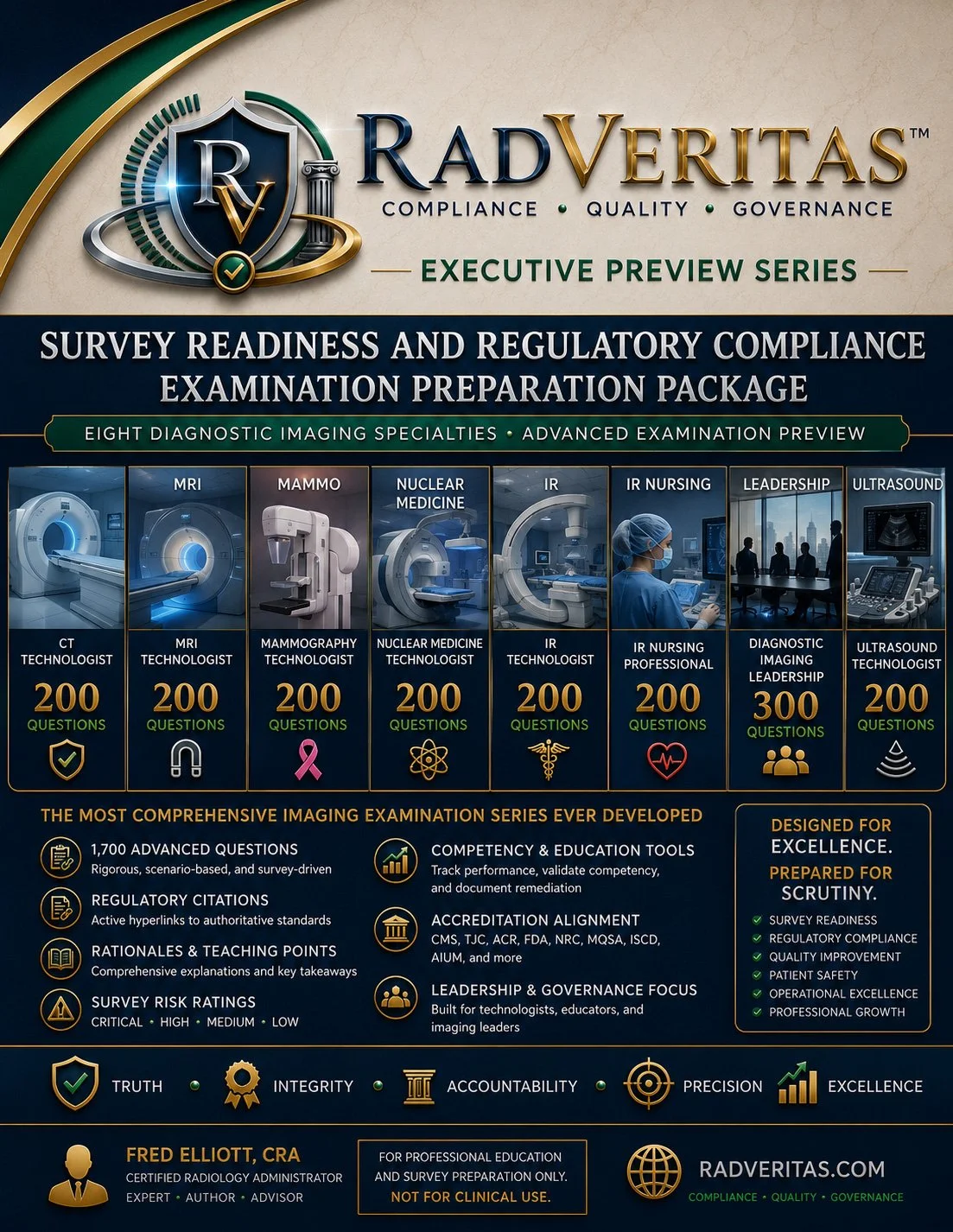
The Most Comprehensive Diagnostic Imaging Examination Library Available
One Platform. Eight Specialties. 1,700 Advanced Questions.
Regulatory expectations continue to evolve. Accreditation standards continue to expand. Survey findings continue to become more complex.
The organizations that succeed are the ones that prepare before the inspection, not after it.
The RadVeritas™ Executive Preview Series was developed to help Diagnostic Imaging professionals strengthen competency, improve survey readiness, and build confidence across the imaging enterprise through practical, scenario-driven education.
Built by a Certified Radiology Administrator with decades of leadership experience, this premium examination series transforms regulations into actionable learning that supports both individual growth and organizational excellence.
Eight Specialized Examination Packages
Choose the specialty that fits your role or build a department-wide education program.
CT Technologist
200 Questions
Master radiation safety, contrast administration, quality assurance, accreditation readiness, and operational excellence.
MRI Technologist
200 Questions
Strengthen expertise in MRI safety, zone management, patient care, emergency preparedness, and regulatory compliance.
Mammography Technologist
200 Questions
Prepare for MQSA inspections, ACR accreditation, quality control, patient safety, and breast imaging excellence.
Nuclear Medicine Technologist
200 Questions
Enhance competency in radiopharmaceutical safety, NRC requirements, patient protection, and survey readiness.
Interventional Radiology Technologist
200 Questions
Build confidence in procedural safety, sterile practice, radiation protection, and clinical operations.
Interventional Radiology Nursing Professional
200 Questions
Advance knowledge in sedation safety, patient care, documentation, infection prevention, and accreditation standards.
Diagnostic Imaging Leadership
300 Questions
Designed for supervisors, managers, and executives responsible for compliance, governance, quality, staffing, and operational performance.
Ultrasound Technologist
200 Questions
Improve competency in patient safety, quality assurance, documentation, regulatory compliance, and professional practice.
Why Healthcare Professionals Choose RadVeritas™
1,700 Advanced Examination Questions
Comprehensive, scenario-based content designed to simulate real-world regulatory and operational challenges.
Detailed Rationales and Teaching Points
Every question reinforces learning through practical explanations and educational insight.
Active Regulatory Citations
Hyperlinked references connect every topic to authoritative standards and guidance.
Survey Risk Intelligence
Questions are structured around high-risk areas commonly identified during accreditation and regulatory inspections.
Competency and Education Tools
Support annual validations, orientation programs, staff development, and departmental education initiatives.
Accreditation Alignment
Content reflects expectations from:
CMS
Joint Commission
American College of Radiology (ACR)
FDA
Nuclear Regulatory Commission (NRC)
MQSA
ISCD
AIUM
ARDMS
State Regulatory Agencies
Designed for Professionals Who Cannot Afford to Guess
Whether you are preparing for a survey, validating staff competency, onboarding new employees, or strengthening leadership oversight, the Executive Preview Series provides a structured path to operational readiness.
Ideal for:
Diagnostic Imaging Departments
Hospital Systems
Outpatient Imaging Centers
Clinical Educators
Imaging Leaders
Accreditation Teams
Quality and Compliance Professionals
Individual Technologists Seeking Career Growth
More Than Examination Questions
The RadVeritas™ Executive Preview Series helps organizations:
Reduce regulatory risk
Improve survey outcomes
Strengthen workforce competency
Support accreditation readiness
Promote patient safety
Build a culture of accountability and excellence
Prepare With Purpose. Lead With Confidence.
The best imaging departments are not built during an inspection.
They are built through continuous education, measurable standards, and disciplined preparation.
Explore the RadVeritas™ Executive Preview Series and discover why healthcare professionals trust RadVeritas to help them prepare for scrutiny, strengthen performance, and achieve excellence.
RadVeritas™
Compliance • Quality • Governance
1,700 Questions. Eight Specialties. One Standard of Excellence.
Elevate Clinical Excellence. Strengthen Compliance. Prepare for Every Challenge.
Interventional Radiology nurses play a critical role in patient safety, procedural success, sedation management, infection prevention, and regulatory compliance. Every patient encounter requires sound clinical judgment, precise documentation, and the ability to perform under the highest professional standards.
The RadVeritas™ Interventional Radiology Nursing Survey Readiness and Regulatory Compliance Examination Package was created to help nurses and healthcare leaders build the knowledge and confidence needed to excel in today's demanding healthcare environment.
Featuring 200 examination-quality questions, this comprehensive education resource supports competency validation, accreditation preparation, and continuous professional growth.
More Than an Examination
This is not simply a collection of questions.
It is a practical learning system designed to help Interventional Radiology nursing teams prepare for regulatory inspections, strengthen clinical practice, and build a culture of accountability and excellence.
Developed from real-world Diagnostic Imaging leadership experience, this package bridges the gap between regulatory expectations and daily patient care.
Core Areas of Focus
Survey Readiness
Prepare for CMS, Joint Commission, ACR, and internal competency reviews with confidence.
Regulatory Compliance
Strengthen understanding of the standards that govern Interventional Radiology nursing practice.
Clinical Competency
Reinforce the knowledge and decision-making skills essential for safe, high-quality patient care.
Accreditation Preparation
Support departmental readiness through structured education and competency development.
Patient Safety
Promote evidence-based practices that protect patients before, during, and after procedures.
Quality Improvement
Build a culture of continuous learning and operational excellence.
Comprehensive Knowledge Domains
The examination package addresses critical areas of Interventional Radiology nursing, including:
Patient Identification and Safety
Regulatory Compliance
Interventional Radiology Nursing Practice
Medication and Sedation Safety
Infection Prevention
Radiation Safety
Documentation and Quality Management
Healthcare Technology
Leadership and Professional Practice
What's Included
✔ 200 Examination-Quality Questions
✔ Survey Readiness Education
✔ Regulatory Compliance Review
✔ Clinical Competency Validation
✔ Patient Safety Principles
✔ Medication and Sedation Safety Content
✔ Infection Prevention Education
✔ Radiation Safety Awareness
✔ Documentation and Quality Improvement Focus
✔ Professional Development Resource
Designed For
Interventional Radiology Nurses
Charge Nurses
Nurse Educators
Imaging Supervisors
Imaging Managers and Directors
Clinical Leaders
Compliance Officers
Accreditation Specialists
Quality Improvement Teams
Healthcare Organizations Preparing for Survey
A Practical Resource for Modern Healthcare
Healthcare organizations face increasing expectations for competency validation, patient safety, documentation excellence, and regulatory compliance.
This examination package helps organizations:
Strengthen nursing competency
Improve survey readiness
Enhance patient safety practices
Support accreditation success
Reduce regulatory risk
Promote quality improvement
Foster leadership accountability
Build Confidence Through Preparation
The strongest Interventional Radiology nursing programs are built on education, consistency, and a commitment to excellence.
The RadVeritas™ Interventional Radiology Nursing Examination Package provides a practical framework to help individuals and organizations prepare for the challenges of modern healthcare while supporting exceptional patient outcomes.
Because excellence is not achieved by chance.
It is achieved through preparation.
Validate Competency. Strengthen Compliance. Advance Excellence.
Whether you are preparing a new nurse, validating annual competencies, or strengthening an entire Interventional Radiology program, this examination package provides the tools to support lasting success.
RadVeritas™
Compliance • Quality • Governance
Truth. Integrity. Accountability. Precision. Excellence.
Excellence Is Not an Act, but a Standard.
Master the Standards. Strengthen Performance. Prepare for Every Survey.
Computed Tomography is one of the most demanding areas in Diagnostic Imaging. Technologists must balance patient safety, radiation protection, contrast administration, regulatory compliance, and operational excellence while meeting constantly evolving accreditation and survey expectations.
The RadVeritas™ CT Technologist Examination Package was developed to help imaging professionals build the knowledge, confidence, and critical thinking skills needed to excel in today's high-accountability healthcare environment.
Featuring 200 examination-quality questions across 14 essential domains, this comprehensive learning system transforms complex regulatory requirements into practical, real-world competency.
More Than a Study Guide
This is not a traditional question bank.
It is a professional development and survey readiness resource designed to support competency validation, annual education, accreditation preparation, and continuous quality improvement.
Built from decades of Diagnostic Imaging leadership experience, this package helps CT departments create a culture of readiness rather than a cycle of last-minute preparation.
What You'll Master
Survey Readiness
Prepare for accreditation surveys and regulatory inspections with confidence.
Regulatory Compliance
Strengthen understanding of the standards that govern modern CT operations.
Radiation and Contrast Safety
Reinforce best practices that protect patients, staff, and the organization.
Operational Excellence
Build the knowledge needed to improve quality, consistency, and workflow performance.
Competency Validation
Support annual education programs, onboarding, and staff development initiatives.
What's Included
✔ 200 Examination-Quality Questions
✔ 14 Core Knowledge Domains
✔ Regulatory Compliance Review
✔ Radiation Safety Education
✔ Contrast Media Safety Concepts
✔ Survey and Accreditation Preparation
✔ Competency Validation Resource
✔ Annual Staff Education Support
✔ Leadership and Department Training Tool
✔ Quality Improvement and Risk Reduction Focus
Designed For
CT Technologists
Lead CT Technologists
Imaging Supervisors
Imaging Managers and Directors
Clinical Educators
Compliance Officers
Accreditation Specialists
Quality Improvement Teams
Healthcare Executives
Multi-Site Imaging Organizations
A Practical Resource for Real Healthcare Challenges
Healthcare organizations are expected to demonstrate continuous compliance, maintain accurate documentation, validate staff competency, and deliver exceptional patient care under increasing regulatory scrutiny.
The CT Technologist Examination Package helps organizations:
Strengthen workforce competency
Improve survey readiness
Support accreditation success
Reduce operational risk
Enhance patient safety
Build consistent clinical practice
Build a Team That Is Ready Every Day
The highest-performing CT departments do not wait for a survey notice to prepare.
They invest in education, accountability, and continuous improvement.
The RadVeritas™ CT Technologist Examination Package provides a practical framework for developing knowledgeable professionals and resilient imaging programs that can withstand expert scrutiny.
Because compliance is not simply about passing an inspection.
It is about protecting patients, supporting staff, and building operational excellence.
Invest in Competency. Strengthen Compliance. Deliver Excellence.
Whether you are preparing an individual technologist or developing an enterprise-wide education program, this examination package provides the tools needed to strengthen knowledge and support long-term success.
Build Competency.
Strengthen Compliance.
Create Confidence.
RadVeritas™
Compliance • Quality • Governance
Expertise. Integrity. Compliance. Quality. Results.
Build the Knowledge. Strengthen the Team. Prepare for Every Survey.
Mammography is one of the most highly regulated specialties in Diagnostic Imaging.
Success requires more than technical skill. It demands a thorough understanding of regulatory requirements, accreditation standards, patient safety practices, documentation expectations, and quality management principles.
The RadVeritas™ Mammography Technologist Survey Readiness and Compliance Examination Preparation Package was created to help imaging professionals develop the knowledge and confidence needed to excel during competency assessments, accreditation surveys, regulatory inspections, and daily clinical practice.
Featuring 200 examination-quality questions, this comprehensive educational resource helps transform compliance requirements into practical knowledge that can be applied immediately.
More Than an Examination Bank
This is not a collection of simple test questions.
It is a structured learning system designed to reinforce critical concepts that impact patient safety, operational excellence, and organizational readiness.
Whether preparing for accreditation, validating annual competencies, onboarding new staff, or strengthening departmental education programs, this package provides a practical and engaging solution.
What You'll Learn
MQSA Compliance
Strengthen understanding of the federal regulations governing mammography services.
ACR Accreditation Standards
Prepare for accreditation requirements and quality performance expectations.
Joint Commission and CMS Readiness
Build confidence for tracers, inspections, and survey activities.
FDA Regulatory Requirements
Improve knowledge of quality systems, documentation, and operational oversight.
HIPAA and Patient Privacy
Reinforce the principles that protect patient information and organizational integrity.
What the Package Includes
✔ 200 Examination-Quality Questions
✔ Survey Readiness and Accreditation Focus
✔ Competency Validation Resource
✔ Annual Education Support
✔ Regulatory and Compliance Review
✔ Leadership Development Tool
✔ Staff Onboarding Resource
✔ Department Education Program Support
✔ Quality Improvement Reinforcement
✔ Risk Awareness and Operational Readiness Training
Ideal For
Mammography Technologists
Breast Imaging Managers
Imaging Directors
Compliance Officers
Accreditation Specialists
Quality Improvement Teams
Clinical Educators
Healthcare Executives
Department Supervisors
Multi-Site Breast Imaging Programs
Designed to Support Real-World Healthcare Operations
Healthcare organizations face increasing regulatory oversight and rising expectations for documentation, competency validation, and patient safety.
This preparation package helps teams stay current, strengthen knowledge, and create a culture of continuous readiness.
It is an ideal resource for:
Annual Competency Programs
Mock Survey Preparation
Staff Development
Department Education
Leadership Training
Accreditation Readiness
Regulatory Compliance Initiatives
The Best Survey Strategy Is Preparation
The strongest imaging departments do not prepare for surveys once a year.
They build knowledge every day.
The RadVeritas™ Mammography Technologist Survey Readiness and Compliance Examination Preparation Package helps organizations strengthen expertise, reduce compliance risk, and develop teams that are prepared for the challenges of modern breast imaging.
Because excellence is not achieved by chance.
It is achieved through education, accountability, and continuous improvement.
Invest in Knowledge. Protect Your Patients. Strengthen Your Program.
Whether you are preparing a single technologist or educating an entire department, this examination package provides a practical, high-value resource designed to support safer care and stronger regulatory performance.
Build Confidence.
Strengthen Compliance.
Prepare for Success.
RadVeritas™
Compliance • Quality • Governance
Excellence Is Not an Act, But a Standard.
Four Modalities. One Complete Survey Readiness Solution.
Healthcare organizations expect today's imaging professionals to do more than produce quality images. They must navigate evolving regulations, maintain patient safety, support accreditation efforts, and demonstrate competency across multiple clinical environments.
The RadVeritas™ General Radiology, Fluoroscopy, C-Arm, and Bone Densitometry (DEXA) Technologist Examination Preparation Package was created to meet that challenge.
This comprehensive professional development resource combines 300 advanced multiple-choice questions with detailed rationales, teaching points, and active regulatory citations to help technologists, educators, and leaders strengthen compliance and operational excellence across four essential imaging modalities.
One Resource. Four Critical Imaging Disciplines.
General Radiology
Build expertise in imaging fundamentals, patient safety, documentation, and quality-focused practice.
Fluoroscopy
Strengthen knowledge of dose optimization, radiation protection, equipment operation, and regulatory compliance.
C-Arm Imaging
Prepare for the unique demands of the surgical environment, including sterile technique, workflow management, and patient safety.
Bone Densitometry (DEXA)
Enhance competency in osteoporosis screening, quality assurance, and adherence to ISCD and accreditation standards.
Built for Survey Readiness
Designed to support preparation for:
CMS Conditions of Participation
Joint Commission Standards
American College of Radiology (ACR)
FDA Requirements
OSHA Regulations
State Licensing and Inspection Programs
Whether preparing for an accreditation survey or annual competency validation, this package helps departments identify knowledge gaps before they become regulatory findings.
What Makes This Package Different
300 Comprehensive Questions
Scenario-driven content designed to challenge critical thinking and reinforce practical application.
Detailed Rationales and Teaching Points
Every answer is supported by educational explanations that strengthen long-term knowledge retention.
Active Regulatory Citations
Hyperlinked references connect learning to authoritative standards and guidance.
Multi-Modality Coverage
A single resource that addresses the responsibilities and regulatory expectations across four essential imaging services.
Workforce Development Tools
Ideal for orientation, annual competencies, continuing education, mock surveys, and leadership development.
Supports Key Operational Priorities
✔ Survey Readiness
✔ Regulatory Compliance
✔ Patient Safety
✔ Radiation Protection
✔ Quality Control and Documentation
✔ Staff Competency Validation
✔ Continuing Education
✔ Accreditation Preparation
✔ Operational Excellence
✔ Performance Improvement
Designed For
Radiologic Technologists
Fluoroscopy Technologists
C-Arm Technologists
Bone Densitometry (DEXA) Technologists
Imaging Supervisors and Managers
Clinical Educators
Compliance and Accreditation Teams
Healthcare Organizations
Diagnostic Imaging Leadership
Strengthen Your Department Before the Survey Arrives
The strongest imaging departments do not wait for an inspection to evaluate their readiness.
They build knowledgeable teams, validate competencies, and create a culture of continuous improvement.
The RadVeritas™ General Radiology, Fluoroscopy, C-Arm, and Bone Densitometry (DEXA) Technologist Examination Preparation Package provides the practical education and regulatory insight needed to reduce risk, improve performance, and support excellence across the imaging enterprise.
Excellence Is Built Through Preparation
Whether you are preparing a single technologist or developing a department-wide education program, this resource helps transform regulatory requirements into everyday operational strength.
Four Modalities. One Complete Resource.
300 Questions. Real-World Scenarios. Survey-Focused Learning.
RadVeritas™
Compliance • Quality • Governance
Truth. Integrity. Accountability. Precision. Excellence.
Strengthen Competency. Achieve Compliance. Prepare for Every Survey.
Ultrasound professionals are expected to deliver exceptional patient care while meeting increasingly complex regulatory, accreditation, and quality standards. Success requires more than technical skill. It demands a deep understanding of patient safety, infection prevention, documentation excellence, and operational accountability.
The RadVeritas™ Ultrasound Technologist Survey Readiness and Regulatory Compliance Examination Preparation Package was developed to help imaging professionals build the knowledge and confidence needed to excel in today's healthcare environment.
Featuring 200 comprehensive clinical questions, this advanced learning system supports competency validation, accreditation readiness, and continuous professional development.
More Than a Study Guide
This is not a conventional examination manual.
It is a practical education and workforce development resource designed to help Ultrasound departments prepare for regulatory inspections, accreditation reviews, annual competency assessments, and quality improvement initiatives.
Built from real-world Diagnostic Imaging leadership experience, this package transforms complex standards into practical knowledge that can be applied every day.
Why Healthcare Professionals Choose RadVeritas
200 Comprehensive Clinical Questions
Survey-focused content designed to reinforce critical thinking and clinical decision-making.
Detailed Rationales
Every answer includes teaching points and practical explanations to strengthen long-term learning.
Active Regulatory Citations
Aligned with current standards and linked to authoritative regulatory guidance.
Survey Readiness Focus
Prepare for CMS, Joint Commission, ACR, AIUM, IAC, ARDMS, FDA, and OSHA expectations.
Competency and Education Tools
Ideal for self-study, continuing education, annual competency validation, and staff development.
Covers Every Critical Ultrasound Domain
Patient Safety and Experience
Promote safe, patient-centered care across every examination.
Infection Prevention
Strengthen knowledge of cleaning, disinfection, and infection control practices.
Quality Assurance and Quality Control
Support consistent imaging performance and operational reliability.
Documentation Excellence
Improve recordkeeping and build defensible compliance practices.
Risk Management
Identify vulnerabilities before they become survey findings.
Emergency Preparedness
Prepare for unexpected events and operational challenges.
Ethics and Professional Practice
Promote accountability, integrity, and professional excellence.
Governance and Leadership
Develop the knowledge needed to support high-performing imaging programs.
Accreditation and Regulatory Standards
Strengthen readiness for accreditation reviews and regulatory inspections.
Built for High-Performing Ultrasound Programs
Regulatory standards continue to evolve. Accreditation expectations continue to increase. Healthcare organizations must demonstrate competency, quality, and operational excellence every day.
The RadVeritas™ Ultrasound Technologist Examination Preparation Package helps organizations:
Improve survey readiness
Strengthen workforce competency
Support accreditation success
Enhance patient safety
Reduce compliance risk
Advance quality improvement initiatives
Build a culture of accountability and excellence
Preparation Creates Confidence
The most successful Ultrasound departments do not prepare only when a survey is scheduled.
They invest in education, validate competency, and build systems that support continuous improvement.
The RadVeritas™ Ultrasound Technologist Survey Readiness and Regulatory Compliance Examination Preparation Package provides the practical tools needed to develop knowledgeable professionals and resilient imaging programs that stand up to expert scrutiny.
Because excellence in healthcare is never accidental.
It is built through preparation, leadership, and a commitment to doing things the right way.
Prepare for the Survey. Strengthen the Team. Protect the Patient.
Whether you are preparing an individual sonographer or supporting a department-wide education initiative, this examination package provides a practical framework for long-term success.
RadVeritas™
Compliance • Quality • Governance
Patient Safety. Regulatory Compliance. Infection Prevention. Quality Management. Risk Reduction. Education. Professional Practice. Leadership.
Build Expertise. Strengthen Safety. Achieve Survey Readiness.
Magnetic Resonance Imaging is one of the most highly regulated and safety-sensitive specialties in healthcare. MRI professionals are expected to manage complex technology, protect patients from invisible hazards, maintain strict regulatory compliance, and deliver exceptional care under constant operational pressure.
The RadVeritas™ MRI Technologist Examination Preparation Package was developed to help MRI professionals and healthcare organizations meet those expectations with confidence.
Featuring 200 comprehensive multiple-choice questions, this advanced learning system is designed to strengthen competency, support accreditation readiness, and build a culture of safety and operational excellence.
More Than an Examination Resource
This is not simply a study guide.
It is a professional education and competency validation system designed to prepare MRI teams for regulatory inspections, accreditation surveys, annual education requirements, and continuous quality improvement initiatives.
Built from real-world Diagnostic Imaging leadership experience, this package transforms complex standards into practical knowledge that can be applied every day.
What Sets This Package Apart
200 Comprehensive Questions
Survey-focused scenarios designed to strengthen critical thinking and decision-making.
Detailed Rationales and Teaching Points
Every answer includes educational explanations that reinforce long-term learning.
Active Regulatory References
Aligned with current standards and linked to authoritative guidance.
Survey Readiness Focus
Prepare for ACR, Joint Commission, CMS, and NRC inspections with confidence.
Competency and Audit Tools
Support workforce validation, performance tracking, and continuous improvement.
Covers Every Critical MRI Domain
Safety and Zone Management
Strengthen knowledge of MRI safety principles and controlled access practices.
Contrast and Medication Safety
Promote safe administration and patient monitoring standards.
Quality Assurance and Quality Control
Support consistent equipment performance and regulatory compliance.
Regulatory Compliance
Build a strong understanding of the standards governing MRI operations.
Patient Safety and Experience
Improve communication, safety, and quality throughout the patient journey.
Documentation and Policies
Reinforce accurate records and defensible operational practices.
Emergency Preparedness
Prepare for critical events and high-risk scenarios.
Accreditation Standards
Strengthen readiness for accreditation reviews and regulatory surveys.
Professional Ethics and Practice
Promote accountability, integrity, and leadership in clinical practice.
What's Included
✔ 200 Examination-Quality Questions
✔ Comprehensive Teaching Rationales
✔ Current Regulatory References
✔ MRI Safety Education
✔ Survey and Accreditation Preparation
✔ Competency Validation Resource
✔ Audit and Performance Tools
✔ Quality Improvement Framework
✔ Professional Development Support
✔ Annual Education and Training Resource
Designed For
MRI Technologists
Lead MRI Technologists
MRI Safety Officers
Imaging Supervisors
Imaging Managers and Directors
Clinical Educators
Compliance Officers
Accreditation Specialists
Quality Improvement Teams
Healthcare Organizations Preparing for Survey
Built for High-Performance MRI Programs
Regulatory expectations continue to evolve. MRI safety standards continue to expand. Surveyors continue to expect stronger documentation, better competency validation, and greater operational accountability.
The RadVeritas™ MRI Technologist Examination Preparation Package helps organizations:
Strengthen MRI safety programs
Improve survey readiness
Support accreditation success
Validate staff competency
Enhance patient safety
Reduce operational risk
Promote continuous quality improvement
Preparation Creates Confidence
The best MRI departments do not prepare only when a survey is scheduled.
They invest in education, reinforce safety, and build systems that support excellence every day.
The RadVeritas™ MRI Technologist Examination Preparation Package provides the practical tools needed to develop knowledgeable professionals and resilient MRI programs that can withstand expert scrutiny.
Because MRI excellence is built through preparation, accountability, and an unwavering commitment to patient safety.
Prepare for the Survey. Strengthen the Team. Protect the Patient.
Whether you are preparing an individual technologist or supporting a department-wide competency initiative, this examination package provides a proven framework for success.
RadVeritas™
Compliance • Quality • Governance
Patient Safety. Regulatory Compliance. Radiation Safety. Quality Assurance. Performance Improvement. Operational Excellence. Professional Growth.
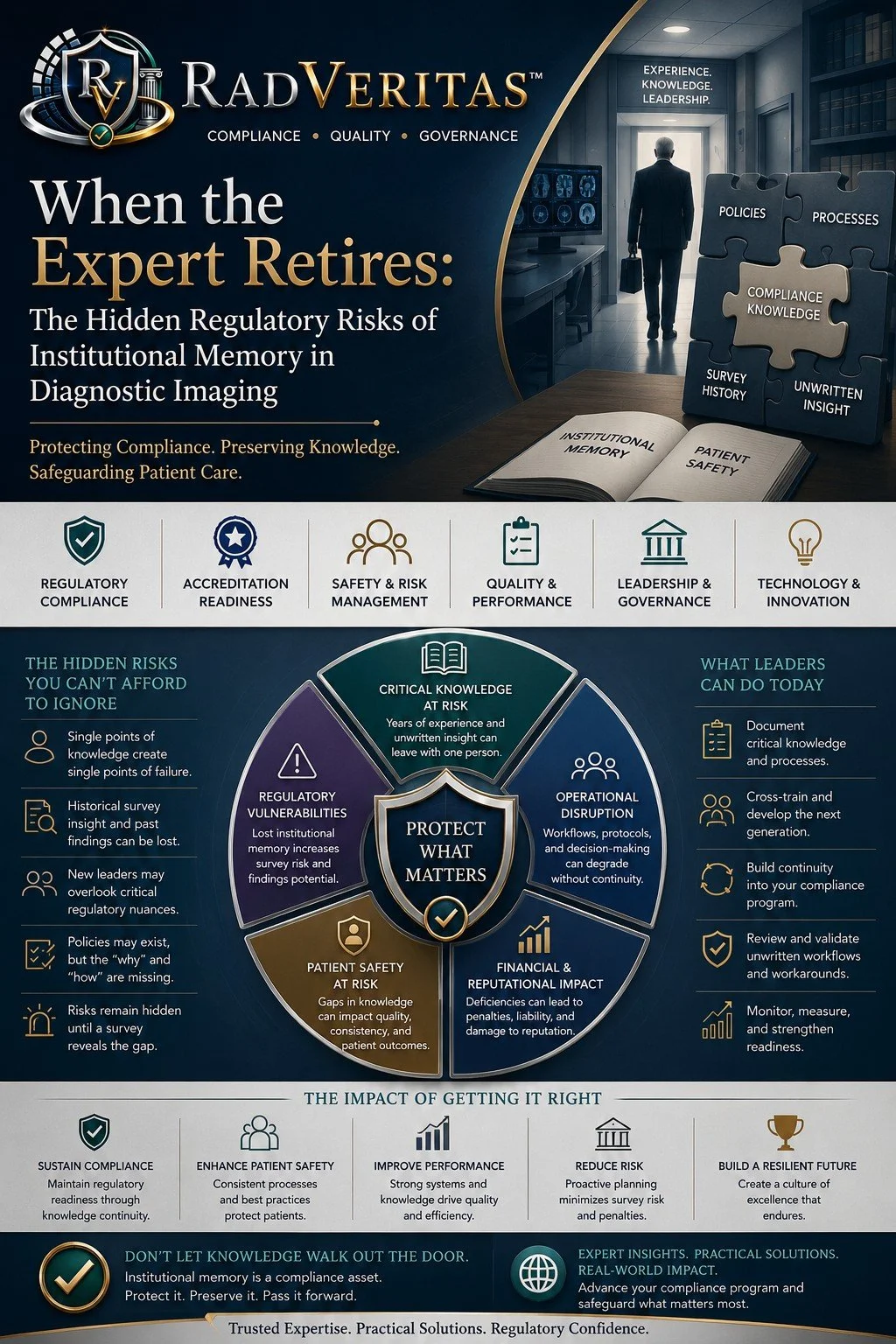
What Happens When the Person Who Knows Everything Walks Out the Door?
Every Diagnostic Imaging department has one.
The leader, supervisor, manager, physicist, technologist, or long-tenured employee who knows where every policy originated, remembers every survey finding, understands every unwritten workflow, and instinctively knows how to navigate complex regulatory requirements.
Their knowledge keeps operations moving, surveys successful, and compliance risks under control.
But what happens when they retire?
The answer is often more costly than organizations realize.
When the Expert Retires: The Hidden Regulatory Risks of Institutional Memory in Diagnostic Imaging is a strategic executive intelligence report designed to help healthcare leaders identify, evaluate, and mitigate one of the most overlooked threats to compliance, accreditation readiness, patient safety, and operational continuity: the loss of institutional knowledge.
The Compliance Risk Most Organizations Never Measure
Policies can be documented.
Procedures can be written.
Checklists can be stored.
But years of experience, historical survey insight, regulatory interpretation, operational workarounds, and organizational memory often exist only in the minds of a few key individuals.
When that knowledge leaves, organizations become vulnerable to:
Regulatory compliance failures
Accreditation deficiencies
Survey findings and citations
Operational disruption
Patient safety risks
Leadership transition challenges
Financial penalties and reputational damage
This report provides leaders with a practical framework for identifying these vulnerabilities before they become costly problems.
Protect What Matters Most
Institutional memory is more than experience.
It is a strategic compliance asset.
The organizations that thrive are not simply the ones with the best people. They are the ones that successfully preserve, transfer, and operationalize the knowledge those people possess.
When the Expert Retires: The Hidden Regulatory Risks of Institutional Memory in Diagnostic Imaging provides healthcare leaders with the insight, strategies, and practical solutions needed to protect critical knowledge before it disappears.
Don't Let Knowledge Walk Out the Door.
Preserve it. Transfer it. Strengthen it.
RadVeritas™
Compliance • Quality • Governance
Protecting Compliance. Preserving Knowledge. Safeguarding Patient Care.
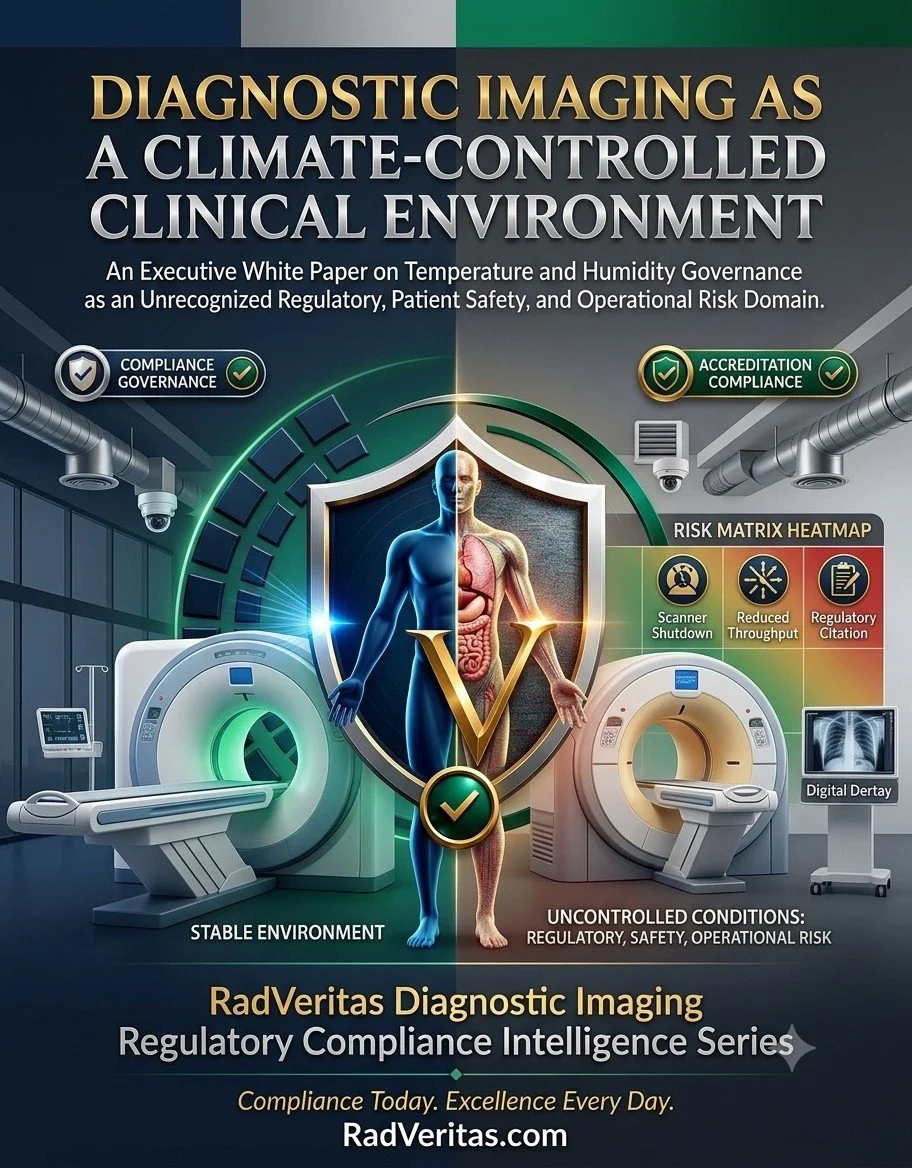
Executive White Paper on Temperature and Humidity Governance in Diagnostic Imaging
Protect Equipment. Safeguard Patients. Reduce Risk. Strengthen Compliance.
Temperature and humidity are often viewed as facilities management concerns. In reality, they represent one of the most overlooked regulatory, patient safety, operational, and accreditation risks in diagnostic imaging.
The Diagnostic Imaging as a Climate-Controlled Clinical Environment™ Executive White Paper challenges traditional thinking by demonstrating how environmental control directly affects imaging system performance, patient safety, equipment reliability, regulatory compliance, workflow continuity, and organizational resilience.
Developed for healthcare executives, imaging leaders, facilities professionals, biomedical engineers, and accreditation teams, this white paper provides a practical governance framework for managing climate control as a mission-critical component of diagnostic imaging operations.
Why Environmental Control Matters
Every diagnostic imaging modality operates within manufacturer-defined environmental specifications for temperature, humidity, and air quality.
When these conditions fall outside acceptable limits, organizations may experience:
Equipment shutdowns and service interruptions
Image quality degradation
Increased equipment failures
Regulatory deficiencies
Accreditation findings
Reduced patient throughput
Delayed diagnosis and treatment
Increased operational costs
Patient safety risks
This white paper explains why climate control should no longer be viewed solely as a facilities issue, but as an enterprise-wide governance responsibility that directly impacts compliance, quality, and operational performance.
What Makes This White Paper Different
Most guidance addresses HVAC systems from an engineering perspective.
This executive resource examines climate control through the lens of healthcare leadership, regulatory compliance, risk management, patient safety, and operational excellence.
It provides an integrated framework that connects environmental conditions with organizational performance, helping leaders identify hidden vulnerabilities before they result in equipment failures, regulatory citations, or patient care disruptions.
Key Topics Covered
Climate Control Governance
Establish leadership accountability for maintaining compliant environmental conditions across all diagnostic imaging areas.
Regulatory and Accreditation Expectations
Understand how temperature and humidity management supports compliance with manufacturer requirements, accreditation standards, and healthcare regulatory expectations.
Equipment Performance Protection
Learn how environmental stability contributes to equipment reliability, image quality, system longevity, and reduced downtime.
Patient Safety
Recognize how uncontrolled environmental conditions can indirectly affect patient care, diagnostic confidence, scheduling efficiency, and clinical outcomes.
Operational Risk Management
Identify environmental vulnerabilities that increase workflow interruptions, service delays, maintenance costs, and operational inefficiencies.
Continuous Monitoring
Develop monitoring programs that detect environmental deviations early, allowing proactive intervention before equipment performance is affected.
Executive Risk Areas Addressed
This white paper helps organizations proactively identify and manage risks associated with:
✔ Temperature excursions
✔ Humidity fluctuations
✔ HVAC system failures
✔ Scanner downtime
✔ Reduced imaging throughput
✔ Image quality degradation
✔ Equipment reliability concerns
✔ Regulatory deficiencies
✔ Accreditation findings
✔ Operational disruptions
✔ Preventive maintenance coordination
✔ Environmental monitoring documentation
Practical Leadership Strategies
The white paper provides actionable recommendations to help healthcare leaders:
Develop enterprise climate control governance programs
Align facilities management with imaging operations
Implement environmental monitoring and alert systems
Standardize escalation and response procedures
Strengthen preventive maintenance coordination
Improve documentation and regulatory defensibility
Reduce equipment downtime through proactive oversight
Integrate environmental performance into quality improvement initiatives
Enhance interdisciplinary collaboration between imaging, facilities, biomedical engineering, infection prevention, and leadership
Build sustainable operational resilience through continuous environmental monitoring
Organizational Benefits
Strengthen Regulatory Compliance
Support continuous alignment with environmental requirements that influence imaging system performance and regulatory readiness.
Improve Accreditation Readiness
Demonstrate effective oversight of environmental conditions that support safe, reliable diagnostic imaging operations.
Protect Equipment Investments
Reduce unnecessary equipment failures, service interruptions, and premature component degradation.
Improve Operational Efficiency
Maintain consistent imaging availability, minimize downtime, and improve patient throughput.
Enhance Patient Safety
Provide stable operating conditions that support accurate imaging, dependable workflows, and uninterrupted patient care.
Reduce Organizational Risk
Identify environmental vulnerabilities before they lead to compliance deficiencies, operational disruptions, or financial loss.
Built for Modern Healthcare Organizations
Healthcare organizations invest millions of dollars in advanced imaging technology, yet many continue to underestimate the operational importance of maintaining optimal environmental conditions.
This executive white paper provides a practical roadmap for integrating climate control into broader governance, quality, and risk management programs, helping organizations strengthen resilience while protecting patients, staff, and critical imaging infrastructure.
Climate Control Is More Than an Engineering Issue. It Is a Leadership Responsibility.
High-performing diagnostic imaging programs recognize that environmental stability is fundamental to regulatory compliance, operational reliability, equipment performance, and patient safety.
The Diagnostic Imaging as a Climate-Controlled Clinical Environment™ Executive White Paper provides the insight, governance framework, and practical strategies needed to transform environmental management into a strategic organizational advantage.
Protect Your Equipment. Protect Your Patients. Protect Your Organization.
Reduce risk. Improve reliability. Strengthen compliance. Drive operational excellence.
RadVeritas™
Compliance • Quality • Governance
Expert Insights. Practical Solutions. Real-World Impact.
Helping Healthcare Leaders Integrate Climate Control Governance into Diagnostic Imaging Operations to Improve Compliance, Protect Critical Imaging Systems, Enhance Patient Safety, and Build Sustainable Operational Excellence.
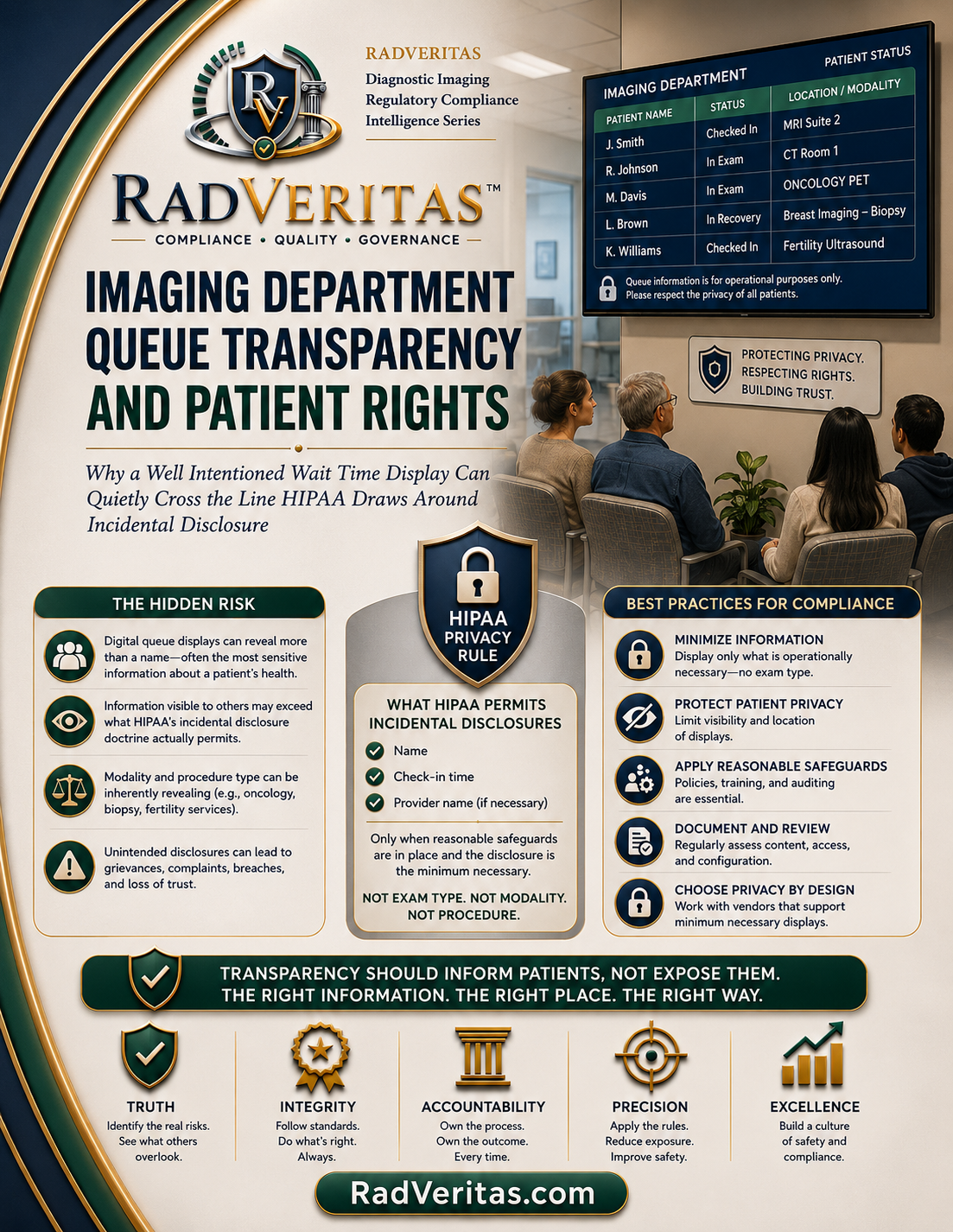
Protect Patient Privacy While Improving Operational Transparency
A Practical Executive Guide for Designing Queue Display Systems That Inform Patients Without Compromising Their Privacy.
Digital queue displays have become a common feature in diagnostic imaging departments. They improve patient flow, reduce uncertainty, and enhance the waiting experience by providing real-time status updates.
However, many organizations unintentionally cross the line between operational transparency and protected health information (PHI) disclosure.
Displaying a patient's location, imaging modality, procedure type, or clinical destination may reveal sensitive medical information that extends beyond what is necessary for operational communication.
Imaging Department Queue Transparency and Patient Rights™ provides healthcare leaders with a comprehensive framework for designing patient queue management systems that improve efficiency while protecting privacy, supporting HIPAA compliance, and strengthening patient trust.
Why This Resource Matters
Transparency should reassure patients, not expose them.
A digital queue board can unintentionally disclose highly sensitive information, including oncology appointments, fertility treatments, biopsies, interventional procedures, or other clinical services simply by displaying a patient's location or examination type.
Without thoughtful governance, these systems can create unnecessary privacy risks, patient complaints, regulatory scrutiny, and reputational harm.
This executive guide helps organizations implement queue display practices that balance operational efficiency with privacy by design.
What Makes This Resource Different
Unlike general HIPAA guidance, this resource focuses specifically on the operational realities of diagnostic imaging departments and the unique privacy challenges associated with digital patient queue displays.
It provides practical, real-world guidance for developing queue management systems that support efficient patient flow while adhering to the HIPAA "Minimum Necessary" standard and the principles of incidental disclosure.
The framework addresses queue displays used in:
Outpatient Imaging Centers
Hospital Radiology Departments
Emergency Departments
Breast Imaging Centers
Oncology Imaging Programs
Interventional Radiology
MRI, CT, Ultrasound, Nuclear Medicine, and Radiography Departments
Multi-site Enterprise Imaging Networks
Comprehensive Topics Covered
HIPAA and Incidental Disclosure
Understand when incidental disclosures may be permissible and when digital displays exceed acceptable privacy safeguards.
The Minimum Necessary Standard
Learn how to configure queue systems so only operationally necessary information is displayed, minimizing unnecessary exposure of patient information.
Queue Display Governance
Develop standardized policies governing the content, placement, visibility, and management of digital patient status boards.
Privacy by Design
Incorporate privacy considerations into system configuration, vendor selection, workflow design, and ongoing operational practices.
Leadership Accountability
Establish oversight processes for reviewing queue displays, monitoring compliance, conducting audits, and implementing corrective actions.
Key Risks Addressed
The guide helps organizations identify and reduce risks associated with:
✔ Inappropriate patient identifiers
✔ Display of examination type or modality
✔ Disclosure of clinical destinations
✔ Visibility of protected health information
✔ Unauthorized viewing by visitors or the public
✔ Patient complaints and grievances
✔ HIPAA privacy concerns
✔ Regulatory investigations
✔ Accreditation deficiencies
✔ Inconsistent departmental practices
✔ Vendor configuration issues
✔ Organizational liability
Practical Resources Included
This executive guide provides actionable tools to help organizations:
Conduct queue display privacy assessments
Develop standardized display policies
Apply the HIPAA Minimum Necessary principle
Configure digital queue systems appropriately
Evaluate display locations and visibility
Audit queue board compliance
Train staff on patient privacy responsibilities
Review vendor capabilities and privacy features
Investigate privacy-related incidents
Develop corrective action plans
Sustain continuous compliance through monitoring and leadership oversight
Designed For
Ideal for:
Diagnostic Imaging Directors
Radiology Administrators
Compliance Officers
HIPAA Privacy Officers
Risk Management Professionals
Accreditation Coordinators
Information Technology Leaders
Patient Experience Teams
Imaging Managers and Supervisors
Enterprise Imaging Executives
Healthcare Operations Leaders
Organizational Benefits
Protect Patient Privacy
Reduce the risk of unnecessary disclosures while preserving patient dignity, confidentiality, and trust.
Improve Regulatory Compliance
Support alignment with HIPAA privacy requirements and organizational expectations through standardized governance and operational safeguards.
Enhance Patient Experience
Provide meaningful wait-time transparency without revealing sensitive clinical information.
Reduce Organizational Risk
Identify and eliminate privacy vulnerabilities before they result in complaints, investigations, or regulatory findings.
Standardize Operational Practices
Create consistent enterprise-wide policies governing digital queue displays across all imaging locations.
Strengthen Leadership Oversight
Equip leaders with practical tools for auditing, monitoring, and continuously improving patient privacy practices.
Built for Modern Diagnostic Imaging Operations
As healthcare organizations continue to adopt digital workflow technologies, patient transparency must never come at the expense of patient privacy.
Whether implementing a new queue management system, upgrading existing digital displays, preparing for accreditation surveys, or strengthening HIPAA compliance, Imaging Department Queue Transparency and Patient Rights™ provides the practical guidance needed to create privacy-conscious, patient-centered imaging environments.
Transparency Should Build Trust, Not Create Exposure.
A thoughtfully designed queue display can improve communication, reduce patient anxiety, and enhance operational efficiency. An improperly configured display can unintentionally reveal sensitive health information and expose the organization to unnecessary risk.
Imaging Department Queue Transparency and Patient Rights™ helps healthcare leaders establish defensible, privacy-focused practices that support operational excellence while protecting every patient's right to confidentiality.
Inform Patients. Protect Privacy. Strengthen Trust.
Reduce risk. Improve compliance. Enhance the patient experience. Build privacy into every display.
RadVeritas™
Compliance • Quality • Governance
Compliance Today. Excellence Every Day.
Expert Insights. Practical Solutions. Real-World Impact.
Helping Diagnostic Imaging Leaders Design Privacy-First Queue Management Systems That Protect Patient Rights, Strengthen HIPAA Compliance, and Deliver Operational Excellence.
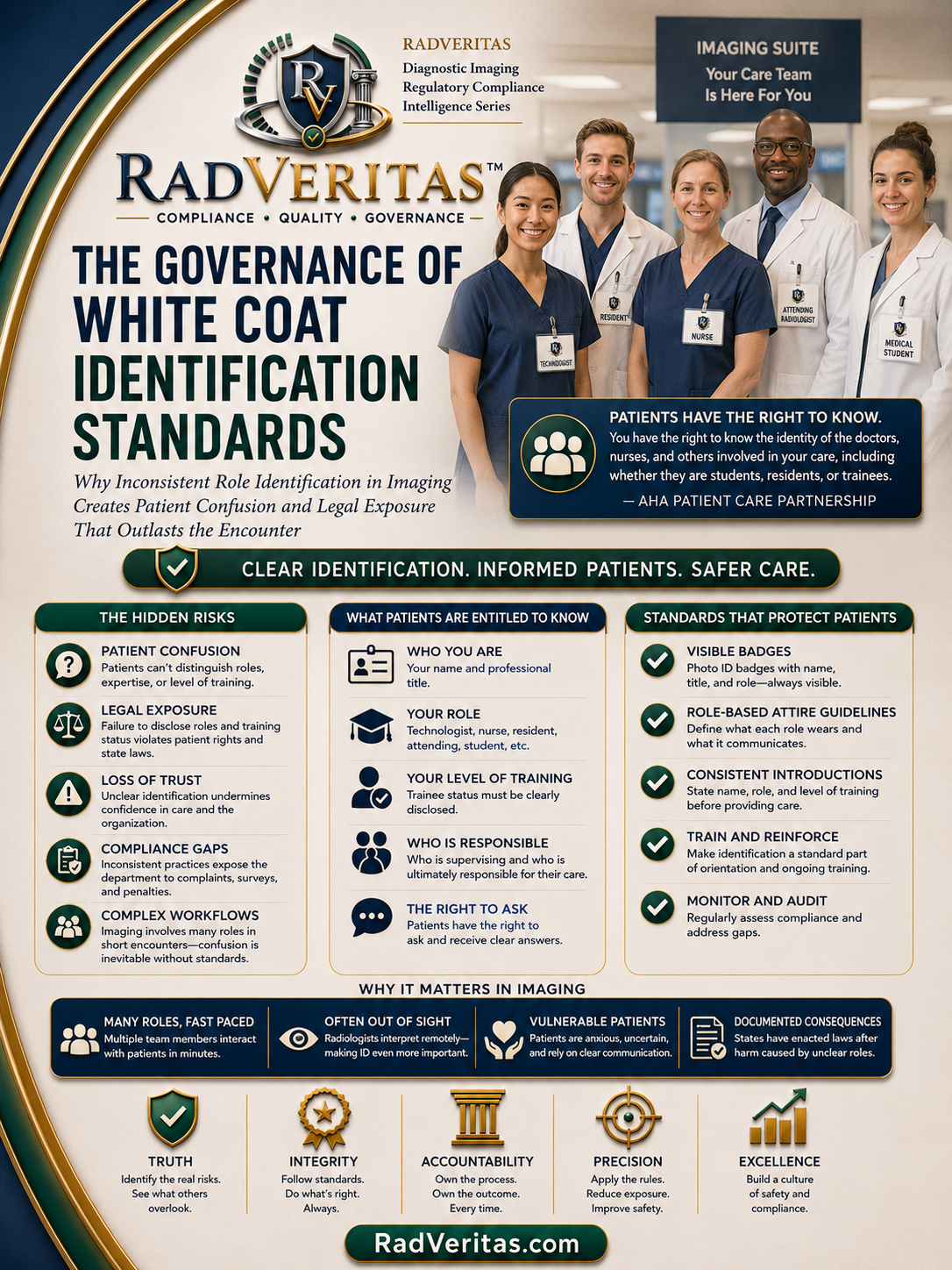
Building Patient Trust Through Clear Identification, Professional Transparency, and Healthcare Accountability
Every Patient Has the Right to Know Who Is Providing Their Care.
A patient entering an imaging department should never have to guess who is caring for them.
Is the individual performing the examination a technologist, nurse, physician, resident, student, or trainee? Who is supervising the procedure? Who is ultimately responsible for clinical decisions?
When professional roles are unclear, patient confidence declines, communication suffers, and organizations increase their exposure to complaints, liability, and regulatory scrutiny.
The Governance of White Coat Identification Standards™ provides healthcare leaders with a comprehensive framework for establishing consistent identification practices that promote transparency, strengthen patient trust, improve communication, and support regulatory and patient-centered care initiatives across diagnostic imaging.
Why This Resource Matters
Every patient interaction begins with identification.
Patients have the right to understand the identity, role, qualifications, and level of training of every individual involved in their care. Consistent identification supports informed decision-making, reinforces confidence, and reduces confusion during what is often a stressful healthcare experience.
Without standardized identification practices, organizations may face:
Patient confusion regarding caregiver roles
Inconsistent introductions across departments
Misunderstanding of trainee participation
Communication breakdowns
Patient complaints and grievances
Survey findings related to patient-centered care
Increased legal and reputational risk
Reduced patient confidence and satisfaction
This executive guide helps organizations create a culture where professional identification is standardized, transparent, and consistently practiced.
What Makes This Resource Different
Unlike general dress code or uniform policies, this guide focuses on identification as a core element of patient safety, communication, governance, and organizational accountability.
It provides a practical framework that integrates patient rights, operational standards, professional appearance, and leadership oversight into one comprehensive governance program.
The framework supports consistency across:
Diagnostic Imaging
Emergency Departments
Outpatient Imaging Centers
Academic Medical Centers
Teaching Hospitals
Ambulatory Care Settings
Multi-Hospital Health Systems
Enterprise Imaging Programs
Comprehensive Topics Covered
Professional Identification Standards
Develop consistent policies governing photo identification badges, professional titles, credentials, uniforms, and white coat use across all imaging disciplines.
Patient Communication
Standardize introductions so every patient clearly understands who is providing care, each individual's role, and the level of supervision involved.
Role Transparency
Clearly distinguish physicians, technologists, nurses, students, residents, fellows, advanced practice providers, and support personnel through visible identification and standardized communication.
Leadership Governance
Create accountability through policies, education, monitoring, and continuous performance improvement.
Patient Rights
Support organizational initiatives that promote informed participation, transparency, respect, and patient-centered care throughout the imaging experience.
Key Risks Addressed
The guide helps organizations identify and reduce risks associated with:
✔ Patient confusion regarding caregiver roles
✔ Failure to identify trainees and supervised personnel
✔ Inconsistent badge and uniform practices
✔ Communication failures
✔ Patient complaints and grievances
✔ Loss of patient confidence
✔ Survey deficiencies related to patient-centered care
✔ Legal exposure associated with unclear role disclosure
✔ Operational inconsistency across imaging departments
✔ Weak leadership oversight of professional identification standards
Practical Resources Included
This executive guide provides actionable tools to help organizations:
Develop standardized identification policies
Establish professional badge display requirements
Define role-based attire and white coat standards
Standardize patient introductions
Create staff education and orientation programs
Develop role identification guides
Perform departmental compliance audits
Monitor adherence to identification standards
Address deficiencies through corrective action planning
Strengthen leadership oversight and continuous improvement initiatives
Designed For
Ideal for:
Diagnostic Imaging Directors
Radiology Administrators
Imaging Managers and Supervisors
Patient Experience Leaders
Compliance Officers
Accreditation Coordinators
Nursing Leadership
Medical Staff Leadership
Quality Improvement Professionals
Human Resources
Executive Healthcare Leadership
Organizational Benefits
Strengthen Patient Trust
Provide patients with clear, consistent information about the professionals involved in their care.
Improve Communication
Reduce uncertainty by ensuring every caregiver introduces themselves with their name, professional role, and responsibilities.
Support Patient-Centered Care
Promote transparency, respect, and informed participation throughout the imaging experience.
Reduce Organizational Risk
Minimize complaints, misunderstandings, and legal exposure associated with inconsistent role identification.
Improve Regulatory Readiness
Demonstrate standardized governance practices that support patient rights, communication, and quality initiatives.
Standardize Enterprise Practices
Create a consistent identification program across hospitals, outpatient imaging centers, and integrated health systems.
Built for Modern Healthcare Organizations
Professional identification is more than a name badge. It is a visible commitment to transparency, accountability, and patient-centered care.
Whether implementing enterprise identification standards, preparing for accreditation surveys, improving patient experience, or strengthening organizational governance, The Governance of White Coat Identification Standards™ provides healthcare leaders with the practical tools needed to create a consistent, defensible identification program.
Clear Identification Builds Confidence.
Patients should never have to wonder who is providing their care or what role each team member plays.
The Governance of White Coat Identification Standards™ helps healthcare organizations transform identification from a routine administrative requirement into a strategic initiative that strengthens communication, reinforces accountability, enhances patient confidence, and supports regulatory excellence.
Clear Identification. Informed Patients. Safer Care.
Strengthen transparency. Improve communication. Enhance patient trust. Build a culture of accountability.
RadVeritas™
Compliance • Quality • Governance
Compliance Today. Excellence Every Day.
Expert Insights. Practical Solutions. Real-World Impact.
Helping Diagnostic Imaging Leaders Standardize Professional Identification, Promote Patient-Centered Care, Strengthen Organizational Accountability, and Build Sustainable Compliance Through Transparency and Operational Excellence.
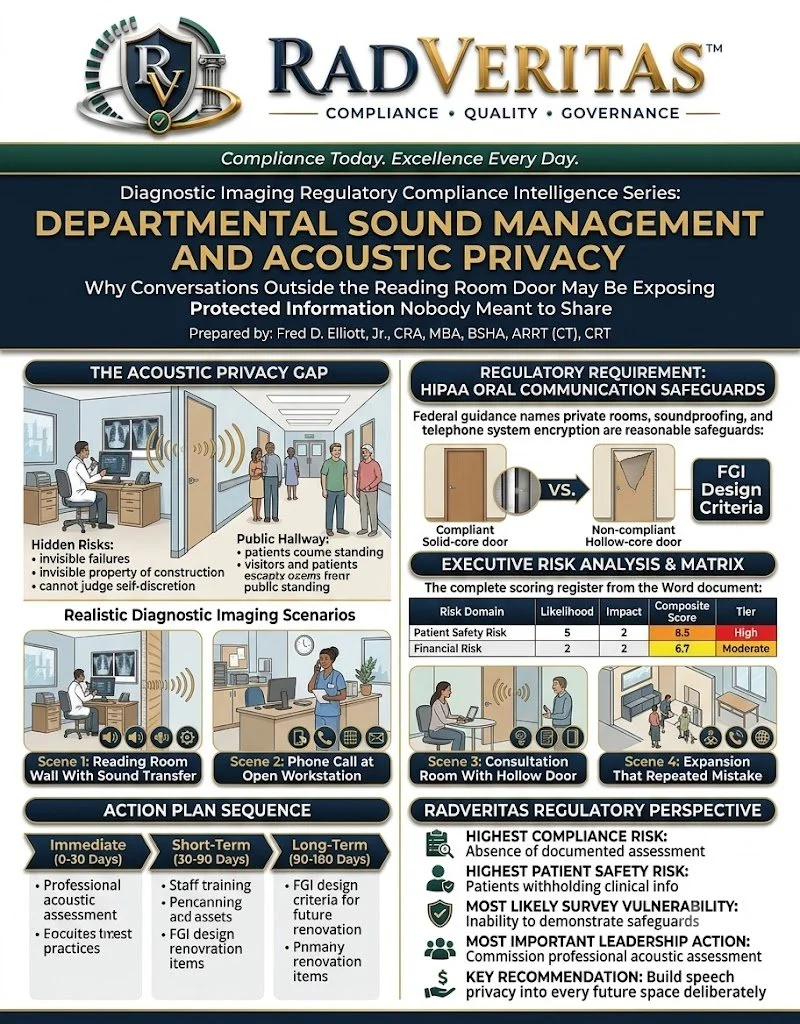
Protect Conversations. Protect Patients. Protect Compliance.
A Comprehensive Governance Framework for Acoustic Privacy, Speech Confidentiality, and HIPAA Compliance in Diagnostic Imaging.
Not every privacy breach begins with a cyberattack.
Sometimes it begins with a conversation that travels through a hollow-core door.
A radiologist discussing critical findings. A technologist confirming a patient's diagnosis. A physician consulting another provider. A scheduler verifying protected health information over the telephone.
When speech extends beyond the intended space, Protected Health Information (PHI) can unintentionally become accessible to patients, visitors, contractors, or staff without a legitimate need to know.
Departmental Sound Management and Acoustic Privacy™ provides healthcare organizations with a comprehensive governance framework for identifying, assessing, and mitigating acoustic privacy risks throughout diagnostic imaging departments. By integrating architectural planning, operational workflows, leadership oversight, and regulatory compliance, this resource helps organizations safeguard confidential conversations while strengthening patient trust and organizational resilience.
Why This Resource Matters
Speech privacy is an essential component of patient privacy.
Diagnostic Imaging environments generate thousands of verbal communications every day involving patient identifiers, imaging findings, clinical discussions, scheduling information, and treatment decisions.
Without effective acoustic safeguards, organizations increase their exposure to:
Unauthorized disclosure of Protected Health Information
HIPAA privacy violations
Patient complaints and grievances
Loss of patient confidence
Regulatory deficiencies
Accreditation findings
Reputational harm
Operational redesign costs
This executive resource helps healthcare leaders proactively identify vulnerabilities before they become reportable privacy events.
What Makes This Resource Different
Most privacy programs emphasize electronic information security while overlooking verbal communication.
This guide focuses specifically on acoustic privacy within diagnostic imaging, combining regulatory expectations with practical architectural and operational strategies.
The framework addresses:
Reading Rooms
Consultation Rooms
Imaging Control Rooms
Patient Registration Areas
Scheduling Offices
Shared Workspaces
Hallways and Public Corridors
Telephone Communications
Staff Collaboration Areas
Future Imaging Facility Design
Rather than treating sound privacy as a construction issue alone, this resource establishes it as an enterprise governance responsibility.
Comprehensive Topics Covered
Acoustic Privacy Risk Assessment
Identify areas where confidential conversations may unintentionally extend beyond intended spaces because of building design, workflow, occupancy, or operational practices.
Architectural Design Considerations
Evaluate doors, wall assemblies, ceilings, glazing, HVAC systems, room placement, and sound isolation strategies that support confidential communication.
HIPAA Oral Communication Safeguards
Develop policies and operational practices that reduce the risk of unauthorized verbal disclosure while maintaining efficient clinical communication.
Operational Workflow Optimization
Improve staff practices related to discussions, consultations, telephone use, interdisciplinary communication, and patient interactions.
Leadership Governance
Establish accountability for monitoring acoustic privacy, implementing corrective actions, and incorporating speech confidentiality into facility planning and renovation projects.
Continuous Improvement
Create sustainable monitoring programs using audits, risk assessments, staff education, and performance metrics to maintain long-term compliance.
Key Risks Addressed
This guide helps organizations proactively reduce:
✔ Unauthorized verbal disclosure of Protected Health Information
✔ Reading room sound transfer
✔ Consultation room confidentiality gaps
✔ Public hallway overhearing
✔ Telephone privacy vulnerabilities
✔ Shared workspace communication risks
✔ Architectural design deficiencies
✔ HIPAA privacy complaints
✔ Accreditation survey findings
✔ Loss of patient confidence and trust
Practical Resources Included
This executive resource provides implementation-ready tools, including:
Acoustic Privacy Risk Assessment Templates
Reading Room Evaluation Checklists
Consultation Room Assessment Guides
HIPAA Oral Communication Audit Tools
Architectural Planning Recommendations
Sound Isolation Assessment Frameworks
Staff Education and Awareness Materials
Leadership Walkthrough Checklists
Corrective Action Plan Templates
Performance Monitoring Dashboards
Renovation Planning Considerations
Continuous Compliance Audit Tools
Designed For
Ideal for:
Diagnostic Imaging Directors
Radiology Administrators
Compliance Officers
Privacy Officers
HIPAA Program Leaders
Facilities Management
Healthcare Architects and Facility Planners
Accreditation Coordinators
Patient Experience Leaders
Quality Improvement Professionals
Risk Management Teams
Executive Healthcare Leadership
Organizational Benefits
Strengthen Patient Privacy
Protect confidential conversations and reinforce every patient's expectation of privacy throughout the imaging experience.
Improve Regulatory Compliance
Demonstrate effective safeguards supporting HIPAA Privacy Rule requirements and accreditation expectations for confidential communication.
Reduce Organizational Risk
Identify architectural and operational vulnerabilities before they result in privacy complaints, investigations, or corrective action.
Support Better Facility Design
Incorporate acoustic privacy into new construction, renovations, and imaging department expansion projects.
Enhance Patient Confidence
Create environments where patients feel secure discussing sensitive medical information without concern that others may overhear.
Build Sustainable Governance
Integrate acoustic privacy into routine operations, leadership oversight, facility planning, and continuous quality improvement initiatives.
Built for Modern Diagnostic Imaging Operations
Protecting patient privacy extends beyond securing electronic records. Every conversation within an imaging department is part of the organization's commitment to confidentiality, professionalism, and patient-centered care.
Whether constructing a new imaging center, renovating existing facilities, preparing for accreditation surveys, or strengthening HIPAA compliance programs, Departmental Sound Management and Acoustic Privacy™ provides healthcare leaders with the practical guidance needed to transform acoustic privacy into a measurable component of operational excellence.
Privacy Is More Than Data. It Is Every Conversation.
The most effective privacy programs protect information wherever it exists, including the spoken word.
Departmental Sound Management and Acoustic Privacy™ helps healthcare organizations establish proactive acoustic privacy programs that strengthen patient trust, reduce regulatory exposure, support architectural excellence, and create environments where confidential conversations remain confidential.
Protect Conversations. Strengthen Privacy. Build Trust.
Reduce risk. Improve confidentiality. Strengthen compliance. Privacy design.
RadVeritas™
Compliance • Quality • Governance
Compliance Today. Excellence Every Day.
Expert Insights. Practical Solutions. Real-World Impact.
Helping Diagnostic Imaging Leaders Build Enterprise Acoustic Privacy Programs That Protect Confidential Communications, Strengthen HIPAA Compliance, Enhance Facility Design, and Promote Patient Trust Through Sustainable Governance and Operational Excellence.
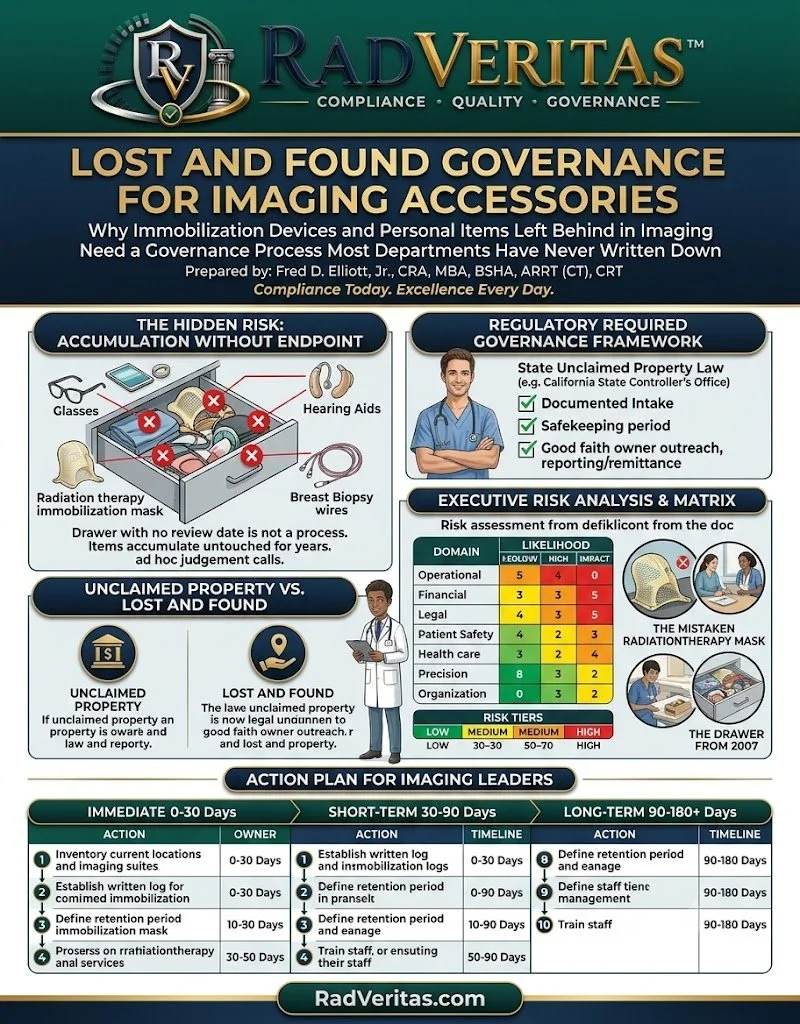
Transform Forgotten Drawers, Unclaimed Accessories, and Personal Items into a Defensible Governance Program.
Because Every Unclaimed Item Represents a Potential Compliance, Legal, Financial, and Patient Trust Risk.
Nearly every diagnostic imaging department has one.
A drawer, cabinet, shelf, or storage room containing forgotten immobilization devices, hearing aids, eyeglasses, prosthetics, biopsy accessories, radiation therapy devices, and personal belongings with no documented ownership, retention process, or disposition plan.
Over time, these items accumulate silently until an inspection, audit, patient inquiry, or legal claim exposes a governance gap that no one realized existed.
Lost and Found Governance for Imaging Accessories™ provides healthcare organizations with a comprehensive framework for establishing a defensible, enterprise-wide governance program for lost, abandoned, unclaimed, and retained imaging accessories and patient property.
Rather than treating lost and found as a housekeeping task, this resource positions it as an essential component of regulatory compliance, risk management, patient safety, and operational accountability.
Why This Resource Matters
Diagnostic imaging departments routinely manage valuable and clinically significant items, including:
Immobilization devices
Radiation therapy masks
Hearing aids
Eyeglasses
Breast biopsy accessories
Prosthetic devices
Patient valuables
Assistive devices
Specialty imaging accessories
Department-owned reusable equipment
Without standardized governance, organizations face risks such as:
Lost patient property claims
Improper retention or disposal
Inconsistent chain of custody
Documentation failures
Regulatory deficiencies
Financial liability
Patient dissatisfaction
Operational inefficiencies
Audit findings
Legal exposure involving unclaimed property laws
This manual provides a structured system to prevent these issues before they become organizational liabilities.
What Makes This Resource Different
Most healthcare organizations have policies for patient belongings, but few have a comprehensive governance program for imaging-specific accessories and unclaimed items.
This resource bridges that gap by integrating:
Regulatory Compliance
Risk Management
Patient Property Governance
Operational Accountability
Documentation Standards
Chain of Custody
Inventory Control
Retention and Disposition
Quality Improvement
Survey Readiness
The result is a repeatable, auditable process that protects patients, staff, and the organization.
Comprehensive Topics Covered
Imaging Accessory Governance
Develop standardized processes for managing department-owned and patient-owned accessories throughout their lifecycle.
Lost and Found Program Development
Create formal procedures for receiving, documenting, storing, tracking, and returning lost items while maintaining accountability.
Unclaimed Property Management
Differentiate between lost-and-found property and legally defined unclaimed property, with guidance for retention periods and disposition processes.
Documentation and Chain of Custody
Establish complete documentation requirements, including intake logs, ownership verification, storage records, transfer documentation, and final disposition.
Inventory Management
Maintain centralized inventories of retained accessories and immobilization devices to improve accountability and reduce unnecessary accumulation.
Regulatory and Legal Considerations
Understand the governance principles that support compliance with organizational policies, patient property expectations, state unclaimed property requirements, and healthcare documentation standards.
Key Risks Addressed
This resource helps organizations reduce:
✔ Lost patient property claims
✔ Improper disposal of patient belongings
✔ Uncontrolled storage of imaging accessories
✔ Missing documentation
✔ Chain-of-custody failures
✔ Inventory inaccuracies
✔ Regulatory and survey findings
✔ Legal exposure related to abandoned property
✔ Operational inefficiencies
✔ Patient dissatisfaction and reputational harm
Practical Resources Included
This implementation-focused guide includes:
Lost and Found Policy Templates
Imaging Accessory Inventory Logs
Chain of Custody Forms
Patient Property Documentation Tools
Unclaimed Property Decision Trees
Retention Schedule Templates
Storage and Security Checklists
Department Audit Checklists
Risk Assessment Matrix
Corrective Action Planning Tools
Leadership Oversight Dashboards
Continuous Compliance Monitoring Worksheets
Designed For
Ideal for:
Diagnostic Imaging Directors
Radiology Administrators
Department Managers
Compliance Officers
Risk Managers
Patient Experience Leaders
Quality Improvement Teams
Radiation Oncology Leaders
Breast Imaging Programs
MRI and CT Leadership
Hospital Operations Executives
Accreditation Coordinators
Organizational Benefits
Protect Patient Trust
Demonstrate respect for patient property through consistent, documented, and accountable management practices.
Strengthen Regulatory Compliance
Establish standardized processes that support organizational policies, documentation expectations, and regulatory readiness.
Reduce Organizational Liability
Minimize legal, financial, and operational risks associated with lost, abandoned, or improperly managed property.
Improve Operational Efficiency
Replace inconsistent practices with standardized workflows that improve accountability and reduce unnecessary storage.
Enhance Survey Readiness
Provide auditors and surveyors with documented evidence of structured governance, inventory control, and continuous oversight.
Support Enterprise Accountability
Create clearly defined ownership, responsibilities, retention schedules, and performance monitoring across imaging operations.
Built for Modern Healthcare Organizations
Every forgotten immobilization device, hearing aid, biopsy accessory, or patient belonging tells a story about organizational governance.
Without standardized oversight, departments accumulate risk that often remains hidden until a patient complaint, audit, or regulatory inspection uncovers it.
Lost and Found Governance for Imaging Accessories™ provides healthcare leaders with the policies, tools, and governance framework needed to transform an overlooked operational task into a mature compliance program that protects patients, strengthens accountability, and supports continuous operational excellence.
Governance Doesn't End When the Exam Is Complete.
True compliance extends beyond image acquisition. It includes responsible stewardship of every accessory, every personal item, and every asset entrusted to your department.
Lost and Found Governance for Imaging Accessories™ helps healthcare organizations build a defensible, organization-wide program that improves documentation, strengthens accountability, reduces legal exposure, and demonstrates an enduring commitment to patient-centered care.
Every Item Accounted For. Every Process Documented. Every Decision Defensible.
Protect patients. Reduce liability. Strengthen governance. Maintain continuous compliance.
RadVeritas™
Compliance • Quality • Governance
Compliance Today. Excellence Every Day.
Expert Insights. Practical Solutions. Real-World Impact.
Helping Diagnostic Imaging Leaders Build Enterprise Governance Programs for Patient Property, Imaging Accessories, Chain of Custody, Documentation, Regulatory Compliance, Risk Reduction, and Operational Excellence.
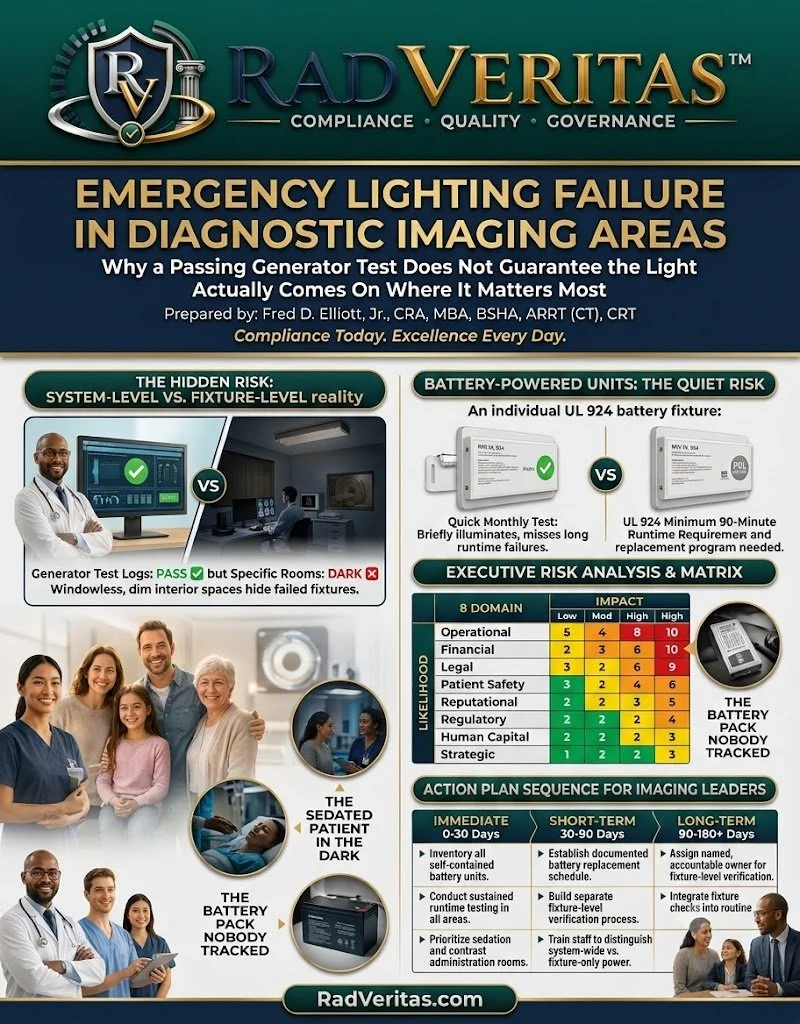
When the Lights Go Out, Compliance, Patient Safety, and Operational Readiness Are Put to the Ultimate Test.
Because a Successful Generator Test Does Not Guarantee That Emergency Lighting Will Work Where Your Patients Need It Most.
Most healthcare organizations routinely test their emergency generators and believe they are fully prepared for a power outage. Yet many diagnostic imaging departments unknowingly rely on emergency lighting fixtures with aging batteries, undocumented maintenance histories, or inadequate runtime verification.
The result is a dangerous gap between system-level readiness and fixture-level performance.
Emergency Lighting Failure in Diagnostic Imaging Areas™ is a comprehensive executive reference that equips healthcare leaders with the tools, governance framework, and operational strategies needed to ensure emergency lighting systems perform reliably during actual emergencies. From battery-powered emergency fixtures to generator-supported lighting, this resource transforms emergency illumination into a measurable, auditable, and continuously managed safety program.
Why This Resource Matters
Diagnostic imaging environments present unique challenges during power failures.
Patients may be sedated, receiving intravenous contrast, positioned within MRI, CT, PET/CT, Interventional Radiology, or Nuclear Medicine suites, or undergoing time-sensitive emergency procedures when normal power is lost.
Without dependable emergency lighting, organizations may face:
Delayed patient evacuation
Increased fall risks
Medication and contrast administration errors
Staff disorientation
Equipment shutdown complications
Fire and life safety deficiencies
Survey findings
Regulatory citations
Operational disruption
Significant organizational liability
This manual provides imaging leaders with a structured governance framework to proactively identify, assess, and mitigate these risks before an emergency occurs.
What Makes This Resource Different
Most emergency preparedness programs focus on generator testing. Few evaluate whether individual emergency lighting fixtures, self-contained battery units, and imaging suite illumination actually perform as required during a prolonged outage.
This resource integrates:
Emergency Preparedness
Environment of Care
Fire and Life Safety
Facilities Management
Diagnostic Imaging Operations
Regulatory Compliance
Risk Management
Accreditation Readiness
Operational Resilience
Executive Governance
The result is a comprehensive program that connects infrastructure testing with real-world patient care conditions.
Comprehensive Topics Covered
Emergency Lighting System Governance
Develop an enterprise-wide oversight program for emergency lighting across all diagnostic imaging environments.
Generator and Fixture Performance
Understand the critical distinction between successful generator testing and individual emergency lighting fixture functionality.
Battery-Powered Emergency Lighting
Establish inspection, maintenance, replacement, and runtime verification programs for self-contained emergency lighting units.
Imaging Suite Risk Assessments
Evaluate emergency illumination in MRI, CT, Nuclear Medicine, PET/CT, Interventional Radiology, Ultrasound, and Radiography environments.
Operational Readiness
Develop procedures that support patient movement, staff response, equipment access, and emergency workflows during power interruptions.
Documentation and Compliance
Implement standardized documentation, testing schedules, maintenance records, corrective actions, and leadership oversight.
Key Risks Addressed
This resource helps organizations reduce:
✔ Emergency lighting failures
✔ Inadequate battery maintenance
✔ Fire and life safety deficiencies
✔ Environment of Care findings
✔ Patient evacuation risks
✔ Staff injury potential
✔ Regulatory citations
✔ Accreditation survey findings
✔ Operational downtime
✔ Financial and reputational exposure
Practical Resources Included
This implementation-focused guide includes:
Emergency Lighting Inspection Checklists
Battery Inventory and Replacement Logs
Runtime Verification Worksheets
Imaging Area Risk Assessments
Preventive Maintenance Schedules
Corrective Action Planning Tools
Executive Risk Matrices
Leadership Oversight Dashboards
Survey Readiness Checklists
Policy and Procedure Templates
Continuous Compliance Monitoring Tools
Performance Audit Worksheets
Designed For
Ideal for:
Diagnostic Imaging Directors
Radiology Administrators
Facilities Management
Environment of Care Leaders
Safety Officers
Emergency Preparedness Coordinators
Compliance Officers
Risk Managers
Biomedical Engineering
Accreditation Coordinators
Hospital Operations Executives
Quality Improvement Teams
Organizational Benefits
Strengthen Emergency Preparedness
Ensure emergency lighting systems perform as expected during real-world power failures, not just during scheduled generator tests.
Protect Patients and Staff
Improve visibility and safety for patients undergoing imaging procedures and staff responding during emergency conditions.
Enhance Regulatory Compliance
Support compliance with fire and life safety expectations, Environment of Care standards, emergency preparedness requirements, and accreditation readiness.
Improve Operational Reliability
Create standardized inspection, maintenance, and testing processes that reduce equipment failures and strengthen organizational resilience.
Reduce Organizational Risk
Identify hidden vulnerabilities before they become patient safety events, operational disruptions, or regulatory findings.
Build Executive Confidence
Provide leadership with measurable performance data, documented oversight, and defensible evidence of continuous compliance.
Built for Modern Diagnostic Imaging Operations
Emergency lighting is more than a facility requirement. It is a critical patient safety system that supports clinical care when every second matters.
Emergency Lighting Failure in Diagnostic Imaging Areas™ provides healthcare organizations with the governance framework, practical tools, and operational guidance needed to ensure emergency illumination remains reliable, compliant, and ready when normal power is no longer available.
Preparedness Is Proven in the Dark.
A passing generator test is only one measure of readiness. True preparedness requires confidence that every emergency lighting fixture, battery unit, and illumination pathway will perform when patients and staff depend on them most.
Emergency Lighting Failure in Diagnostic Imaging Areas™ helps healthcare leaders transform emergency lighting from a routine maintenance task into a comprehensive governance program that strengthens patient safety, regulatory compliance, and operational resilience.
Every Fixture Verified. Every Battery Accounted For. Every Emergency Prepared For.
Protect patients. Support staff. Strengthen resilience. Demonstrate compliance.
RadVeritas™
Compliance • Quality • Governance
Compliance Today. Excellence Every Day.
Expert Insights. Practical Solutions. Real-World Impact.
Helping Diagnostic Imaging Leaders Build Enterprise Programs for Emergency Lighting, Environment of Care, Fire and Life Safety, Operational Readiness, Regulatory Compliance, Risk Management, and Continuous Organizational Resilience.
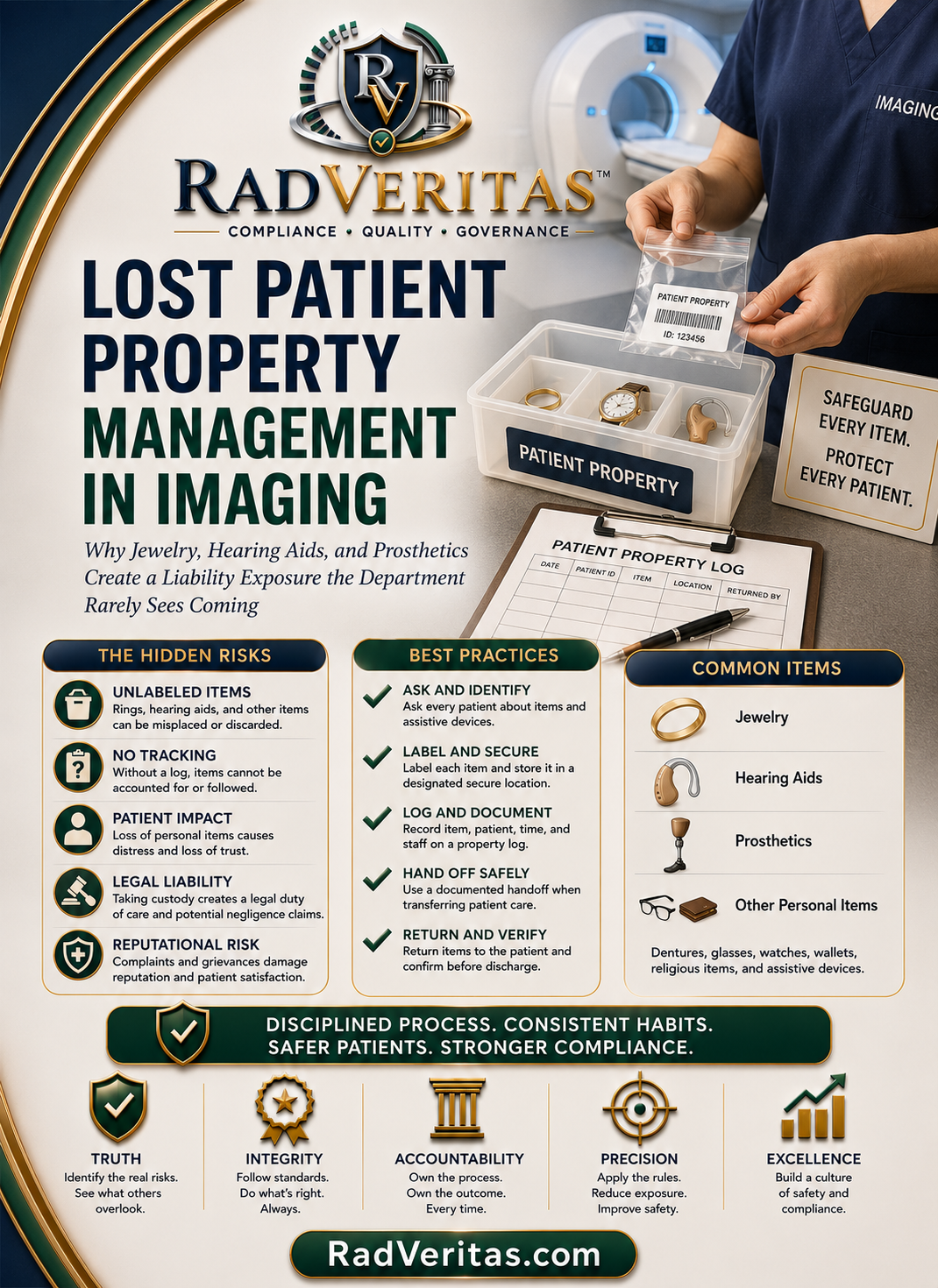
Protect Patient Belongings. Reduce Liability. Strengthen Accountability.
The Executive Resource for Building a Defensible Patient Property Management Program in Diagnostic Imaging.
Every day, patients entrust diagnostic imaging departments with their most valuable personal belongings, including wedding rings, hearing aids, dentures, eyeglasses, prosthetics, wallets, mobile devices, religious items, and other assistive devices.
When those items are misplaced, damaged, or lost, the consequences extend far beyond replacement costs. Patient complaints, liability claims, regulatory scrutiny, staff distrust, and reputational damage can all stem from a single breakdown in property management.
The Lost Patient Property Management in Imaging™ guide provides healthcare organizations with a comprehensive framework to establish standardized processes that protect patient property, reduce organizational risk, and improve patient confidence through consistent, accountable practices.
Why Patient Property Management Matters
Every item removed from a patient creates a chain of responsibility.
Without standardized procedures, organizations face unnecessary exposure from:
Lost or misplaced patient belongings
Inconsistent documentation
Breakdowns during patient handoffs
Patient complaints and grievances
Financial reimbursement claims
Legal liability
Staff accountability issues
Reduced patient trust
Operational inefficiencies
Regulatory and accreditation concerns
A disciplined property management process protects both patients and healthcare organizations while reinforcing a culture of safety and accountability.
What Makes This Resource Different
Unlike general lost-and-found policies, this executive guide focuses specifically on the unique operational challenges within diagnostic imaging departments.
It addresses property management across the complete imaging workflow, including:
Outpatient imaging
Emergency Department imaging
Inpatient imaging
Surgical and procedural imaging
Trauma imaging
Mobile imaging
MRI safety screening
CT and Interventional Radiology preparation
Nuclear Medicine
Radiation Oncology
Patient transport and care transitions
The framework integrates operational best practices with regulatory expectations to create a consistent, defensible process for safeguarding patient belongings.
Comprehensive Topics Covered
Patient Property Identification
Implement standardized screening procedures to identify jewelry, hearing aids, dentures, prosthetics, eyeglasses, wallets, mobile devices, and other personal belongings before imaging begins.
Property Documentation
Establish clear documentation standards that record each item, its condition, storage location, transfer of custody, and return to the patient.
Secure Storage Procedures
Develop secure, organized storage systems that minimize the risk of loss, theft, damage, or unauthorized access.
Chain of Custody
Create documented handoff procedures that establish accountability whenever patient property changes possession between departments, caregivers, or transport personnel.
Return Verification
Implement standardized verification processes to ensure belongings are returned to the correct patient before discharge or transfer.
Staff Accountability
Define responsibilities for every member of the care team to ensure consistent handling of patient property across all imaging environments.
Key Risks Addressed
The guide helps organizations reduce risks associated with:
✔ Lost patient belongings
✔ Unlabeled personal items
✔ Missing documentation
✔ Breakdowns in the chain of custody
✔ Hearing aids, dentures, and prosthetic devices
✔ Jewelry and valuables
✔ Mobile phones and electronic devices
✔ Patient complaints and grievances
✔ Liability and negligence claims
✔ Reimbursement disputes
✔ Staff accountability failures
✔ Reputational harm
Best Practices Included
The resource provides practical guidance for:
Identifying patient belongings before imaging
Labeling and securing valuables
Establishing standardized property logs
Creating chain-of-custody documentation
Performing patient handoff verification
Returning belongings safely before discharge
Training staff on consistent property management procedures
Auditing compliance and identifying process gaps
Investigating property-related incidents
Building a culture of accountability and patient trust
Designed For
Ideal for:
Diagnostic Imaging Directors
Radiology Administrators
Imaging Managers and Supervisors
MRI Safety Officers
Patient Experience Leaders
Compliance Officers
Risk Management Professionals
Accreditation Coordinators
Quality Improvement Teams
Emergency Department Leaders
Perioperative Services
Transport Services
Hospital Executives
Organizational Benefits
Protect Patients
Safeguard valuables, assistive devices, and personal belongings while improving the overall patient experience.
Reduce Liability
Minimize claims, complaints, investigations, and financial losses associated with missing or damaged property.
Improve Accountability
Establish standardized documentation and chain-of-custody processes that clearly define staff responsibilities.
Enhance Operational Efficiency
Create consistent workflows that reduce confusion, improve communication, and streamline patient transitions.
Strengthen Regulatory Readiness
Support compliance with organizational policies, patient rights, quality standards, and accreditation expectations through documented, repeatable processes.
Build Patient Confidence
Demonstrate professionalism and respect by protecting the belongings patients value most during their care.
Built for Modern Diagnostic Imaging Operations
Patient property management is more than a courtesy. It is a patient safety, quality, operational, and risk management responsibility.
Whether handling a wedding ring before an MRI, securing a hearing aid before CT, documenting dentures before sedation, or returning personal items after a procedure, every interaction reflects an organization's commitment to excellence.
The Lost Patient Property Management in Imaging™ guide provides the policies, workflows, documentation tools, and leadership strategies needed to create a standardized, defensible property management program across every imaging modality.
Small Items. Significant Responsibility.
The loss of a single personal item can damage patient trust, generate costly claims, and expose weaknesses in organizational processes.
The Lost Patient Property Management in Imaging™ guide helps healthcare leaders transform patient property management into a disciplined, standardized practice that protects patients, strengthens accountability, and reduces organizational risk.
Protect Every Item. Protect Every Patient.
Reduce liability. Strengthen accountability. Improve patient confidence. Build a culture of operational excellence.
RadVeritas™
Compliance • Quality • Governance
Compliance Today. Excellence Every Day.
Expert Insights. Practical Solutions. Real-World Impact.
Helping Diagnostic Imaging Leaders Standardize Patient Property Management, Reduce Organizational Risk, Strengthen Operational Accountability, and Deliver a Safer, More Trusted Patient Experience.
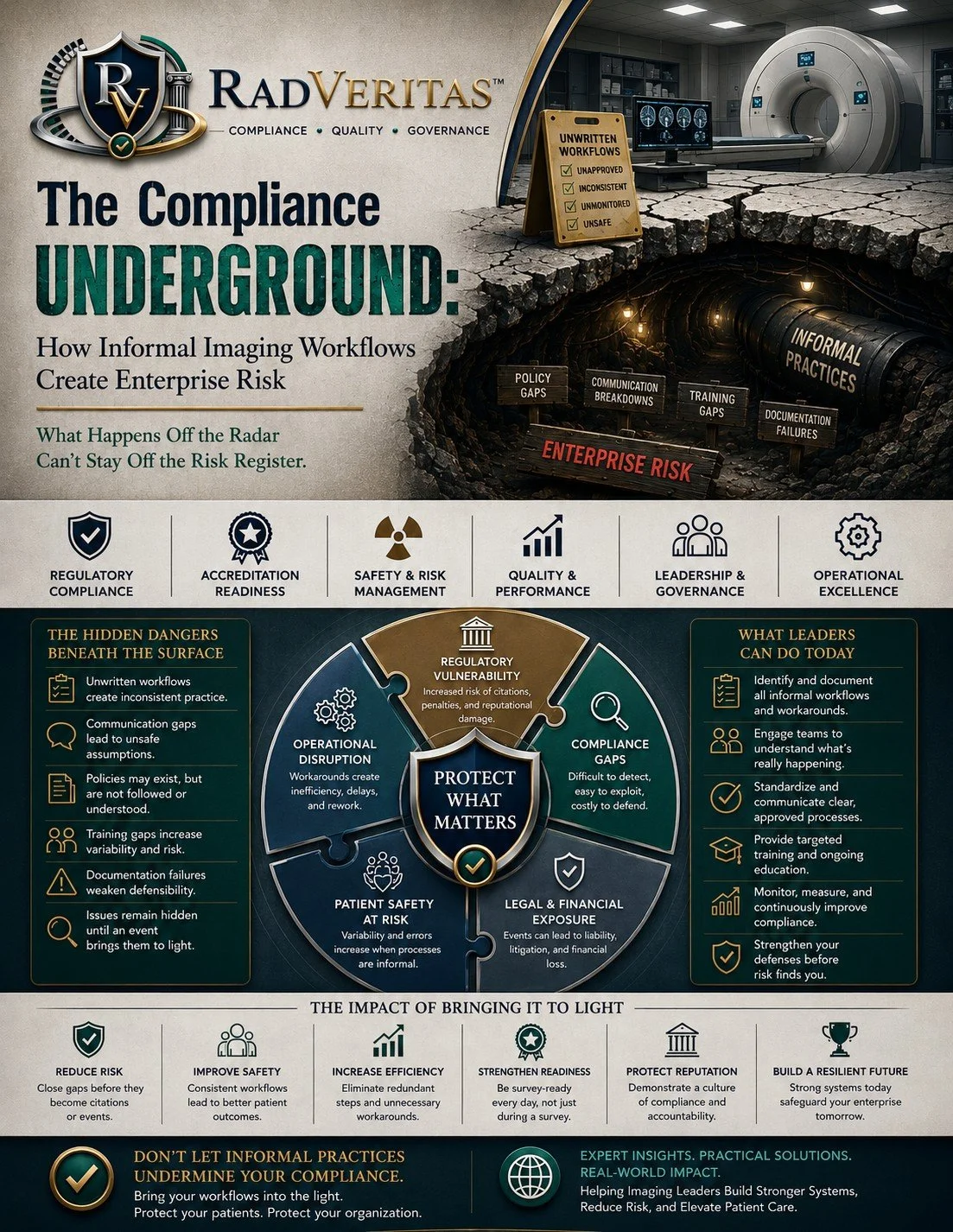
How Informal Imaging Workflows Create Enterprise Risk
What Happens Off the Radar Doesn't Stay Off the Risk Register
Every Diagnostic Imaging department has them.
The shortcut that "works." The undocumented process everyone follows. The workaround passed from one employee to the next. The unofficial workflow that solves today's problem but quietly creates tomorrow's risk.
Most organizations don't discover these hidden practices until a surveyor asks the wrong question, a patient safety event occurs, a compliance audit uncovers inconsistencies, or a legal review exposes a gap that leadership never knew existed.
The Compliance Underground™: How Informal Imaging Workflows Create Enterprise Risk is a powerful executive intelligence report that reveals the hidden operational practices, undocumented processes, and cultural workarounds that place Diagnostic Imaging departments at risk for regulatory findings, accreditation deficiencies, patient safety events, and financial exposure.
The Risks Leaders Rarely See
Informal workflows often develop with good intentions.
Teams create shortcuts to improve efficiency, overcome resource limitations, or solve operational challenges.
Over time, those workarounds become accepted practice.
The problem?
They are often:
Unapproved
Inconsistently applied
Poorly communicated
Undocumented
Difficult to monitor
Impossible to defend during a survey or investigation
What begins as convenience can quickly evolve into enterprise risk.
Bring Your Workflows Into the Light
The strongest organizations are not those without risk.
They are the ones that identify risk early, address it proactively, and create systems that withstand scrutiny.
The Compliance Underground™ provides healthcare leaders with the insight, tools, and practical strategies needed to uncover hidden vulnerabilities before they become survey findings, safety events, or organizational crises.
Don't Let Informal Practices Undermine Your Compliance Program.
Identify the gaps. Strengthen the process. Protect what matters.
RadVeritas™
Compliance • Quality • Governance
Expert Insights. Practical Solutions. Real-World Impact.
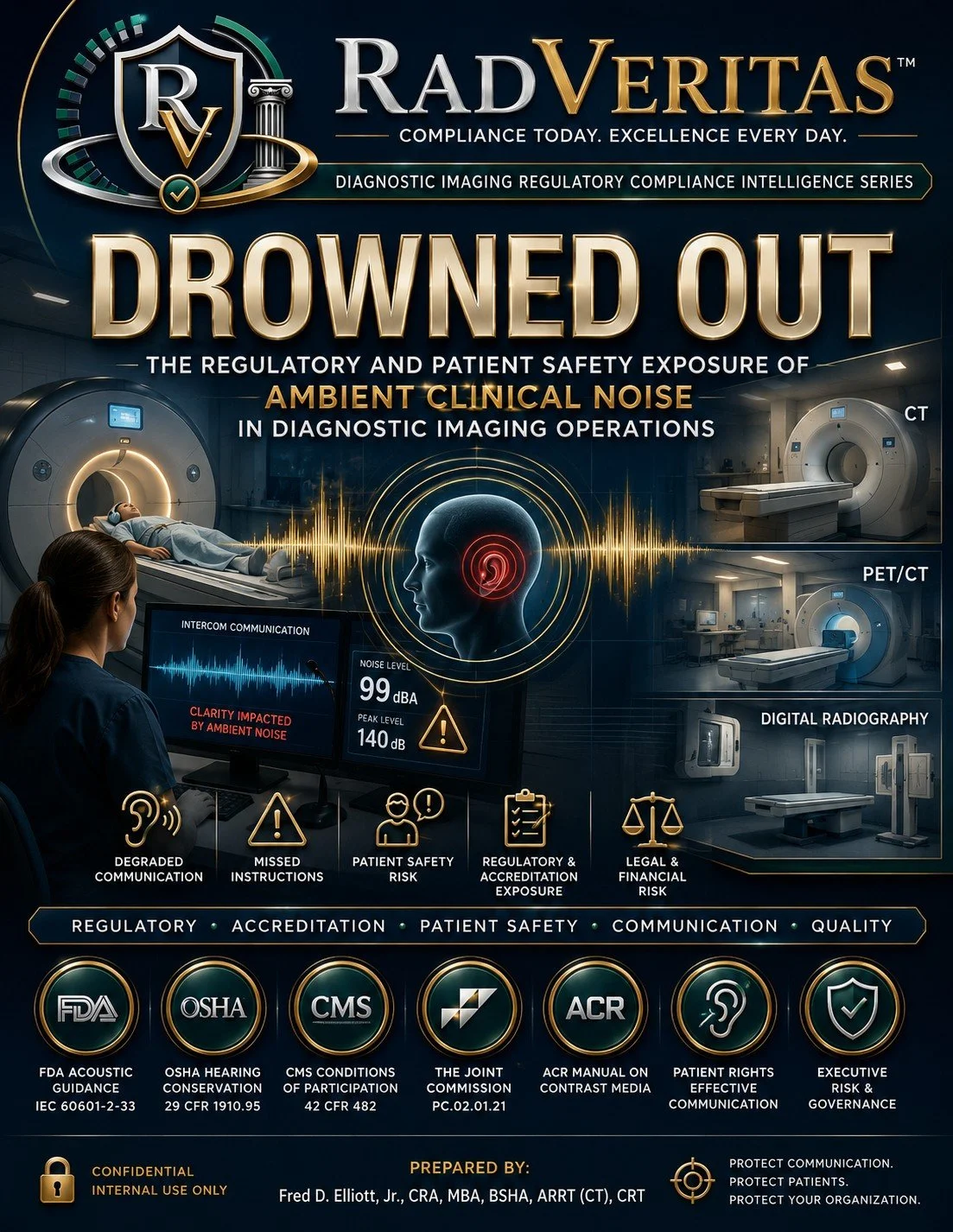
When Patients Cannot Hear, Organizations Assume Risk.
Diagnostic imaging depends on clear communication. Yet one of the most overlooked threats to patient safety, regulatory compliance, and operational performance is not found in equipment specifications or accreditation manuals. It is found in the clinical environment itself.
Drowned Out™ is an executive white paper that examines how excessive ambient noise in diagnostic imaging departments can compromise communication, interfere with patient understanding, delay reactions, increase operational errors, and expose healthcare organizations to regulatory, legal, and accreditation risk.
Developed for healthcare executives, diagnostic imaging leaders, patient safety professionals, risk managers, and accreditation teams, this resource provides a practical framework for identifying, evaluating, and mitigating communication failures caused by high-noise clinical environments.
Why Ambient Clinical Noise Matters
Every imaging examination depends on accurate communication between healthcare professionals and patients.
When verbal instructions are masked by scanner noise, alarms, ventilation systems, conversations, or other environmental distractions, organizations risk:
Missed patient instructions
Delayed patient responses
Repeat examinations
Increased radiation exposure
Motion-related image degradation
Workflow delays
Patient anxiety and dissatisfaction
Documentation inconsistencies
Regulatory deficiencies
Increased liability exposure
This white paper demonstrates that communication failures caused by ambient clinical noise represent a significant patient safety and compliance challenge rather than simply an operational inconvenience.
What Makes This White Paper Different
Most discussions about clinical noise focus on patient comfort or occupational exposure.
Drowned Out™ approaches the issue through the combined perspectives of regulatory compliance, accreditation readiness, human factors engineering, patient safety, healthcare communication, and operational governance.
It connects environmental noise directly to organizational risk, showing how ineffective communication can affect informed consent, patient understanding, diagnostic accuracy, workflow efficiency, and regulatory defensibility.
Key Topics Covered
Patient Communication Under High-Noise Conditions
Examine how excessive environmental noise interferes with patient comprehension, cooperation, and procedural success.
Regulatory and Accreditation Considerations
Understand how communication failures may influence compliance with accreditation standards, patient rights, informed consent requirements, accessibility obligations, and quality expectations.
Human Factors and Cognitive Performance
Explore how auditory overload affects clinical decision-making, attention, communication accuracy, and staff performance.
Operational Risk Management
Identify how communication breakdowns contribute to repeat imaging, delayed examinations, workflow interruptions, and avoidable operational costs.
Patient Safety
Recognize how misunderstood instructions may increase the likelihood of motion artifacts, delayed reactions, procedural interruptions, and preventable adverse events.
Organizational Governance
Develop leadership strategies that integrate communication effectiveness into patient safety, quality improvement, and enterprise risk management programs.
Practical Leadership Strategies
The white paper provides actionable guidance to help healthcare organizations:
Evaluate communication effectiveness within imaging environments
Assess ambient noise sources that interfere with patient understanding
Implement standardized communication verification techniques
Incorporate teach-back and confirmation strategies into imaging workflows
Strengthen intercom system performance and reliability
Improve accommodations for patients with hearing impairments or communication barriers
Reduce repeat imaging through improved communication practices
Integrate communication assessments into quality improvement initiatives
Monitor communication-related performance metrics
Build a culture where effective communication is recognized as a patient safety priority
Organizational Benefits
Improve Patient Safety
Reduce communication failures that contribute to repeat imaging, delayed responses, and procedural interruptions.
Strengthen Regulatory Compliance
Support consistent communication practices that align with accreditation expectations and patient-centered care standards.
Reduce Operational Risk
Minimize repeat examinations, workflow inefficiencies, and unnecessary resource utilization caused by communication breakdowns.
Enhance Patient Experience
Improve patient confidence, reduce anxiety, and promote clearer understanding throughout the imaging process.
Improve Imaging Quality
Increase first-time examination success by ensuring patients clearly understand procedural instructions.
Protect Organizational Reputation
Demonstrate a proactive commitment to communication excellence, patient safety, and continuous quality improvement.
Built for Modern Diagnostic Imaging Departments
Today's imaging environments are increasingly complex, technologically advanced, and acoustically challenging. Effective communication cannot be assumed simply because instructions are given.
Drowned Out™ provides healthcare organizations with a practical governance framework to evaluate communication effectiveness, reduce environmental barriers, and strengthen regulatory readiness through evidence-based operational improvements.
Communication Is a Patient Safety System
The ability of patients to hear, understand, and correctly respond to clinical instructions directly influences examination quality, operational efficiency, regulatory compliance, and patient outcomes.
The Drowned Out™ Executive White Paper equips healthcare leaders with the knowledge, strategies, and governance framework needed to transform communication from an overlooked operational task into a measurable component of patient safety and organizational excellence.
Make Every Instruction Heard. Every Response Understood. Every Examination Safer.
Reduce communication failures. Strengthen patient safety. Improve operational performance. Build lasting regulatory confidence.
RadVeritas™
Compliance • Quality • Governance
Expert Insights. Practical Solutions. Real-World Impact.
Helping Diagnostic Imaging Leaders Reduce Communication Risk, Strengthen Patient Safety, Improve Operational Reliability, and Build Sustainable Compliance Through Evidence-Based Communication Governance.
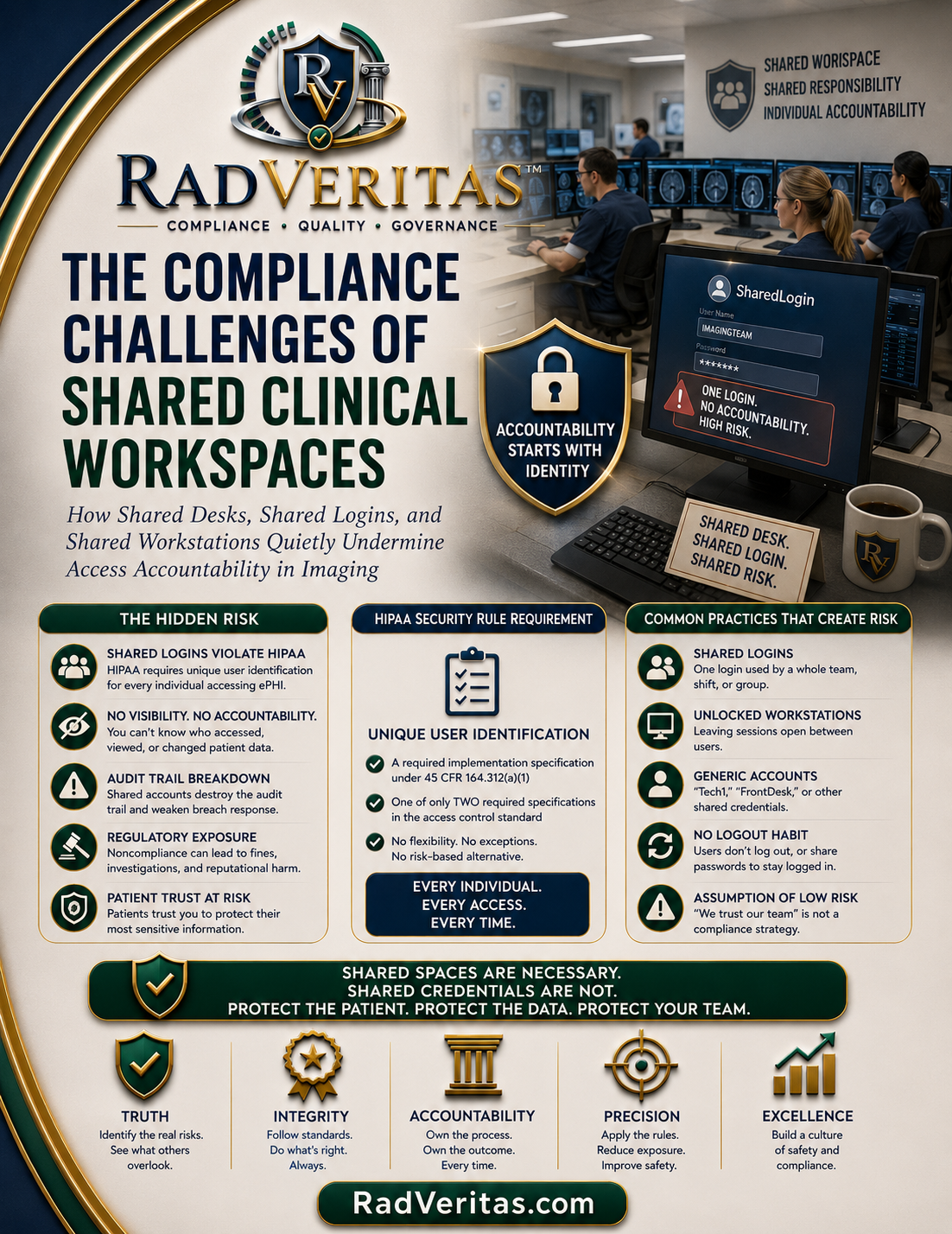
Shared Workspaces Require Shared Responsibility. Never Shared Accountability.
The Executive Guide to Securing Shared Clinical Environments Through Identity Management, Access Control, and Regulatory Compliance.
Diagnostic imaging departments depend on collaboration. Shared workstations, centralized reading rooms, modality consoles, and high-volume clinical workspaces enable teams to deliver efficient patient care around the clock.
Yet one of the most common operational practices in healthcare continues to undermine compliance, cybersecurity, and patient safety: shared user accounts, shared passwords, unlocked workstations, and undocumented system access.
What begins as a workflow shortcut can quickly become a regulatory finding, a security breach, or an investigation that no organization can defend.
The Compliance Challenges of Shared Clinical Workspaces™ provides healthcare leaders with a comprehensive governance framework for strengthening user accountability, protecting electronic protected health information (ePHI), and building secure, compliant imaging environments where every action is attributable to an individual user.
Why This Resource Matters
Every access to patient information must be traceable to a single individual.
When multiple employees share credentials or leave workstations unlocked, organizations lose the ability to determine who viewed, modified, transmitted, or deleted sensitive information.
The result is weakened audit trails, compromised investigations, increased cybersecurity exposure, and significant regulatory risk.
This executive guide helps healthcare organizations eliminate shared-access vulnerabilities while improving operational efficiency, security, and accountability.
What Makes This Resource Different
Unlike general cybersecurity resources, this guide focuses specifically on the operational realities of diagnostic imaging departments, where multiple users frequently share clinical workspaces, modality consoles, reading stations, and patient care environments.
It combines regulatory intelligence with practical operational guidance to help organizations implement secure identity management without disrupting clinical workflow.
The framework applies across:
MRI
CT
Ultrasound
Nuclear Medicine
PET/CT
Mammography
Radiography
Interventional Radiology
Radiation Oncology
Reading Rooms
Imaging Control Rooms
Enterprise Imaging Networks
Multi-site Health Systems
Comprehensive Topics Covered
Unique User Identification
Understand why individual user credentials are fundamental to regulatory compliance, audit integrity, cybersecurity, and organizational accountability.
Shared Workspace Governance
Develop standardized policies for workstation use, user authentication, session management, and secure access across shared clinical environments.
Access Control and Identity Management
Strengthen authentication practices through role-based access, user provisioning, password management, session controls, and account oversight.
Audit Trail Integrity
Protect the integrity of electronic audit logs by ensuring every system activity can be attributed to a uniquely identified individual.
Leadership Accountability
Establish governance structures that support ongoing monitoring, auditing, education, corrective actions, and continuous compliance improvement.
Key Risks Addressed
The guide helps organizations identify and reduce risks associated with:
✔ Shared usernames and passwords
✔ Generic departmental accounts
✔ Unlocked workstations
✔ Incomplete audit trails
✔ Unauthorized access to ePHI
✔ Weak identity management
✔ Cybersecurity vulnerabilities
✔ HIPAA Security Rule deficiencies
✔ Regulatory investigations
✔ Accreditation findings
✔ Insider security threats
✔ Organizational liability
Practical Resources Included
This executive guide provides actionable tools to help organizations:
Assess shared workspace risks
Eliminate shared login practices
Develop secure access policies
Strengthen user authentication processes
Standardize workstation security procedures
Improve password management practices
Conduct access control audits
Train staff on identity accountability
Investigate security incidents
Develop corrective action plans
Monitor compliance through continuous auditing and leadership oversight
Designed For
Ideal for:
Diagnostic Imaging Directors
Radiology Administrators
Chief Information Security Officers
Compliance Officers
HIPAA Security Officers
Enterprise Imaging Leaders
Information Technology Teams
Cybersecurity Professionals
Risk Management Leaders
Accreditation Coordinators
Imaging Managers and Supervisors
Executive Healthcare Leadership
Organizational Benefits
Strengthen HIPAA Compliance
Support compliance with the HIPAA Security Rule by implementing secure identity management, individual accountability, and effective access controls.
Improve Cybersecurity
Reduce the risk of unauthorized access, insider threats, credential misuse, and security breaches through standardized authentication practices.
Protect Patient Information
Ensure electronic protected health information is accessed only by authorized individuals with fully traceable user activity.
Preserve Audit Integrity
Maintain accurate, defensible audit trails that support investigations, regulatory reviews, and organizational accountability.
Standardize Enterprise Access Controls
Create consistent authentication and workstation security practices across every imaging modality and clinical location.
Build a Culture of Accountability
Reinforce the principle that every access, every action, and every decision within the clinical information system belongs to an individually identifiable user.
Built for Modern Diagnostic Imaging Operations
Shared workspaces are essential to efficient healthcare delivery. Shared credentials are not.
Whether strengthening cybersecurity, preparing for accreditation surveys, improving HIPAA compliance, or modernizing enterprise identity management, The Compliance Challenges of Shared Clinical Workspaces™ provides the practical guidance needed to secure clinical environments without compromising workflow or patient care.
Accountability Begins with Identity.
When organizations cannot identify who accessed patient information, they cannot confidently demonstrate compliance, investigate incidents, or defend their security practices.
The Compliance Challenges of Shared Clinical Workspaces™ helps healthcare leaders establish secure identity management, preserve audit integrity, and build a culture where accountability is embedded into every clinical workflow.
Secure Every Login. Protect Every Patient.
Reduce cybersecurity risk. Strengthen compliance. Preserve accountability. Build resilient clinical workspaces.
RadVeritas™
Compliance • Quality • Governance
Compliance Today. Excellence Every Day.
Expert Insights. Practical Solutions. Real-World Impact.
Helping Diagnostic Imaging Leaders Strengthen Identity Management, Protect Electronic Health Information, Improve Cybersecurity, and Build Secure, Accountable Clinical Workspaces.
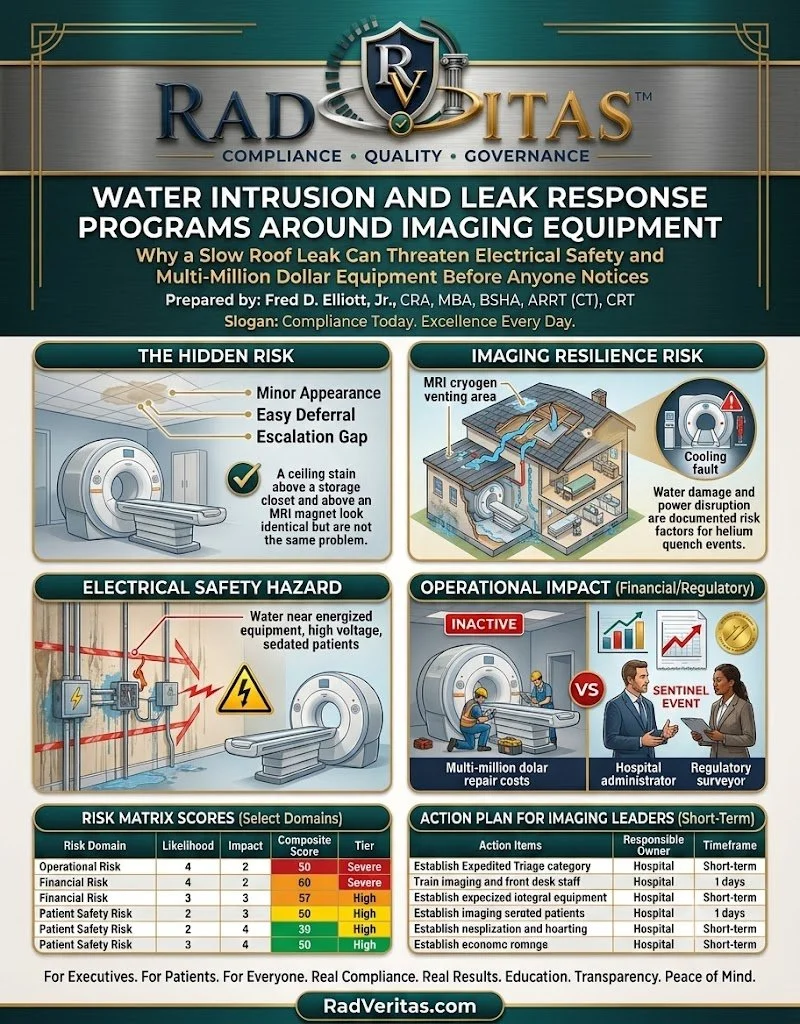
Protect Critical Imaging Assets Before Minor Water Damage Becomes a Major Operational Crisis.
A Comprehensive Governance Framework for Managing Water Intrusion, Leak Response, Electrical Safety, Equipment Protection, and Regulatory Readiness in Diagnostic Imaging.
A small ceiling stain.
A slow roof leak.
A minor plumbing issue.
Most healthcare organizations see these as routine facilities problems. In reality, water intrusion around diagnostic imaging equipment can rapidly escalate into a patient safety event, equipment failure, electrical hazard, regulatory deficiency, operational shutdown, and multimillion-dollar financial loss.
Water Intrusion and Leak Response Programs Around Imaging Equipment™ provides imaging leaders with a practical, evidence-based framework for identifying, escalating, mitigating, and managing water intrusion risks before they compromise patient care, damage high-value equipment, or disrupt clinical operations.
Developed specifically for diagnostic imaging environments, this executive resource integrates facilities management, engineering, environmental services, imaging operations, biomedical engineering, emergency preparedness, risk management, and regulatory compliance into one coordinated response program.
Why This Resource Matters
Water intrusion is rarely just a maintenance issue.
Even minor leaks can threaten:
MRI, CT, PET/CT, PET/MRI, Nuclear Medicine, and Interventional equipment
High-voltage electrical systems
Cryogen venting infrastructure
HVAC performance and environmental controls
Image quality and equipment calibration
Patient and staff safety
Clinical throughput
Accreditation readiness
Insurance claims and business continuity
Organizations without a structured leak response program often discover problems only after equipment damage, patient disruption, or regulatory findings have already occurred.
This guide helps leaders recognize vulnerabilities early, respond effectively, and recover quickly.
What Makes This Resource Different
Unlike general facilities maintenance manuals, this resource focuses exclusively on the unique operational, regulatory, and patient safety risks associated with water intrusion in diagnostic imaging environments.
It combines engineering principles, operational governance, emergency response, and regulatory intelligence into a single enterprise framework that supports continuous readiness.
The program is designed to help healthcare organizations move from reactive cleanup to proactive risk management.
Comprehensive Topics Covered
Water Intrusion Risk Assessment
Identify vulnerable areas surrounding MRI, CT, PET/CT, Nuclear Medicine, Ultrasound, Radiography, Fluoroscopy, Mammography, and Interventional Imaging suites before failures occur.
Leak Detection and Early Escalation
Develop standardized procedures for recognizing ceiling stains, moisture intrusion, condensation, roof leaks, plumbing failures, HVAC issues, and hidden water sources before equipment is affected.
Electrical and Life Safety
Reduce risks associated with energized equipment, electrical distribution systems, power supplies, cooling infrastructure, and patient care environments where water and electricity intersect.
Imaging Equipment Protection
Implement procedures for safely removing equipment from service, protecting sensitive components, coordinating vendor assessments, and minimizing costly repairs and downtime.
Operational Continuity
Maintain patient access through contingency planning, equipment relocation strategies, workflow redesign, communication plans, and recovery operations.
Leadership Governance
Establish clear accountability among Imaging, Facilities Management, Biomedical Engineering, Environmental Services, Safety, Emergency Management, and Executive Leadership.
Key Risks Addressed
This guide helps organizations proactively identify and reduce:
✔ Water intrusion around imaging equipment
✔ Electrical hazards in patient care environments
✔ Equipment damage and premature failure
✔ MRI cooling and environmental control failures
✔ Operational shutdowns and reduced patient throughput
✔ Delayed diagnosis and treatment
✔ Regulatory citations and accreditation findings
✔ Insurance and financial exposure
✔ Inadequate escalation and communication processes
✔ Business continuity and disaster recovery gaps
Practical Resources Included
This executive resource includes practical tools that organizations can immediately implement, including:
Water Intrusion Risk Assessment Templates
Leak Response Activation Checklists
Imaging Equipment Protection Procedures
Electrical Safety Decision Trees
Escalation and Notification Algorithms
Department Leadership Response Guides
Facilities and Engineering Coordination Checklists
Equipment Shutdown and Recovery Procedures
Business Continuity Planning Tools
Corrective Action Plan Templates
Executive Dashboard Metrics
Audit and Performance Monitoring Tools
Designed For
Ideal for:
Diagnostic Imaging Directors
Radiology Administrators
Imaging Managers and Supervisors
Facilities Management Leaders
Biomedical Engineering Departments
Safety Officers
Environment of Care Committees
Emergency Preparedness Coordinators
Risk Management Professionals
Compliance Officers
Accreditation Coordinators
Executive Healthcare Leadership
Organizational Benefits
Protect High-Value Equipment
Reduce the likelihood of catastrophic equipment damage through early identification, standardized response, and coordinated mitigation.
Improve Patient Safety
Minimize electrical hazards, environmental risks, and operational disruptions that can affect patient care.
Reduce Operational Downtime
Maintain imaging services through structured contingency planning, equipment recovery, and coordinated response efforts.
Strengthen Regulatory Readiness
Demonstrate effective governance aligned with Environment of Care, Life Safety, emergency preparedness, and organizational risk management expectations.
Reduce Financial Exposure
Protect multimillion-dollar imaging assets while minimizing repair costs, business interruption, insurance claims, and lost revenue.
Build Organizational Resilience
Create a sustainable response program capable of protecting imaging operations during routine maintenance events, severe weather, infrastructure failures, and facility emergencies.
Built for Modern Diagnostic Imaging Operations
Water intrusion is not simply a facilities issue. It is an enterprise imaging risk that demands coordinated leadership, standardized processes, and rapid decision-making.
Whether responding to an active leak, protecting newly installed imaging equipment, strengthening emergency preparedness, or improving Environment of Care programs, Water Intrusion and Leak Response Programs Around Imaging Equipment™ provides healthcare leaders with the tools needed to safeguard patients, protect critical assets, and maintain uninterrupted imaging operations.
Small Leaks Can Create Major Consequences.
The organizations that recover fastest are the ones that prepare before water ever reaches the imaging suite.
Water Intrusion and Leak Response Programs Around Imaging Equipment™ helps healthcare leaders establish proactive governance, strengthen operational resilience, reduce regulatory exposure, and protect the technology that patients depend on every day.
Protect Your Equipment. Protect Your Patients. Protect Your Operations.
Reduce risk. Improve resilience. Strengthen compliance. Preserve operational continuity.
RadVeritas™
Compliance • Quality • Governance
Compliance Today. Excellence Every Day.
Expert Insights. Practical Solutions. Real-World Impact.
Helping Diagnostic Imaging Leaders Build Enterprise Water Intrusion Response Programs That Protect Patients, Preserve High-Value Imaging Assets, Strengthen Regulatory Compliance, and Ensure Operational Continuity Before Minor Leaks Become Major Organizational Events.
Transform Temporary Equipment Demonstrations into Fully Governed, Regulatory-Compliant Clinical Processes.
Because "Temporary" Equipment Can Create Permanent Regulatory Consequences.
Vendor demonstration equipment plays an essential role in evaluating new technology, supporting capital planning, and advancing patient care. Yet, demonstration systems often arrive through pathways that bypass the rigorous inspection, registration, cybersecurity, radiation safety, and compliance processes required for permanently installed medical equipment.
The result is a hidden governance gap that can expose healthcare organizations to regulatory deficiencies, patient safety risks, cybersecurity vulnerabilities, and operational liability.
The Regulatory Risks of Vendor Demonstration Equipment™ provides healthcare leaders with a comprehensive governance framework for safely evaluating, approving, monitoring, and removing vendor demonstration equipment while maintaining continuous compliance with regulatory, accreditation, and organizational requirements.
Designed specifically for diagnostic imaging environments, this executive resource integrates clinical operations, biomedical engineering, radiation safety, information technology, cybersecurity, infection prevention, facilities management, and leadership oversight into one standardized demonstration equipment program.
Why This Resource Matters
Every temporary imaging system introduced into a healthcare organization has the potential to affect patient safety, data security, clinical workflows, and regulatory compliance.
Without a standardized intake and governance process, organizations increase their exposure to:
Unapproved clinical equipment entering patient care areas
Incomplete Biomedical Engineering inspections
Radiation safety oversight gaps
Cybersecurity vulnerabilities
PACS, RIS, and network integration risks
HIPAA and patient privacy concerns
Infection prevention deficiencies
Improper equipment documentation
Accreditation survey findings
Increased organizational liability
This guide provides a structured process for evaluating demonstration equipment before it reaches patients or clinical operations.
What Makes This Resource Different
Most organizations rely on informal coordination between vendors and department managers.
This resource establishes an enterprise-wide governance program that standardizes every phase of the demonstration lifecycle, from initial request through final equipment removal.
The framework integrates:
Regulatory Compliance
Biomedical Engineering
Radiation Safety
Medical Physics
Information Technology
Cybersecurity
HIPAA Compliance
Infection Prevention
Clinical Engineering
Facilities Management
Risk Management
Executive Leadership
The result is a defensible, repeatable process that protects patients, staff, and the organization while supporting informed technology evaluation.
Comprehensive Topics Covered
Vendor Equipment Intake
Establish standardized approval processes before demonstration equipment is delivered, installed, or connected to hospital systems.
Biomedical Engineering Verification
Verify equipment safety, performance, electrical integrity, preventive maintenance status, and manufacturer documentation before clinical use.
Radiation Safety and Medical Physics
Confirm regulatory registration requirements, shielding considerations, radiation safety evaluations, dose optimization, and physics oversight where applicable.
Information Technology and Cybersecurity
Evaluate network connectivity, software security, remote access, cybersecurity controls, device authentication, and integration with enterprise imaging infrastructure.
HIPAA and Patient Privacy
Ensure demonstration equipment complies with organizational privacy policies, secure handling of Protected Health Information (PHI), and data retention requirements.
Leadership Governance
Define accountability across Imaging Leadership, Purchasing, Clinical Engineering, Information Technology, Compliance, Radiation Safety, and Vendor Management.
Key Risks Addressed
This guide helps organizations proactively reduce:
✔ Unapproved demonstration equipment entering clinical areas
✔ Biomedical Engineering inspection gaps
✔ Radiation safety compliance deficiencies
✔ Cybersecurity vulnerabilities
✔ Unauthorized network connections
✔ HIPAA and patient privacy exposure
✔ Incomplete vendor documentation
✔ Accreditation and regulatory survey findings
✔ Operational disruption during equipment evaluations
✔ Organizational liability associated with temporary equipment
Practical Resources Included
This executive resource provides implementation-ready tools, including:
Vendor Demonstration Equipment Intake Checklist
Executive Approval Workflow
Biomedical Engineering Inspection Forms
Radiation Safety Evaluation Checklists
Medical Physics Review Templates
Cybersecurity Risk Assessment Tools
IT Connectivity Approval Forms
HIPAA and Privacy Review Checklists
Vendor Responsibility Agreements
Demonstration Equipment Tracking Logs
Corrective Action Plan Templates
Executive Dashboard Metrics and Audit Tools
Designed For
Ideal for:
Diagnostic Imaging Directors
Radiology Administrators
Biomedical Engineering Leaders
Clinical Engineering Departments
Radiation Safety Officers
Medical Physicists
Information Technology Leaders
Cybersecurity Teams
Compliance Officers
Purchasing and Supply Chain Leaders
Risk Management Professionals
Executive Healthcare Leadership
Organizational Benefits
Strengthen Patient Safety
Ensure demonstration equipment meets organizational safety expectations before it enters clinical service.
Improve Regulatory Compliance
Establish standardized governance that aligns with federal, state, accreditation, and organizational requirements.
Protect Enterprise Systems
Reduce cybersecurity and data integrity risks by controlling how temporary devices connect to clinical networks.
Improve Technology Evaluation
Create structured, objective evaluation processes that support informed capital purchasing decisions.
Reduce Organizational Risk
Prevent documentation gaps, inspection failures, and compliance deficiencies that may result in regulatory findings or liability.
Standardize Enterprise Governance
Develop a repeatable process that applies consistently across hospitals, imaging centers, outpatient facilities, and integrated health systems.
Built for Modern Healthcare Technology Programs
Vendor demonstration equipment should never bypass the same governance principles that protect patients, staff, and organizational assets.
Whether evaluating new imaging technology, introducing advanced software, piloting AI-enabled solutions, or conducting capital equipment assessments, The Regulatory Risks of Vendor Demonstration Equipment™ provides healthcare leaders with the framework needed to evaluate innovation without compromising compliance.
Innovation Requires Oversight.
The most successful healthcare organizations evaluate new technology through disciplined governance, not informal processes.
The Regulatory Risks of Vendor Demonstration Equipment™ helps healthcare organizations build a standardized demonstration equipment program that protects patients, strengthens regulatory compliance, supports informed purchasing decisions, and ensures every temporary device meets permanent standards of safety and accountability.
Evaluate Technology with Confidence.
Strengthen governance. Reduce risk. Protect patients. Support innovation.
RadVeritas™
Compliance • Quality • Governance
Compliance Today. Excellence Every Day.
Expert Insights. Practical Solutions. Real-World Impact.
Helping Diagnostic Imaging Leaders Build Enterprise Vendor Demonstration Equipment Programs That Strengthen Regulatory Compliance, Enhance Cybersecurity, Improve Technology Evaluation, Protect Patient Safety, and Support Sustainable Operational Excellence.

Transform Decorative Choices into Defensible Compliance Decisions.
Because Every Plant, Picture, Fabric Panel, and Decorative Display Has the Potential to Become a Regulatory Finding.
Healthcare leaders invest significant time and resources in creating welcoming imaging environments that reduce patient anxiety and improve the patient experience. Yet many decorative elements introduced with the best intentions can unintentionally create infection prevention, fire safety, environmental, and regulatory compliance risks.
The Hidden Compliance Risks of Decorative Department Furnishings™ is a comprehensive executive reference that helps imaging leaders evaluate decorative furnishings through the lens of regulatory compliance, patient safety, infection prevention, fire protection, and operational governance.
Instead of relying on subjective design preferences, this resource provides a structured framework for making evidence-based decisions that protect patients while maintaining an inviting healthcare environment.
Why This Resource Matters
Decorative furnishings are rarely viewed as part of an organization's compliance program until they become the subject of a survey finding, infection prevention concern, or fire safety deficiency.
This guide examines commonly overlooked risks involving:
Live and artificial plants
Artwork and framed displays
Upholstered furniture
Decorative fabrics and curtains
Wall-mounted décor
Seasonal decorations
Donated furnishings
Staff-created displays
Waiting room enhancements
Patient comfort initiatives
By integrating regulatory requirements with practical operational guidance, this resource enables healthcare organizations to create healing environments without compromising compliance.
What Makes This Resource Different
Most resources discuss interior design or patient experience. Very few evaluate decorative furnishings through a multidisciplinary regulatory framework.
This reference integrates:
Infection Prevention
Environment of Care
Fire and Life Safety
Accreditation Readiness
Operational Risk Management
Executive Governance
Documentation Standards
Facility Design Review
Continuous Compliance Monitoring
Patient-Centered Environment Planning
The result is a repeatable governance process that balances aesthetics with safety, regulatory compliance, and operational excellence.
Comprehensive Topics Covered
Decorative Furnishing Risk Assessments
Evaluate furnishings before installation using standardized compliance and safety criteria.
Infection Prevention Considerations
Understand how decorative items may affect environmental hygiene, vulnerable patient populations, and infection prevention practices.
Fire and Life Safety Requirements
Review flame resistance considerations, combustible materials, furnishings, and placement within patient care environments.
Facility Design Governance
Establish multidisciplinary review processes involving Facilities, Infection Prevention, Safety, Compliance, and departmental leadership before decorative items are introduced.
Documentation and Approval Workflows
Implement standardized approval processes, inventories, documentation requirements, and periodic reassessments.
Continuous Compliance Monitoring
Develop ongoing inspection programs to ensure decorative items remain compliant throughout their lifecycle.
Key Risks Addressed
This resource helps organizations reduce:
✔ Infection prevention deficiencies
✔ Fire and life safety violations
✔ Environmental compliance gaps
✔ Unapproved decorative installations
✔ Survey findings
✔ Documentation deficiencies
✔ Facility design inconsistencies
✔ Patient safety risks
✔ Operational liability
✔ Reputational damage
Practical Resources Included
This implementation-focused guide includes:
Decorative Furnishing Evaluation Checklists
Infection Prevention Review Tools
Fire Safety Assessment Templates
Environmental Risk Assessment Forms
Decorative Item Approval Workflows
Executive Risk Matrix
Compliance Review Documentation
Inspection Checklists
Corrective Action Planning Tools
Leadership Dashboards
Governance Frameworks
Continuous Monitoring Worksheets
Designed For
Ideal for:
Diagnostic Imaging Directors
Radiology Administrators
Environment of Care Leaders
Infection Prevention Professionals
Facilities Management
Life Safety Officers
Compliance Officers
Risk Managers
Accreditation Coordinators
Quality Improvement Leaders
Hospital Operations Executives
Design and Construction Teams
Organizational Benefits
Protect Vulnerable Patients
Ensure decorative elements support patient comfort without introducing avoidable infection prevention or environmental risks.
Strengthen Regulatory Compliance
Standardize decision-making with documented review processes aligned with healthcare safety and accreditation expectations.
Reduce Survey Vulnerability
Identify and address hidden compliance risks before inspections, accreditation surveys, or regulatory reviews.
Improve Cross-Department Collaboration
Create a coordinated review process involving Facilities, Infection Prevention, Safety, Compliance, and Imaging leadership.
Support Sustainable Design Decisions
Balance aesthetics, patient experience, and regulatory requirements with a repeatable governance model.
Build a Culture of Proactive Oversight
Shift decorative furnishing decisions from informal choices to documented, risk-informed leadership practices.
Built for Modern Healthcare Organizations
Decorative furnishings influence more than appearance. They can affect infection prevention practices, fire safety, regulatory compliance, and patient confidence.
The Hidden Compliance Risks of Decorative Department Furnishings™ provides healthcare leaders with the governance framework, evaluation tools, and operational guidance needed to ensure every decorative decision supports safety, compliance, and organizational excellence.
Beautiful Spaces Should Also Be Compliant Spaces.
Patient-centered design and regulatory excellence are not competing priorities. With the right governance framework, healthcare organizations can create welcoming environments while maintaining the highest standards of safety, accountability, and compliance.
The Hidden Compliance Risks of Decorative Department Furnishings™ helps organizations transform decorative decisions into documented, defensible, and survey-ready practices.
Every Decorative Choice Reviewed. Every Risk Evaluated. Every Decision Defensible.
Protect patients. Reduce regulatory exposure. Strengthen governance. Create healing environments with confidence.
RadVeritas™
Compliance • Quality • Governance
Compliance Today. Excellence Every Day.
Expert Insights. Practical Solutions. Real-World Impact.
Helping Diagnostic Imaging Leaders Build Safer, More Compliant, and More Resilient Healthcare Environments Through Practical Regulatory Intelligence and Operational Excellence.

Turn Informal Knowledge Transfer into a Defensible Leadership Competency Program.
Because What Isn't Documented During Leadership Transition Can't Be Proven When It Matters Most.
Every healthcare organization depends on experienced leaders to transfer critical operational knowledge to the next generation. Yet in many diagnostic imaging departments, leadership shadowing occurs through conversations, observations, and informal mentoring that leave no documented evidence of what was taught, learned, or verified.
When a surveyor, regulator, attorney, or executive asks how a new leader was prepared to assume responsibility, organizations often have little more than verbal assurances.
The Regulatory Value of Shadowing Programs for New Leaders™ provides a comprehensive governance framework for transforming informal leadership transitions into structured, documented, and measurable competency programs that strengthen compliance, operational continuity, and organizational resilience.
Why This Resource Matters
Leadership transitions represent one of the most significant yet least documented operational risks in healthcare.
Critical responsibilities are frequently transferred without standardized documentation for areas such as:
Radiation Safety Officer (RSO) responsibilities
MRI Safety Officer (MRSO) duties
Accreditation readiness
Regulatory oversight
Quality management
Environment of Care
Policy governance
Emergency preparedness
Compliance leadership
Department operations
Without documented knowledge transfer, organizations risk leadership gaps, inconsistent practices, survey deficiencies, and avoidable operational failures.
This manual establishes a repeatable process that captures institutional knowledge before it is lost.
What Makes This Resource Different
Most leadership orientation programs focus on introductions, meetings, and general onboarding. Few provide a governance model that documents competency transfer in a manner that can withstand regulatory, accreditation, or legal scrutiny.
This resource integrates:
Leadership Development
Regulatory Compliance
Competency Verification
Succession Planning
Knowledge Management
Accreditation Readiness
Operational Governance
Risk Management
Documentation Standards
Executive Accountability
The result is a structured framework that transforms leadership shadowing into documented organizational evidence.
Comprehensive Topics Covered
Leadership Transition Governance
Develop standardized processes that define responsibilities, timelines, documentation requirements, and accountability during leadership transitions.
Structured Shadowing Programs
Replace informal observation with organized learning plans that include defined objectives, competency milestones, and measurable outcomes.
Competency Verification
Document knowledge transfer through sign-offs, validation tools, competency checklists, and leadership assessments.
Institutional Knowledge Preservation
Capture operational expertise, regulatory insights, historical decisions, and department-specific practices before they are lost through retirement, promotion, or turnover.
Documentation and Audit Readiness
Create records that demonstrate leadership preparation during accreditation surveys, regulatory inspections, and organizational reviews.
Continuous Leadership Development
Implement ongoing competency reviews that support professional growth beyond initial onboarding.
Key Risks Addressed
This resource helps organizations reduce:
✔ Undocumented leadership transitions
✔ Loss of institutional knowledge
✔ Leadership competency gaps
✔ Regulatory survey deficiencies
✔ Operational inconsistency
✔ Succession planning failures
✔ Accreditation findings
✔ Compliance vulnerabilities
✔ Organizational disruption
✔ Increased legal and operational exposure
Practical Resources Included
This implementation-focused guide includes:
Leadership Shadowing Checklists
Competency Verification Forms
Transition Planning Templates
Knowledge Transfer Logs
Leadership Sign-Off Documents
Role-Specific Orientation Guides
Succession Planning Worksheets
Executive Risk Assessments
Leadership Development Dashboards
Audit Readiness Checklists
Corrective Action Planning Tools
Continuous Competency Monitoring Resources
Designed For
Ideal for:
Diagnostic Imaging Directors
Radiology Administrators
Department Managers
Compliance Officers
Quality Improvement Leaders
Accreditation Coordinators
Human Resources Leaders
Executive Leadership
Radiation Safety Officers
MRI Safety Officers
Hospital Operations Executives
Organizational Development Teams
Organizational Benefits
Preserve Institutional Knowledge
Capture valuable operational expertise before it leaves the organization through leadership changes or workforce turnover.
Strengthen Regulatory Compliance
Demonstrate documented leadership preparation that supports accreditation, regulatory inspections, and organizational accountability.
Standardize Leadership Development
Replace inconsistent onboarding practices with structured, measurable competency programs.
Improve Succession Planning
Prepare future leaders through organized knowledge transfer that supports continuity and operational stability.
Enhance Executive Confidence
Provide leadership with documented evidence that new managers have completed defined competency milestones before assuming responsibility.
Reduce Organizational Risk
Minimize the operational, regulatory, and legal exposure associated with undocumented leadership transitions.
Built for Modern Healthcare Organizations
Leadership knowledge is one of the organization's most valuable assets, yet it is often transferred through informal conversations that disappear when experienced leaders move on.
The Regulatory Value of Shadowing Programs for New Leaders™ helps healthcare organizations preserve expertise, document competency, and establish governance processes that create confident leaders and stronger organizations.
Leadership Knowledge Should Never Walk Out the Door.
Shadowing without documentation creates memories. Shadowing with governance creates evidence.
By implementing structured competency verification, documented knowledge transfer, and standardized leadership development, organizations can protect institutional knowledge while strengthening regulatory readiness and operational excellence.
The Regulatory Value of Shadowing Programs for New Leaders™ provides the governance framework needed to transform leadership transitions into measurable, defensible, and sustainable organizational processes.
Every Transition Documented. Every Competency Verified. Every Future Leader Prepared.
Protect institutional knowledge. Strengthen leadership. Preserve organizational excellence.
RadVeritas™
Compliance • Quality • Governance
Compliance Today. Excellence Every Day.
Expert Insights. Practical Solutions. Real-World Impact.
Helping Diagnostic Imaging Leaders Build Enterprise Programs for Leadership Development, Succession Planning, Competency Verification, Knowledge Transfer, Regulatory Compliance, Governance, and Long-Term Organizational Resilience.
Overlooked Regulatory Risks of Diagnostic Imaging Operations Series
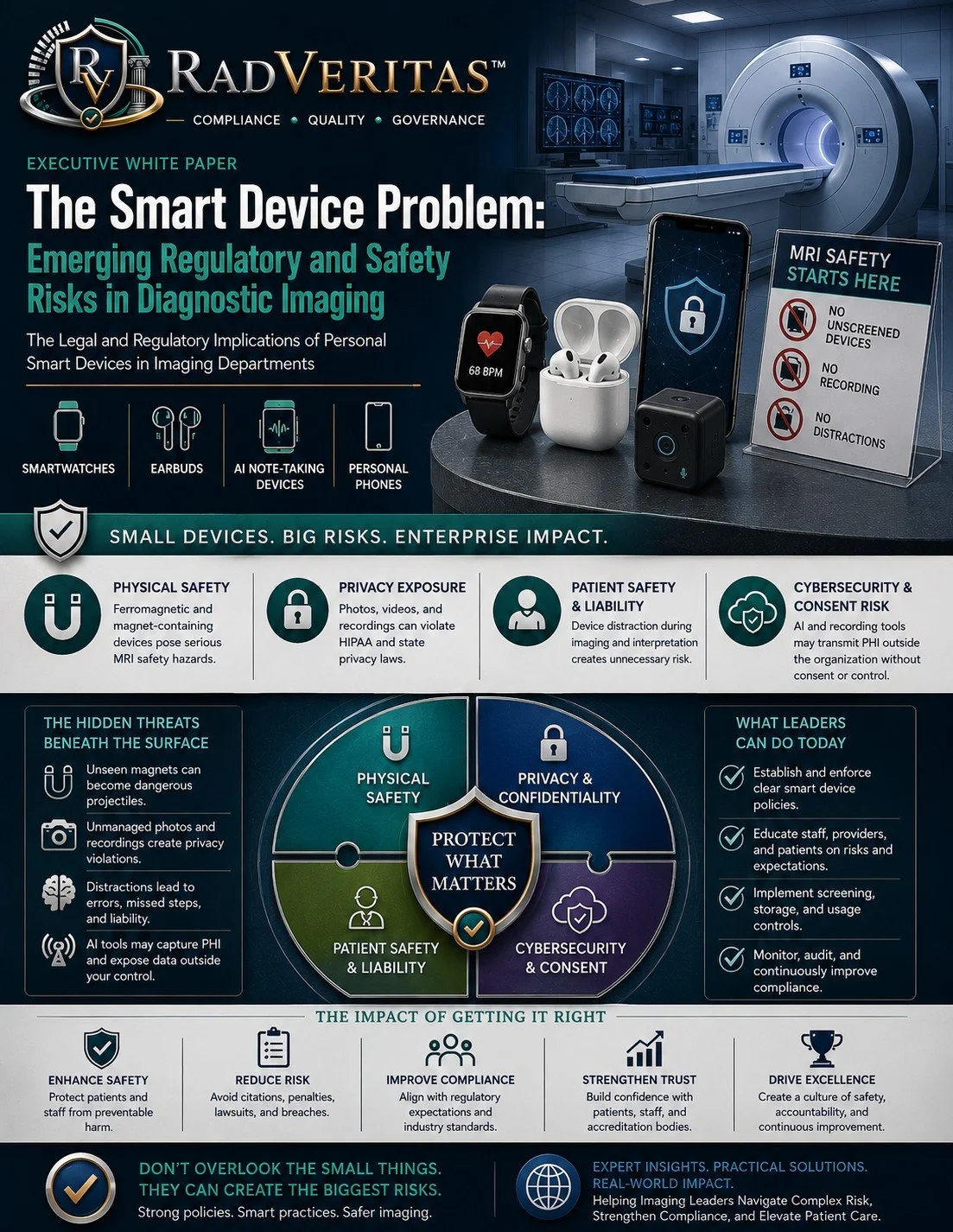
Small Devices. Big Risks. Enterprise Impact.
Smartphones. Smartwatches. Wireless earbuds. AI note-taking tools. Personal recording devices.
They are now part of everyday life and increasingly present inside healthcare environments.
Yet many Diagnostic Imaging departments remain unprepared for the regulatory, safety, privacy, and cybersecurity risks these technologies introduce.
The Smart Device Problem: Emerging Regulatory and Safety Risks in Diagnostic Imaging is a timely executive white paper that examines one of the fastest-growing and least understood threats facing imaging leaders today.
This comprehensive resource provides healthcare organizations with practical guidance to identify vulnerabilities, reduce risk, strengthen compliance, and protect patients, staff, and organizational reputation.
The Risk Most Organizations Are Not Actively Managing
While healthcare leaders focus on accreditation readiness, cybersecurity, patient safety, and regulatory compliance, personal smart devices continue to enter imaging environments with little oversight.
What appears harmless can quickly create significant exposure.
A smartwatch can become an MRI projectile.
An AI transcription application can capture protected health information.
A smartphone photo can trigger a HIPAA investigation.
A distraction during imaging can contribute to patient harm.
The risks are no longer theoretical.
They are already inside the department.
Four Converging Risks. One Compliance Failure.
Physical Safety
Understand how smart devices containing magnets, wireless technology, and metal components can create hazards in MRI and other imaging environments.
Privacy and Confidentiality
Learn how photos, recordings, screenshots, messaging applications, and cloud-connected devices can compromise patient privacy and regulatory compliance.
Patient Safety and Liability
Explore how distractions, workflow interruptions, and unauthorized device use can increase the likelihood of errors and adverse events.
Cybersecurity and Consent
Examine the growing risks associated with AI-powered applications, third-party data transmission, unauthorized recordings, and unsecured information sharing.
What You'll Learn
Hidden Threats Beneath the Surface
Identify risks that often remain unnoticed until an event, complaint, audit, or investigation occurs.
Regulatory Expectations
Understand how smart device use intersects with healthcare regulations, privacy requirements, and accreditation standards.
Risk Assessment Strategies
Evaluate vulnerabilities across imaging operations and determine where exposure exists within your organization.
Policy Development Guidance
Learn how effective organizations establish governance, accountability, and oversight for personal device use.
Operational Safeguards
Implement practical controls to reduce risk while maintaining workflow efficiency.
Turn an Emerging Threat Into a Competitive Advantage
The organizations that will succeed in the future are not those that react after an incident.
They are the ones that recognize emerging risks early and build proactive systems to manage them.
The Smart Device Problem: Emerging Regulatory and Safety Risks in Diagnostic Imaging provides healthcare leaders with the insight, framework, and practical solutions needed to navigate this rapidly evolving challenge.
Don't Overlook the Small Things
Because sometimes the greatest threats are the ones that fit in a pocket.
Protect your patients. Protect your staff. Protect your organization.
RadVeritas™
Compliance • Quality • Governance
Expert Insights. Practical Solutions. Real-World Impact.
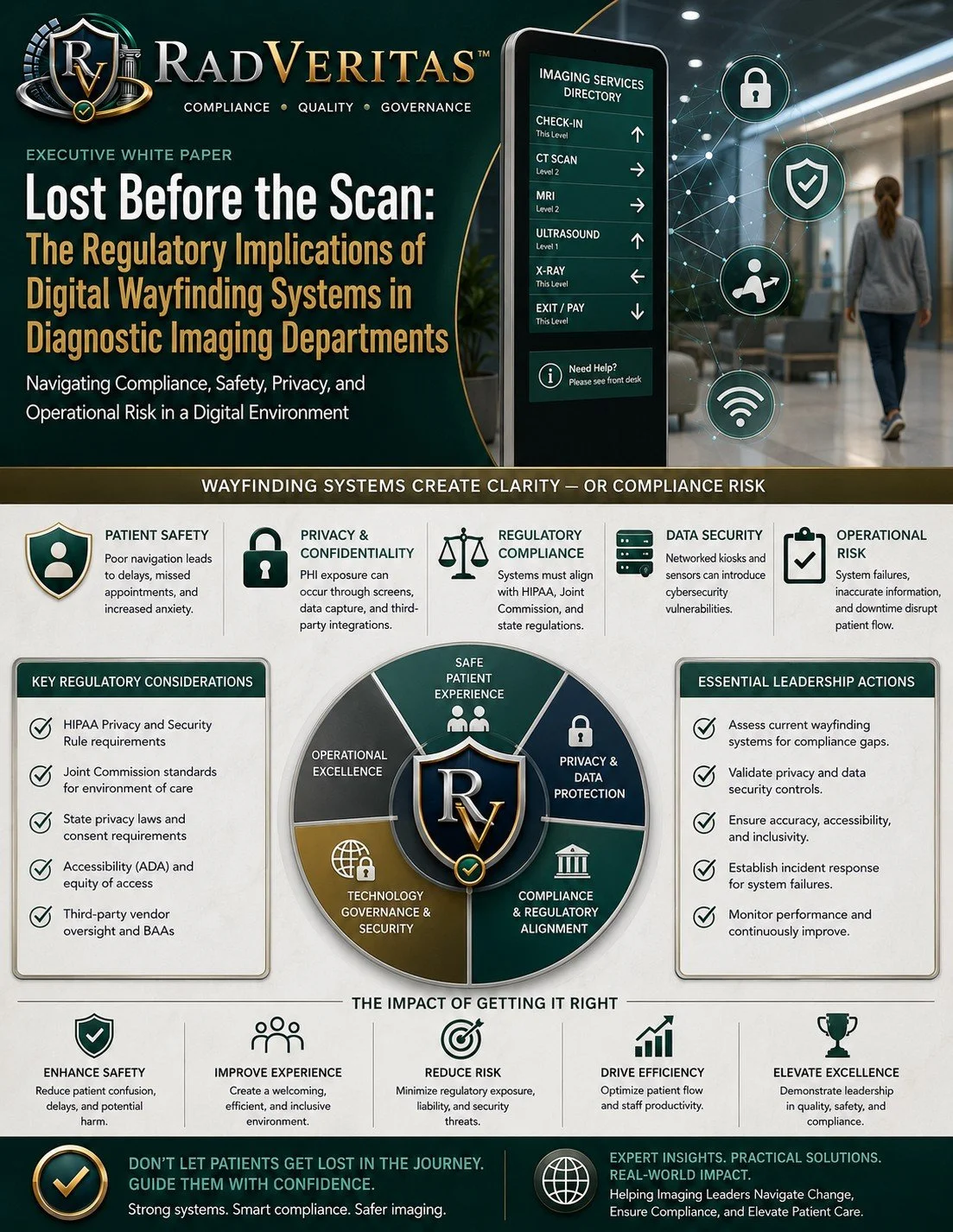
Navigating Compliance, Privacy, Patient Safety, and Operational Risk in a Digital Healthcare Environment
Digital wayfinding systems are rapidly transforming the patient experience across healthcare organizations. From touchscreen kiosks and interactive directories to mobile navigation platforms and integrated patient guidance systems, these technologies promise improved access, streamlined workflows, and enhanced patient satisfaction.
But beneath the convenience lies a growing and often overlooked area of regulatory, privacy, cybersecurity, and operational risk.
Lost Before the Scan™ is an executive-level regulatory intelligence white paper designed to help Diagnostic Imaging leaders identify, evaluate, and manage the emerging compliance challenges associated with digital wayfinding technologies throughout imaging departments and healthcare facilities.
This comprehensive resource provides healthcare executives, compliance professionals, imaging leaders, patient experience teams, information technology departments, and accreditation coordinators with a practical framework for ensuring that digital navigation solutions support organizational goals while remaining compliant, secure, and patient-centered.
Why This White Paper Matters
Digital wayfinding systems directly influence the patient journey before imaging even begins.
When these systems function effectively, they can:
Improve patient flow
Reduce appointment delays
Enhance patient satisfaction
Support accessibility initiatives
Improve operational efficiency
When poorly designed, inadequately governed, or improperly monitored, they can create significant organizational risk, including:
Privacy breaches
HIPAA violations
Cybersecurity vulnerabilities
Accessibility concerns
Patient safety issues
Operational disruptions
Regulatory deficiencies
This white paper examines the intersection of technology, compliance, patient experience, and governance through the lens of Diagnostic Imaging operations.
What You'll Learn
Patient Safety Implications
Explore how ineffective navigation systems can contribute to:
Missed appointments
Delayed imaging studies
Patient confusion and anxiety
Workflow disruptions
Increased operational inefficiencies
Privacy and Confidentiality Risks
Understand how digital displays, data collection practices, and third-party integrations may create exposure to:
Protected Health Information (PHI)
HIPAA Privacy Rule requirements
State privacy regulations
Unauthorized disclosures
Regulatory Compliance Expectations
Review key regulatory considerations related to:
HIPAA Privacy and Security Rules
Joint Commission Environment of Care standards
Accessibility requirements
State regulatory obligations
Third-party vendor oversight
Business Associate Agreements (BAAs)
Cybersecurity and Data Governance
Evaluate risks associated with:
Connected kiosks
Wireless technologies
Mobile navigation applications
Sensor-enabled systems
Network vulnerabilities
Data retention and security controls
Operational Excellence and Governance
Learn how leading organizations establish governance structures that support:
System reliability
Performance monitoring
Incident response planning
Continuous improvement
Enterprise risk management
More Than a Technology Discussion
Digital wayfinding is no longer simply a convenience tool.
It is a patient safety issue.
A privacy issue.
A cybersecurity issue.
A compliance issue.
And increasingly, a leadership issue.
Lost Before the Scan™ helps healthcare organizations understand the hidden risks, evaluate existing systems, and build governance strategies that support safe, compliant, and efficient Diagnostic Imaging operations.
Don't Let Patients Get Lost in the Journey
Strong systems. Smart compliance. Safer imaging.
Lost Before the Scan™ provides the executive insights, regulatory intelligence, and practical guidance needed to confidently navigate the evolving landscape of digital wayfinding technologies in healthcare.
RadVeritas™
Compliance • Quality • Governance
Expert Insights. Practical Solutions. Real-World Impact.
Helping Diagnostic Imaging Leaders Navigate Change, Ensure Compliance, and Elevate Patient Care.

The Hidden Fire, Electrical Safety, and Compliance Risks Every Diagnostic Imaging Leader Should Be Managing
Protect Patients. Protect Staff. Protect Your Organization.
Phone chargers, portable charging stations, power banks, tablets, smart devices, and personal electronics have quietly become part of everyday operations in diagnostic imaging. Yet many healthcare organizations lack clear governance over where these devices are used, how they are maintained, or whether they comply with patient care environment requirements.
What appears to be a harmless convenience can quickly become a significant source of fire hazards, electrical failures, patient safety incidents, regulatory deficiencies, and organizational liability.
The Regulatory Oversight of Portable Charging Stations and Personal Electronics™ provides healthcare leaders with a comprehensive governance framework for managing personal electronics and charging devices throughout diagnostic imaging departments. Designed for today's increasingly connected healthcare environment, this executive resource combines regulatory intelligence, risk management, and operational best practices to help organizations build safer, more compliant imaging environments.
Why This Resource Matters
Personal electronics are now found in nearly every imaging department.
Employees charge phones at workstations.
Portable charging towers appear in control rooms.
Patients arrive with power banks and charging cables.
Personal devices are routinely connected to hospital electrical systems.
Without formal oversight, these everyday practices can introduce significant operational and regulatory risks.
This guide helps organizations establish standardized policies that reduce exposure while supporting safe, efficient clinical operations.
What Makes This Resource Different
Unlike general electrical safety guidance, this executive resource focuses specifically on the unique risks associated with portable charging devices and personal electronics in diagnostic imaging environments.
It provides practical, healthcare-specific guidance for developing policies, governance structures, and accountability processes that align with patient safety, operational reliability, and regulatory expectations.
The framework addresses both clinical and non-clinical areas, including:
MRI suites
CT departments
Nuclear Medicine
Interventional Radiology
Ultrasound
Mammography
Radiography
Radiation Oncology
Imaging control rooms
Staff workstations
Waiting areas
Patient care spaces
Administrative offices
Comprehensive Topics Covered
Portable Charging Station Governance
Develop policies governing the placement, inspection, approval, maintenance, and monitoring of charging stations used throughout imaging departments.
Personal Electronic Device Management
Create standardized expectations for employee-owned and patient-owned electronic devices, including smartphones, tablets, laptops, smartwatches, earbuds, portable batteries, and accessories.
Fire and Electrical Safety
Reduce risks associated with overloaded outlets, damaged charging cables, counterfeit adapters, lithium-ion battery failures, overheating, and unauthorized charging equipment.
Patient Care Environment Compliance
Establish clear guidance regarding the use of personal electronics in patient care areas to support a safe clinical environment and minimize operational hazards.
Leadership Oversight
Implement governance structures that define accountability, auditing, staff education, corrective actions, and continuous monitoring.
Key Risks Addressed
The guide helps organizations identify and mitigate risks related to:
✔ Unauthorized charging devices
✔ Lithium-ion battery failures
✔ Fire and electrical hazards
✔ Overloaded outlets and power strips
✔ Counterfeit or damaged charging equipment
✔ Patient care vicinity electrical risks
✔ Personal electronic device misuse
✔ Operational disruptions
✔ Regulatory deficiencies
✔ Staff education gaps
✔ Policy inconsistencies
✔ Organizational liability
Practical Resources Included
This executive guide provides actionable tools to help organizations:
Develop enterprise charging device policies
Establish approved equipment standards
Create inspection and maintenance programs
Standardize staff education and competency
Conduct environmental safety assessments
Evaluate patient care areas for compliance
Strengthen electrical safety practices
Perform leadership compliance audits
Investigate charging-related incidents
Build corrective action plans
Monitor ongoing compliance and performance improvement
Designed For
Ideal for:
Diagnostic Imaging Directors
Radiology Administrators
Safety Officers
Facilities Management
Biomedical Engineering
Compliance Officers
Risk Management Professionals
Accreditation Coordinators
Environment of Care Teams
Imaging Managers and Supervisors
Security Leaders
Executive Healthcare Leadership
Organizational Benefits
Protect Patients and Staff
Reduce the risk of preventable fires, electrical incidents, equipment damage, and injuries associated with portable charging devices and personal electronics.
Strengthen Regulatory Compliance
Support organizational alignment with applicable regulatory, accreditation, and patient safety expectations through standardized policies and governance.
Reduce Organizational Risk
Identify vulnerabilities before they become incidents, survey findings, citations, or costly liability exposures.
Improve Operational Consistency
Create clear expectations for device use, charging practices, inspections, maintenance, and accountability across every imaging location.
Enhance Leadership Oversight
Provide executives with practical tools for monitoring compliance, educating staff, and sustaining long-term operational excellence.
Build a Culture of Safety
Demonstrate a proactive commitment to protecting patients, staff, facilities, and critical clinical operations from avoidable electrical and fire hazards.
Built for Modern Healthcare Operations
Portable charging devices and personal electronics are no longer incidental workplace conveniences. They are operational assets that require governance, oversight, and accountability.
Whether developing new organizational policies, preparing for accreditation surveys, strengthening Environment of Care programs, or reducing electrical safety risks, The Regulatory Oversight of Portable Charging Stations and Personal Electronics™ equips healthcare leaders with the practical guidance needed to build a safer, more resilient imaging environment.
Small Devices. Significant Risk.
The greatest risks are often the ones organizations overlook. A single unauthorized charger, damaged power adapter, or overloaded outlet can compromise patient safety, disrupt operations, and expose an organization to unnecessary regulatory and legal consequences.
The Regulatory Oversight of Portable Charging Stations and Personal Electronics™ helps healthcare leaders transform an often-overlooked operational issue into a structured, defensible program built on safety, accountability, and continuous compliance.
Protect Patients. Protect Staff. Protect Your Organization.
Reduce risk. Strengthen governance. Improve electrical safety. Build lasting operational resilience.
RadVeritas™
Compliance • Quality • Governance
Compliance Today. Excellence Every Day.
Expert Insights. Practical Solutions. Real-World Impact.
Helping Diagnostic Imaging Leaders Build Safer Clinical Environments Through Practical Governance, Regulatory Intelligence, and Operational Excellence.
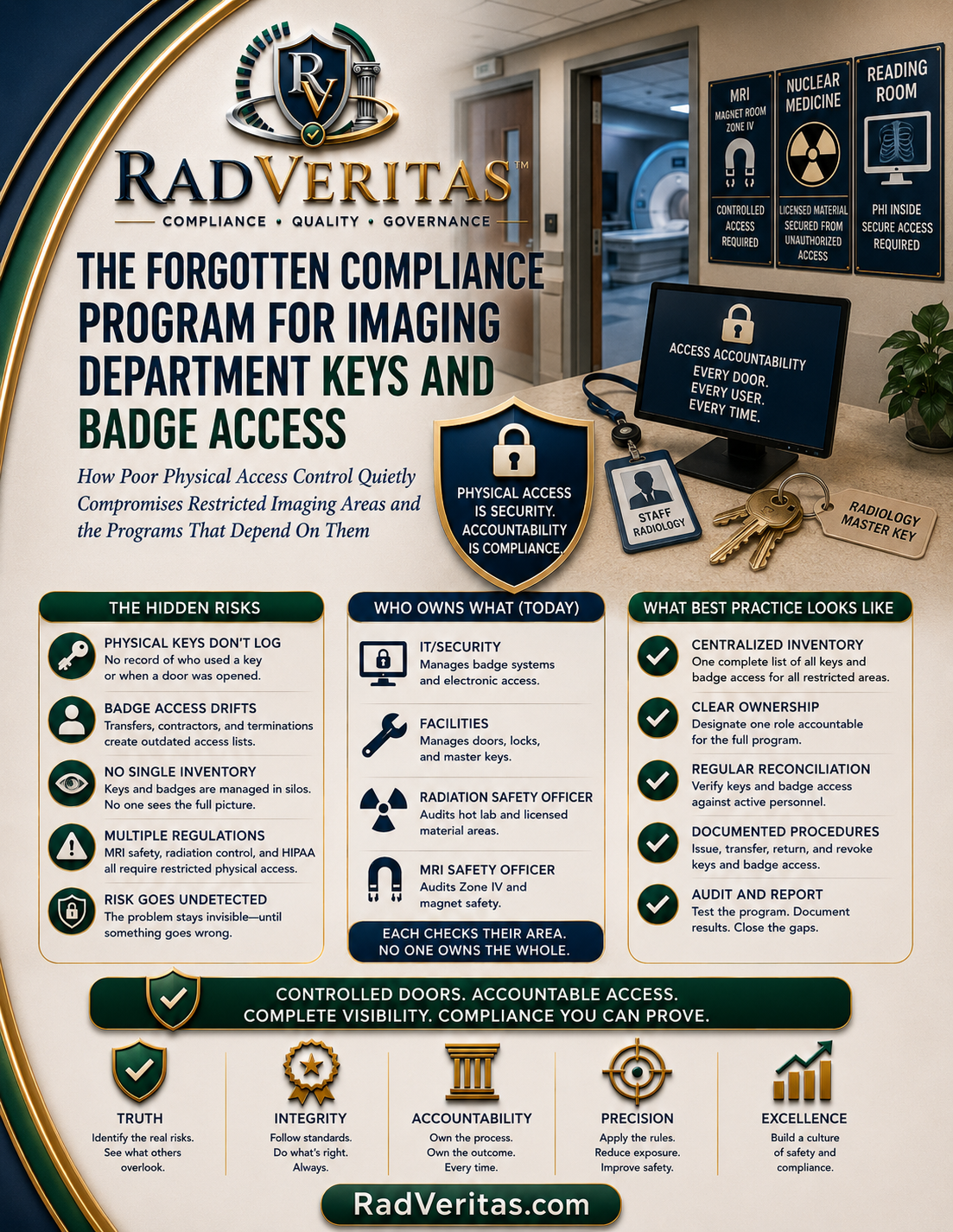
The Missing Link Between Physical Security, Regulatory Compliance, and Imaging Department Accountability
Secure Every Door. Control Every Credential. Protect Every Patient.
Every imaging department relies on physical access controls to protect patients, staff, radioactive materials, controlled equipment, electronic protected health information (ePHI), and restricted clinical environments.
Yet one of the most overlooked compliance programs in healthcare is the governance of keys, badge access, master key inventories, and restricted-area authorization.
While organizations often focus on cybersecurity, they frequently overlook the physical security controls that protect MRI suites, Nuclear Medicine hot labs, reading rooms, equipment rooms, server rooms, medication storage, and other restricted imaging areas.
The Forgotten Compliance Program for Imaging Department Keys and Badge Access™ provides healthcare leaders with a comprehensive governance framework for managing physical access controls through standardized policies, centralized accountability, and continuous regulatory oversight.
Why This Resource Matters
Every restricted door represents a compliance responsibility.
Without a structured key and badge access program, organizations may lose visibility into who has access, why they have access, and whether that access remains appropriate.
Poor physical access management can result in:
Unauthorized entry into restricted areas
Compromised patient privacy
MRI safety incidents
Security breaches
Radiation safety violations
Regulatory deficiencies
Inaccurate badge access lists
Lost master keys
Weak audit trails
Increased organizational liability
This executive guide helps organizations establish a defensible physical access management program that supports safety, accountability, and regulatory compliance.
What Makes This Resource Different
Unlike general facility security manuals, this guide focuses specifically on the unique operational and regulatory requirements of diagnostic imaging environments.
It integrates physical security, regulatory compliance, and operational governance into a single framework that aligns key and badge management with healthcare best practices.
The framework applies across:
MRI Suites
Nuclear Medicine Hot Labs
PET/CT Departments
CT and Radiography Areas
Ultrasound
Mammography
Interventional Radiology
Radiation Oncology
Reading Rooms
PACS and Server Rooms
Medication Storage Areas
Equipment Rooms
Enterprise Imaging Facilities
Multi-site Health Systems
Comprehensive Topics Covered
Physical Access Governance
Develop standardized policies governing the issuance, tracking, transfer, recovery, and auditing of keys, badges, and electronic access credentials.
Key and Badge Inventory Management
Create centralized inventories that document every physical key, master key, badge credential, access level, and assigned custodian.
Restricted Area Access
Define authorization requirements for MRI Zones, radiation-controlled areas, licensed material storage, reading rooms, equipment rooms, and other secured clinical environments.
Access Accountability
Strengthen accountability through documented ownership, periodic reconciliation, access reviews, and audit-ready records.
Leadership Oversight
Establish governance structures that support ongoing monitoring, corrective actions, policy compliance, and continuous program improvement.
Key Risks Addressed
The guide helps organizations identify and reduce risks associated with:
✔ Lost or unaccounted-for master keys
✔ Inaccurate badge access lists
✔ Former employee access
✔ Contractor access management
✔ Unauthorized entry into restricted imaging areas
✔ Weak physical security controls
✔ MRI restricted access deficiencies
✔ Radiation safety access concerns
✔ Fragmented departmental ownership
✔ Incomplete audit documentation
✔ Regulatory survey findings
✔ Organizational liability
Practical Resources Included
This executive guide provides actionable tools to help organizations:
Develop comprehensive key and badge policies
Create centralized access inventories
Standardize key issuance and recovery procedures
Conduct routine access reconciliations
Review employee, contractor, and vendor access
Audit restricted-area authorization
Monitor compliance with physical security requirements
Investigate security incidents
Develop corrective action plans
Strengthen leadership accountability through continuous oversight and performance monitoring
Designed For
Ideal for:
Diagnostic Imaging Directors
Radiology Administrators
MRI Safety Officers
Radiation Safety Officers
Facilities Management
Security Directors
Compliance Officers
Risk Management Professionals
Accreditation Coordinators
Enterprise Imaging Leaders
Imaging Managers and Supervisors
Executive Healthcare Leadership
Organizational Benefits
Strengthen Physical Security
Protect restricted imaging environments through standardized key, badge, and access management practices.
Improve Regulatory Compliance
Support compliance with organizational policies, accreditation standards, and regulatory expectations governing controlled access to restricted clinical areas.
Reduce Organizational Risk
Identify and correct access vulnerabilities before they result in security incidents, patient safety events, or survey findings.
Improve Accountability
Establish clear ownership, documented authorization, and audit-ready records for every key, badge, and access credential.
Standardize Enterprise Access Management
Create consistent physical security practices across hospitals, outpatient imaging centers, and enterprise imaging networks.
Build a Culture of Security
Promote accountability by ensuring that every access decision is deliberate, documented, monitored, and regularly reviewed.
Built for Modern Diagnostic Imaging Operations
Physical access control is more than a facilities function. It is a patient safety, regulatory compliance, security, and operational governance responsibility.
Whether preparing for an accreditation survey, strengthening MRI safety programs, improving radiation security, or modernizing enterprise physical security practices, The Forgotten Compliance Program for Imaging Department Keys and Badge Access™ provides the practical guidance needed to establish a comprehensive, defensible access management program.
Physical Security Is Compliance You Can Demonstrate.
The strongest cybersecurity program cannot compensate for weak physical access controls. Every unrestricted door, untracked master key, or outdated badge authorization creates unnecessary organizational risk.
The Forgotten Compliance Program for Imaging Department Keys and Badge Access™ helps healthcare leaders transform fragmented access control practices into an integrated governance program built on accountability, visibility, and continuous compliance.
Secure Every Door. Control Every Credential. Strengthen Every Program.
Reduce risk. Improve accountability. Protect restricted imaging environments. Build lasting operational resilience.
RadVeritas™
Compliance • Quality • Governance
Compliance Today. Excellence Every Day.
Expert Insights. Practical Solutions. Real-World Impact.
Helping Diagnostic Imaging Leaders Strengthen Physical Security, Standardize Access Governance, Protect Restricted Clinical Areas, and Build Defensible Compliance Programs Through Operational Excellence.
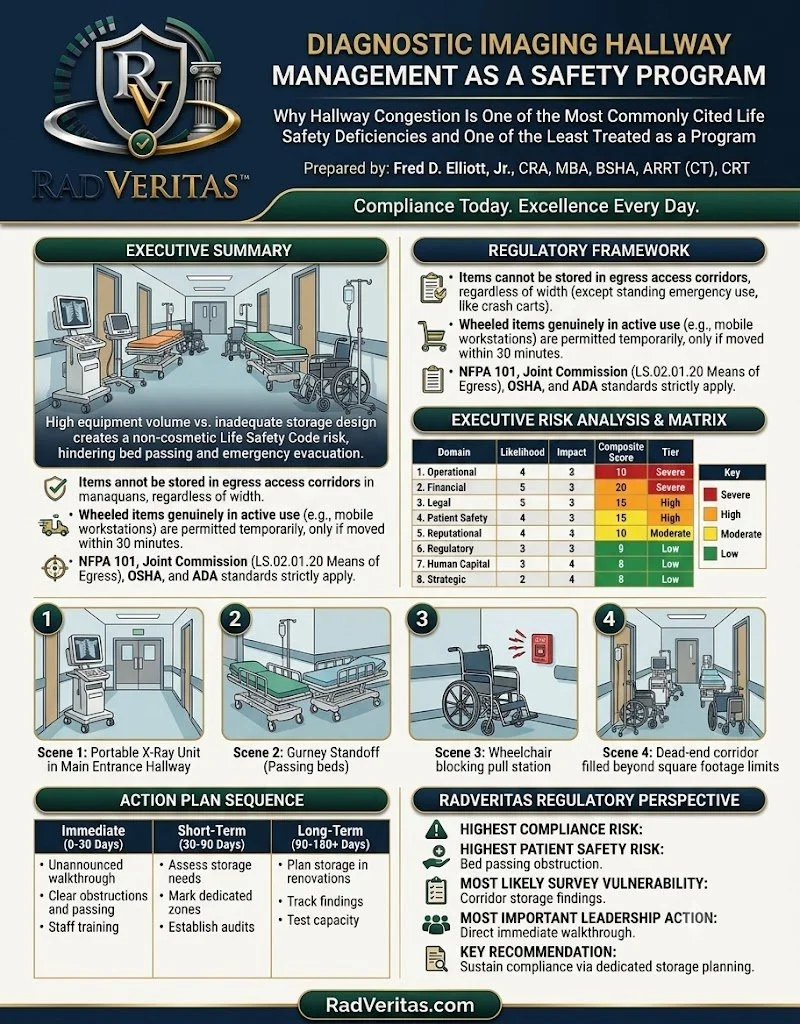
Transform Hallway Compliance from a Recurring Survey Finding into a Sustainable Patient Safety and Operational Excellence Program.
Because Every Hallway Is More Than a Corridor. It Is a Critical Patient Care and Emergency Access Pathway.
Hallway congestion is one of the most frequently cited Life Safety deficiencies in healthcare, yet it is often treated as a housekeeping issue rather than an enterprise-wide safety program.
Portable imaging equipment, stretchers, wheelchairs, mobile workstations, supply carts, oxygen cylinders, and temporary storage routinely migrate into corridors intended for patient transport and emergency egress. What begins as a convenient solution can quickly become a patient safety hazard, a regulatory deficiency, and a barrier to emergency response.
Diagnostic Imaging Hallway Management as a Safety Program™ provides healthcare leaders with a comprehensive governance framework for eliminating corridor hazards, strengthening Life Safety compliance, improving operational efficiency, and creating sustainable hallway management practices across diagnostic imaging.
Why This Resource Matters
Diagnostic Imaging departments operate in high-volume, fast-paced environments where every square foot matters.
Without a structured hallway management program, organizations risk:
Blocked emergency egress routes
Delayed patient transport
Impeded emergency response
Reduced patient throughput
Wheelchair and stretcher congestion
Increased trip and fall hazards
Environment of Care deficiencies
Accreditation findings
Regulatory citations
Poor patient and visitor experiences
This resource helps organizations shift from reactive corridor cleanups to proactive operational governance.
What Makes This Resource Different
Most hallway inspections focus only on what surveyors can see.
This executive resource focuses on why hallway congestion occurs and provides leaders with sustainable operational solutions rather than temporary corrective actions.
The framework integrates:
Life Safety
Environment of Care
Patient Flow
Facilities Planning
Lean Operations
Regulatory Compliance
Executive Governance
Continuous Performance Improvement
The result is a comprehensive hallway management program that improves safety while supporting efficient imaging operations.
Comprehensive Topics Covered
Corridor Compliance Governance
Develop standardized policies that ensure hallways remain safe, accessible, and compliant while supporting daily imaging operations.
Regulatory Requirements
Interpret and operationalize requirements related to Life Safety, emergency egress, corridor storage, temporary equipment placement, and patient care environments.
Operational Workflow Analysis
Identify the operational factors that contribute to hallway congestion, including inadequate storage, equipment utilization, workflow bottlenecks, and patient transport challenges.
Risk Assessment
Evaluate corridor hazards using structured risk assessment tools that prioritize patient safety, regulatory exposure, and operational impact.
Leadership Accountability
Define responsibilities across Imaging Leadership, Facilities Management, Environmental Services, Safety, Security, Patient Transport, and Executive Leadership.
Continuous Monitoring
Implement routine inspections, performance metrics, audit processes, and corrective action plans to sustain compliance.
Key Risks Addressed
This guide helps organizations proactively reduce:
✔ Corridor storage deficiencies
✔ Blocked emergency exits and egress pathways
✔ Patient transport delays
✔ Wheelchair and stretcher obstructions
✔ Fire and Life Safety violations
✔ Environment of Care survey findings
✔ Operational inefficiencies
✔ Trip and fall hazards
✔ Poor emergency response access
✔ Repeat accreditation deficiencies
Practical Resources Included
This executive resource provides implementation-ready tools, including:
Hallway Management Program Framework
Corridor Inspection Checklists
Executive Walkthrough Guides
Life Safety Audit Tools
Hallway Risk Assessment Matrix
Equipment Storage Assessment Templates
Patient Transport Workflow Evaluations
Corrective Action Plan Templates
Department Accountability Matrices
Leadership Performance Dashboards
Staff Education Resources
Continuous Monitoring and Audit Tools
Designed For
Ideal for:
Diagnostic Imaging Directors
Radiology Administrators
Imaging Managers and Supervisors
Environment of Care Committees
Facilities Management Leaders
Patient Safety Officers
Safety and Security Teams
Accreditation Coordinators
Compliance Officers
Quality Improvement Professionals
Hospital Operations Leaders
Executive Healthcare Leadership
Organizational Benefits
Improve Patient Safety
Maintain unobstructed pathways that support safe patient movement, emergency response, and rapid evacuation when needed.
Strengthen Regulatory Compliance
Demonstrate sustainable compliance with Life Safety, Environment of Care, and accreditation expectations through standardized governance.
Reduce Survey Findings
Identify and correct corridor vulnerabilities before they become deficiencies during accreditation or regulatory inspections.
Improve Operational Efficiency
Optimize equipment storage, patient transport, and workflow to reduce congestion and improve departmental throughput.
Increase Leadership Accountability
Clearly define ownership, monitoring responsibilities, and escalation pathways for hallway compliance.
Build a Culture of Continuous Readiness
Embed hallway management into everyday operations rather than relying on last-minute survey preparation.
Built for Modern Diagnostic Imaging Operations
Hallway management is not simply about keeping corridors clear. It is about protecting patients, enabling emergency response, supporting operational efficiency, and demonstrating organizational excellence.
Whether preparing for an accreditation survey, redesigning imaging workflows, expanding departmental capacity, or strengthening Environment of Care programs, Diagnostic Imaging Hallway Management as a Safety Program™ provides leaders with the practical tools needed to create lasting improvements.
Every Corridor Reflects Your Commitment to Safety.
The safest imaging departments do not wait for surveyors to identify hallway hazards. They build systems that prevent them.
Diagnostic Imaging Hallway Management as a Safety Program™ helps healthcare organizations transform corridor compliance into a proactive, measurable, and sustainable patient safety initiative that strengthens operational performance and regulatory readiness.
Clear Hallways. Safer Patients. Stronger Compliance.
Reduce risk. Improve patient flow. Strengthen Life Safety. Build operational excellence.
RadVeritas™
Compliance • Quality • Governance
Compliance Today. Excellence Every Day.
Expert Insights. Practical Solutions. Real-World Impact.
Helping Diagnostic Imaging Leaders Build Sustainable Hallway Management Programs That Protect Patients, Support Emergency Access, Strengthen Regulatory Compliance, and Drive Continuous Operational Excellence.
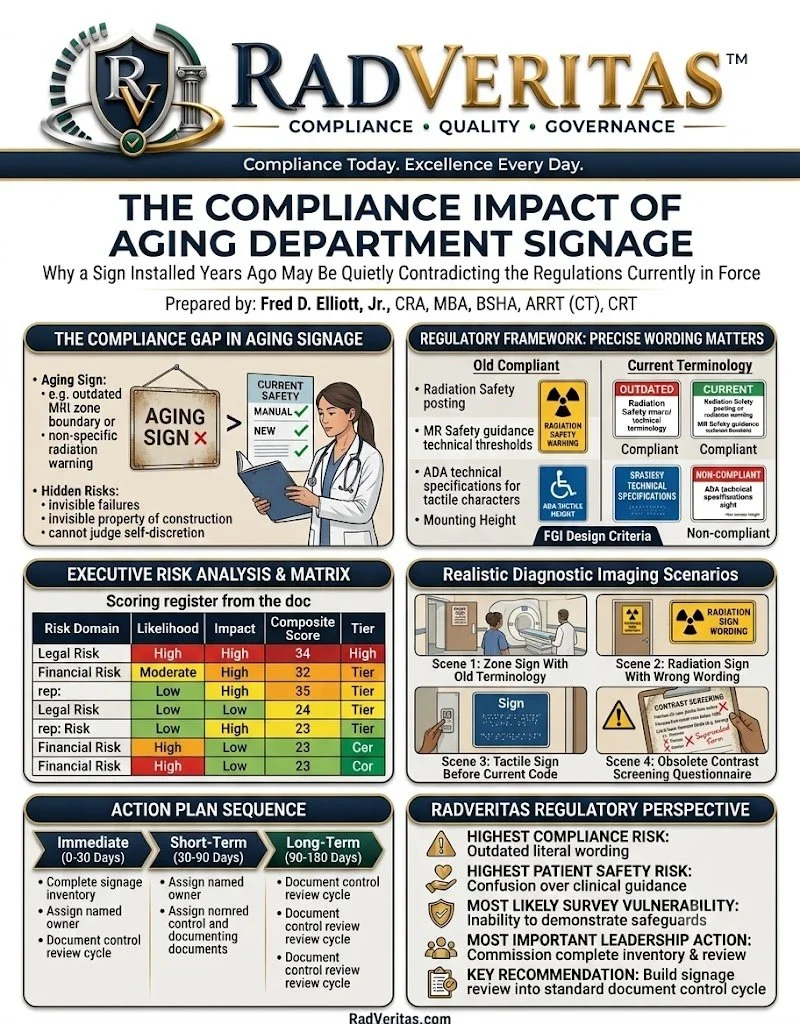
Transform Department Signage from a Forgotten Maintenance Task into a Strategic Regulatory Compliance Program.
Because Yesterday's Compliant Sign May Be Today's Regulatory Deficiency.
Healthcare organizations invest significant resources in policies, procedures, equipment, and staff education, yet one of the most visible components of regulatory compliance is often overlooked.
Department signage.
Over time, regulations evolve, terminology changes, design standards are updated, and patient communication requirements expand. Signs that were fully compliant when installed may gradually become outdated, inconsistent, or inaccurate, creating unnecessary regulatory exposure and patient confusion.
The Compliance Impact of Aging Department Signage™ provides healthcare leaders with a comprehensive governance framework for inventorying, evaluating, updating, and sustaining regulatory signage throughout diagnostic imaging departments and healthcare facilities.
This executive resource transforms signage management into a structured compliance program that strengthens patient safety, improves communication, and supports continuous survey readiness.
Why This Resource Matters
Every sign communicates organizational expectations.
Whether identifying MRI safety zones, radiation areas, restricted access, patient instructions, emergency exits, or departmental policies, signage serves as an extension of regulatory compliance and patient safety.
Without a structured signage governance program, organizations increase their exposure to:
Outdated regulatory terminology
Inconsistent safety messaging
Incorrect patient instructions
Obsolete warning signs
Accessibility deficiencies
Survey findings
Patient confusion
Operational inconsistency
Legal and regulatory liability
Documentation gaps
This resource helps organizations proactively identify and correct signage deficiencies before they become survey findings or patient safety concerns.
What Makes This Resource Different
Most organizations replace signs only when they become damaged or unreadable.
This guide treats signage as a controlled compliance document requiring routine review, standardized governance, and lifecycle management.
The framework integrates:
Regulatory Compliance
Accreditation Readiness
Environment of Care
Life Safety
Radiation Safety
MRI Safety
Patient Communication
Accessibility Standards
Facilities Management
Quality Improvement
Executive Oversight
The result is a sustainable signage governance program that evolves alongside changing regulatory requirements.
Comprehensive Topics Covered
Signage Inventory Management
Develop a centralized inventory of all departmental signage, including safety signs, regulatory postings, patient instructions, directional signs, and operational notices.
Regulatory Compliance Review
Evaluate signage against current federal, state, accreditation, accessibility, and organizational requirements to identify outdated terminology, obsolete references, and inconsistent messaging.
Patient Safety Communication
Ensure signage clearly communicates hazards, patient instructions, emergency procedures, and restricted access requirements using current standards and best practices.
Design and Accessibility Standards
Assess placement, visibility, readability, symbols, tactile features, language requirements, and accessibility considerations to improve communication for all patients and staff.
Document Control and Governance
Integrate signage into the organization's document control process with defined ownership, revision cycles, approval workflows, and version management.
Continuous Monitoring
Establish recurring audits, leadership walkthroughs, and performance indicators to maintain ongoing compliance and prevent signage from becoming outdated.
Key Risks Addressed
This guide helps organizations proactively reduce:
✔ Outdated regulatory terminology
✔ Incorrect safety messaging
✔ Obsolete patient instruction signs
✔ Inconsistent departmental communication
✔ Accessibility deficiencies
✔ Survey findings related to signage
✔ Patient confusion and misinformation
✔ Documentation and document control gaps
✔ Environmental compliance deficiencies
✔ Organizational liability associated with inaccurate postings
Practical Resources Included
This executive resource provides implementation-ready tools, including:
Department Signage Inventory Templates
Regulatory Signage Audit Checklists
Signage Risk Assessment Matrix
Document Control Procedures for Signage
Standardized Review and Approval Workflows
Accessibility Evaluation Checklists
Executive Walkthrough Guides
Corrective Action Plan Templates
Performance Monitoring Dashboards
Department Ownership Matrix
Annual Review Schedules
Continuous Compliance Audit Tools
Designed For
Ideal for:
Diagnostic Imaging Directors
Radiology Administrators
Facilities Management Leaders
Compliance Officers
Accreditation Coordinators
Radiation Safety Officers
MRI Safety Officers
Environment of Care Committees
Patient Safety Leaders
Quality Improvement Professionals
Risk Management Teams
Executive Healthcare Leadership
Organizational Benefits
Improve Regulatory Compliance
Maintain signage that accurately reflects current regulatory requirements, accreditation standards, and organizational policies.
Strengthen Patient Safety
Provide clear, consistent, and current information that supports safe patient care, informed decision-making, and hazard awareness.
Reduce Survey Findings
Identify and correct outdated signage before inspections, accreditation surveys, or regulatory reviews.
Standardize Communication
Ensure consistent messaging across hospitals, outpatient imaging centers, ambulatory facilities, and integrated health systems.
Enhance Operational Governance
Treat signage as a controlled compliance asset with defined ownership, review cycles, and documented accountability.
Build Continuous Readiness
Create a sustainable signage management program that supports long-term regulatory excellence rather than periodic replacement efforts.
Built for Modern Healthcare Organizations
Signs are more than wall decorations. They communicate expectations, reinforce safety practices, support regulatory compliance, and guide patients through complex healthcare environments.
Whether preparing for accreditation surveys, renovating imaging facilities, expanding services, or strengthening document control programs, The Compliance Impact of Aging Department Signage™ provides healthcare leaders with the tools needed to ensure every sign reflects current standards and organizational excellence.
Every Sign Tells a Story About Your Organization.
The most successful healthcare organizations understand that compliance extends beyond policies and procedures. It is visible in every patient-facing message, every safety warning, and every instruction displayed throughout the facility.
The Compliance Impact of Aging Department Signage™ helps healthcare organizations establish a proactive signage governance program that strengthens regulatory compliance, improves patient communication, reduces operational risk, and supports continuous accreditation readiness.
Current Signs. Clear Communication. Continuous Compliance.
Reduce risk. Improve consistency. Strengthen governance. Protect patients.
RadVeritas™
Compliance • Quality • Governance
Compliance Today. Excellence Every Day.
Expert Insights. Practical Solutions. Real-World Impact.
Helping Diagnostic Imaging Leaders Build Enterprise Signage Governance Programs That Strengthen Regulatory Compliance, Improve Patient Communication, Support Accreditation Readiness, and Sustain Operational Excellence Through Standardized Document Control and Continuous Review.
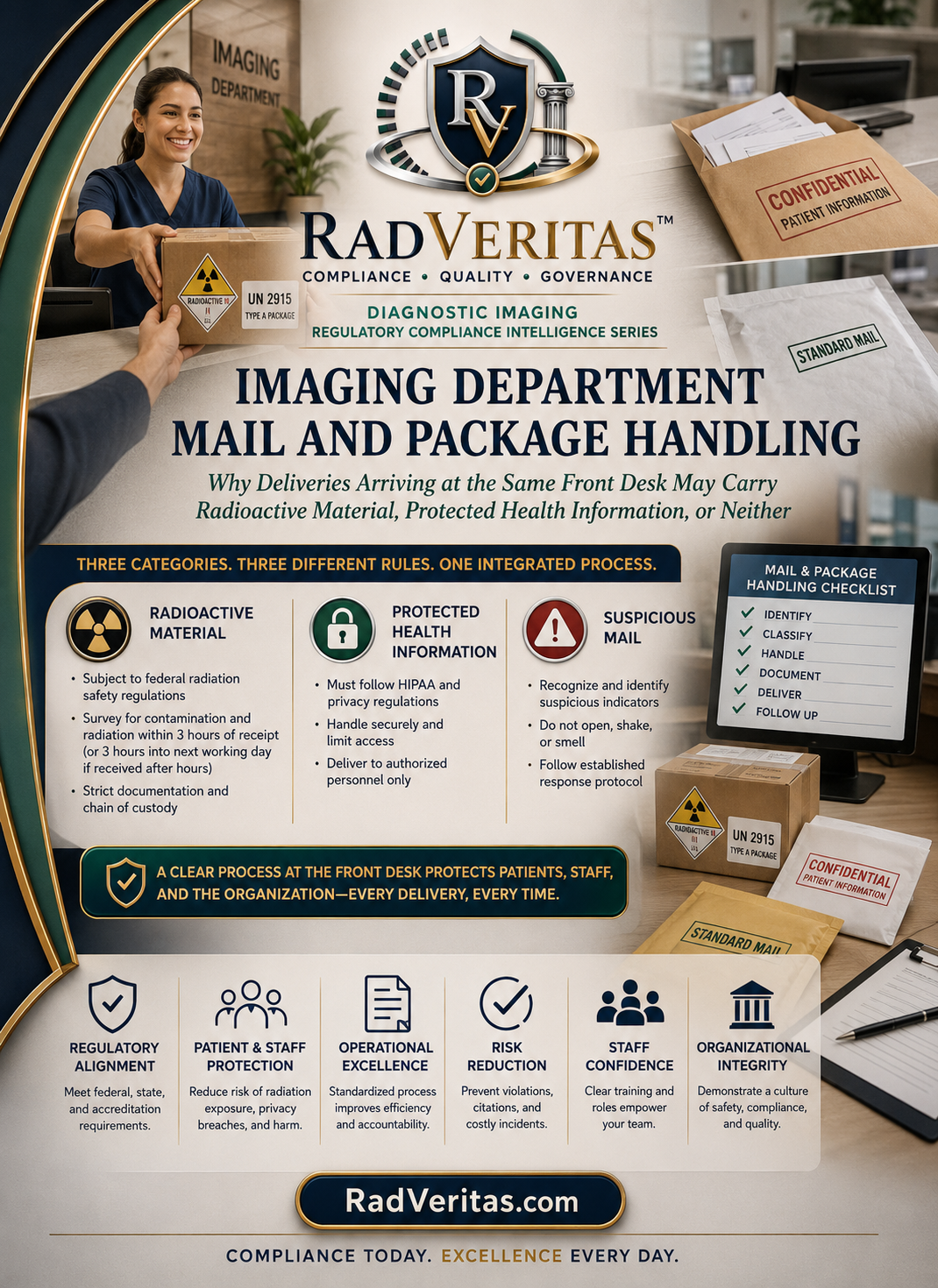
One Front Desk. Three Categories of Deliveries. Countless Opportunities for Regulatory Exposure.
Build a Standardized Mail and Package Handling Program That Protects Patients, Staff, and Your Organization.
Every day, imaging departments receive deliveries that appear routine but may carry vastly different regulatory obligations.
One package may contain radioactive material subject to federal radiation control regulations. Another may include protected health information governed by HIPAA. A third could be suspicious mail requiring immediate security response.
Treating every delivery the same is one of the most overlooked operational risks in diagnostic imaging.
Imaging Department Mail and Package Handling™ provides a comprehensive governance framework for safely receiving, classifying, documenting, routing, and securing all incoming mail and packages. It equips imaging leaders with standardized processes that improve regulatory compliance, strengthen operational readiness, and reduce organizational risk.
Why This Resource Matters
Mail and package handling is often viewed as an administrative function rather than a compliance process. Yet a single delivery may involve multiple regulatory requirements, including:
Radioactive material shipments
Sealed source deliveries
Patient medical records
Protected Health Information (PHI)
Vendor documentation
Controlled shipments
Hazardous materials
Suspicious mail or packages
Legal notices
Time-sensitive regulatory correspondence
Without standardized procedures, organizations risk delayed processing, chain-of-custody failures, privacy breaches, radiation safety violations, and operational disruptions.
This manual transforms routine package handling into a structured governance program that supports patient safety, regulatory compliance, and organizational accountability.
What Makes This Resource Different
Most organizations have general mailroom procedures. Very few have imaging-specific guidance that integrates radiation safety, privacy, security, and operational requirements into a single workflow.
This reference combines:
Radiation Safety
HIPAA Privacy and Security
Mail and Package Security
Chain of Custody
Operational Risk Management
Regulatory Compliance
Documentation Standards
Front Desk Operations
Executive Governance
Survey Readiness
The result is a practical, department-specific system that enables staff to make informed decisions regardless of the type of delivery received.
Comprehensive Topics Covered
Radioactive Material Handling
Establish standardized procedures for receiving, documenting, inspecting, surveying, and transferring radioactive material shipments in accordance with organizational radiation safety protocols.
Protected Health Information (PHI)
Implement secure handling, restricted access, and documented routing for confidential patient information to support privacy and confidentiality.
Suspicious Mail Recognition
Develop staff awareness and response procedures for identifying suspicious packages while protecting personnel and maintaining operational continuity.
Chain of Custody Documentation
Create complete documentation processes from receipt through final delivery, ensuring accountability for sensitive materials.
Front Desk Workflow Standardization
Define clear responsibilities for reception staff, imaging personnel, radiation safety, compliance, and leadership.
Operational Governance
Integrate mail handling into broader departmental quality, safety, compliance, and risk management programs.
Key Risks Addressed
This resource helps organizations reduce:
✔ Radiation safety compliance gaps
✔ HIPAA privacy violations
✔ Improper handling of sensitive deliveries
✔ Chain-of-custody failures
✔ Lost or misdirected packages
✔ Suspicious mail response deficiencies
✔ Documentation inconsistencies
✔ Regulatory citations
✔ Operational delays
✔ Patient safety and organizational liability
Practical Resources Included
This implementation-focused guide includes:
Mail and Package Handling Policies
Delivery Classification Decision Trees
Chain of Custody Forms
Radioactive Material Receiving Checklists
PHI Handling Procedures
Suspicious Mail Response Protocols
Front Desk Workflow Guides
Staff Training Materials
Compliance Audit Checklists
Leadership Oversight Dashboards
Corrective Action Planning Tools
Continuous Monitoring Worksheets
Designed For
Ideal for:
Diagnostic Imaging Directors
Radiology Administrators
Radiation Safety Officers
Nuclear Medicine Leaders
PET/CT Programs
Front Desk Supervisors
Compliance Officers
Privacy Officers
Risk Managers
Quality Improvement Teams
Hospital Operations Leaders
Accreditation Coordinators
Organizational Benefits
Strengthen Regulatory Compliance
Standardize handling processes for radioactive materials, confidential information, and sensitive deliveries while supporting regulatory and accreditation expectations.
Protect Patients and Staff
Reduce the risk of radiation exposure, privacy breaches, mishandled deliveries, and inappropriate responses to suspicious packages.
Improve Operational Consistency
Provide staff with clear procedures that eliminate uncertainty and improve efficiency across all delivery types.
Enhance Accountability
Create documented workflows that establish responsibility from receipt through final disposition.
Increase Survey Readiness
Demonstrate organized, defensible processes supported by written procedures, documentation, training, and continuous oversight.
Build Organizational Resilience
Transform an often-overlooked administrative function into a mature governance process that supports enterprise-wide compliance.
Built for Modern Diagnostic Imaging Operations
Every delivery entering your department deserves more than a signature. It deserves a standardized process that recognizes regulatory obligations before risk becomes an incident.
Imaging Department Mail and Package Handling™ provides healthcare organizations with the governance framework, operational tools, and practical guidance needed to ensure every package is handled safely, securely, and consistently.
Every Delivery Carries Responsibility.
Whether receiving radioactive material, confidential patient information, or routine correspondence, imaging departments need clear processes that protect patients, support staff, and withstand regulatory scrutiny.
Imaging Department Mail and Package Handling™ helps healthcare leaders establish a comprehensive, survey-ready program that strengthens compliance, improves accountability, and reduces organizational risk.
Every Package Identified. Every Delivery Documented. Every Decision Defensible.
Protect patients. Protect staff. Protect your organization.
RadVeritas™
Compliance • Quality • Governance
Compliance Today. Excellence Every Day.
Expert Insights. Practical Solutions. Real-World Impact.
Helping Diagnostic Imaging Leaders Build Enterprise Programs for Mail Handling, Radiation Safety, Privacy Protection, Chain of Custody, Operational Governance, Regulatory Compliance, and Organizational Excellence.
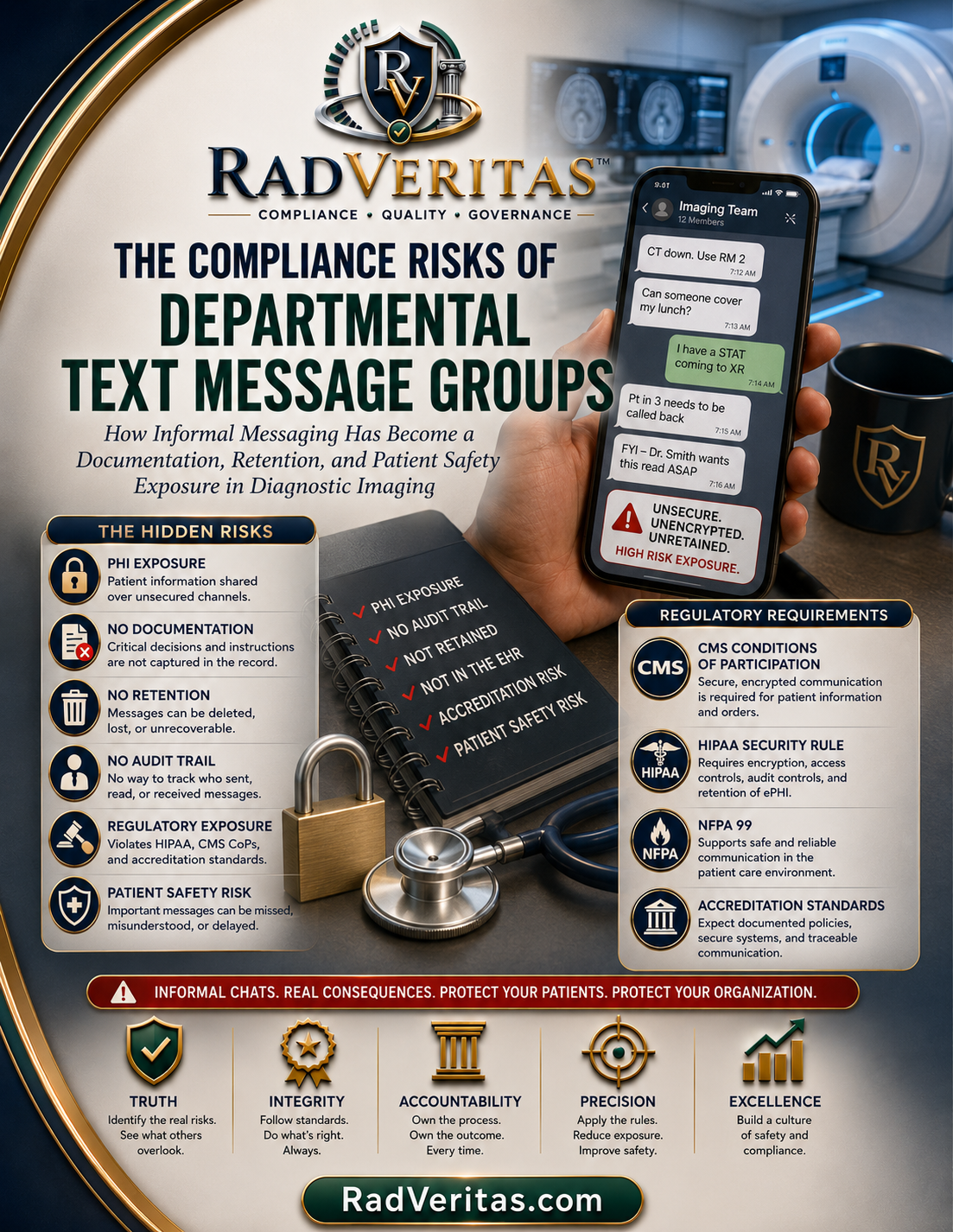
How Informal Messaging Creates Documentation, Retention, Privacy, and Patient Safety Risk in Diagnostic Imaging
Protect Patient Information. Preserve Critical Decisions. Strengthen Regulatory Compliance.
Departmental text message groups have become one of the most widely used communication tools in healthcare. While they offer speed and convenience, they often operate outside approved clinical communication systems, creating significant risks for patient privacy, documentation integrity, regulatory compliance, and patient safety.
The Compliance Risks of Departmental Text Message Groups™ equips healthcare leaders with the knowledge and practical strategies needed to identify, govern, and eliminate one of the most common yet least recognized compliance vulnerabilities in modern diagnostic imaging operations.
Developed for healthcare executives, diagnostic imaging leaders, compliance professionals, information security teams, privacy officers, and accreditation coordinators, this executive resource provides an enterprise framework for replacing informal messaging with secure, compliant, and defensible communication practices.
Why This Resource Matters
Every day, healthcare teams exchange time-sensitive information through group text messages.
Patient updates, workflow changes, staffing requests, physician instructions, critical results, and operational decisions are often communicated using consumer messaging platforms that were never designed for regulated healthcare environments.
Without proper governance, organizations may face:
Unauthorized disclosure of Protected Health Information (PHI)
HIPAA Privacy and Security Rule violations
Missing clinical documentation
No legal record of critical communications
No audit trail for decision-making
Inconsistent message retention
Lost or deleted communications
Accreditation deficiencies
Patient safety events
Increased legal and financial liability
This guide demonstrates why informal text messaging should be treated as an enterprise governance issue rather than simply a communication preference.
What Makes This Resource Different
Most organizations recognize the importance of secure messaging but underestimate the operational and regulatory consequences of informal departmental text groups.
This executive resource examines messaging practices through the combined perspectives of:
HIPAA compliance
CMS Conditions of Participation
Accreditation readiness
Patient safety
Information governance
Health information management
Cybersecurity
Legal defensibility
Enterprise risk management
Rather than focusing solely on technology, it provides leadership strategies for creating sustainable communication governance across diagnostic imaging operations.
Key Topics Covered
Secure Clinical Communication
Understand the regulatory expectations for communicating patient information through approved, encrypted, and monitored platforms.
Documentation Integrity
Learn why critical clinical decisions, physician instructions, patient updates, and operational communications must be appropriately documented and retained.
Privacy and Confidentiality
Identify how informal messaging increases the risk of unauthorized disclosure, unsecured transmission, and accidental sharing of Protected Health Information.
Audit Trails and Record Retention
Develop communication systems that provide traceable records, accountability, and defensible documentation during audits, investigations, and litigation.
Patient Safety
Recognize how missed, delayed, deleted, or misunderstood text messages can contribute to communication failures that directly affect patient care.
Leadership Governance
Establish organizational policies governing messaging platforms, user responsibilities, retention standards, monitoring, and accountability.
Key Risks Addressed
This executive resource helps organizations identify and mitigate risks associated with:
✔ Informal departmental group text messages
✔ Unsecured communication platforms
✔ Protected Health Information (PHI) exposure
✔ Missing clinical documentation
✔ Lack of audit trails
✔ Message deletion and data loss
✔ Inadequate record retention
✔ HIPAA Privacy and Security Rule violations
✔ Accreditation deficiencies
✔ CMS Conditions of Participation compliance
✔ Patient safety communication failures
✔ Legal and regulatory liability
Practical Leadership Strategies
The guide provides actionable recommendations to help healthcare organizations:
Develop enterprise policies governing electronic communications
Transition from consumer messaging platforms to secure clinical communication systems
Standardize documentation expectations for operational and clinical communications
Implement retention and audit trail requirements
Strengthen privacy and cybersecurity safeguards
Educate staff on regulatory responsibilities for electronic communication
Conduct communication risk assessments
Monitor compliance through routine audits and leadership oversight
Integrate messaging governance into quality improvement and patient safety initiatives
Build a culture of accountability where communication is secure, documented, and defensible
Designed For
Ideal for:
Diagnostic Imaging Directors
Radiology Administrators
Hospital Executives
Compliance Officers
HIPAA Privacy Officers
Information Security Leaders
Health Information Management Professionals
Risk Management Leaders
Accreditation Coordinators
Patient Safety Officers
Imaging Supervisors
Quality Improvement Professionals
Clinical Informatics Teams
Healthcare Legal and Governance Leaders
Organizational Benefits
Protect Patient Privacy
Reduce the risk of unauthorized disclosure of Protected Health Information by implementing secure communication practices.
Strengthen Regulatory Compliance
Align messaging practices with HIPAA requirements, CMS Conditions of Participation, accreditation standards, and organizational policies.
Improve Documentation Integrity
Ensure critical clinical and operational communications are properly documented, retained, and available when needed.
Enhance Patient Safety
Reduce communication failures that contribute to delays, misunderstandings, missed follow-up, and preventable patient harm.
Improve Organizational Defensibility
Establish complete audit trails, reliable record retention, and documented communication processes that support investigations, surveys, and legal proceedings.
Build Enterprise Communication Governance
Create standardized, organization-wide communication practices that improve accountability, operational consistency, and leadership oversight.
Built for Modern Healthcare Organizations
Fast communication should never come at the expense of patient safety or regulatory compliance.
As healthcare organizations become increasingly dependent on mobile technology, communication governance must evolve to ensure every message involving patient care is secure, traceable, appropriately retained, and operationally defensible.
The Compliance Risks of Departmental Text Message Groups™ provides the framework, policies, and leadership strategies needed to transform informal messaging into a secure, compliant communication ecosystem.
Every Message Matters
A single unsecured text message can expose Protected Health Information, compromise patient safety, undermine documentation integrity, and create significant regulatory liability.
The Compliance Risks of Departmental Text Message Groups™ helps healthcare leaders establish communication systems that protect patients, strengthen compliance, and support operational excellence through secure, accountable, and well-governed messaging practices.
Replace Informal Messaging with Enterprise Communication Governance.
Protect patient information. Preserve critical decisions. Reduce regulatory risk. Strengthen organizational accountability.
RadVeritas™
Compliance • Quality • Governance
Compliance Today. Excellence Every Day.
Expert Insights. Practical Solutions. Real-World Impact.
Helping Healthcare Organizations Build Secure Communication Systems That Protect Patient Privacy, Strengthen Documentation Integrity, Improve Patient Safety, and Achieve Sustainable Regulatory Compliance.

Imaging Answers
Understand Your Imaging Test, Results, Safety, and More
A Patient and Family Guide to Reading, Understanding, and Acting on Your Radiology Report
Medical imaging reports can be confusing, but they don't have to be. Understanding My Imaging Results is a patient-friendly guide that explains your radiology report in clear, everyday language so you can better understand your results, know what they mean, and feel more confident discussing them with your healthcare provider.
Created by RadVeritas, this easy-to-follow resource walks you through common imaging terms, report sections, and next steps while helping you separate facts from unnecessary worry. Whether you've had an X-ray, CT scan, MRI, ultrasound, mammogram, or another imaging exam, this guide helps you become an informed partner in your care.
What You'll Learn
How to read and understand your radiology report.
What common medical terms and findings really mean.
Which results are routine and which may need follow-up.
What questions to ask your healthcare provider.
What happens after your imaging exam and report.
How to make informed decisions with confidence.
Perfect For
Patients and families
Caregivers
Healthcare educators
Imaging centers
Hospitals and physician practices
Why You'll Love It
Written in plain language anyone can understand.
Reduces confusion and unnecessary anxiety.
Builds confidence before discussing results with your provider.
Helps patients become active partners in their healthcare.
Created by trusted diagnostic imaging experts.
Turn confusing medical reports into clear, understandable information with the RadVeritas™ guide that helps you understand your imaging results with confidence.
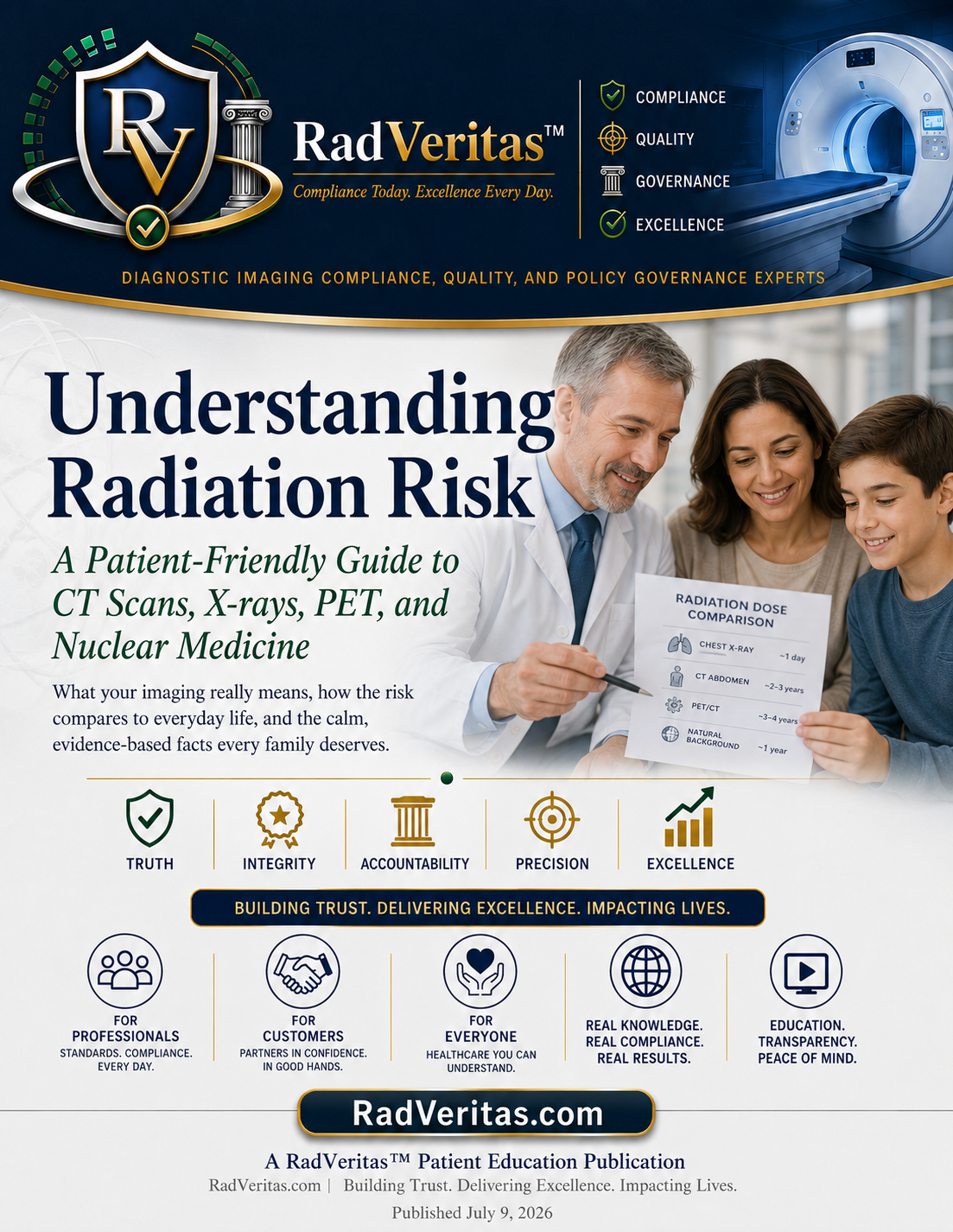
A Patient-Friendly Guide to CT Scans, X-rays, PET, and Nuclear Medicine
Concerned about radiation from a medical imaging exam? Understanding Radiation Risk gives you clear, evidence-based answers in simple language you can trust. This patient-friendly guide explains how radiation is used in medical imaging, what the actual risks are, and why the benefits of an accurate diagnosis often far outweigh the risks.
Learn how radiation doses compare to everyday life, why your healthcare team carefully manages every exam, and what you can do to make informed decisions with confidence. Whether you're preparing for a CT scan, X-ray, PET scan, or nuclear medicine exam, this guide helps replace fear with facts.
What You'll Learn
What radiation is and how it is used in medical imaging.
How much radiation common imaging exams actually use.
How imaging benefits compare with potential risks.
How hospitals keep radiation exposure as low as safely possible.
Common myths and facts about radiation.
Questions to ask your imaging team before your exam.
Perfect For
Patients and families
Caregivers
Healthcare educators
Imaging centers
Hospitals and physician practices
Why You'll Love It
Written in plain language anyone can understand.
Separates facts from common myths.
Reduces fear and unnecessary anxiety.
Helps you make informed healthcare decisions with confidence.
Created by trusted diagnostic imaging experts.
Understand the facts, not the fear. Build confidence before your next imaging exam with the RadVeritas™ guide to radiation risk.
No insurance doesn't have to mean no healthcare. Imaging Without Insurance is a practical, easy-to-understand guide that helps you find affordable CT scans, MRIs, X-rays, ultrasounds, and other imaging exams without unnecessary stress or surprise costs.
Whether you've lost your insurance, have a high deductible, or are paying out of pocket, this guide shows you how to compare prices, ask the right questions, explore financial assistance, and find programs that can make imaging more affordable. You'll learn about cash pricing, charity care, community resources, and your rights as a healthcare consumer.
What You'll Learn
How to find affordable imaging without health insurance.
The difference between cash prices, financial assistance, and charity care.
How to compare imaging centers and avoid unexpected bills.
Your rights under healthcare price transparency laws.
Questions to ask before scheduling your exam.
National, state, and community resources that may help lower your costs.
Perfect For
Uninsured patients.
People with high-deductible health plans.
Patients paying for imaging out of pocket.
Families, caregivers, and healthcare consumers looking for affordable options.
Why You'll Love It
Written in simple language that's easy to understand.
Provides step-by-step guidance for finding affordable imaging.
Helps you make informed financial and healthcare decisions.
Includes practical tips that can save you money.
Features trusted resources and patient-focused information you can use immediately.
Quality imaging should never feel out of reach. Learn how to lower your costs, understand your options, and find the care you need with confidence, even if you don't have health insurance.
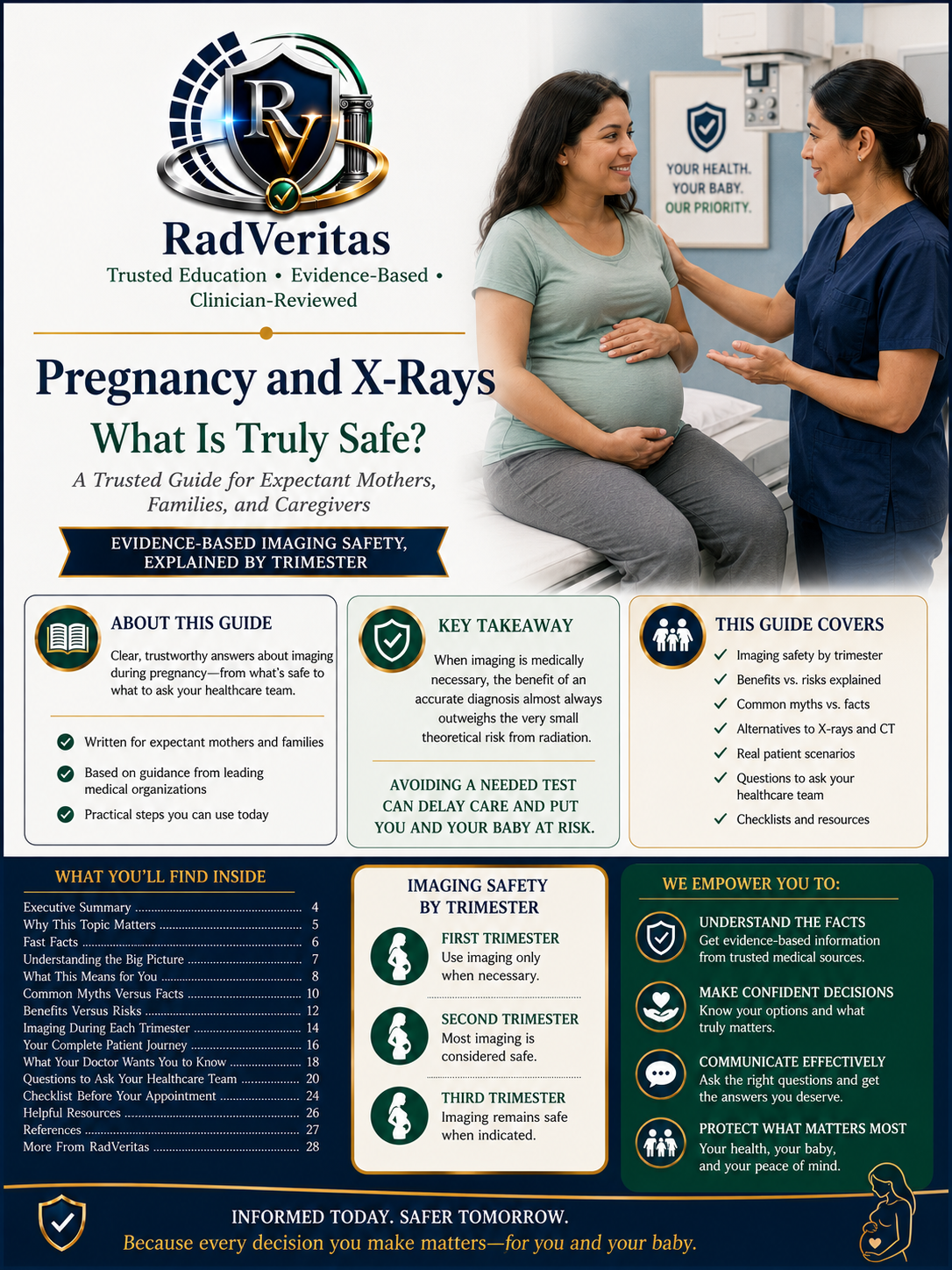
A Trusted Guide for Expectant Mothers, Families, and Caregivers
Pregnancy comes with many questions, and one of the biggest concerns is whether an X-ray or other imaging test could harm your baby. This comprehensive RadVeritas guide provides clear, evidence-based answers so you can make informed decisions with confidence instead of fear.
Created for expectant mothers, partners, families, and caregivers, this easy-to-understand guide explains when imaging is safe during pregnancy, how doctors carefully balance benefits and risks, and why delaying a medically necessary exam may sometimes pose a greater risk than the imaging itself.
Using trusted medical guidance and plain language, this resource separates facts from myths and helps you understand exactly what to expect before, during, and after your imaging exam.
What You'll Learn
When X-rays are considered safe during pregnancy.
How imaging recommendations change during each trimester.
The difference between common imaging exams, including X-rays, CT scans, MRI, and ultrasound.
The real facts about radiation exposure and your baby's safety.
When imaging is medically necessary and why delaying care can be harmful.
Common myths and misconceptions explained.
Questions to ask your healthcare provider before your exam.
Practical tips to help you feel informed and prepared.
Why You'll Love This Guide
Written in plain language that is easy to understand.
Based on recommendations from leading medical organizations.
Explains benefits and risks without creating unnecessary fear.
Organized step by step for quick, easy reading.
Includes practical checklists, real-life examples, and trusted resources.
Helps reduce anxiety by providing accurate, evidence-based information.
Perfect For
Expectant mothers.
Partners and family members.
Caregivers.
Patients who have been told they need an imaging exam during pregnancy.
Anyone who wants trustworthy information about imaging safety during pregnancy.
Product Features
Comprehensive digital white paper and reference guide.
Instant digital download.
Easy-to-follow chapters organized by trimester.
Evidence-based medical information reviewed for accuracy.
Practical checklists and questions for your healthcare team.
Educational resource you can reference throughout your pregnancy.
Make Decisions with Confidence
When it comes to your health and your baby's health, accurate information matters. This guide helps you understand when imaging is appropriate, what the real risks are, and how your healthcare team works to keep both you and your baby safe.
Clear answers. Trusted medical guidance. Peace of mind for every stage of pregnancy.
A Patient and Family Guide to Medical Implants, Pacemakers, Pregnancy, and Breastfeeding
Have questions about having an imaging exam with a pacemaker, metal implant, during pregnancy, or while breastfeeding? Imaging Safety You Can Trust provides clear, easy-to-understand answers to help you prepare for your exam with confidence.
This patient-friendly guide explains how imaging teams protect your safety, what information you should share before your appointment, and when special precautions may be needed. Learn the facts about MRI, CT, X-ray, ultrasound, and other imaging exams so you can feel informed, prepared, and reassured every step of the way.
What You'll Learn
Which imaging exams are safe with medical implants and pacemakers.
What to know before imaging during pregnancy or while breastfeeding.
How imaging teams protect your safety.
When special precautions or additional planning may be needed.
Questions to ask before your appointment.
How to prepare for a safe and successful imaging exam.
Perfect For
Patients and families
Expectant and breastfeeding mothers
People with pacemakers or medical implants
Caregivers
Imaging centers
Hospitals and physician practices
Why You'll Love It
Written in plain language anyone can understand.
Answers common safety questions with trusted, evidence-based information.
Reduces anxiety by explaining what to expect.
Helps you prepare for your imaging appointment with confidence.
Created by trusted diagnostic imaging experts.
Know what to expect before your imaging exam. Learn how medical imaging stays safe for patients with implants, during pregnancy, and while breastfeeding with the RadVeritas™ Imaging Safety Guide.
A Patient and Family Guide to Understanding Why Your Doctor Recommended CT, MRI, Ultrasound, X-ray, or Nuclear Medicine
Ever wondered why your doctor ordered one imaging test instead of another? Why This Imaging Test Was Chosen? explains how healthcare providers select the right exam for your symptoms, condition, and medical history. Written in simple, everyday language, this guide helps you understand the purpose of your test and why it offers the best answers for your care.
Learn the differences between CT, MRI, ultrasound, X-ray, and nuclear medicine, what each exam is best at detecting, and how the right test leads to faster, more accurate diagnoses. Replace uncertainty with confidence and become a more informed partner in your healthcare.
What You'll Learn
Why doctors choose one imaging test over another.
What CT, MRI, ultrasound, X-ray, and nuclear medicine each do best.
How your symptoms help determine the right exam.
What to expect before, during, and after your test.
Questions to ask your healthcare provider.
How the right imaging test helps improve diagnosis and treatment.
Perfect For
Patients and families
Caregivers
Healthcare educators
Imaging centers
Hospitals and physician practices
Why You'll Love It
Written in plain language anyone can understand.
Explains medical imaging without confusing jargon.
Helps you understand your doctor's decision with confidence.
Reduces anxiety by answering common patient questions.
Created by trusted diagnostic imaging experts.
Understand why your imaging test was chosen and feel confident knowing you're getting the right exam for the right reason with the RadVeritas™ Patient Guide.
A Patient's Complete Guide to AI, Your Scan, and What Really Happens Behind the Scenes
Artificial intelligence is changing medical imaging, but many patients still have important questions. Did AI read my scan? Can I trust the results? Did a radiologist review my images? This easy-to-understand guide provides clear, evidence-based answers to help you understand how AI is used in radiology and what it means for your care.
Written in simple language, this guide explains how AI helps radiologists detect disease, improve accuracy, and support faster diagnoses while emphasizing that trained medical professionals remain responsible for interpreting your imaging results. Learn the facts, separate myths from reality, and feel confident before your next imaging exam.
What You'll Learn
How artificial intelligence is used in medical imaging.
Whether AI or a radiologist reads your scan.
How accurate AI is and what its limitations are.
How AI helps improve patient care and diagnostic accuracy.
Common myths and facts about AI in healthcare.
Questions to ask your imaging team about AI.
Perfect For
Patients and families
Caregivers
Healthcare educators
Imaging centers
Hospitals and physician practices
Why You'll Love It
Written in plain language anyone can understand.
Explains complex technology without confusing medical jargon.
Replaces uncertainty with trusted, evidence-based information.
Helps you feel informed and confident before your imaging exam.
Created by trusted diagnostic imaging experts.
Discover how artificial intelligence and expert radiologists work together to deliver safer, smarter, and more accurate imaging care with the RadVeritas™ AI in Radiology Patient Guide.
If you've been scheduled for an MRI, it's normal to have questions. Understanding Your MRI is a simple, patient-friendly guide that explains exactly what an MRI is, why it's recommended, and what you can expect from the moment your exam is scheduled until you receive your results.
Written in everyday language, this guide takes the mystery out of MRI. You'll learn how the scan works, how to prepare, what happens during the exam, and what to expect afterward. Whether it's your first MRI or your fifth, you'll feel more informed, more comfortable, and more confident.
What You'll Learn
What an MRI is and why your doctor ordered it.
How to prepare before your appointment.
What happens before, during, and after your scan.
What the MRI machine looks and sounds like.
Whether you'll need contrast and what to expect if you do.
How and when you'll receive your imaging results.
Perfect For
First-time MRI patients.
Family members and caregivers.
Patients preparing for outpatient or hospital MRI exams.
Anyone who wants clear, reliable information before an MRI.
Why You'll Love It
Written in plain language that anyone can understand.
Answers the most common patient questions.
Step-by-step guidance from preparation through results.
Helps reduce anxiety by explaining what to expect.
Includes practical tips, checklists, FAQs, and trusted educational resources.
Take the uncertainty out of your MRI experience. Learn what to expect, prepare with confidence, and walk into your appointment knowing exactly what happens every step of the way.
Receiving a letter that says you have dense breast tissue can be confusing and even frightening. Many women immediately wonder, "Does this mean I have cancer?" or "What should I do now?" This comprehensive RadVeritas guide provides clear, trustworthy answers in simple language so you can understand your results with confidence and know what steps to take next.
Written for patients, families, caregivers, and healthcare consumers, this evidence-based guide explains what breast density is, why you received a breast density notification, and how it may affect your future breast cancer screening. Instead of confusing medical terms, you'll find practical explanations, trusted resources, and questions you can ask your healthcare provider to make informed decisions about your care.
Whether you recently received your mammogram results or simply want to better understand breast density, this guide helps replace uncertainty with knowledge and confidence.
What You'll Learn
What a breast density notification letter really means.
What "dense" and "not dense" breast tissue mean.
Why breast density matters during mammography.
How dense tissue can affect the visibility of breast cancer on a mammogram.
When additional screening tests may or may not be recommended.
Questions to discuss with your healthcare provider.
Current recommendations based on trusted medical organizations.
How to make informed decisions without unnecessary fear.
Why You'll Love This Guide
Written in plain, easy-to-understand language.
Based on trusted medical and imaging sources.
Organized in a step-by-step format that is easy to follow.
Helps reduce anxiety by explaining complex topics clearly.
Includes practical guidance you can use immediately.
Created specifically for patients, not medical professionals.
Perfect For
Women who recently received a breast density notification.
Patients preparing for a mammogram.
Family members and caregivers.
Anyone who wants to better understand breast health and breast cancer screening.
Product Features
Comprehensive digital white paper and reference guide.
Instant digital download.
Patient-friendly explanations with practical examples.
Easy-to-navigate table of contents.
Educational resource suitable for future reference.
Take Control of Your Breast Health
Knowledge leads to better conversations, better decisions, and greater peace of mind. Learn what your breast density notification really means, understand your screening options, and approach your next healthcare appointment with confidence.
Clear answers. Trusted information. Better decisions for your health.
Reading a radiology report can feel overwhelming. Medical terms, unfamiliar phrases, and technical language often leave patients with more questions than answers. This comprehensive RadVeritas guide helps you understand exactly what your imaging report says, what it means, and what to do next.
Created for patients, families, caregivers, and healthcare consumers, this easy-to-read guide translates complex radiology language into plain English. You'll learn how radiology reports are organized, what common findings really mean, and which results require follow-up so you can have more informed conversations with your healthcare provider.
Whether you've had an X-ray, CT scan, MRI, ultrasound, mammogram, or nuclear medicine exam, this guide gives you the knowledge to better understand your results with confidence.
What You'll Learn
How to read a radiology report from beginning to end.
What common medical terms actually mean.
The purpose of each section of your imaging report.
The difference between normal findings and abnormal findings.
What words like "impression," "incidental finding," "lesion," "cyst," and "nodule" may mean.
Common myths and misunderstandings about imaging reports.
When to contact your healthcare provider.
Questions to ask during your next appointment.
Why You'll Love This Guide
Written in plain language anyone can understand.
Explains complex medical terms without confusing jargon.
Based on trusted medical references and evidence-based information.
Helps reduce unnecessary worry and confusion.
Includes practical checklists and helpful resources.
Gives you the confidence to take an active role in your healthcare.
Perfect For
Patients who recently received imaging results.
Family members and caregivers helping interpret a loved one's report.
Anyone scheduled for an imaging exam.
Individuals who want to better understand their health information.
Patients preparing for follow-up appointments with their healthcare provider.
Product Features
Comprehensive digital white paper and reference guide.
Instant digital download.
Step-by-step explanations of radiology reports.
Easy-to-follow chapters and practical examples.
Helpful checklists before and after appointments.
Frequently asked questions and patient scenarios.
Trusted references and educational resources for additional learning.
Turn Confusion Into Confidence
Your radiology report contains important information about your health, but understanding it shouldn't require a medical degree. This guide empowers you to understand your imaging results, ask informed questions, and become a more confident partner in your healthcare.
Clear explanations. Trusted information. Better conversations. Smarter healthcare decisions.
Su informe de radiología acaba de aparecer en su portal del paciente y está lleno de lenguaje técnico. Esta guía para pacientes y familias traduce sus resultados de imágenes a palabras de todos los días y le da un plan.
Aprenda qué significa cada sección de un informe de radiología, qué palabras suenan alarmantes pero suelen ser inofensivas, qué es un hallazgo incidental y cuándo un resultado realmente necesita atención urgente. Incluye más de cuarenta preguntas frecuentes, casos reales de pacientes, mitos y realidades, listas de verificación y un glosario.
Para pacientes que ahora pueden ver sus resultados de imágenes de inmediato gracias a la ley federal, y para los familiares y cuidadores que les ayudan a entender un informe.
Los informes suelen aparecer en pocas horas, a veces antes de que su médico los haya leído. Un poco de traducción y contexto puede reemplazar el miedo con comprensión y prepararlo para una conversación productiva con su equipo de salud.
Lea la guía antes de abrir su próximo informe y lleve sus preguntas a su cita de seguimiento.
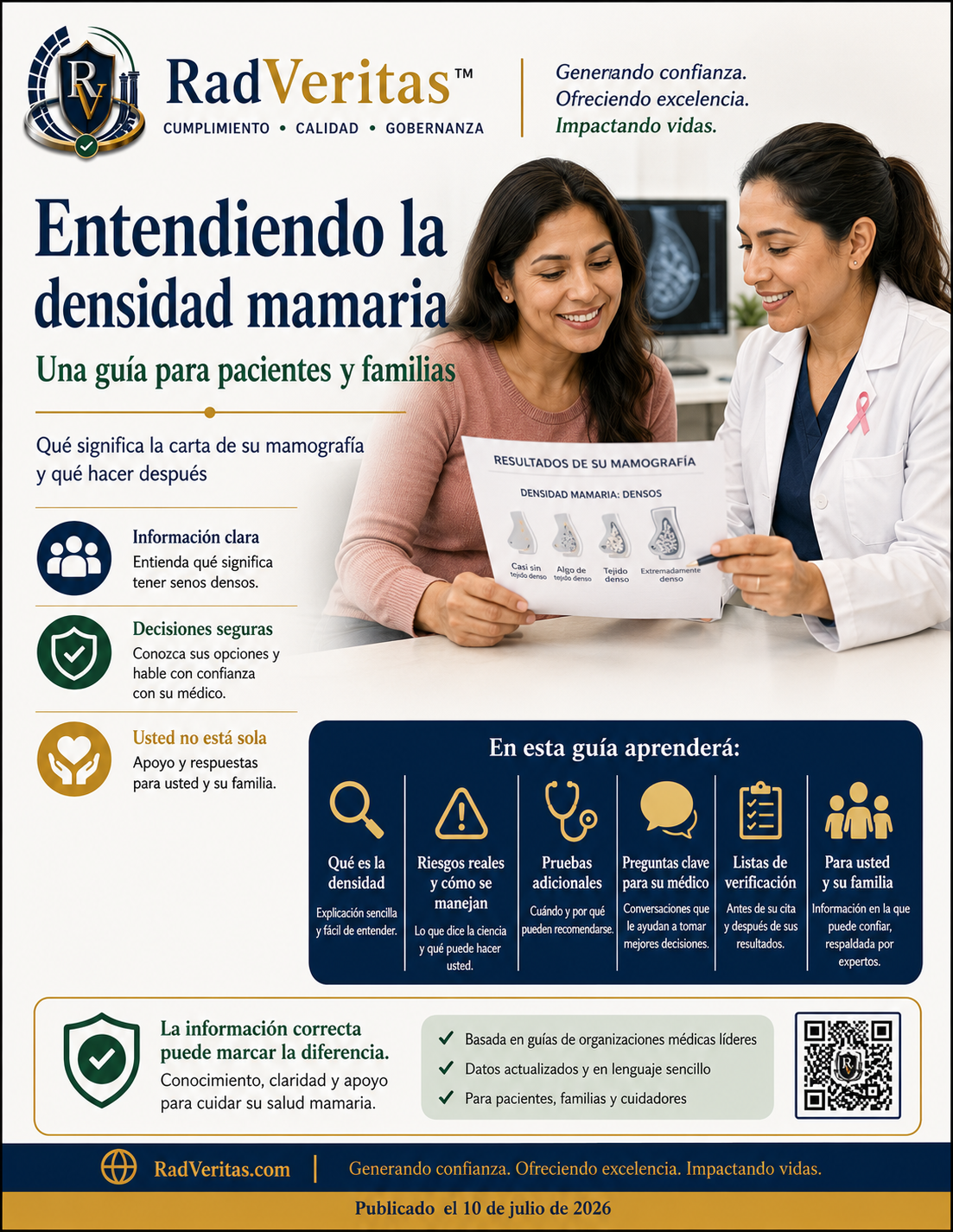
Descripción general del producto
La carta de su mamografía dice que usted tiene senos densos. ¿Y ahora qué? Esta guía para pacientes y familias explica qué significa la densidad mamaria, por qué importa y qué hacer después.
Beneficios principales
Entienda por qué el tejido denso puede ocultar el cáncer en una mamografía y aumenta un poco el riesgo con el tiempo. Conozca las pruebas adicionales, como la resonancia magnética, la mamografía con contraste y el ultrasonido, y encuentre respuestas sobre costos y cobertura, mitos y realidades, listas de verificación y casos reales de pacientes.
Quién debe usarla
Para mujeres que recibieron una carta de notificación sobre densidad mamaria y para los familiares que quieren apoyarlas. Aproximadamente la mitad de todas las mujeres que se hacen mamografías tienen senos densos.
Por qué es valiosa
La FDA ahora exige que cada centro de mamografía en los EE. UU. informe a las pacientes si sus senos son densos. Esta guía le ayuda a convertir esa carta en una conversación calmada y segura con su proveedor de salud.
Llamado a la acción
Siga haciéndose sus mamografías; todavía salvan vidas. Lea la guía y pregunte a su proveedor qué plan de detección es el adecuado para usted.
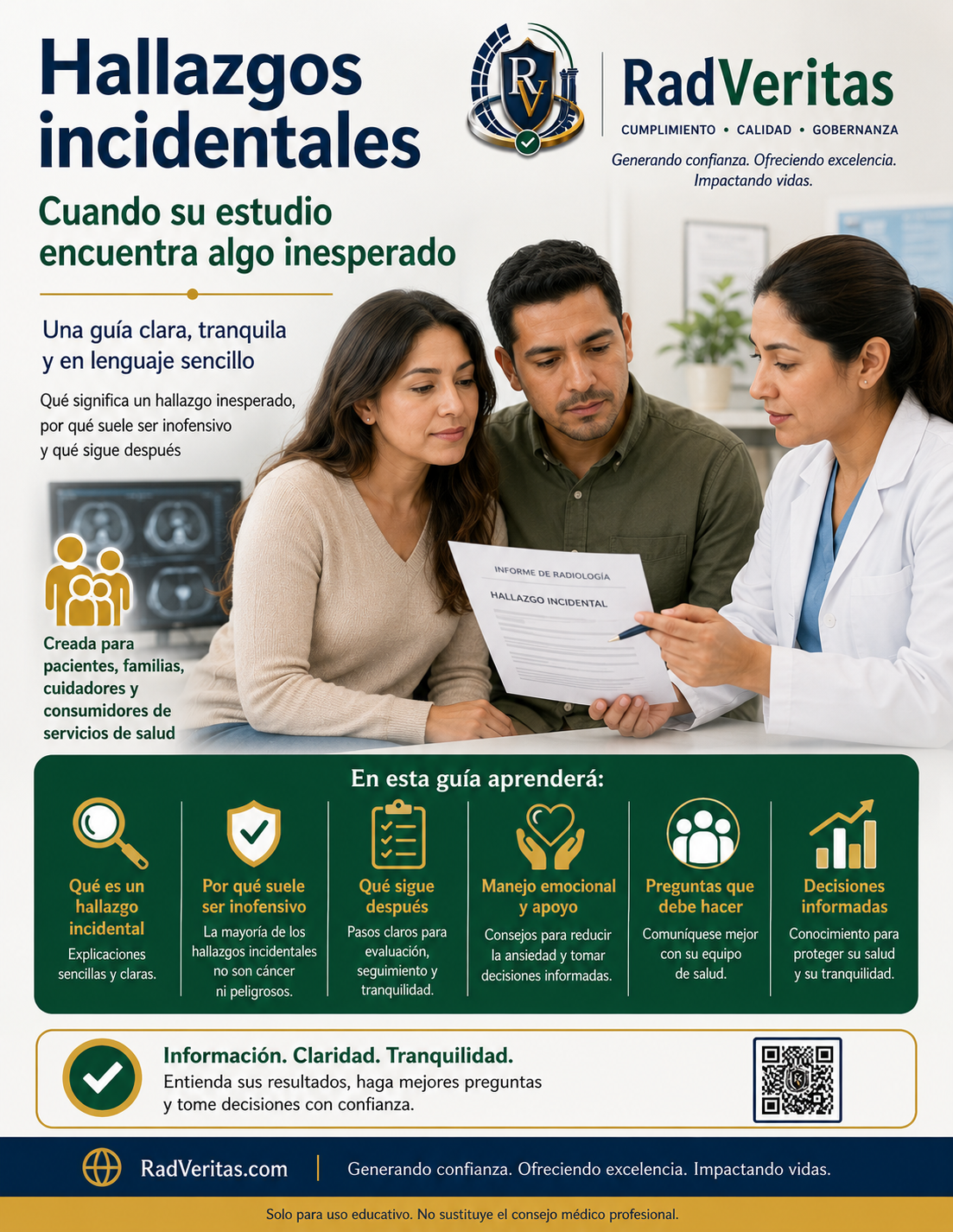
Descripción general del producto
“Encontramos algo más en su estudio”. Esta guía para pacientes explica los hallazgos incidentales, las manchas o los cambios inesperados que un estudio detecta por casualidad, por qué la mayoría no son dañinos y qué sucede después.
Beneficios principales
Conozca los tres datos que calman la mayoría de las preocupaciones: los hallazgos incidentales son comunes, la mayoría son benignos y los médicos siguen guías claras para el seguimiento. La guía incluye mitos y realidades, hallazgos comunes de un vistazo, casos de la vida real, preguntas frecuentes y preguntas para su equipo de salud.
Quién debe usarla
Para pacientes, familias, cuidadores y cualquier persona que acaba de saber que una tomografía computarizada (CT), una resonancia magnética, una radiografía o un ultrasonido encontró algo inesperado.
Por qué es valiosa
Entender los hallazgos incidentales puede ahorrarle días o semanas de preocupación innecesaria, y le ayuda a evitar dos errores opuestos: entrar en pánico o ignorar un hallazgo que merece un seguimiento sencillo.
Llamado a la acción
Lea la guía, anote sus preguntas y hable con su equipo de salud sobre sus próximos pasos.
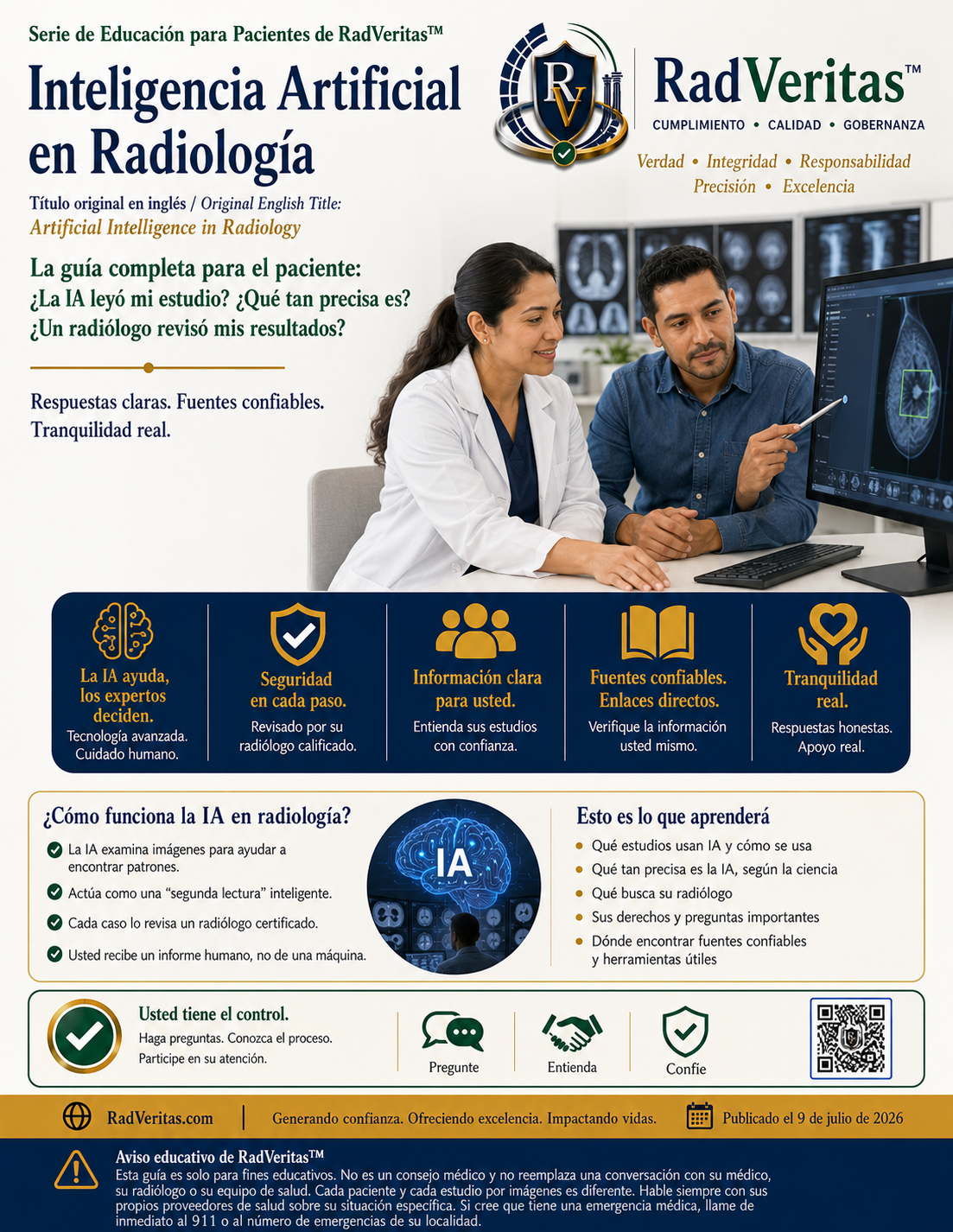
Descripción general del producto
¿La IA leyó mi estudio? Esta guía educativa para pacientes de RadVeritas explica, en lenguaje sencillo, cómo se usa hoy la inteligencia artificial (IA) en radiología, qué tan precisas son realmente las herramientas de IA y por qué un radiólogo con licencia sigue revisando y firmando su informe.
Beneficios principales
Obtenga respuestas claras a las tres preguntas que más hacen los pacientes sobre la IA en los estudios por imágenes. Conozca los beneficios y los límites de la IA, separe los mitos de las realidades y use listas de verificación, casos reales de pacientes, un glosario y preguntas para su equipo de salud, todo respaldado por fuentes confiables como la FDA, el Colegio Americano de Radiología y la Sociedad Radiológica de Norteamérica.
Quién debe usarla
Esta guía es para pacientes que se preparan para una radiografía, una tomografía computarizada (CT), una resonancia magnética o una mamografía, y para familiares y cuidadores que quieren entender cómo la IA apoya la atención por imágenes. No se necesitan conocimientos médicos.
Por qué es valiosa
La IA ya es parte de los estudios por imágenes de todos los días en los Estados Unidos, y un radiólogo con licencia sigue leyendo sus imágenes y firmando su informe. Saber cómo se usa la IA le ayuda a hacer mejores preguntas y a sentirse seguro con sus resultados.
Llamado a la acción
Lea la guía antes de su próxima cita de imágenes y lleve sus preguntas con usted. Visite RadVeritas.com para más educación confiable para pacientes.
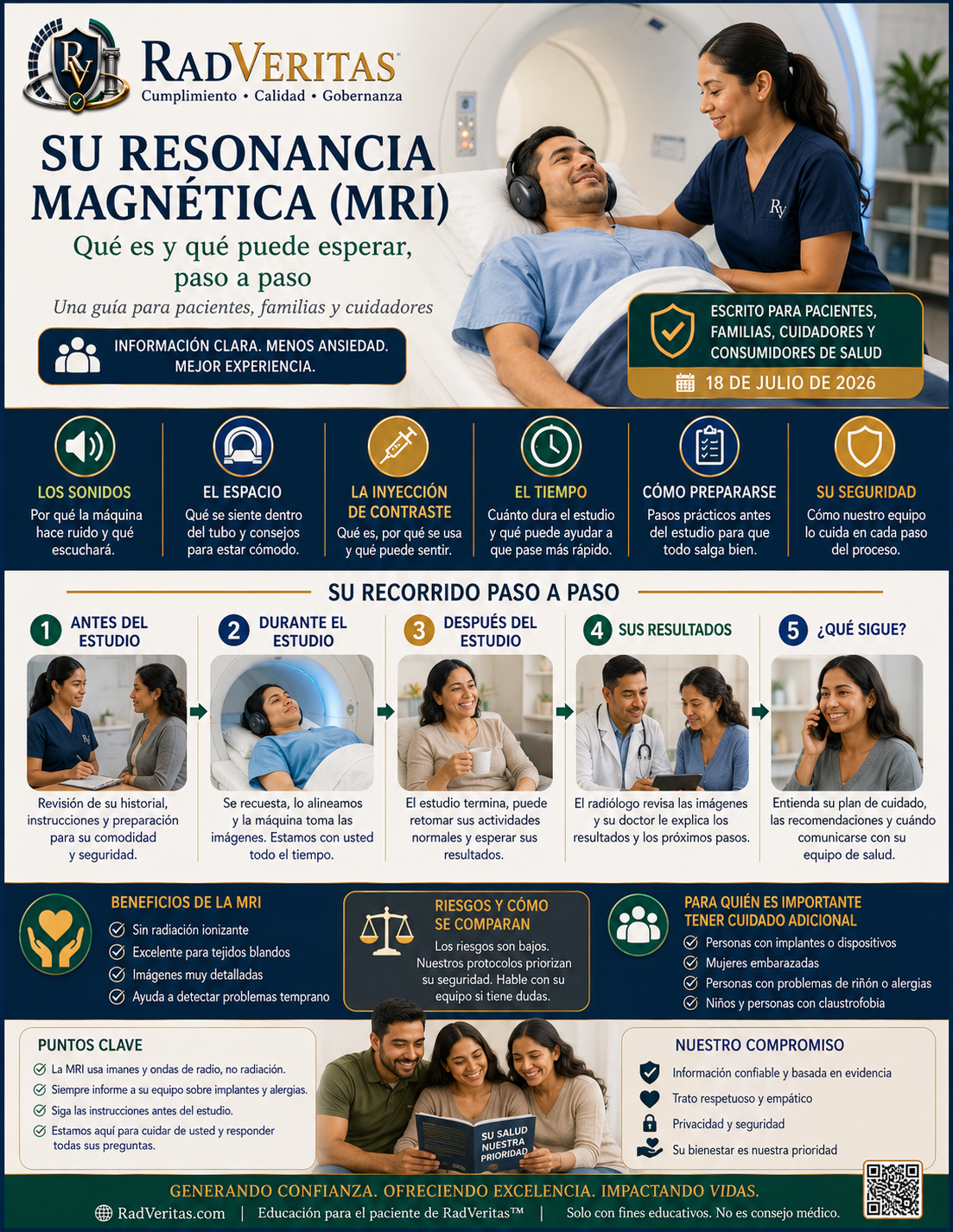
¿Tiene programada una resonancia magnética (MRI) y no sabe qué esperar? Entendiendo Su Resonancia Magnética es una guía clara y fácil de entender que responde las preguntas más comunes antes, durante y después del estudio.
Escrita en un lenguaje sencillo para pacientes y familias, esta guía explica por qué su médico recomendó una MRI, cómo prepararse, qué sucederá durante el examen y cuándo recibirá sus resultados. Con información confiable y explicaciones paso a paso, podrá asistir a su cita con mayor tranquilidad y confianza.
Lo Que Aprenderá
Qué es una resonancia magnética (MRI) y por qué puede ser necesaria.
Cómo prepararse antes de su cita.
Qué sucede antes, durante y después del examen.
Cómo es la máquina de MRI y qué puede sentir durante el estudio.
Cuándo se utiliza el medio de contraste y qué puede esperar si lo necesita.
Cómo y cuándo recibirá los resultados de su estudio.
Ideal Para
Personas que tendrán una MRI por primera vez.
Pacientes que desean sentirse más preparados y tranquilos.
Familiares y cuidadores.
Cualquier persona que quiera entender mejor el proceso de una resonancia magnética.
Por Qué Le Gustará
Escrito en un lenguaje sencillo y fácil de comprender.
Responde las preguntas que los pacientes hacen con más frecuencia.
Explica cada paso del proceso, desde la preparación hasta los resultados.
Ayuda a disminuir el estrés y la incertidumbre antes del examen.
Incluye consejos prácticos, listas de verificación, preguntas frecuentes y recursos confiables para tomar decisiones informadas.
Convierta la incertidumbre en tranquilidad. Descubra cómo funciona una resonancia magnética, prepárese con confianza y llegue a su cita sabiendo exactamente qué esperar en cada paso del proceso.
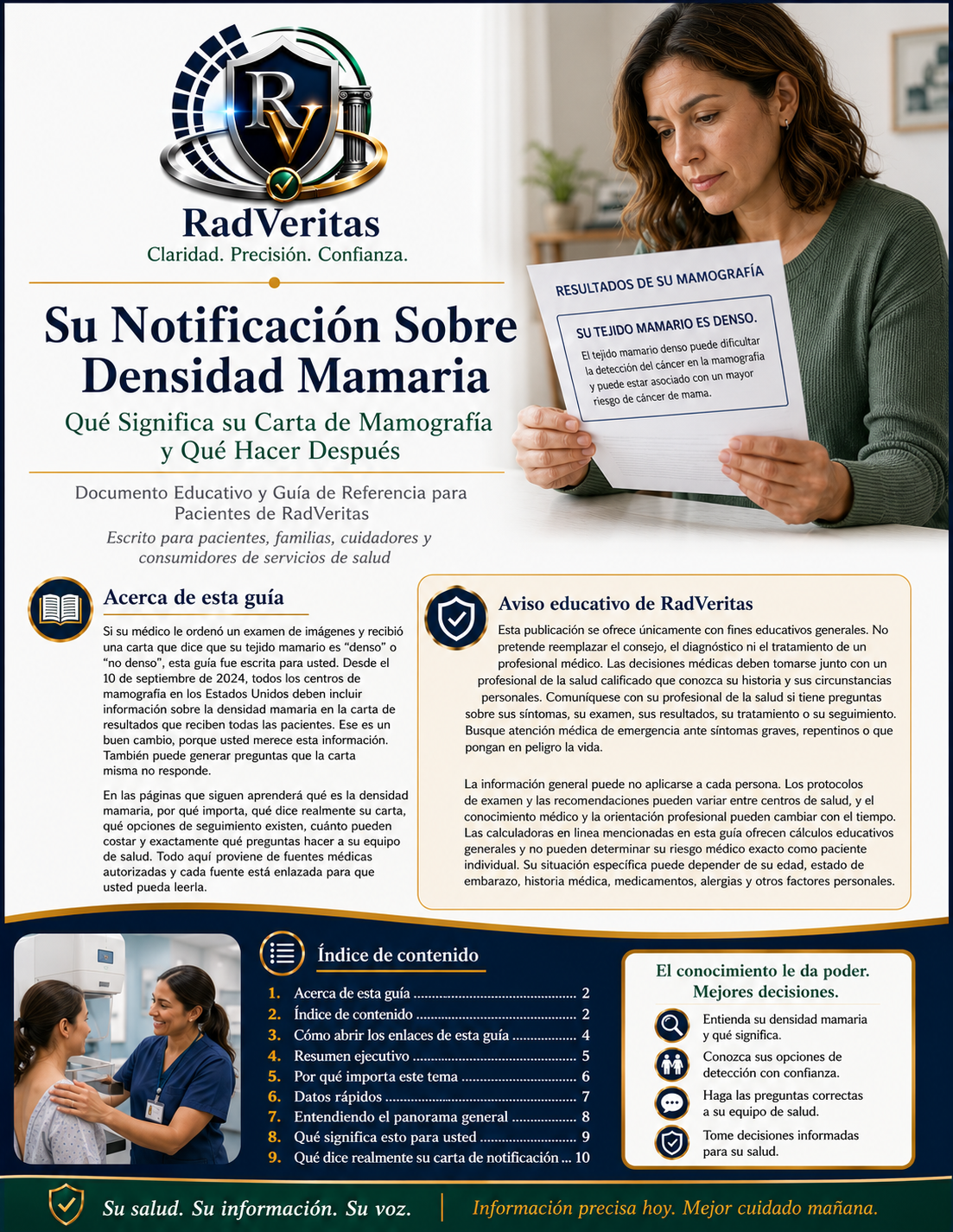
Recibir una carta que dice que tiene tejido mamario denso puede generar muchas preguntas. ¿Significa que tengo cáncer? ¿Necesito más estudios? ¿Debo preocuparme? Esta guía de RadVeritas fue creada para responder esas preguntas con información clara, sencilla y basada en evidencia médica.
Escrita especialmente para pacientes, familias, cuidadores y consumidores de servicios de salud en los Estados Unidos, esta guía explica qué significa una notificación sobre densidad mamaria, por qué la recibió y qué pasos podría considerar junto con su profesional de la salud. Todo está explicado en un lenguaje fácil de entender, sin términos médicos complicados.
Ya sea que acaba de recibir los resultados de su mamografía o simplemente desea conocer más sobre la densidad mamaria, esta guía le ayudará a comprender mejor su salud y a tomar decisiones con mayor confianza.
Lo Que Aprenderá
Qué significa realmente que sus senos sean "densos".
Por qué recibió una carta sobre densidad mamaria.
Cómo la densidad mamaria puede afectar una mamografía.
Cuándo podrían recomendarse estudios adicionales.
Qué preguntas hacer durante su próxima cita médica.
Qué dicen las recomendaciones actuales de organizaciones médicas confiables.
Cómo tomar decisiones informadas sin dejarse llevar por el miedo.
¿Por Qué Elegir Esta Guía?
Explicaciones claras y fáciles de entender.
Información basada en fuentes médicas confiables.
Diseñada para pacientes, no para profesionales de la salud.
Ayuda a reducir la ansiedad y la incertidumbre.
Incluye orientación práctica que puede aplicar de inmediato.
Organizada paso a paso para facilitar la lectura y la comprensión.
Ideal Para
Mujeres que recibieron una carta indicando que tienen tejido mamario denso.
Pacientes que se preparan para una mamografía.
Familiares y cuidadores que desean comprender mejor los resultados.
Personas que quieren aprender más sobre la salud de los senos y la detección temprana del cáncer de mama.
Características del Producto
Libro digital completo y guía de referencia.
Descarga digital inmediata.
Explicaciones fáciles de comprender.
Índice organizado para encontrar la información rápidamente.
Recurso educativo que puede consultar cuando lo necesite.
Basado en información médica actual y fuentes confiables.
Tome el Control de su Salud
Comprender su carta de mamografía es el primer paso para tomar decisiones informadas sobre su salud. Esta guía le ayudará a entender qué significa la densidad mamaria, conocer sus opciones y hablar con su equipo médico con mayor confianza.
Respuestas claras. Información confiable. Decisiones más seguras para su salud.
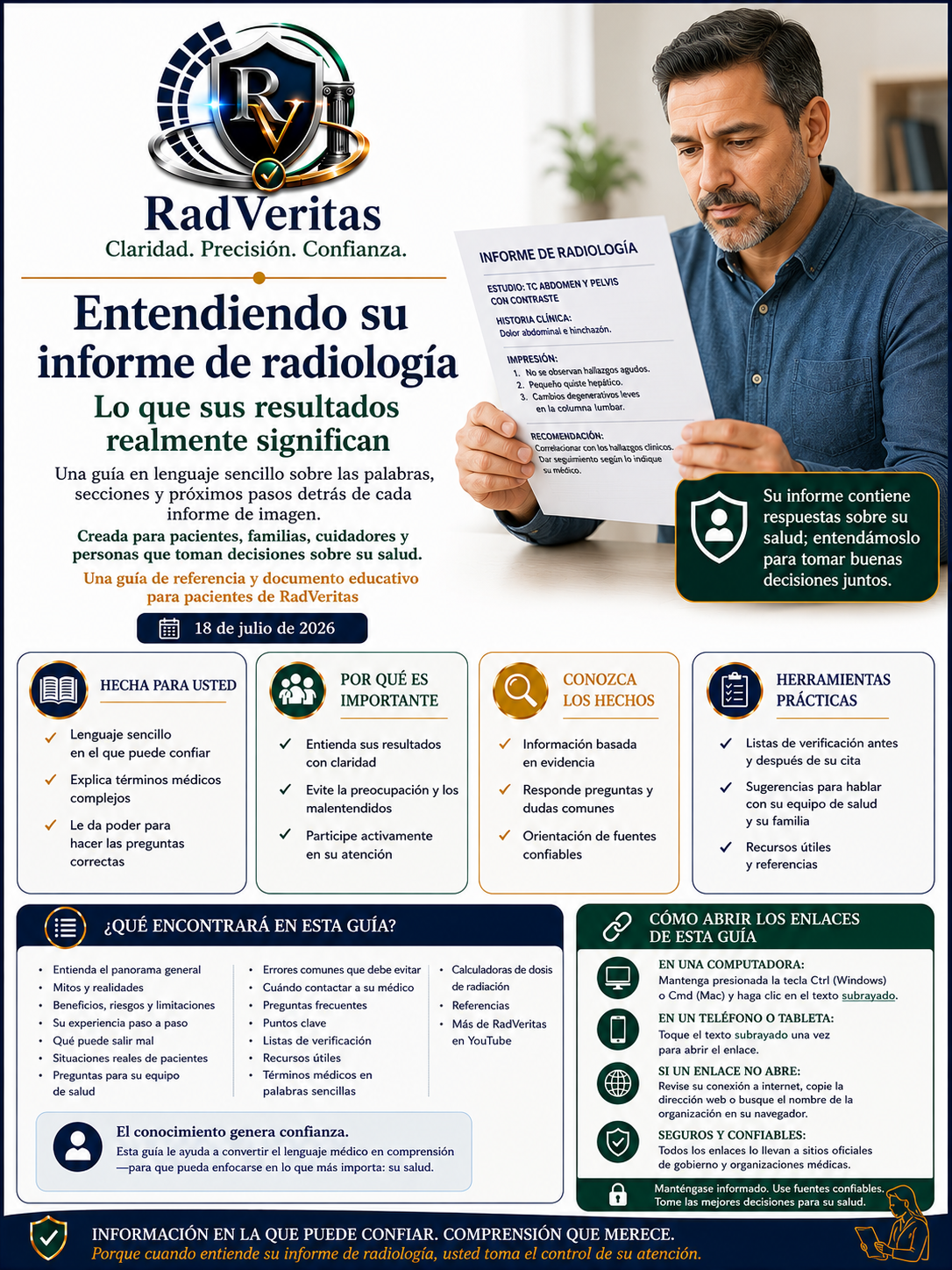
Recibir un informe de radiología puede ser confuso. Palabras médicas difíciles, términos desconocidos y descripciones técnicas pueden hacer que sea complicado entender qué dicen realmente sus resultados. Esta guía completa de RadVeritas traduce el lenguaje médico a un español claro y sencillo para que usted comprenda su informe con confianza.
Creada especialmente para pacientes, familias, cuidadores y personas que toman decisiones sobre su salud, esta guía explica cómo leer un informe de radiología paso a paso, qué significan los hallazgos más comunes y cuáles son los siguientes pasos recomendados. Ya sea que se haya realizado una radiografía, tomografía computarizada (CT), resonancia magnética (MRI), ultrasonido, mamografía o estudio de medicina nuclear, encontrará respuestas claras que le ayudarán a comprender mejor su atención médica.
Con información basada en evidencia y recursos confiables, esta guía le permitirá participar activamente en las conversaciones con su equipo de salud y tomar decisiones mejor informadas.
Lo Que Aprenderá
Cómo leer un informe de radiología de principio a fin.
Qué significan los términos médicos más comunes.
Para qué sirve cada sección del informe.
La diferencia entre hallazgos normales y anormales.
Qué pueden significar palabras como "quiste", "nódulo", "lesión", "hallazgo incidental" e "impresión".
Los mitos y malentendidos más frecuentes sobre los informes de imágenes.
Cuándo debe comunicarse con su profesional de la salud.
Qué preguntas hacer durante su próxima consulta médica.
¿Por Qué Elegir Esta Guía?
Escrita en español claro y fácil de entender.
Convierte el lenguaje médico complejo en explicaciones sencillas.
Basada en información médica confiable y actual.
Ayuda a disminuir la preocupación causada por términos difíciles.
Incluye listas de verificación, ejemplos prácticos y recursos útiles.
Le permite participar con mayor confianza en las decisiones sobre su salud.
Ideal Para
Pacientes que acaban de recibir un informe de radiología.
Familiares y cuidadores que desean comprender mejor los resultados.
Personas que tienen programado un estudio de imágenes.
Pacientes que desean prepararse para una consulta médica.
Cualquier persona que quiera entender mejor su información médica.
Características del Producto
Libro digital completo y guía práctica de referencia.
Descarga digital inmediata.
Explicaciones paso a paso fáciles de seguir.
Ejemplos de términos médicos traducidos a lenguaje sencillo.
Listas de verificación antes y después de sus citas médicas.
Preguntas frecuentes y situaciones reales de pacientes.
Recursos confiables para ampliar su conocimiento.
Convierta la Confusión en Confianza
Su informe de radiología contiene información importante sobre su salud. Comprenderlo le permitirá hacer mejores preguntas, participar activamente en su atención médica y tomar decisiones con mayor seguridad.
Información clara. Explicaciones sencillas. Decisiones más inteligentes para cuidar su salud.
A Calm, Complete Guide to Your MRI: The Sounds, the Space, the Injection, the Time, and How to Prepare
An MRI can feel intimidating when you don't know what to expect. What the Scan Will Be Like takes away the uncertainty by walking you through every step of the experience before you even arrive for your appointment.
Written in simple, reassuring language, this guide explains why MRI machines are loud, what it feels like inside the scanner, whether you'll receive an injection, how long the exam takes, and how to prepare for the best possible results. You'll gain practical tips to reduce anxiety, avoid surprises, and feel more confident throughout your visit.
What You'll Learn
What happens before, during, and after your MRI.
Why MRI machines make loud sounds and what they mean.
What the scanner feels like and how much space you'll have.
Whether you'll need contrast and what to expect if you do.
How long your exam will take and why timing can vary.
Simple ways to prepare for a smooth, successful appointment.
Perfect For
Patients having an MRI for the first time.
Family members and caregivers.
Anyone with MRI anxiety or claustrophobia.
Parents preparing children for an MRI.
Healthcare consumers who want clear, trustworthy information.
Why You'll Love It
Written in plain language that's easy to understand.
Helps reduce fear by explaining every step of the MRI process.
Answers the questions patients ask most often.
Provides practical preparation tips to improve your experience.
Created by trusted diagnostic imaging professionals committed to patient education.
Walk into your MRI with confidence instead of uncertainty. Learn exactly what to expect, understand how the exam works, and discover why being prepared can make your imaging experience safer, easier, and far less stressful.

¿Puede hacerse un estudio si tiene un marcapasos? ¿Son seguros los estudios por imágenes durante el embarazo o la lactancia? Esta guía para pacientes y familias responde esas preguntas con datos de importantes organizaciones médicas.
Aprenda cómo funcionan los estudios por imágenes con dispositivos implantados, durante el embarazo y durante la lactancia, cómo su equipo de atención lo evalúa antes de un estudio y qué preguntas vale la pena hacer. Incluye preguntas frecuentes, mitos y realidades, casos reales de pacientes, listas de verificación y un glosario, con base en las guías del ACR, la RSNA, el ACOG y la FDA.
Para personas con marcapasos, articulaciones artificiales, implantes cocleares u otros dispositivos implantados, para pacientes embarazadas o en período de lactancia, y para sus familias y cuidadores.
El miedo y la confusión causan daños reales cuando llevan a las personas a retrasar o rechazar un estudio que realmente necesitan. En casi todos los casos, el estudio por imágenes que su médico necesita puede hacerse de forma segura.
Lea la guía, informe a su equipo de imágenes sobre cada dispositivo y sobre cualquier posibilidad de embarazo, y haga sus preguntas con confianza.
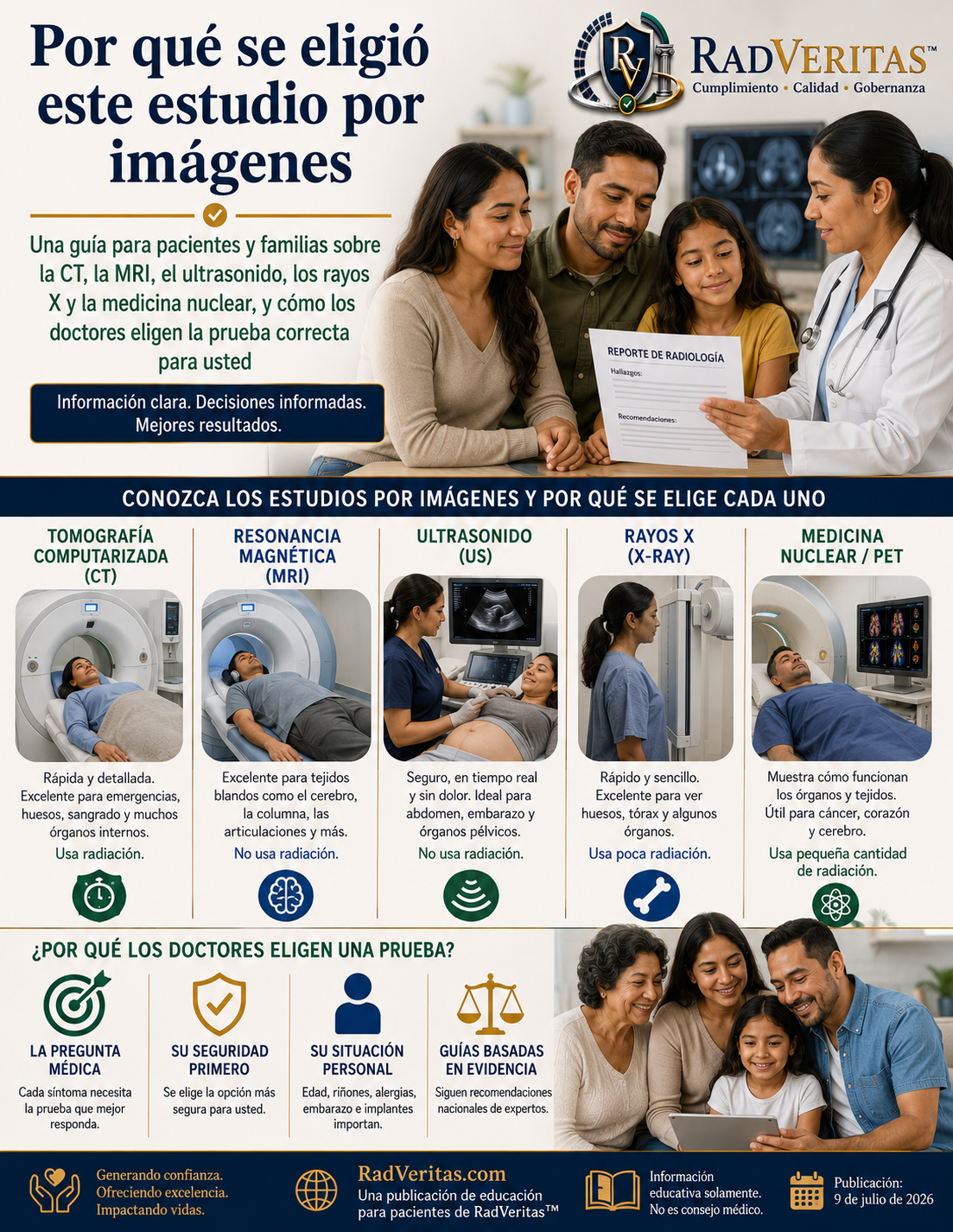
Descripción general del producto
¿Por qué su médico pidió una tomografía computarizada (CT) en lugar de una resonancia magnética, o un ultrasonido en lugar de una CT? Esta guía para pacientes y familias explica cómo los médicos eligen el estudio por imágenes adecuado para usted.
Beneficios principales
Aprenda qué hace mejor cada prueba: la radiografía, la tomografía computarizada (CT), la resonancia magnética, el ultrasonido y la medicina nuclear o el PET. Entienda cómo las guías nacionales basadas en evidencia y su situación personal, como la edad, la función de los riñones, las alergias, los implantes y el embarazo, influyen en la elección.
Quién debe usarla
Para pacientes a quienes se les acaba de indicar un estudio por imágenes, y para las familias y cuidadores que quieren entender las razones detrás de la decisión. No se necesitan conocimientos médicos.
Por qué es valiosa
La prueba más nueva o más cara a menudo no es la mejor. La mejor prueba es la que tiene más probabilidad de responder la pregunta de su médico de forma segura, rápida y precisa, y esta guía le muestra cómo hablar de esto con su equipo de salud.
Llamado a la acción
Lea la guía y luego pregunte a su médico qué pregunta responderá el estudio y si otra opción podría ser más segura o mejor para usted.
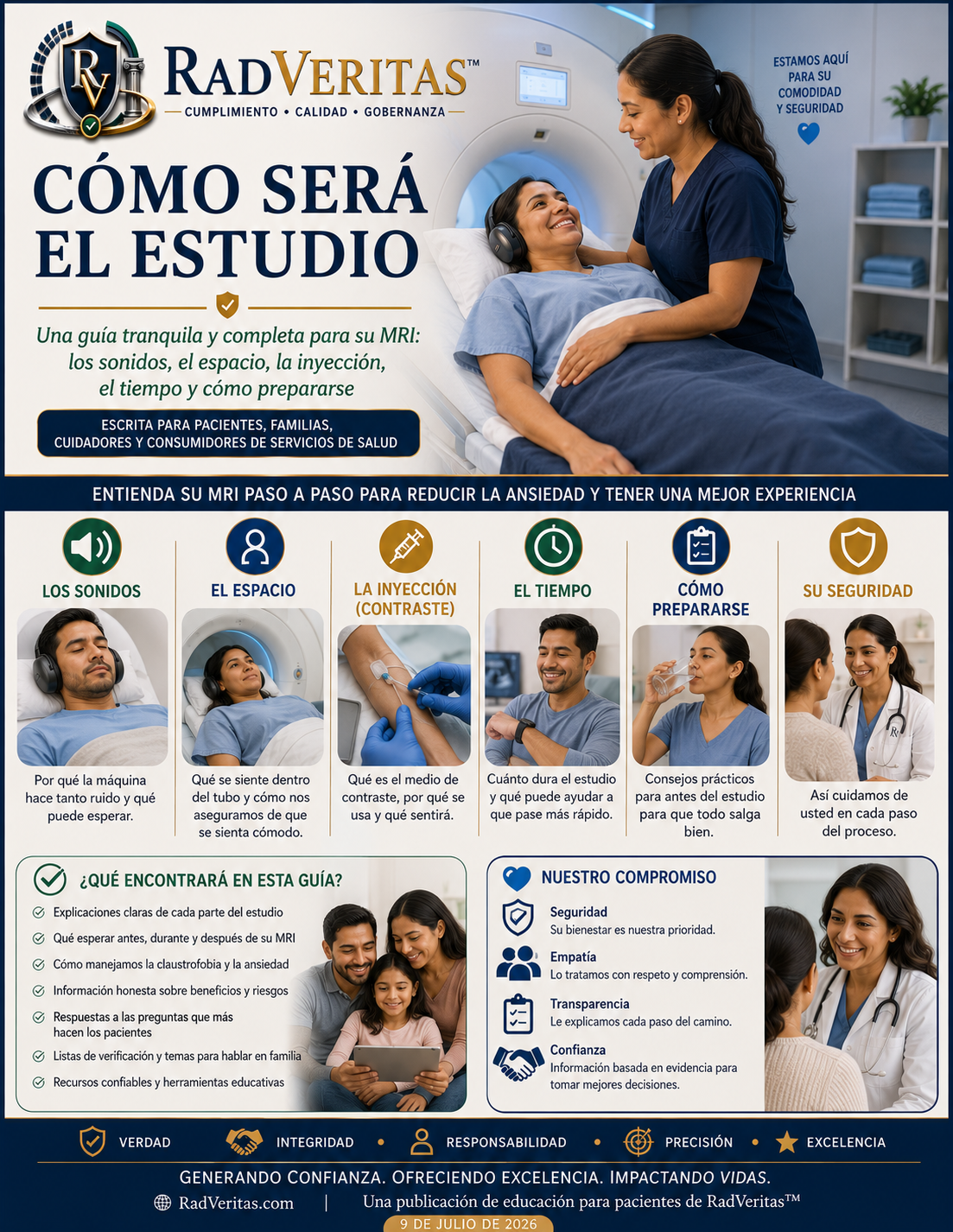
Descripción general del producto
¿Nervioso por su resonancia magnética? Esta guía calmada y completa para pacientes explica cómo será el estudio: los sonidos, el espacio, la inyección, el tiempo y cómo prepararse.
Beneficios principales
Sepa por qué la máquina hace tanto ruido, qué sucede realmente si siente claustrofobia, qué implica la inyección de medio de contraste y cuánto dura el examen. Incluye consejos de preparación, mitos y realidades, preguntas frecuentes, listas de verificación, casos reales de pacientes y un glosario en lenguaje sencillo.
Quién debe usarla
Para cualquier persona que tenga una resonancia magnética programada, en especial si es su primer estudio, y para las familias y cuidadores que la apoyan.
Por qué es valiosa
La resonancia magnética usa un imán potente y ondas de radio, no rayos X, así que el estudio en sí no lo expone a radiación. El estudio no causa dolor, usted nunca queda encerrado y alrededor de 99 de cada 100 personas lo terminan sin detenerse antes de tiempo.
Llamado a la acción
Lea la guía antes de su cita, use las listas de verificación y comparta sus preocupaciones con su equipo de imágenes; ellos tienen opciones eficaces para ayudarle.
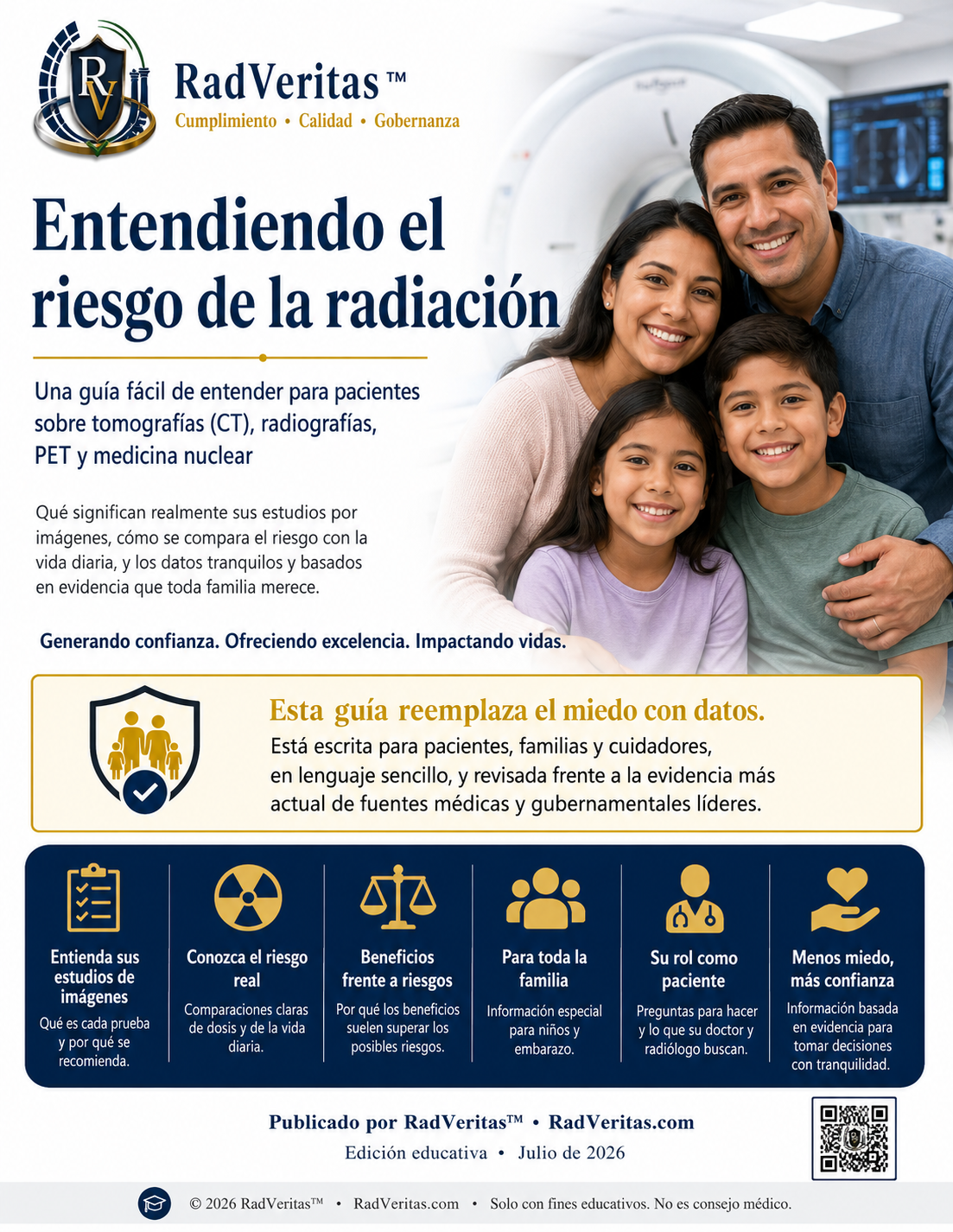
Descripción general del producto
¿Qué tan riesgosa es la radiación de una tomografía computarizada (CT) o de una radiografía? Esta guía amigable para el paciente reemplaza el miedo con datos sobre la radiación de las tomografías computarizadas (CT), las radiografías, los estudios PET y la medicina nuclear, y muestra cómo se compara el riesgo con la vida diaria.
Beneficios principales
Vea una tabla de comparación de dosis de radiación, aprenda qué significan realmente los números de riesgo, lea secciones especiales sobre niños y embarazo, y encuentre mitos y realidades, casos reales de pacientes, preguntas para su equipo de salud y calculadoras de dosis de radiación confiables.
Quién debe usarla
Para pacientes con un estudio programado, para padres y cuidadores, y para cualquier persona preocupada por un titular sobre la radiación médica.
Por qué es valiosa
Para cualquier estudio que su médico realmente recomiende, el riesgo es muy pequeño, y el beneficio de un diagnóstico preciso, que a veces salva la vida, casi siempre pesa más. Entender los números le ayuda a tomar decisiones calmadas e informadas.
Llamado a la acción
Lea la guía, pregunte por qué se necesita el estudio y si una opción sin radiación funcionaría, y nunca deje de hacerse un estudio que realmente necesita por miedo.
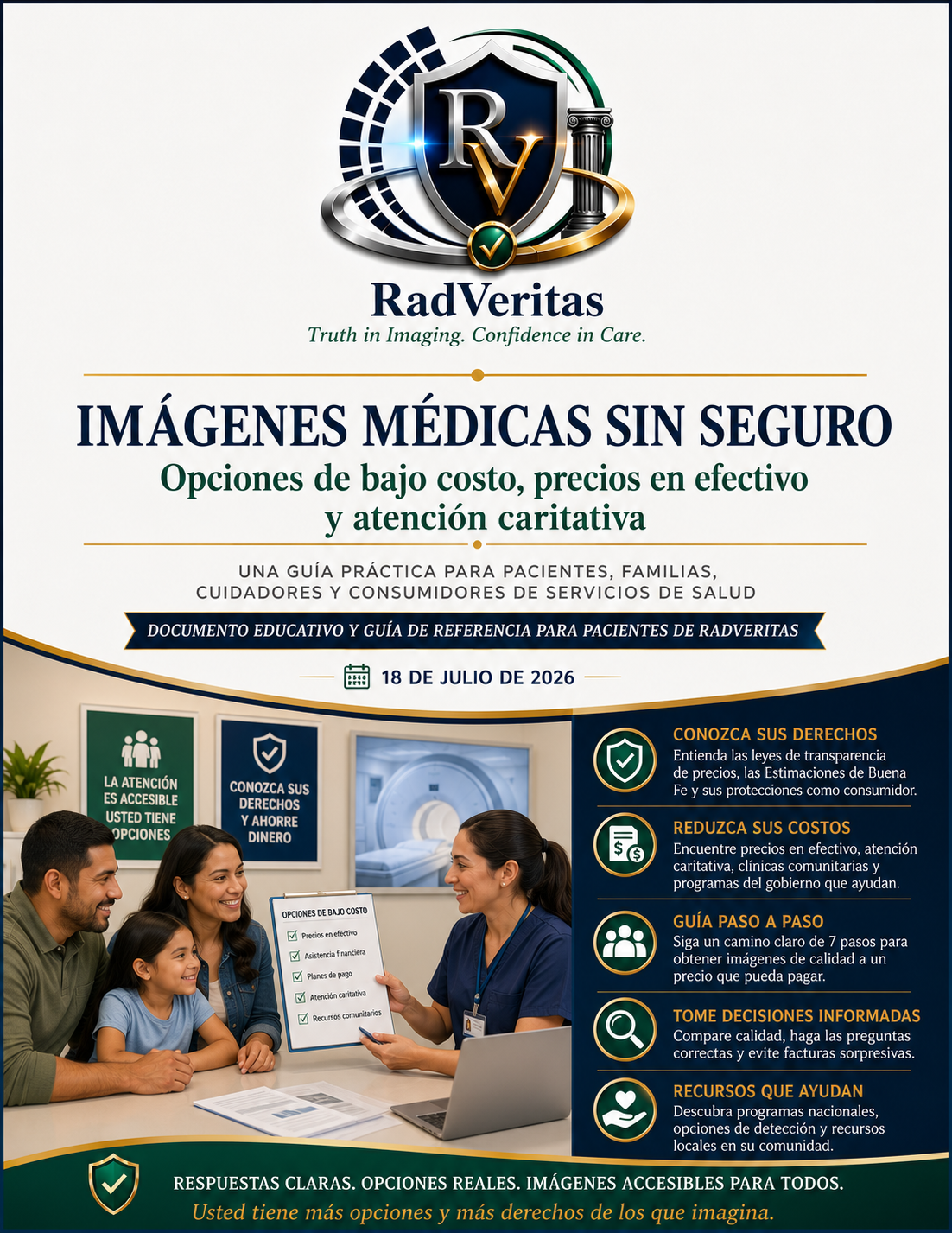
No tener seguro médico no significa que no pueda recibir la atención que necesita. Imágenes Médicas Sin Seguro es una guía práctica y fácil de entender que le ayuda a encontrar opciones económicas para estudios como resonancias magnéticas (MRI), tomografías (CT), radiografías, ultrasonidos y otros exámenes de diagnóstico por imágenes.
Ya sea que no tenga seguro, tenga un deducible alto o pague de su propio bolsillo, esta guía le muestra cómo comparar precios, conocer sus derechos, encontrar programas de asistencia financiera y evitar costos inesperados. Descubra que existen más opciones de las que muchas personas imaginan.
Lo Que Aprenderá
Cómo encontrar estudios de diagnóstico por imágenes a precios más accesibles.
La diferencia entre precios en efectivo, programas de asistencia financiera y atención de beneficencia (Charity Care).
Cómo comparar centros de imágenes y evitar facturas inesperadas.
Sus derechos como paciente bajo las leyes de transparencia de precios.
Qué preguntas hacer antes de programar su estudio.
Recursos nacionales, estatales y comunitarios que pueden ayudar a reducir sus gastos médicos.
Ideal Para
Personas sin seguro médico.
Pacientes con planes de deducible alto.
Personas que pagan sus estudios de su propio bolsillo.
Familias, cuidadores y consumidores que buscan atención médica de calidad a un costo razonable.
Por Qué Le Gustará
Escrito en un lenguaje sencillo y fácil de comprender.
Ofrece una guía paso a paso para encontrar opciones de bajo costo.
Le ayuda a ahorrar dinero y tomar mejores decisiones para su salud.
Explica claramente sus derechos y las opciones disponibles.
Incluye recursos confiables que puede utilizar de inmediato.
No permita que el costo le impida recibir la atención que necesita. Descubra cómo encontrar estudios de diagnóstico por imágenes a precios accesibles, conozca sus derechos y tome decisiones informadas con confianza para usted y su familia.
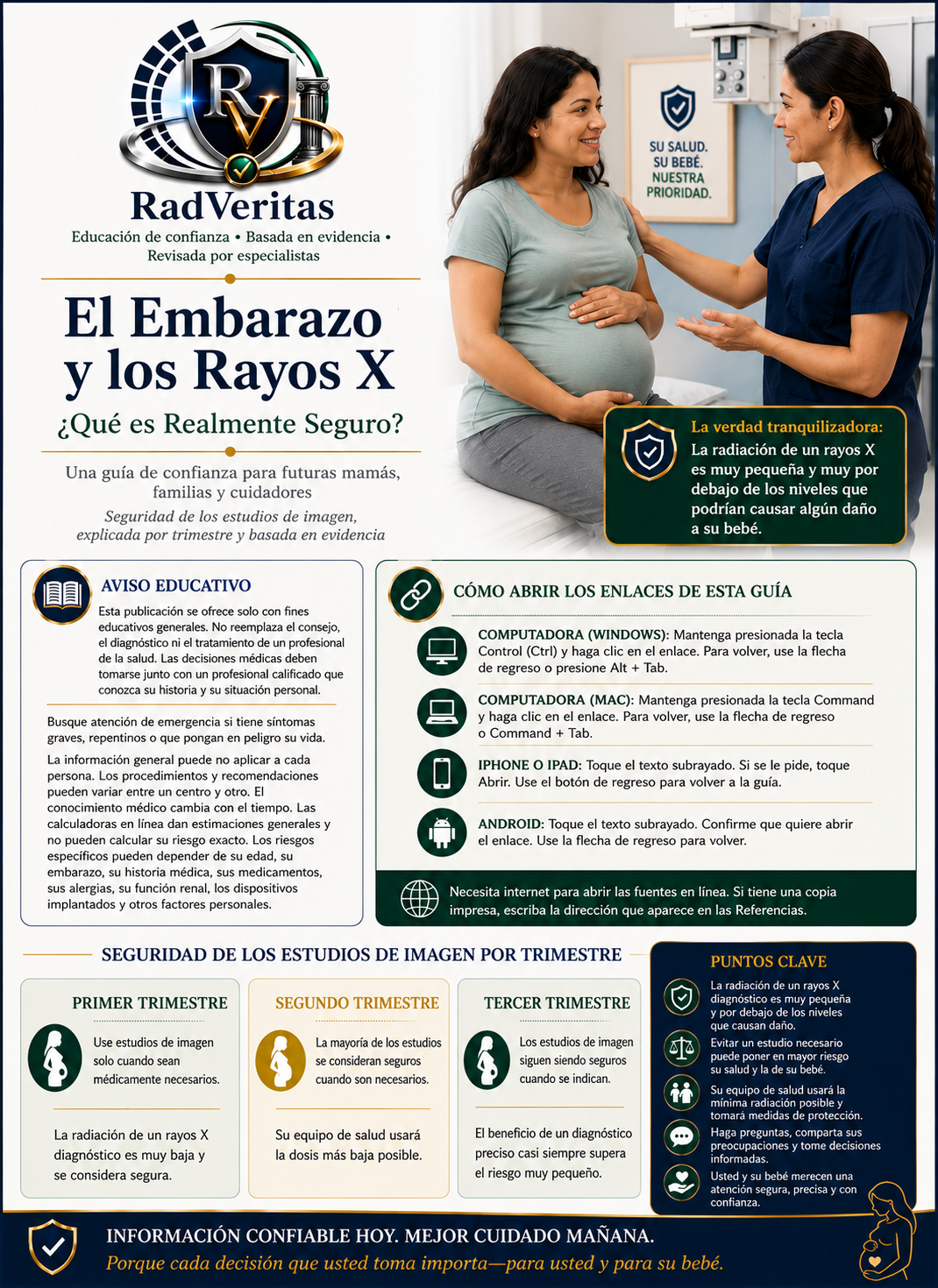
¿Qué es Realmente Seguro?
Estar embarazada puede traer muchas preguntas, especialmente si su médico le recomienda un estudio de imágenes. ¿Los rayos X son seguros? ¿Podrían afectar a mi bebé? ¿Debo esperar hasta después del parto? Esta guía completa de RadVeritas le ofrece respuestas claras, confiables y basadas en evidencia para que pueda tomar decisiones con tranquilidad.
Escrita especialmente para futuras mamás, familias y cuidadores hispanohablantes en los Estados Unidos, esta guía explica cuándo un estudio de imágenes es seguro durante el embarazo, por qué a veces es necesario realizarlo y cómo su equipo médico protege tanto su salud como la de su bebé.
Con un lenguaje sencillo y fácil de entender, aprenderá a distinguir los hechos de los mitos y descubrirá por qué retrasar un estudio médicamente necesario, en algunos casos, puede representar un riesgo mayor que el propio examen.
Lo Que Aprenderá
Cuándo los rayos X son seguros durante el embarazo.
Cómo cambian las recomendaciones en cada trimestre.
La diferencia entre rayos X, tomografía computarizada (CT), resonancia magnética (MRI) y ultrasonido.
Qué tan baja es realmente la radiación utilizada en los estudios diagnósticos.
Cuándo un estudio de imágenes puede ser esencial para proteger su salud y la de su bebé.
Los mitos más comunes y la realidad respaldada por la ciencia.
Qué preguntas hacer antes de aceptar un estudio de imágenes.
Cómo prepararse para su examen y sentirse más tranquila.
¿Por Qué Elegir Esta Guía?
Escrita en español sencillo y fácil de comprender.
Basada en recomendaciones de organizaciones médicas reconocidas.
Explica beneficios y riesgos sin crear miedo innecesario.
Organizada paso a paso para una lectura rápida y práctica.
Incluye ejemplos reales, listas útiles y recursos confiables.
Le ayuda a sentirse informada y segura durante todo el embarazo.
Ideal Para
Mujeres embarazadas.
Futuras mamás que necesitan un estudio de imágenes.
Padres y familiares que desean comprender mejor la seguridad de estos exámenes.
Cuidadores y personas que apoyan a una mujer embarazada.
Cualquier persona que busque información confiable sobre estudios de imágenes durante el embarazo.
Características del Producto
Libro digital completo y guía práctica de referencia.
Descarga digital inmediata.
Información organizada por trimestre del embarazo.
Contenido basado en evidencia médica actual.
Listas de verificación y preguntas para su equipo de salud.
Recurso educativo que podrá consultar durante todo su embarazo.
Tome Decisiones con Confianza
Cuando se trata de su salud y la de su bebé, contar con información confiable marca la diferencia. Esta guía le ayudará a comprender cuándo un estudio de imágenes es apropiado, cuáles son los riesgos reales y cómo su equipo médico trabaja para mantenerla a usted y a su bebé protegidos en cada etapa del embarazo.
Información clara. Respuestas confiables. Tranquilidad para usted y la mejor protección para su bebé.

A Patient and Family Guide to What Your Mammogram Letter Means and What to Do Next
Receiving a breast density notification can raise a lot of questions. Understanding Breast Density explains what your mammogram results mean in clear, everyday language so you can feel informed, confident, and prepared for your next conversation with your healthcare provider.
Learn what breast density is, why it matters, how it may affect mammogram screening, and whether additional imaging may be recommended. This easy-to-understand guide helps replace confusion with trusted, evidence-based information so you can make informed decisions about your breast health.
What You'll Learn
What breast density means.
Why breast density is included in your mammogram results.
How dense breast tissue can affect cancer detection.
When additional imaging may be recommended.
Questions to ask your healthcare provider.
What steps you can take to protect your breast health.
Perfect For
Women receiving mammogram results
Patients and families
Caregivers
Breast imaging centers
Hospitals and physician practices
Why You'll Love It
Written in plain language anyone can understand.
Explains breast density without confusing medical terms.
Reduces anxiety by answering common questions.
Helps you understand your mammogram report and next steps.
Created by trusted diagnostic imaging experts.
Take the uncertainty out of your mammogram results. Understand what breast density means and make informed decisions with confidence using the RadVeritas™ Patient Guide.
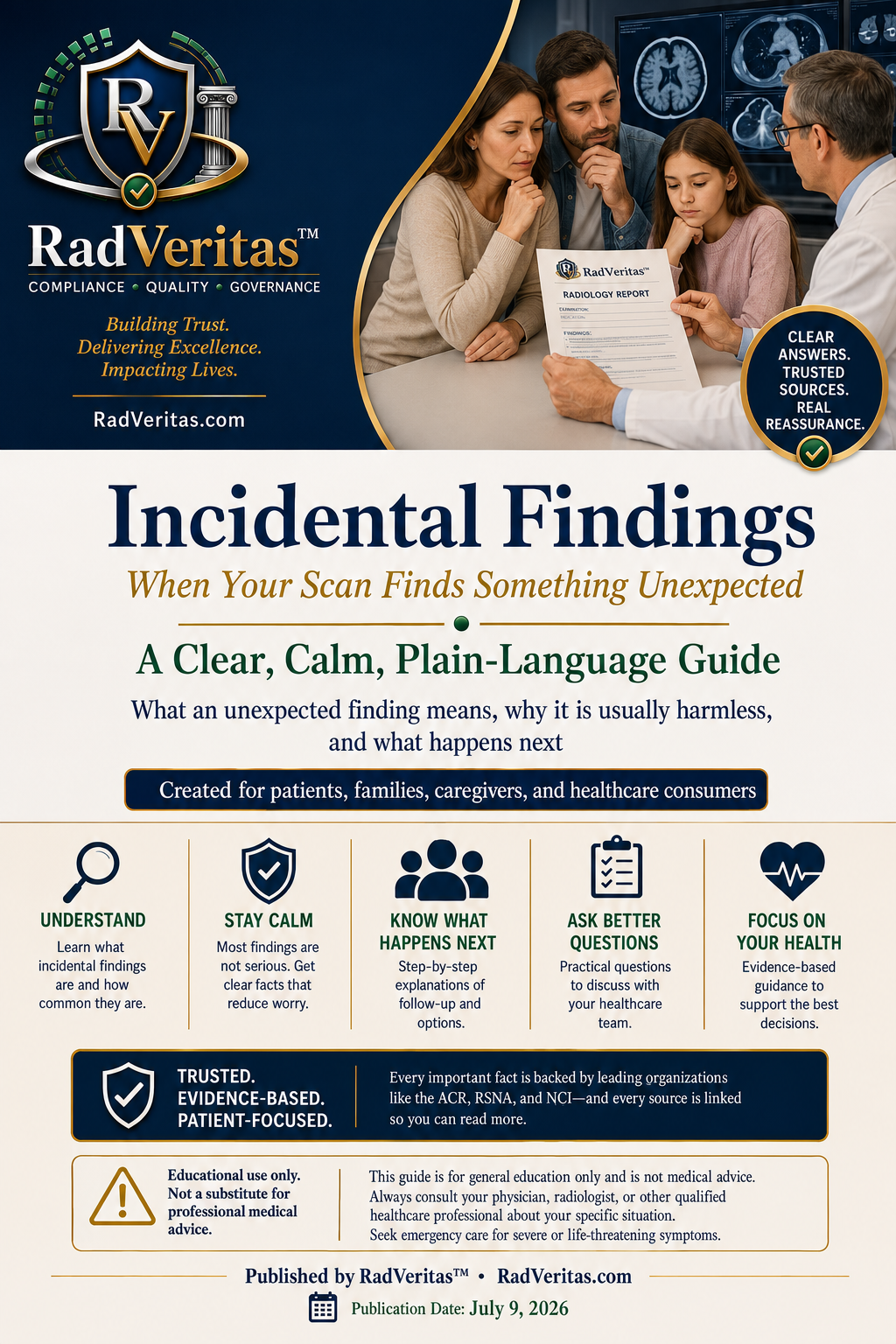
A Clear, Calm, Plain-Language Guide to Understanding Unexpected Imaging Results
Hearing that your scan found an "incidental finding" can be unsettling, but it usually doesn't mean something is seriously wrong. This easy-to-understand guide explains what incidental findings are, why they happen, and what they could mean for your health.
Written in plain language for patients and families, this guide helps you understand your radiology report, know what questions to ask, and feel more confident about your next steps. Instead of fear and confusion, you'll gain clear, evidence-based information from trusted medical organizations.
What You'll Learn
What an incidental finding is and why it is common.
Why many unexpected findings are harmless.
What follow-up testing or monitoring may be recommended.
How radiologists and your healthcare team decide what happens next.
Questions to ask your doctor to better understand your results.
When an incidental finding needs immediate attention and when it does not.
Perfect For
Patients who received unexpected imaging results.
Family members and caregivers.
Anyone reading a radiology report for the first time.
Healthcare consumers who want reliable, easy-to-understand information.
Why You'll Love It
Written in simple language with no confusing medical jargon.
Helps reduce worry by explaining what incidental findings really mean.
Uses trusted, evidence-based medical information.
Encourages informed conversations with your healthcare team.
Gives you practical guidance so you know what to expect next.
Don't let an unexpected finding create unnecessary fear. Learn what your radiology report is telling you, understand your options, and approach your next appointment with confidence, knowledge, and peace of mind.

YouTube Videos Informational Packages

Understand your options. Feel confident about your care.
If you've ever wondered whether you should have a 2D or 3D mammogram, this easy-to-understand guide is for you. Learn how each type of mammogram works, why many imaging centers use both together, and what you can expect before, during, and after your exam. Written in plain language, this guide helps you make informed decisions with confidence and less anxiety.
Perfect For: Women preparing for a mammogram, those with dense breast tissue, first-time patients, caregivers, and anyone who wants clear, trustworthy information about breast imaging.
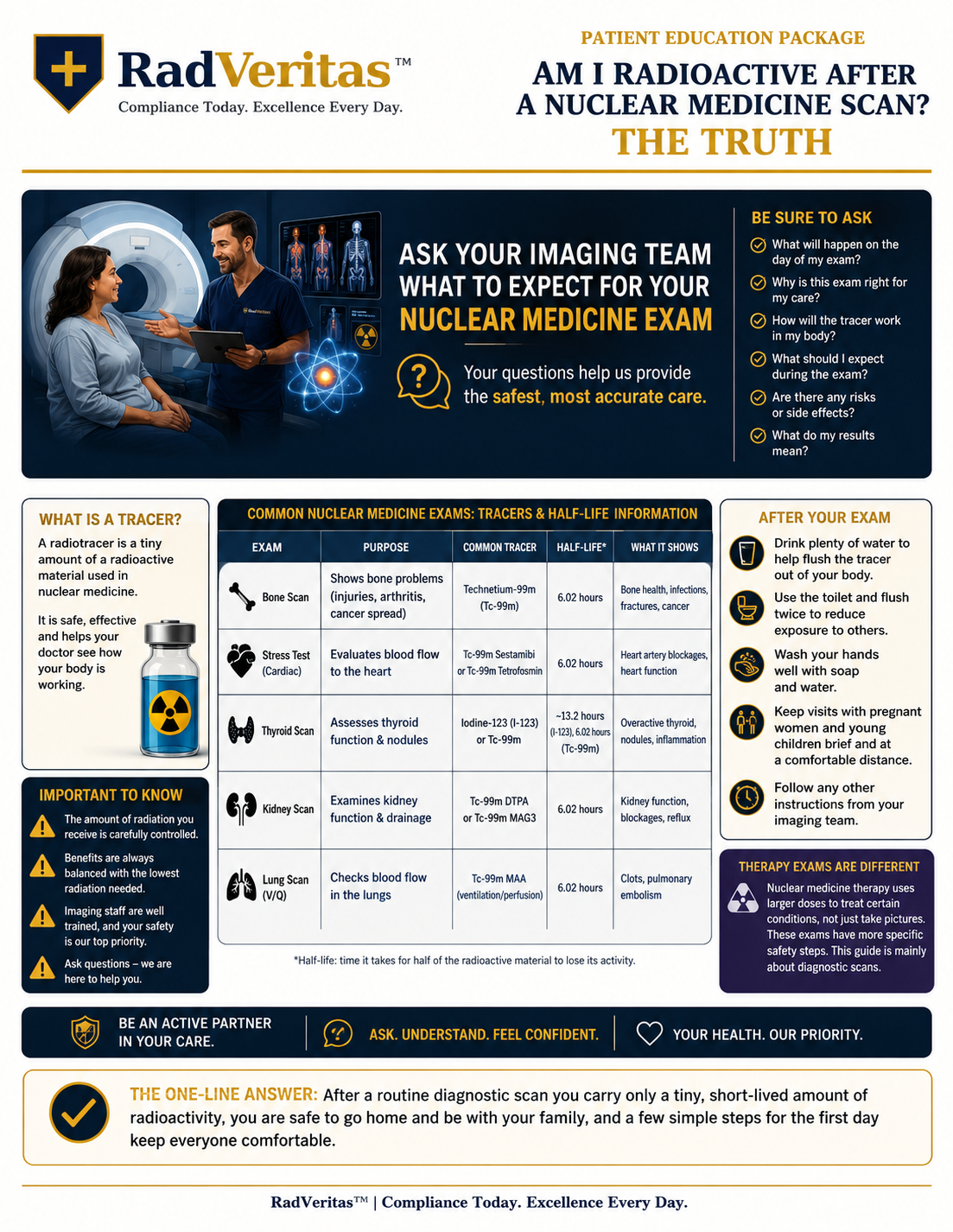
Get the facts before and after your nuclear medicine exam.
Many patients worry about being radioactive after a nuclear medicine scan. This easy-to-understand guide explains what the small amount of radioactive tracer does, how long it stays in your body, what to expect after your exam, and when simple precautions may be recommended. Written in plain language, it helps you separate fact from myth so you can feel informed, reassured, and confident about your care.
Perfect For: Patients, family members, caregivers, and anyone preparing for a nuclear medicine exam who wants clear, trustworthy answers before, during, and after their visit.

Know what happens after your scan and why results can take time.
Waiting for imaging results can be stressful. This easy-to-understand guide explains what happens after your exam, why some results are available sooner than others, and how radiologists carefully review your images before your provider receives the report. Learn what affects turnaround times, when to expect results, and how to stay informed throughout the process.
Perfect For: Patients, caregivers, and families who want clear, reliable answers about the imaging results process and what to expect after their exam.
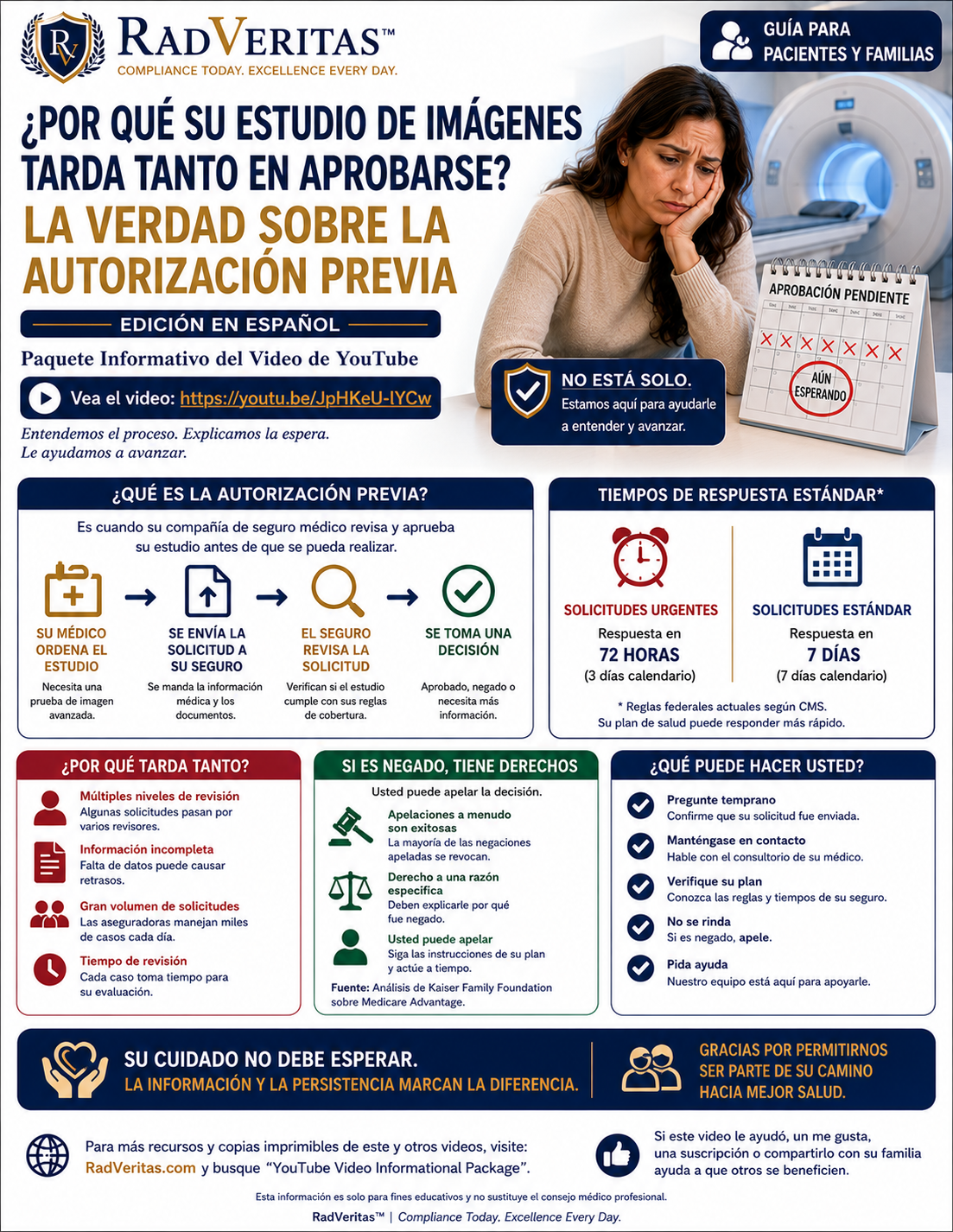
Su médico ordenó su estudio. Entonces, ¿por qué sigue esperando? Esta guía complementaria del video de RadVeritas en YouTube revela lo que hay detrás de la autorización previa, el paso de aprobación del seguro que retrasa más resonancias magnéticas, tomografías y estudios PET que cualquier otra parte del proceso. En lenguaje sencillo y amable, le muestra exactamente qué sucede detrás de escena, cuánto deben tardar las decisiones y qué puede hacer usted para que su atención siga avanzando.
Qué Contiene
▪ Un resumen en lenguaje sencillo que puede leer en dos minutos, más una explicación completa escrita para lectores sin formación médica.
▪ Catorce de las preguntas más comunes de los pacientes, respondidas de forma simple y completa, desde quién envía la solicitud hasta qué hacer si la respuesta es no.
▪ Un recorrido por el antes, durante y después de todo el proceso de aprobación, para que siempre sepa qué viene después.
▪ Una guía amigable sobre sus protecciones: los plazos federales que ahora exigen respuestas dentro de setenta y dos horas para solicitudes urgentes y siete días calendario para solicitudes estándar, las razones específicas que los planes deben dar al negar, y su derecho legal de apelar.
▪ Ocho imágenes imprimibles de página completa tomadas directamente del video, cada una colocada junto a la sección que explica y con su descripción en español sencillo.
▪ Un escenario realista de paciente, una lista de preguntas para su equipo de imágenes, un glosario en lenguaje sencillo y un conjunto completo de referencias con enlaces de fuentes confiables como CMS, la Asociación Médica Americana, CuidadoDeSalud.gov y RadiologyInfo.org.
Para Quién Es
Para pacientes que esperan la aprobación de un estudio de imagen, cuidadores que ayudan a un ser querido durante el proceso y familiares que quieren entender por qué ocurre la espera y cómo acortarla. No se necesita formación médica. Cada página está diseñada para imprimirse, colocarse a la vista y compartirse. La edición en español explica en español claro todas las imágenes del video, que están en inglés, e incluye enlaces a recursos oficiales del gobierno en español.
Por Qué RadVeritas
Los materiales educativos de RadVeritas están escritos por un profesional experimentado en imágenes diagnósticas y se basan en fuentes regulatorias y clínicas autorizadas. Cada afirmación es verificable, cada protección es real y cada página está hecha para que usted llegue a su próxima cita informado y con confianza.
Vea el video y luego descargue el paquete completo aquí en RadVeritas.com bajo YouTube Video Informational Package. Disponible también en inglés. Vienen más videos y guías en camino en el canal de RadVeritas en YouTube.
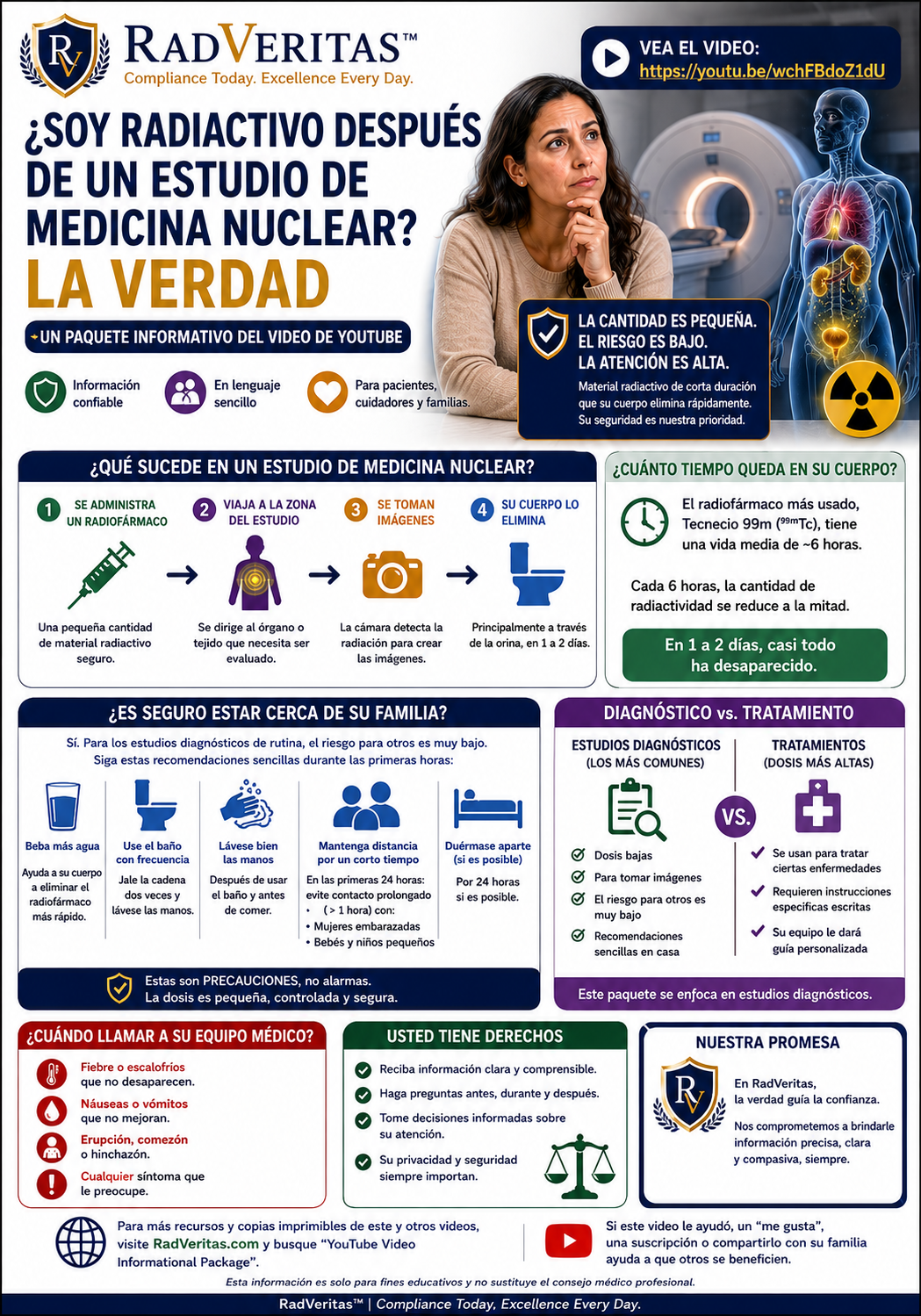
Si tiene programado un estudio de medicina nuclear, hay una pregunta que suele quitarle el sueño a la gente. ¿Voy a quedar radiactivo? ¿Es seguro abrazar a mis hijos, cargar a mi nieto o sentarme junto a mi hija embarazada después?
Esta guía responde esa pregunta con honestidad, y la respuesta es más tranquilizadora de lo que la mayoría espera. Por un corto tiempo después de un estudio de rutina, su cuerpo sí lleva una cantidad diminuta de material radiactivo. Pero la cantidad es pequeña, está cuidadosamente controlada y desaparece rápido por sí sola. Usted puede irse a casa sin problema. Puede estar con su familia. Unos pocos pasos fáciles durante el primer día suelen ser todo lo necesario.
Escrita por un Administrador de Radiología Certificado y pensada para personas sin conocimientos médicos, esta guía le explica qué es un radiotrazador, qué tan rápido sale de su cuerpo, qué esperar antes, durante y después de su estudio, y exactamente qué preguntarle a su equipo de imágenes. Cada dato está respaldado por fuentes confiables que usted mismo puede revisar, incluidas la Comisión Reguladora Nuclear, los CDC, la EPA y RadiologyInfo.org.
Qué incluye
● Un resumen de una página en lenguaje sencillo que puede leer en un minuto
● Diez preguntas comunes respondidas con claridad, incluidas la lactancia, las alarmas de radiación en los aeropuertos y cómo estar cerca de niños y familiares embarazadas
● Un recorrido claro de antes, durante y después de su estudio
● Cómo está usted protegido: las reglas de seguridad, los profesionales capacitados y las normas de acreditación que trabajan tras bambalinas
● Una hoja de referencia imprimible de página completa que puede pegar en su refrigerador
● Una historia realista de una paciente que vive toda la experiencia
● Diez preguntas para llevar y hacerle a su equipo de imágenes
● Un glosario en lenguaje sencillo y una lista completa de fuentes confiables con enlaces
Para quién es
Para pacientes con una cita de gammagrafía ósea, prueba de esfuerzo cardíaca, estudio de tiroides, estudio renal, estudio cerebral, estudio pulmonar o cualquier otro examen de medicina nuclear. También está escrita para los cuidadores, esposos, hijos adultos y familiares que quieren entender qué es seguro y qué esperar.
Formato
● PDF gratuito para descargar, listo para leer en cualquier teléfono o computadora
● Fácil de imprimir, con una imagen de página completa que puede pegar en casa
● Disponible también como documento de Word editable
● Disponible en inglés y en español
Una nota de RadVeritas
Este paquete acompaña al video de RadVeritas del mismo nombre. Vienen más guías y videos para pacientes en camino. Si este le sirve, nos daría gusto que viera el video, y siempre es bienvenido a darle me gusta, suscribirse y compartirlo con alguien que tenga un estudio próximo.
Solo con fines educativos. Esta guía no es consejo médico y no sustituye las instrucciones de su propio equipo de salud. Siga siempre las indicaciones que le dé su equipo de imágenes.
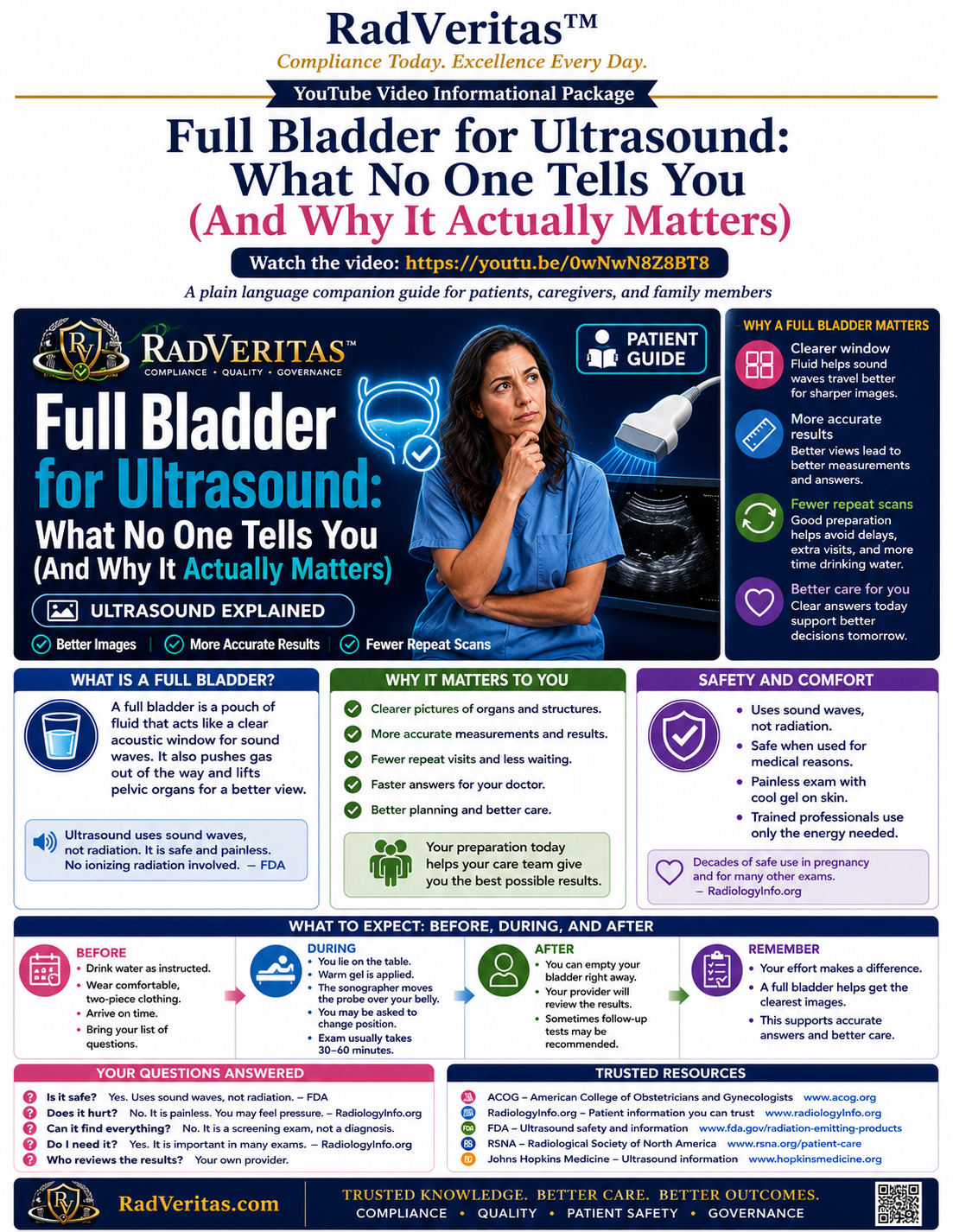
The Simple Step That Can Make Your Ultrasound More Accurate
Have you ever been told to arrive for an ultrasound with a full bladder and wondered...
"Why is this so important?"
You're not alone.
Many patients are instructed to drink water before an ultrasound but are never told why. Without understanding the reason, it's easy to arrive unprepared, leading to delayed appointments, repeat imaging, or less accurate results.
The RadVeritas™ Full Bladder for Ultrasound Informational Package explains everything in clear, simple language so you know exactly what to expect and why your preparation matters.
Whether you're having your first ultrasound or helping a loved one prepare, this guide gives you the knowledge to walk into your appointment with confidence.
Why This Guide Is Different
Instead of using confusing medical terminology, this patient-friendly guide explains:
• Why a full bladder improves ultrasound images
• How proper preparation helps your healthcare team obtain better results
• What happens before, during, and after your exam
• Why drinking water can help prevent repeat imaging
• What you should expect during your appointment
• The answers to the questions patients ask most often
Everything is explained in language that's easy to understand, even if you've never had an ultrasound before.
What You'll Learn
✔ Why some ultrasound exams require a full bladder
✔ How a full bladder creates clearer images
✔ Why proper preparation can improve diagnostic accuracy
✔ What happens if your bladder is not full enough
✔ What to expect before, during, and after the exam
✔ How ultrasound differs from X-rays and CT scans
✔ Why ultrasound uses sound waves instead of radiation
✔ Common questions answered by imaging experts
✔ Trusted medical resources for additional learning
What's Included
Your downloadable package includes:
• Easy-to-understand educational guide
• Step-by-step patient preparation instructions
• Before, During, and After examination guide
• Frequently Asked Questions
• Full-color educational graphics
• Safety and comfort information
• Trusted medical references
• Patient-friendly illustrations
• Printable reference pages
• Companion resource to the RadVeritas™ YouTube video
Perfect For
This resource is ideal for:
• Patients scheduled for an ultrasound
• Expectant mothers
• Family members and caregivers
• First-time imaging patients
• Women's health patients
• Urology patients
• Imaging centers
• Physician offices
• Patient education programs
Why Proper Preparation Matters
Something as simple as drinking enough water before your appointment can make a significant difference.
Proper preparation may help:
• Produce clearer ultrasound images
• Improve measurement accuracy
• Reduce unnecessary repeat scans
• Shorten appointment delays
• Help your healthcare provider make more confident decisions
• Create a smoother experience from start to finish
Knowing what to do before your appointment helps you play an important role in obtaining the best possible results.
Built on Trusted Medical Information
This educational package references guidance from respected healthcare organizations, including:
• American College of Obstetricians and Gynecologists (ACOG)
• U.S. Food and Drug Administration (FDA)
• Radiological Society of North America (RSNA)
• Johns Hopkins Medicine
These trusted sources help ensure the information is accurate, current, and patient focused.
A Perfect Companion to the YouTube Video
This guide expands on the RadVeritas™ YouTube video:
Full Bladder for Ultrasound: What No One Tells You (And Why It Actually Matters)
Watch the video, then use this downloadable guide as a convenient reference before your ultrasound appointment.
Instant Digital Download
Immediately after purchase, you'll receive a downloadable PDF that you can:
• Read on your computer, tablet, or phone
• Print for easy reference
• Share with family members or caregivers
• Bring to your imaging appointment
• Keep for future ultrasound exams
Arrive Prepared. Leave Confident.
A full bladder may seem like a small detail, but it can make a big difference in the quality of your ultrasound.
This RadVeritas™ educational guide helps you understand the purpose behind the instructions, prepares you for your appointment, and gives you the confidence to be an informed partner in your healthcare.
Download your copy today and discover why proper preparation leads to clearer images, better answers, and a better ultrasound experience.
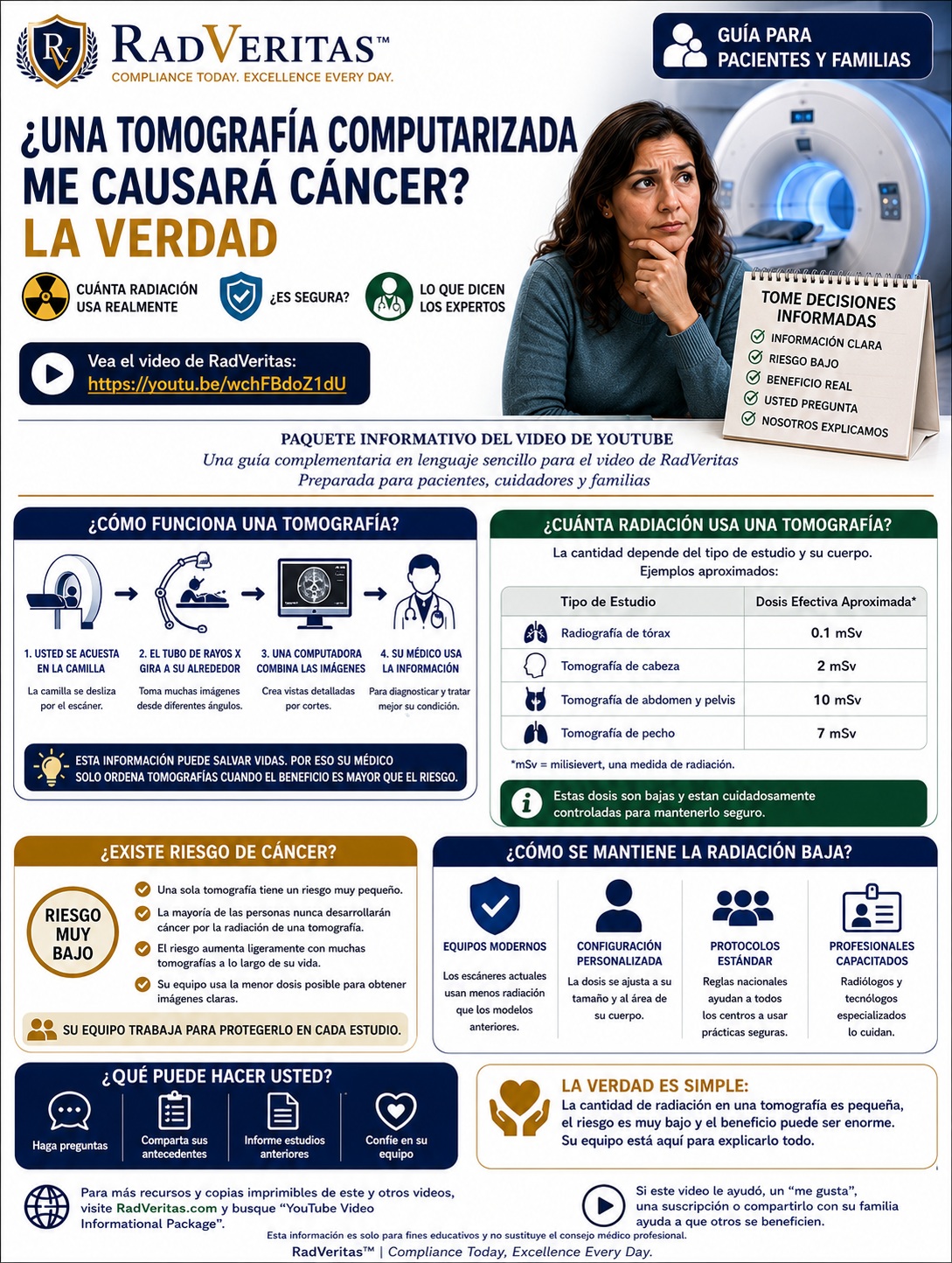
Si su médico le recomendó una tomografía computarizada, es posible que haya sentido un momento de preocupación. Ha escuchado que estos estudios usan radiación y quiere saber si esa radiación podría hacerle daño. Es una pregunta justa y merece una respuesta clara y honesta.
Este paquete es la guía escrita que acompaña al video de RadVeritas “WILL A CT SCAN GIVE ME CANCER”, es decir, “¿Una tomografía computarizada me causará cáncer?”. Toma el mismo tema y lo explica con palabras sencillas y cotidianas, para que usted pueda leerlo a su propio ritmo, compartirlo con su familia y llevarlo a su cita.
Adentro aprenderá qué es realmente una tomografía, cuánta radiación usa y cómo se compara esa cantidad con la radiación natural a la que todos estamos expuestos cada año. Recibirá una respuesta directa sobre el riesgo de cáncer, incluido lo que en verdad encontró un estudio nacional muy difundido y cómo interpretar ese hallazgo correctamente. También verá por qué los médicos ordenan estos estudios y por qué el beneficio de un estudio necesario suele superar el pequeño riesgo.
La guía lo acompaña paso a paso en lo que puede esperar antes, durante y después de su estudio. Explica, en términos fáciles de entender, las reglas de seguridad y las inspecciones que lo protegen, desde la supervisión federal y la acreditación de los centros hasta los profesionales capacitados que realizan e interpretan su estudio. Responde las preguntas que los pacientes hacen con más frecuencia, como si las tomografías son seguras para los niños, si son seguras durante el embarazo, si el medio de contraste causa cáncer y si la radiación se queda en el cuerpo después.
Qué Incluye
• Un resumen en lenguaje sencillo que cualquier persona entiende desde la primera lectura
• Una amplia sección de preguntas y respuestas con las dudas más comunes de los pacientes
• Una guía sencilla de lo que ocurre antes, durante y después de su estudio
• Una explicación fácil de entender sobre las reglas de seguridad y las normas de acreditación que lo protegen
• Imágenes del video en páginas completas que puede imprimir, colocar a la vista o llevar a su cita
• Una historia realista que muestra a una paciente viviendo la experiencia
• Una lista lista para usar con preguntas para su equipo de imagenología
• La Perspectiva de RadVeritas, con el punto de seguridad clave y la mejor pregunta que puede hacer
• Un glosario que define cada término técnico con palabras cotidianas
• Referencias completas con enlaces a fuentes confiables como la FDA, RadiologyInfo.org, la Sociedad Americana Contra el Cáncer, los Institutos Nacionales de la Salud, los CDC, Image Wisely e Image Gently
Para Quién Es
Para pacientes que tienen una tomografía programada, para cuidadores y familiares que ayudan a alguien a prepararse, y para cualquier persona que quiera una respuesta confiable sobre la radiación y el riesgo de cáncer, sin miedo y sin exageraciones. No se necesitan conocimientos médicos.
Formato
Disponible como un documento con formato completo que puede leer en cualquier dispositivo o imprimir en casa. Las páginas de imágenes están diseñadas como páginas completas, para que se vean claras y fáciles de leer al imprimirlas.
Recurso complementario gratuito. Pronto habrá más videos y guías de RadVeritas. Si esto le sirve, considere darle me gusta al video, suscribirse al canal y compartirlo con familiares y amigos que puedan tener las mismas preguntas.
Nota Importante
Este material es solo educativo. No es asesoramiento médico y no sustituye la orientación de su propio médico. Hable siempre con un profesional de la salud calificado sobre su situación específica. Disponible en inglés y español en RadVeritas.com en la sección “YouTube Video Informational Package”.
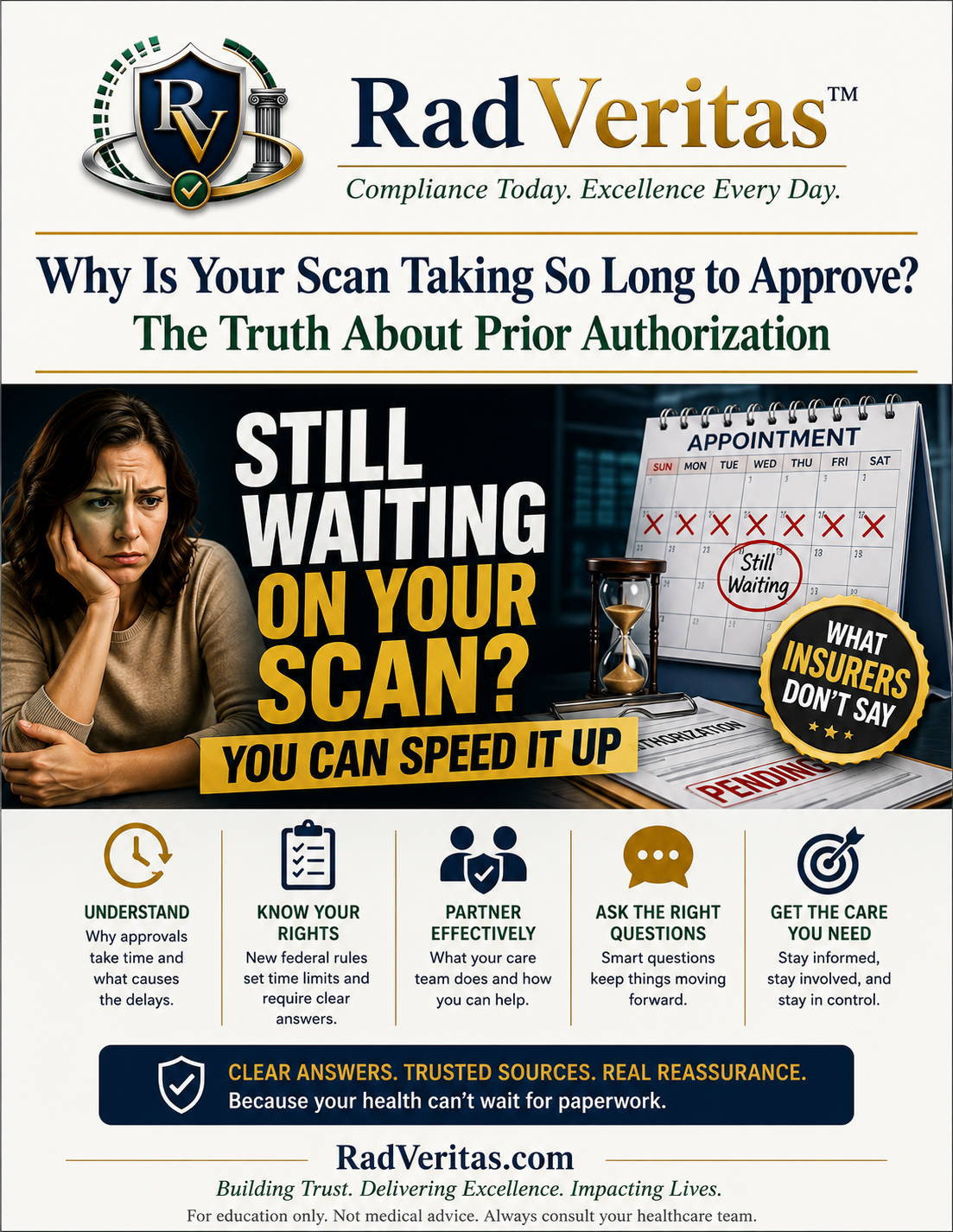
The Truth About Prior Authorization
Waiting for an imaging exam can be frustrating, especially when you don't know why it's taking so long. Why Is Your Scan Taking So Long to Approve? explains the prior authorization process in clear, everyday language so you understand what is happening, why delays occur, and what you can do to help move things forward.
This easy-to-read guide helps you understand the roles of your doctor, insurance company, and imaging center while showing you practical steps that may reduce unnecessary delays. Instead of feeling stuck, you'll know what questions to ask, what your rights are, and how to become an active partner in your care.
What You'll Learn
What prior authorization is and why some imaging exams require it.
The most common reasons imaging approvals are delayed.
Who is responsible for each step of the approval process.
Questions to ask your doctor's office, imaging center, and insurance company.
Your rights as a patient under current healthcare regulations.
Simple actions that may help speed up your imaging approval.
Perfect For
Patients waiting for CT, MRI, PET, ultrasound, or other imaging exams.
Family members and caregivers.
Anyone confused by the insurance approval process.
Healthcare consumers who want clear, practical answers.
Why You'll Love It
Written in plain language that's easy to understand.
Removes the mystery behind prior authorization.
Provides practical tips you can use immediately.
Helps reduce stress by explaining what happens behind the scenes.
Empowers you to advocate for your healthcare with confidence.
Don't let paperwork leave you wondering what happens next. Learn how the imaging approval process works, understand your options, and discover simple ways to help move your care forward with confidence.
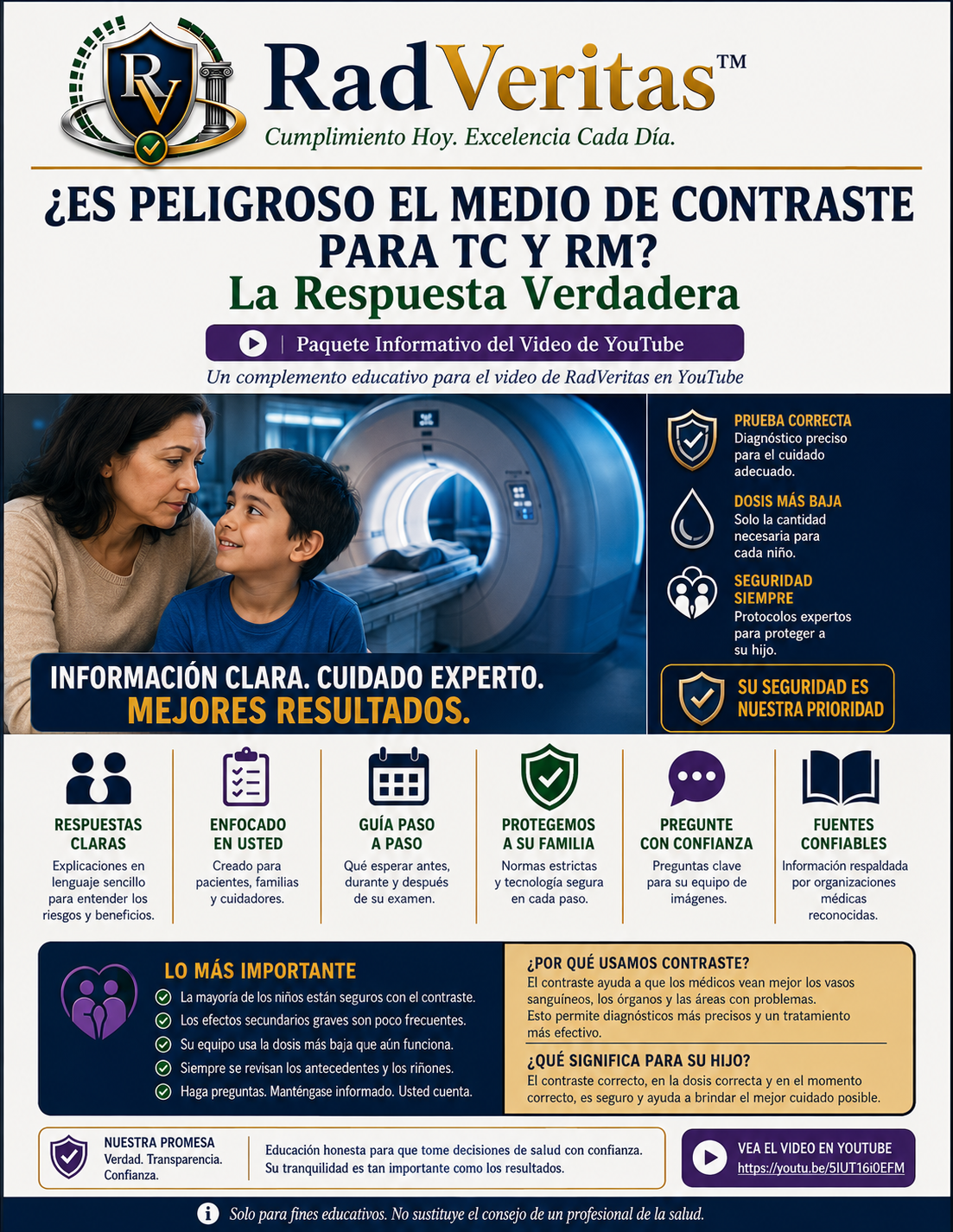
Su médico ordenó un estudio con contraste y ahora usted tiene preguntas. ¿Es seguro? ¿Dolerá? ¿Puede dañar mis riñones? ¿Y qué hay del gadolinio del que leí en internet?
Este paquete responde todo eso en lenguaje sencillo. Sin términos médicos complicados. Sin alarmismo. Solo información clara y honesta de un Administrador de Radiología Certificado, respaldada por agencias federales y normas nacionales de imágenes.
El contraste no es realmente un tinte. Es un líquido transparente que ayuda a su médico a ver con más claridad los vasos sanguíneos, los órganos y las áreas con problemas. Para la mayoría de las personas es muy seguro. Las reacciones graves son poco frecuentes, y su equipo de imágenes lo evalúa, lo vigila y se prepara para ellas. El verdadero riesgo suele ser el contrario, un diagnóstico perdido porque un estudio necesario se omitió por miedo.
Lea esto antes de su cita y entre informado en lugar de ansioso.
Qué Incluye
• Una guía imprimible de 34 páginas en Microsoft Word y PDF
• Un resumen de una página en lenguaje sencillo que puede leer en dos minutos
• Catorce preguntas comunes de pacientes, respondidas de forma simple y completa
• Una guía paso a paso de lo que sucede antes, durante y después de su examen
• Una explicación clara de las reglas de seguridad, las inspecciones y la acreditación que lo protegen
• Ocho imágenes del video en páginas completas, listas para imprimir, colocar o llevar a su cita
• Una lista de preguntas para hacerle a su equipo de imágenes
• Un glosario en lenguaje sencillo y una lista completa de fuentes confiables con enlaces activos
Preguntas que Responde Este Paquete
• ¿Es peligroso el tinte de contraste?
• ¿Cuál es la diferencia entre el contraste de TC y el de RM?
• ¿Dolerá la inyección y qué sentiré?
• ¿Puede el contraste dañar mis riñones y qué es la TFGe?
• ¿Debo preocuparme por el gadolinio que permanece en mi cuerpo?
• ¿Qué pasa si estoy embarazada, amamantando o tuve una reacción antes?
• ¿Puedo negarme al contraste?
Para Quién Es
Pacientes que tienen programada una TC o una RM con contraste, cuidadores y familiares, y cualquier persona que quiera entender qué se le está inyectando realmente y por qué.
También Disponible
Este paquete está disponible en inglés y en español. Vea el video complementario en el canal de RadVeritas en YouTube y busque nuevos paquetes de video a medida que se publiquen.
RadVeritas™ | Cumplimiento Hoy. Excelencia Cada Día.
Solo para uso educativo. No es consejo médico. Consulte siempre a sus propios proveedores de atención médica calificados.
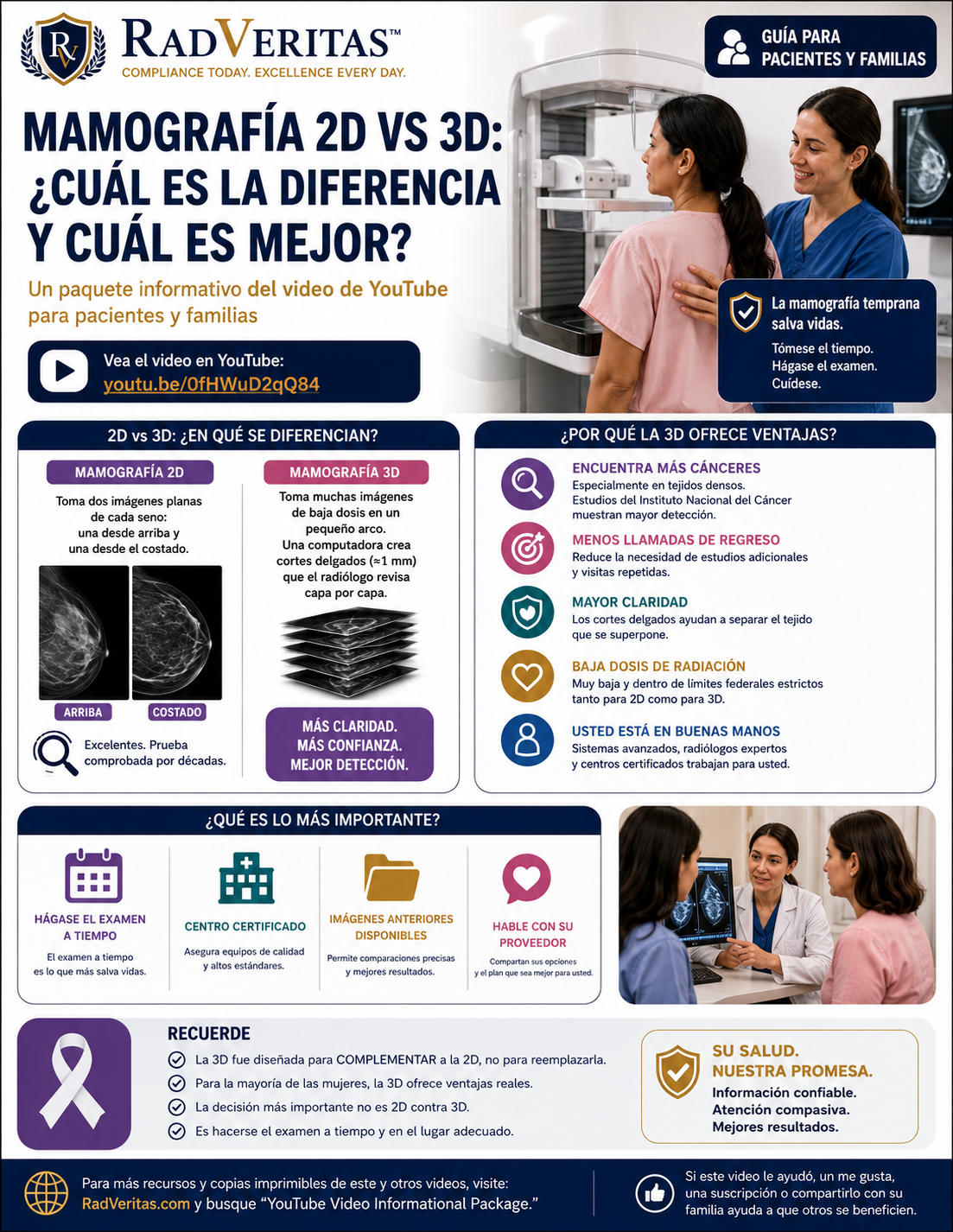
Esta guía para pacientes explica la diferencia entre la mamografía 2D y la mamografía 3D con palabras claras y fáciles de entender. Una mamografía 2D toma dos imágenes planas de cada seno. Una mamografía 3D, también llamada tomosíntesis mamaria, toma muchas imágenes de baja dosis desde diferentes ángulos y las combina en capas delgadas que el radiólogo puede revisar una sección a la vez.
Ambos exámenes son herramientas eficaces para detectar el cáncer de seno en una etapa temprana. Para muchas mujeres, la mamografía 3D puede ofrecer una vista más clara, detectar más cánceres pequeños y reducir la necesidad de regresar para imágenes adicionales, especialmente cuando el tejido mamario es denso. La guía también explica la seguridad de la radiación, la compresión del seno, cuánto dura el examen, cómo prepararse, qué significa tener senos densos y qué esperar si se necesitan más imágenes.
El mensaje más importante es sencillo: la mejor mamografía es la que se realiza a tiempo, en un centro certificado y con las imágenes anteriores disponibles para comparación. Se recomienda que las pacientes hablen con su profesional de la salud sobre la densidad mamaria, sus factores personales de riesgo, la frecuencia de los exámenes y si la mamografía 2D o 3D es la mejor opción para ellas.
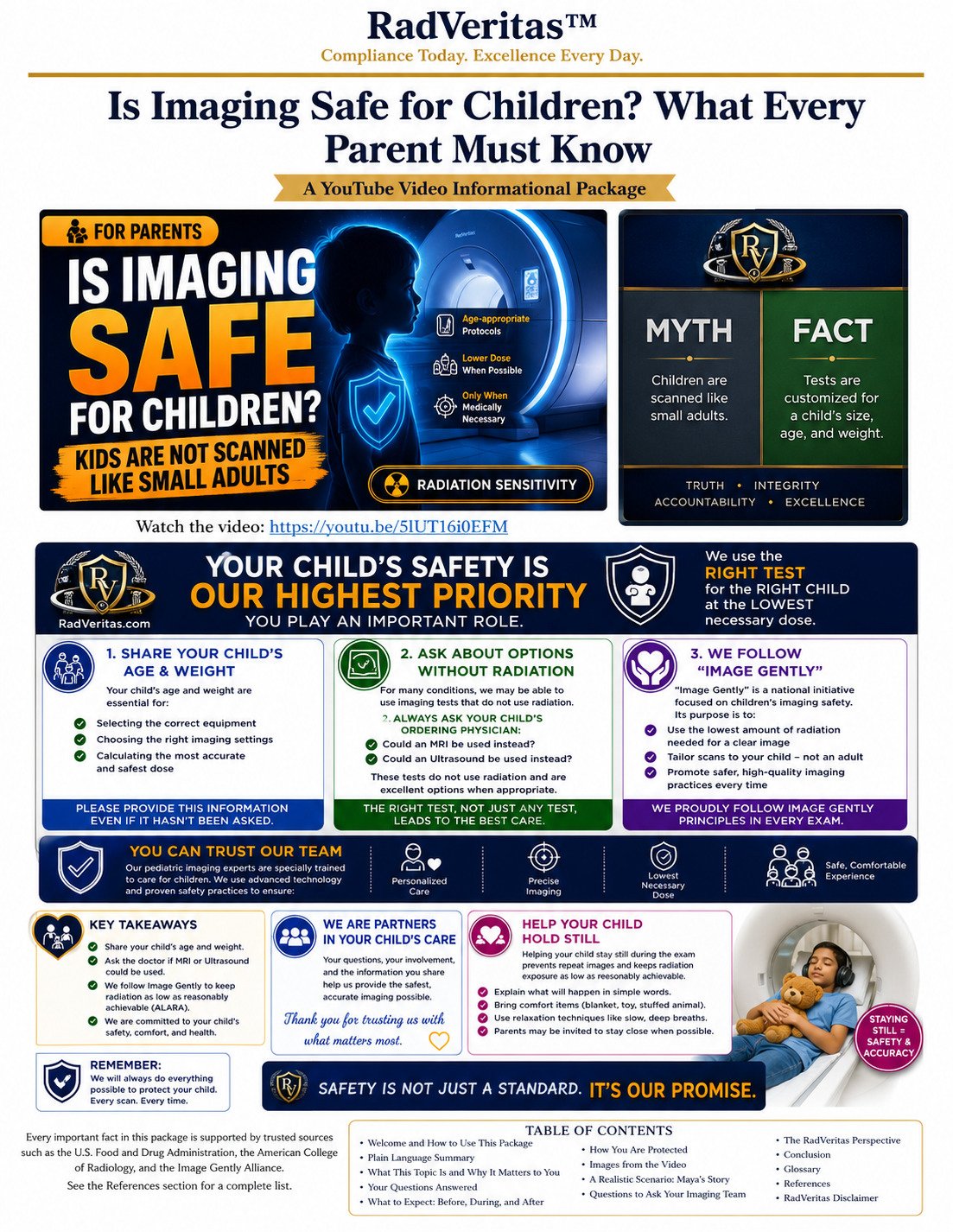
Understand Your Child's Imaging Exam With Confidence
When your child needs an X-ray, CT scan, MRI, or ultrasound, it's natural to have questions.
Is it safe?
Does my child really need the exam?
How much radiation is involved?
Could another test be used instead?
This comprehensive RadVeritas™ YouTube Video Informational Package gives parents clear, trustworthy answers in simple language that anyone can understand.
Created by diagnostic imaging experts, this guide expands on the accompanying YouTube video and explains what happens before, during, and after your child's imaging exam. You'll learn how imaging professionals protect children, why pediatric imaging is different from adult imaging, and what questions every parent should ask before an exam.
Instead of searching dozens of websites for answers, you'll have one easy-to-read resource built around trusted medical guidance and nationally recognized safety standards.
What You'll Learn
• Which imaging exams use radiation and which do not
• Why children are never scanned like small adults
• How imaging teams reduce radiation exposure using the ALARA safety principle
• When ultrasound or MRI may be an alternative to X-rays or CT scans
• What happens before, during, and after an imaging exam
• How imaging equipment is adjusted specifically for children
• What imaging professionals do to protect your child
• How to understand imaging results and next steps
• The most common myths about pediatric imaging and the facts behind them
• The most important questions every parent should ask before an imaging exam
What's Included
This professionally designed informational package includes:
✔ Plain-language explanations
✔ Parent-friendly Question and Answer section
✔ Step-by-step imaging exam guide
✔ Child imaging safety overview
✔ Real-life patient scenario
✔ Full-page educational graphics from the video
✔ Myth vs. Fact learning series
✔ Parent imaging safety checklist
✔ Questions to ask your healthcare team
✔ Pediatric imaging glossary
✔ References from trusted healthcare organizations
✔ Printable educational pages for future use
Designed For
This package is ideal for:
• Parents
• Grandparents
• Guardians
• Family caregivers
• Teachers
• Child advocates
• Pediatric healthcare professionals
• Medical offices
• Imaging centers
• Children's hospitals
Why Parents Love This Guide
Parents often feel overwhelmed after hearing that their child needs medical imaging.
This guide replaces uncertainty with knowledge.
You'll learn what to expect, understand why certain imaging exams are recommended, and gain practical tips that help you become an informed partner in your child's healthcare.
Whether your child is having an X-ray, CT scan, MRI, or ultrasound, you'll walk into the appointment feeling more prepared and confident.
Built on Trusted Sources
Every topic is supported by nationally recognized organizations, including:
• American College of Radiology (ACR)
• U.S. Food and Drug Administration (FDA)
• Image Gently Alliance
• National Cancer Institute (NCI)
• ARRT
• ARDMS
• The Joint Commission
• HIPAA and other recognized healthcare resources
Perfect Companion to the YouTube Video
This downloadable package expands on the RadVeritas™ YouTube video:
Is Imaging Safe for Children? What Every Parent Must Know
Watch the video first, then use this guide as your personal reference before your child's next imaging appointment.
Digital Download
Immediately after purchase, you'll receive a downloadable PDF that you can:
• Read on any device
• Print at home
• Share with family members
• Bring to imaging appointments
• Keep as a trusted healthcare reference
Give Yourself Peace of Mind
Knowledge is one of the best ways to reduce fear.
Learn how pediatric imaging keeps children safe, understand why imaging exams are performed, and become a confident advocate for your child's healthcare with this comprehensive educational guide from RadVeritas™.
Download today and approach your child's next imaging exam with confidence.
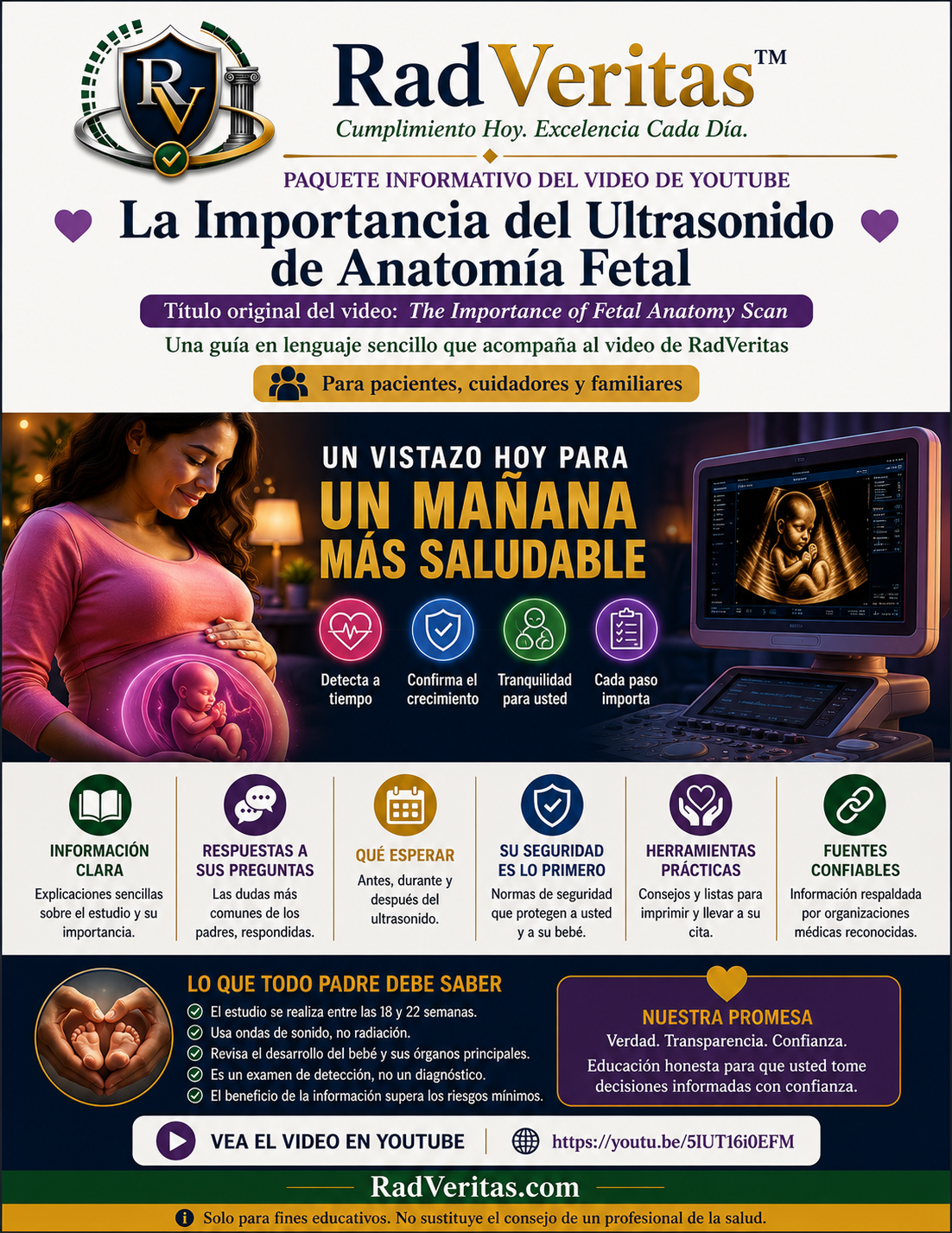
El ultrasonido de anatomía es una de las revisiones más detalladas de su bebé en todo el embarazo. Es normal tener preguntas. ¿Qué van a revisar? ¿Es seguro? ¿Duele? ¿Qué significan realmente los resultados?
Esta guía responde esas preguntas en un lenguaje sencillo y cotidiano, sin necesidad de tener formación médica. Acompaña al video de RadVeritas The Importance of Fetal Anatomy Scan, y va más allá del video porque la lleva paso a paso por toda la experiencia, de principio a fin.
Usted aprenderá que el estudio normalmente se realiza entre las 18 y 22 semanas, que usa ondas de sonido y no radiación, y que es un examen de detección y no un diagnóstico. Sabrá exactamente qué partes del cuerpo se examinan, qué significan las medidas, cuánto dura la cita, y cómo y cuándo recibirá sus resultados.
Cada dato de la guía proviene de fuentes confiables como la FDA, ACOG, RadiologyInfo.org del Colegio Americano de Radiología, el Instituto Estadounidense de Ultrasonido en Medicina y los Institutos Nacionales de Salud. Cada fuente tiene un enlace para que usted pueda leer más cuando quiera.
Qué incluye
• Un resumen en lenguaje sencillo que puede leer en un par de minutos.
• Quince preguntas comunes respondidas, incluyendo si es seguro, si duele, cómo prepararse, y si un estudio normal garantiza un bebé sano.
• Una guía de antes, durante y después, para que sepa exactamente cómo será su cita.
• Una sección sobre cómo está usted protegida, que explica las reglas de seguridad, las credenciales de la ecografista y qué significa para usted la acreditación de la clínica.
• Las diecinueve imágenes del video, cada una en su propia página completa con una explicación en lenguaje sencillo, listas para imprimir.
• Una historia realista que sigue a una mamá durante su estudio, desde la noche anterior hasta sus resultados.
• Preguntas para hacerle a su equipo de imágenes, escritas para que las lleve con usted.
• Un glosario que define cada palabra médica en términos sencillos.
• Referencias completas con enlaces activos a organizaciones de salud confiables.
Para quién es
Para futuras mamás, parejas, cuidadores y familiares que quieren respuestas claras antes, durante o después de un ultrasonido de anatomía. No se necesita formación médica. Si alguna vez salió de una cita deseando que alguien se lo hubiera explicado con claridad, esta guía se escribió para usted.
Por qué las familias la usan
• Usted llega a su cita sabiendo qué esperar, así que hay menos sorpresas.
• Sabe cuáles preguntas importan más, así que se va con las respuestas que de verdad necesita.
• Entiende qué puede y qué no puede decirle el estudio, lo que evita tanto la alarma innecesaria como la falsa tranquilidad.
• Puede imprimir las páginas y compartirlas con las personas que la apoyan.
Formato
Una guía lista para imprimir de unas treinta páginas. Disponible como documento de Microsoft Word que usted puede editar y como PDF que se imprime tal como fue diseñado. Las páginas de imágenes están en formato horizontal para que se impriman en tamaño completo.
Nota: las imágenes provienen del video original en inglés, por lo que el texto dentro de los gráficos aparece en inglés. Cada imagen incluye una explicación completa en español, de modo que usted pueda entender todo el contenido.
Una nota sobre los resultados
Esta guía es educativa. No brinda asesoramiento médico y no reemplaza a su médico, partera o equipo de salud. Hable siempre con su propio profesional de salud sobre su embarazo y sus resultados.
Llamado a la acción sugerido
Vea el video y descargue la guía. Sepa qué esperar en su ultrasonido de anatomía.
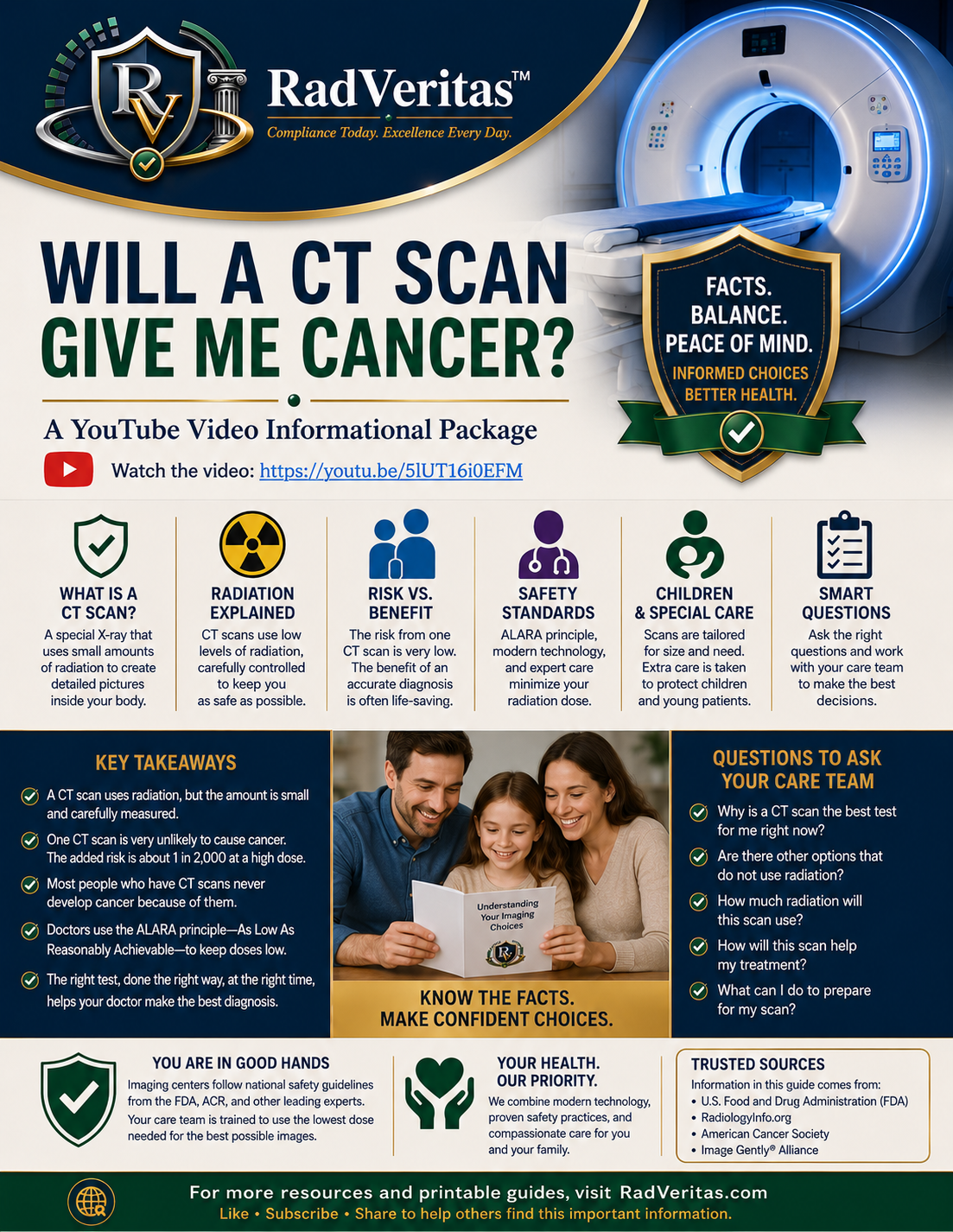
Get the Facts. Reduce the Fear. Make Informed Decisions.
If your doctor recommends a CT scan, it's normal to wonder, "Is the radiation safe?" or "Could this scan increase my cancer risk?"
The RadVeritas™ CT Scan Informational Package separates facts from myths using simple, easy-to-understand language backed by trusted medical guidance.
Created as a companion to the RadVeritas™ YouTube video, this guide explains why CT scans are performed, how radiation is carefully managed, what the actual risks are, and why the benefits often far outweigh the risks.
What You'll Learn
• How much radiation a CT scan uses
• Whether CT scans can increase cancer risk
• Why your doctor may recommend a CT scan
• How imaging teams keep radiation as low as possible
• What experts and national safety organizations recommend
• Common myths and the real facts
What's Included
✔ Easy-to-read patient guide
✔ Radiation risk explained in plain language
✔ CT safety facts and FAQs
✔ Medical expert insights
✔ Helpful illustrations and graphics
✔ Trusted healthcare references
✔ Companion guide to the RadVeritas™ YouTube video
Perfect For
• Patients and families
• Caregivers
• Anyone scheduled for a CT scan
• Healthcare waiting rooms
• Imaging centers
• Patient education programs
Why You'll Love It
Fear often comes from not knowing the facts. This guide helps you understand the real benefits and risks of CT imaging so you can feel informed, confident, and prepared to discuss your care with your healthcare provider.
Download today and discover the truth about CT scan radiation so you can make informed healthcare decisions with confidence.
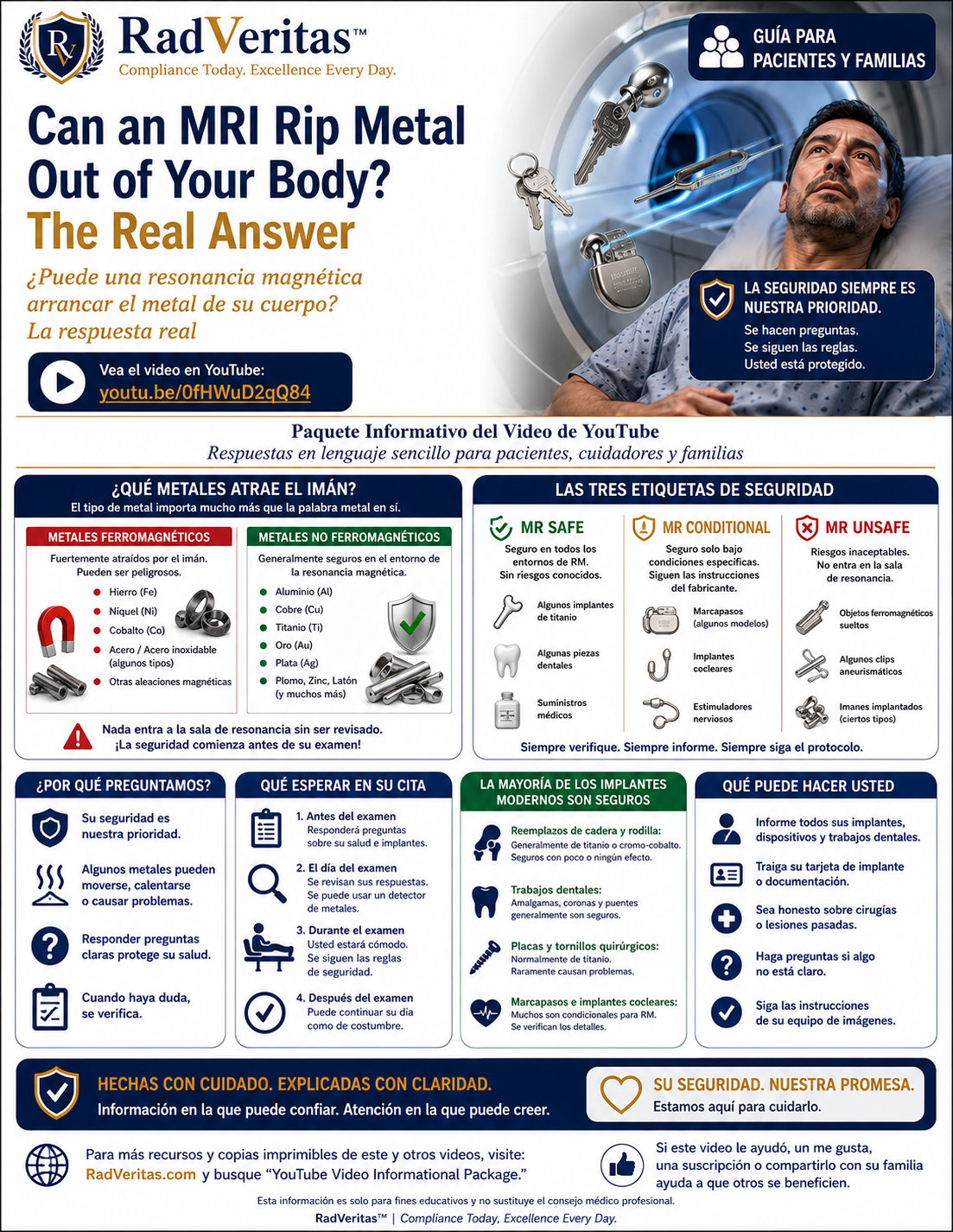
Usted tiene una cita para una resonancia magnética. Tiene un reemplazo de cadera, o un marcapasos, o trabajo dental, o un tatuaje, o el recuerdo de haber trabajado con metal en un taller hace años. Y en algún rincón de su mente está esa historia que escuchó alguna vez sobre un imán que atrajo un tanque de metal a través de una sala.
Entonces hace la pregunta. ¿Puede una resonancia magnética arrancar el metal de su cuerpo?
Esta guía le da la respuesta real, con palabras que cualquiera puede entender, sin tácticas de miedo y sin lenguaje técnico. El imán de la resonancia es poderoso y está siempre encendido, incluso entre un paciente y otro. Pero solo atrae con fuerza ciertos metales, principalmente los que contienen hierro. La mayoría de los implantes modernos están hechos de materiales que el imán apenas afecta, y están anclados firmemente en el hueso o el tejido. Las historias dramáticas que ha escuchado casi siempre involucran objetos sueltos que alguien llevó a la sala por error, no implantes saliendo de los pacientes.
Adentro encontrará las respuestas a quince de las preguntas que los pacientes hacen con más frecuencia, una explicación honesta de lo que sí es motivo de cuidado y por qué, un recorrido por lo que sucede exactamente antes, durante y después de su examen, y una mirada en lenguaje sencillo a las reglas de seguridad y las inspecciones que lo protegen. También aprenderá cuáles preguntas vale la pena hacerle a su equipo de imágenes, y cuál es el papel que vale la pena buscar antes de salir de casa.
Se incluyen trece imágenes de página completa del video como páginas imprimibles. Imprima cualquiera de ellas y colóquela en el refrigerador, en la carpeta del cuidador o en su carpeta de citas.
Qué Incluye
• Un resumen en lenguaje sencillo que puede leer en dos minutos
• Quince preguntas respondidas, desde reemplazos de articulaciones y marcapasos hasta tatuajes, trabajo dental, joyas y fragmentos de metal
• Una explicación clara de las etiquetas MR Safe, MR Conditional y MR Unsafe que usa su equipo de imágenes
• Qué esperar antes, durante y después de su examen
• Cómo lo protegen las reglas federales, la acreditación y los profesionales capacitados
• Trece imágenes imprimibles de página completa del video, cada una con un pie de imagen en lenguaje sencillo
• Una historia realista de paciente que muestra cómo transcurre una cita de verdad
• Una lista de preguntas para hacerle a su equipo de imágenes
• Un glosario y una lista completa de fuentes confiables, con enlaces que funcionan
Para Quién Es
Para pacientes con una cita de resonancia magnética, especialmente si tienen un implante, un dispositivo médico, trabajo dental, tatuajes o un historial de trabajo con metal. Para cuidadores y familiares que quieren saber qué esperar. Para cualquier persona que haya pospuesto un examen por algo que leyó o escuchó.
Formatos
Disponible como documento de Microsoft Word totalmente editable y como PDF, en inglés y en español. Los cuatro archivos son suyos para descargar, imprimir y compartir.
Vea el Video
Esta guía acompaña al video de RadVeritas del mismo nombre. Véalo en nuestro canal de YouTube y conserve esta guía como su referencia imprimible. Vienen más videos y paquetes complementarios de RadVeritas en camino. Si le ayuda, considere darle me gusta al video, suscribirse y compartirlo con un familiar o amigo que tenga una resonancia próximamente. Encuentre más paquetes en RadVeritas.com bajo YouTube Video Informational Package.
Solo con Fines Educativos
Este material se proporciona únicamente con fines educativos. No constituye consejo médico y no crea una relación entre proveedor y paciente. Consulte siempre a sus propios proveedores de salud calificados para obtener orientación específica sobre su situación, sus implantes y sus dispositivos médicos.
Esta traducción se ofrece para facilitar la comprensión. En caso de cualquier diferencia, prevalece la versión original en inglés.
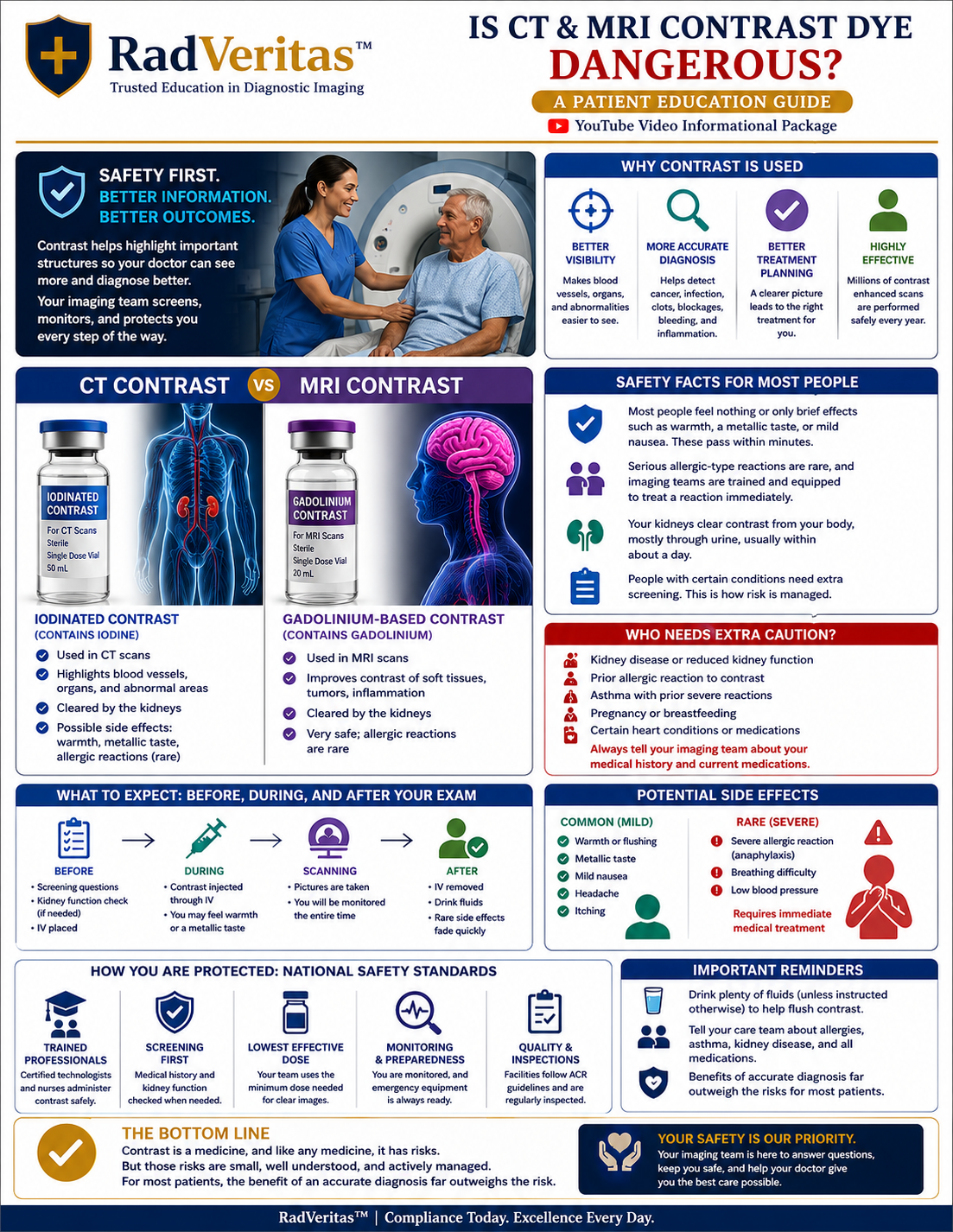
Get the facts before your exam. Feel confident about your care.
Contrast dye helps doctors see important details that may not be visible on regular CT or MRI images. This easy-to-understand guide explains why contrast is used, how it works, possible side effects, who may need extra precautions, and what to expect before, during, and after your exam. Learn the facts, separate myths from reality, and make informed decisions with confidence.
Perfect For: Patients, caregivers, and families preparing for a CT or MRI exam who want clear, reliable answers about contrast dye, safety, and what to expect.
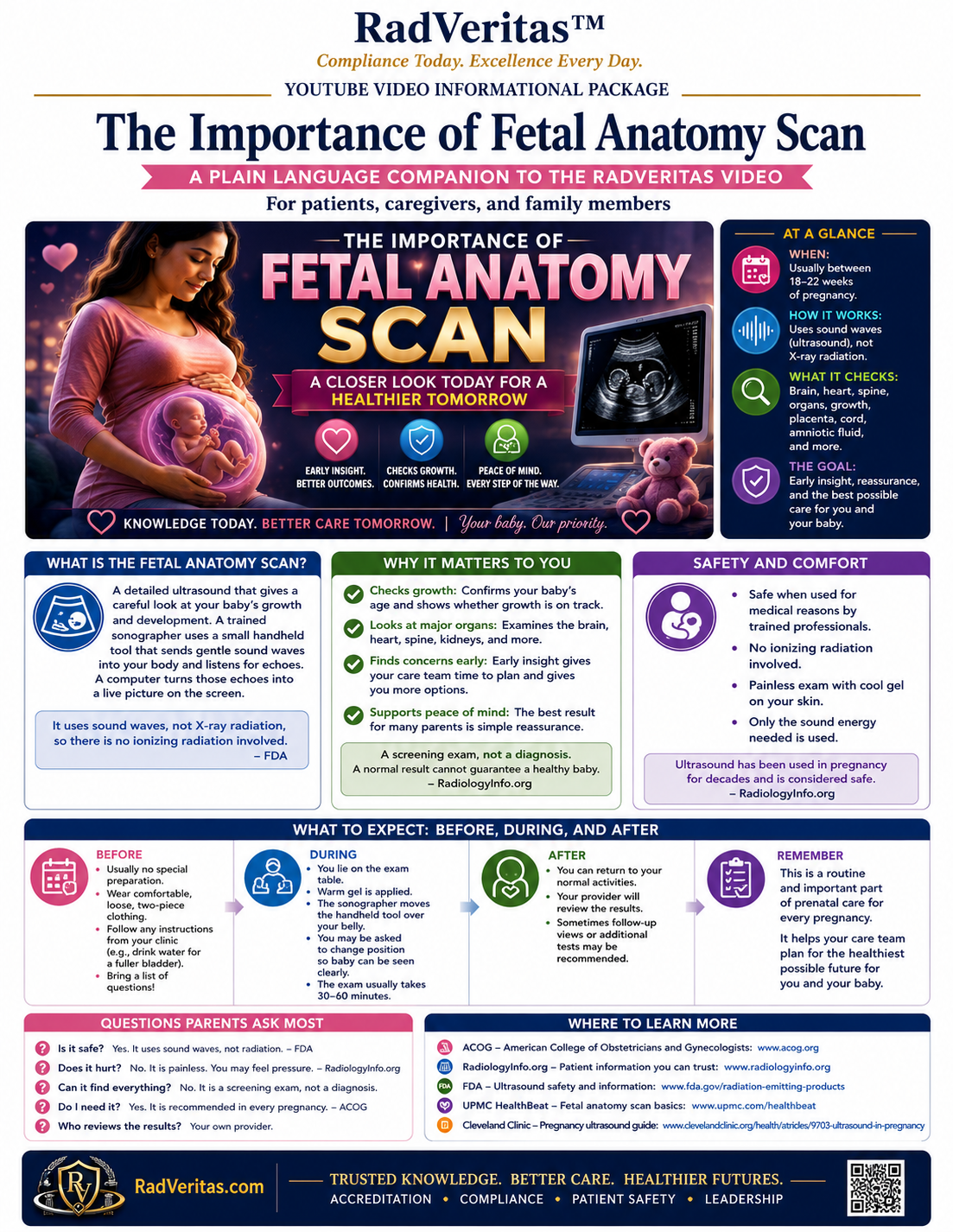
Helping You Understand One of Pregnancy's Most Important Ultrasounds
Your baby's anatomy scan is one of the most important milestones during pregnancy, but many parents don't know what to expect or why it's performed.
The RadVeritas™ Fetal Anatomy Scan Informational Package explains the exam in clear, easy-to-understand language so you can feel informed, prepared, and confident every step of the way.
Created as a companion to the RadVeritas™ YouTube video, this guide explains how the anatomy scan helps evaluate your baby's growth, development, and overall health while answering the questions parents ask most.
What You'll Learn
• What a fetal anatomy scan is and why it matters
• What the sonographer looks for during the exam
• What happens before, during, and after your appointment
• Why ultrasound is safe for you and your baby
• What your results may mean
• Common questions answered in simple language
What's Included
✔ Easy-to-read patient guide
✔ Step-by-step exam overview
✔ Pregnancy ultrasound safety information
✔ Frequently asked questions
✔ Helpful illustrations and graphics
✔ Trusted medical resources
✔ Companion guide to the RadVeritas™ YouTube video
Perfect For
• Expectant parents
• Family members and caregivers
• First-time parents
• Obstetric and imaging practices
• Childbirth education programs
Why You'll Love It
Knowing what to expect can make pregnancy less stressful. This guide helps you understand your baby's anatomy scan, prepares you for your appointment, and gives you the confidence to ask informed questions about your care.
Download today and feel informed, prepared, and confident before your baby's anatomy scan.
The Real Answer
It's one of the most common fears people have before an MRI. Can the powerful magnet pull metal out of your body? The answer is more reassuring than most people expect.
Can an MRI Rip Metal Out of Your Body? separates fact from fiction using clear, easy-to-understand language backed by trusted medical sources. You'll learn how MRI safety really works, which metal implants are safe, which require special precautions, and why your MRI screening is one of the most important parts of your visit.
Whether you have a joint replacement, surgical clips, dental work, or another implanted device, this guide helps you understand what matters and what doesn't, so you can walk into your MRI with confidence instead of fear.
What You'll Learn
Whether an MRI can actually move metal inside your body.
Which implants are MRI Safe, MRI Conditional, or require additional review.
Why MRI screening questions are so important.
What to expect before, during, and after your MRI.
Common myths about metal and MRI explained with facts.
The questions you should ask your imaging team before your exam.
Perfect For
Patients preparing for an MRI.
People with implants, surgical hardware, or medical devices.
Family members and caregivers.
Anyone who wants trustworthy answers about MRI safety.
Why You'll Love It
Written in simple language with no confusing medical jargon.
Replaces fear with clear, evidence-based facts.
Explains MRI safety in a way anyone can understand.
Includes practical guidance you can use before your appointment.
Based on trusted medical organizations and current MRI safety practices.
Don't let myths keep you from getting the care you need. Discover the real science behind MRI safety, understand how imaging professionals protect every patient, and approach your MRI with confidence, knowledge, and peace of mind.
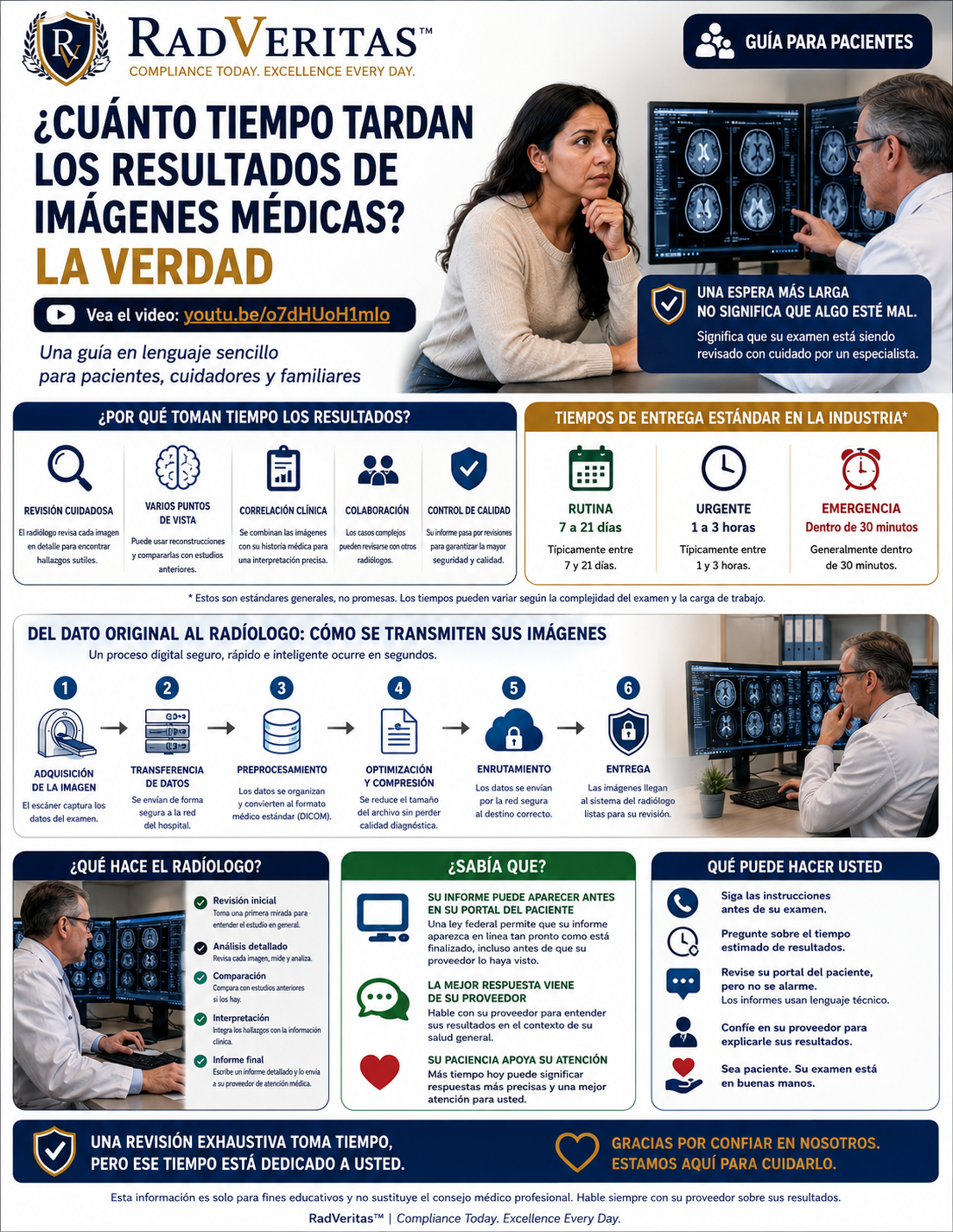
Esperar los resultados de imágenes es una de las partes más difíciles de cualquier radiografía, tomografía (CT), resonancia magnética (MRI) o ultrasonido. Los minutos se sienten como horas, y es fácil temer que una demora signifique malas noticias. Casi nunca es así. Esta guía completa, que acompaña al video de RadVeritas, le muestra con palabras sencillas y cotidianas exactamente qué pasa con sus imágenes después del examen y por qué una revisión cuidadosa toma tiempo.
En su interior, usted seguirá el recorrido seguro de sus imágenes desde el escáner hasta el radiólogo, el médico especialista que estudia cada imagen y escribe su informe. Aprenderá por qué los exámenes de rutina pueden tardar días mientras que los urgentes se leen en minutos, por qué su informe puede aparecer en su portal del paciente antes de que su médico lo llame, y qué significa todo esto para usted.
Qué incluye
• Un resumen de una página en lenguaje sencillo que puede leer en un minuto
• Catorce respuestas honestas a las preguntas que los pacientes realmente hacen sobre los tiempos de sus resultados
• Una guía simple para el antes, el durante y el después de la espera
• Una explicación amigable de las leyes federales, los estándares profesionales y las reglas de acreditación que lo protegen
• Las seis láminas visuales del video, formateadas como páginas completas para imprimir, con leyendas en español en lenguaje sencillo
• Una historia realista de la espera de una paciente, desde el examen hasta las respuestas
• Una lista para llevar con preguntas para su equipo de imagenología
• Un glosario que convierte palabras de los informes como STAT, PACS y unremarkable en español claro
• Referencias con enlaces a fuentes confiables como la FDA, HHS, el American College of Radiology y RadiologyInfo.org, incluyendo recursos en español
Para quién es
Para pacientes, cuidadores y familiares sin formación médica. Si usted o alguien que quiere está esperando resultados de imágenes en este momento, esta guía reemplaza la preocupación con hechos. También es un material útil para departamentos de imágenes, clínicas y programas de educación para pacientes. Nota: el texto dentro de las imágenes del video está en inglés; todas las explicaciones y leyendas de la guía están en español.
Cómo obtenerla
Vea el video en youtu.be/o7dHUoH1mIo y después descargue el paquete completo aquí en RadVeritas.com, en la sección YouTube Video Informational Package. Disponible en inglés y en español, en Word y PDF, y listo para imprimir. Vienen más videos y paquetes de RadVeritas en camino.

Build the regulatory habits that prevent patient identification errors, strengthen documentation, and improve survey readiness. This 1.5 Category A continuing education course equips radiologic technologists and imaging leaders with practical guidance on Joint Commission patient identification standards, CMS competency validation, HIPAA, infection prevention, equipment safety, and accreditation expectations. Through real-world case studies and scenario-based learning, participants gain the knowledge and confidence to reduce compliance risk, enhance patient safety, and achieve continuous readiness for CMS, ACR, Joint Commission, and state inspections.