 Image 1 of 1
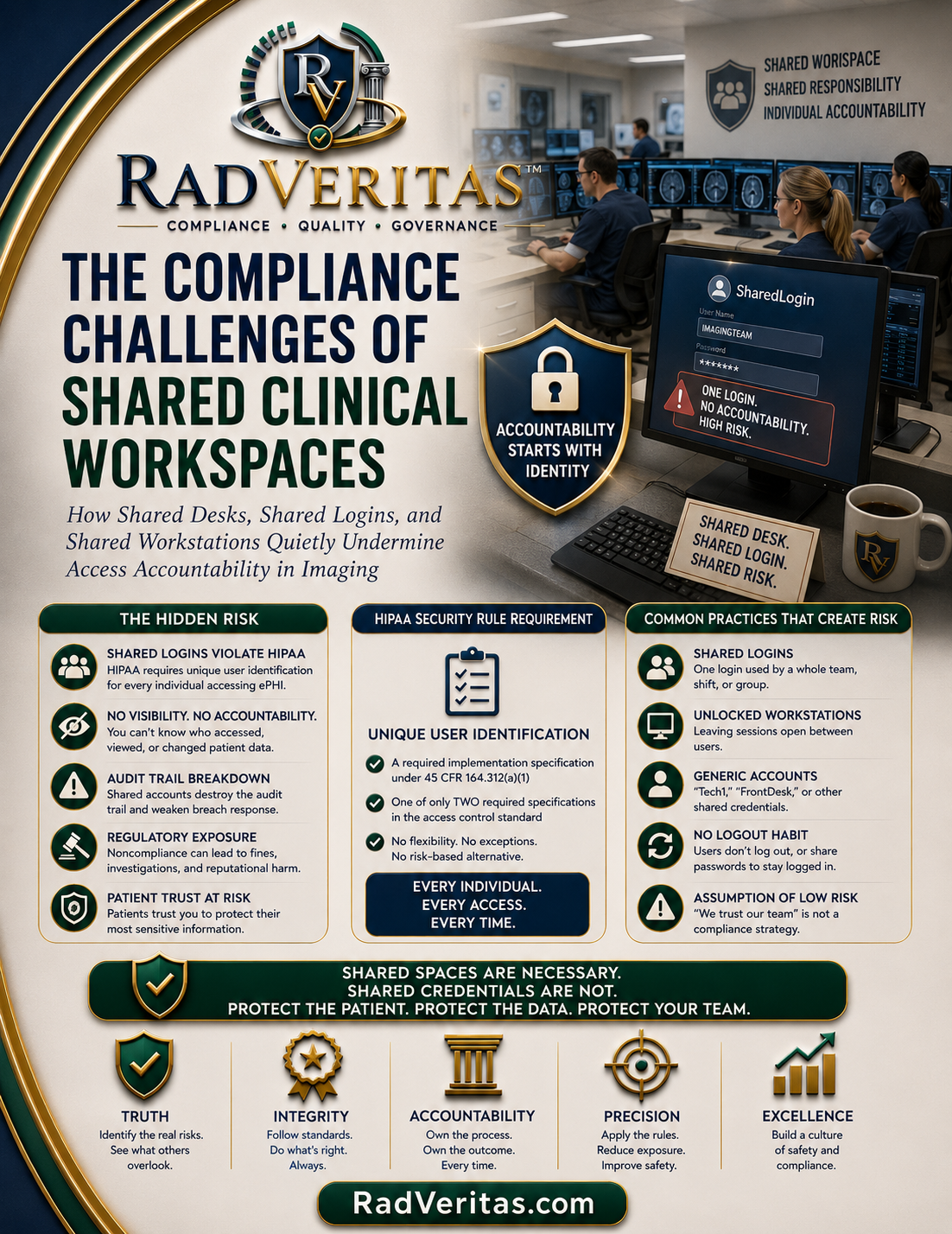
The Compliance Challenges of Shared Clinical Workspaces™
Shared Workspaces Require Shared Responsibility. Never Shared Accountability.
The Executive Guide to Securing Shared Clinical Environments Through Identity Management, Access Control, and Regulatory Compliance.
Diagnostic imaging departments depend on collaboration. Shared workstations, centralized reading rooms, modality consoles, and high-volume clinical workspaces enable teams to deliver efficient patient care around the clock.
Yet one of the most common operational practices in healthcare continues to undermine compliance, cybersecurity, and patient safety: shared user accounts, shared passwords, unlocked workstations, and undocumented system access.
What begins as a workflow shortcut can quickly become a regulatory finding, a security breach, or an investigation that no organization can defend.
The Compliance Challenges of Shared Clinical Workspaces™ provides healthcare leaders with a comprehensive governance framework for strengthening user accountability, protecting electronic protected health information (ePHI), and building secure, compliant imaging environments where every action is attributable to an individual user.
Why This Resource Matters
Every access to patient information must be traceable to a single individual.
When multiple employees share credentials or leave workstations unlocked, organizations lose the ability to determine who viewed, modified, transmitted, or deleted sensitive information.
The result is weakened audit trails, compromised investigations, increased cybersecurity exposure, and significant regulatory risk.
This executive guide helps healthcare organizations eliminate shared-access vulnerabilities while improving operational efficiency, security, and accountability.
What Makes This Resource Different
Unlike general cybersecurity resources, this guide focuses specifically on the operational realities of diagnostic imaging departments, where multiple users frequently share clinical workspaces, modality consoles, reading stations, and patient care environments.
It combines regulatory intelligence with practical operational guidance to help organizations implement secure identity management without disrupting clinical workflow.
The framework applies across:
MRI
CT
Ultrasound
Nuclear Medicine
PET/CT
Mammography
Radiography
Interventional Radiology
Radiation Oncology
Reading Rooms
Imaging Control Rooms
Enterprise Imaging Networks
Multi-site Health Systems
Comprehensive Topics Covered
Unique User Identification
Understand why individual user credentials are fundamental to regulatory compliance, audit integrity, cybersecurity, and organizational accountability.
Shared Workspace Governance
Develop standardized policies for workstation use, user authentication, session management, and secure access across shared clinical environments.
Access Control and Identity Management
Strengthen authentication practices through role-based access, user provisioning, password management, session controls, and account oversight.
Audit Trail Integrity
Protect the integrity of electronic audit logs by ensuring every system activity can be attributed to a uniquely identified individual.
Leadership Accountability
Establish governance structures that support ongoing monitoring, auditing, education, corrective actions, and continuous compliance improvement.
Key Risks Addressed
The guide helps organizations identify and reduce risks associated with:
✔ Shared usernames and passwords
✔ Generic departmental accounts
✔ Unlocked workstations
✔ Incomplete audit trails
✔ Unauthorized access to ePHI
✔ Weak identity management
✔ Cybersecurity vulnerabilities
✔ HIPAA Security Rule deficiencies
✔ Regulatory investigations
✔ Accreditation findings
✔ Insider security threats
✔ Organizational liability
Practical Resources Included
This executive guide provides actionable tools to help organizations:
Assess shared workspace risks
Eliminate shared login practices
Develop secure access policies
Strengthen user authentication processes
Standardize workstation security procedures
Improve password management practices
Conduct access control audits
Train staff on identity accountability
Investigate security incidents
Develop corrective action plans
Monitor compliance through continuous auditing and leadership oversight
Designed For
Ideal for:
Diagnostic Imaging Directors
Radiology Administrators
Chief Information Security Officers
Compliance Officers
HIPAA Security Officers
Enterprise Imaging Leaders
Information Technology Teams
Cybersecurity Professionals
Risk Management Leaders
Accreditation Coordinators
Imaging Managers and Supervisors
Executive Healthcare Leadership
Organizational Benefits
Strengthen HIPAA Compliance
Support compliance with the HIPAA Security Rule by implementing secure identity management, individual accountability, and effective access controls.
Improve Cybersecurity
Reduce the risk of unauthorized access, insider threats, credential misuse, and security breaches through standardized authentication practices.
Protect Patient Information
Ensure electronic protected health information is accessed only by authorized individuals with fully traceable user activity.
Preserve Audit Integrity
Maintain accurate, defensible audit trails that support investigations, regulatory reviews, and organizational accountability.
Standardize Enterprise Access Controls
Create consistent authentication and workstation security practices across every imaging modality and clinical location.
Build a Culture of Accountability
Reinforce the principle that every access, every action, and every decision within the clinical information system belongs to an individually identifiable user.
Built for Modern Diagnostic Imaging Operations
Shared workspaces are essential to efficient healthcare delivery. Shared credentials are not.
Whether strengthening cybersecurity, preparing for accreditation surveys, improving HIPAA compliance, or modernizing enterprise identity management, The Compliance Challenges of Shared Clinical Workspaces™ provides the practical guidance needed to secure clinical environments without compromising workflow or patient care.
Accountability Begins with Identity.
When organizations cannot identify who accessed patient information, they cannot confidently demonstrate compliance, investigate incidents, or defend their security practices.
The Compliance Challenges of Shared Clinical Workspaces™ helps healthcare leaders establish secure identity management, preserve audit integrity, and build a culture where accountability is embedded into every clinical workflow.
Secure Every Login. Protect Every Patient.
Reduce cybersecurity risk. Strengthen compliance. Preserve accountability. Build resilient clinical workspaces.
RadVeritas™
Compliance • Quality • Governance
Compliance Today. Excellence Every Day.
Expert Insights. Practical Solutions. Real-World Impact.
Helping Diagnostic Imaging Leaders Strengthen Identity Management, Protect Electronic Health Information, Improve Cybersecurity, and Build Secure, Accountable Clinical Workspaces.
Shared Workspaces Require Shared Responsibility. Never Shared Accountability.
The Executive Guide to Securing Shared Clinical Environments Through Identity Management, Access Control, and Regulatory Compliance.
Diagnostic imaging departments depend on collaboration. Shared workstations, centralized reading rooms, modality consoles, and high-volume clinical workspaces enable teams to deliver efficient patient care around the clock.
Yet one of the most common operational practices in healthcare continues to undermine compliance, cybersecurity, and patient safety: shared user accounts, shared passwords, unlocked workstations, and undocumented system access.
What begins as a workflow shortcut can quickly become a regulatory finding, a security breach, or an investigation that no organization can defend.
The Compliance Challenges of Shared Clinical Workspaces™ provides healthcare leaders with a comprehensive governance framework for strengthening user accountability, protecting electronic protected health information (ePHI), and building secure, compliant imaging environments where every action is attributable to an individual user.
Why This Resource Matters
Every access to patient information must be traceable to a single individual.
When multiple employees share credentials or leave workstations unlocked, organizations lose the ability to determine who viewed, modified, transmitted, or deleted sensitive information.
The result is weakened audit trails, compromised investigations, increased cybersecurity exposure, and significant regulatory risk.
This executive guide helps healthcare organizations eliminate shared-access vulnerabilities while improving operational efficiency, security, and accountability.
What Makes This Resource Different
Unlike general cybersecurity resources, this guide focuses specifically on the operational realities of diagnostic imaging departments, where multiple users frequently share clinical workspaces, modality consoles, reading stations, and patient care environments.
It combines regulatory intelligence with practical operational guidance to help organizations implement secure identity management without disrupting clinical workflow.
The framework applies across:
MRI
CT
Ultrasound
Nuclear Medicine
PET/CT
Mammography
Radiography
Interventional Radiology
Radiation Oncology
Reading Rooms
Imaging Control Rooms
Enterprise Imaging Networks
Multi-site Health Systems
Comprehensive Topics Covered
Unique User Identification
Understand why individual user credentials are fundamental to regulatory compliance, audit integrity, cybersecurity, and organizational accountability.
Shared Workspace Governance
Develop standardized policies for workstation use, user authentication, session management, and secure access across shared clinical environments.
Access Control and Identity Management
Strengthen authentication practices through role-based access, user provisioning, password management, session controls, and account oversight.
Audit Trail Integrity
Protect the integrity of electronic audit logs by ensuring every system activity can be attributed to a uniquely identified individual.
Leadership Accountability
Establish governance structures that support ongoing monitoring, auditing, education, corrective actions, and continuous compliance improvement.
Key Risks Addressed
The guide helps organizations identify and reduce risks associated with:
✔ Shared usernames and passwords
✔ Generic departmental accounts
✔ Unlocked workstations
✔ Incomplete audit trails
✔ Unauthorized access to ePHI
✔ Weak identity management
✔ Cybersecurity vulnerabilities
✔ HIPAA Security Rule deficiencies
✔ Regulatory investigations
✔ Accreditation findings
✔ Insider security threats
✔ Organizational liability
Practical Resources Included
This executive guide provides actionable tools to help organizations:
Assess shared workspace risks
Eliminate shared login practices
Develop secure access policies
Strengthen user authentication processes
Standardize workstation security procedures
Improve password management practices
Conduct access control audits
Train staff on identity accountability
Investigate security incidents
Develop corrective action plans
Monitor compliance through continuous auditing and leadership oversight
Designed For
Ideal for:
Diagnostic Imaging Directors
Radiology Administrators
Chief Information Security Officers
Compliance Officers
HIPAA Security Officers
Enterprise Imaging Leaders
Information Technology Teams
Cybersecurity Professionals
Risk Management Leaders
Accreditation Coordinators
Imaging Managers and Supervisors
Executive Healthcare Leadership
Organizational Benefits
Strengthen HIPAA Compliance
Support compliance with the HIPAA Security Rule by implementing secure identity management, individual accountability, and effective access controls.
Improve Cybersecurity
Reduce the risk of unauthorized access, insider threats, credential misuse, and security breaches through standardized authentication practices.
Protect Patient Information
Ensure electronic protected health information is accessed only by authorized individuals with fully traceable user activity.
Preserve Audit Integrity
Maintain accurate, defensible audit trails that support investigations, regulatory reviews, and organizational accountability.
Standardize Enterprise Access Controls
Create consistent authentication and workstation security practices across every imaging modality and clinical location.
Build a Culture of Accountability
Reinforce the principle that every access, every action, and every decision within the clinical information system belongs to an individually identifiable user.
Built for Modern Diagnostic Imaging Operations
Shared workspaces are essential to efficient healthcare delivery. Shared credentials are not.
Whether strengthening cybersecurity, preparing for accreditation surveys, improving HIPAA compliance, or modernizing enterprise identity management, The Compliance Challenges of Shared Clinical Workspaces™ provides the practical guidance needed to secure clinical environments without compromising workflow or patient care.
Accountability Begins with Identity.
When organizations cannot identify who accessed patient information, they cannot confidently demonstrate compliance, investigate incidents, or defend their security practices.
The Compliance Challenges of Shared Clinical Workspaces™ helps healthcare leaders establish secure identity management, preserve audit integrity, and build a culture where accountability is embedded into every clinical workflow.
Secure Every Login. Protect Every Patient.
Reduce cybersecurity risk. Strengthen compliance. Preserve accountability. Build resilient clinical workspaces.
RadVeritas™
Compliance • Quality • Governance
Compliance Today. Excellence Every Day.
Expert Insights. Practical Solutions. Real-World Impact.
Helping Diagnostic Imaging Leaders Strengthen Identity Management, Protect Electronic Health Information, Improve Cybersecurity, and Build Secure, Accountable Clinical Workspaces.