 Image 1 of 1
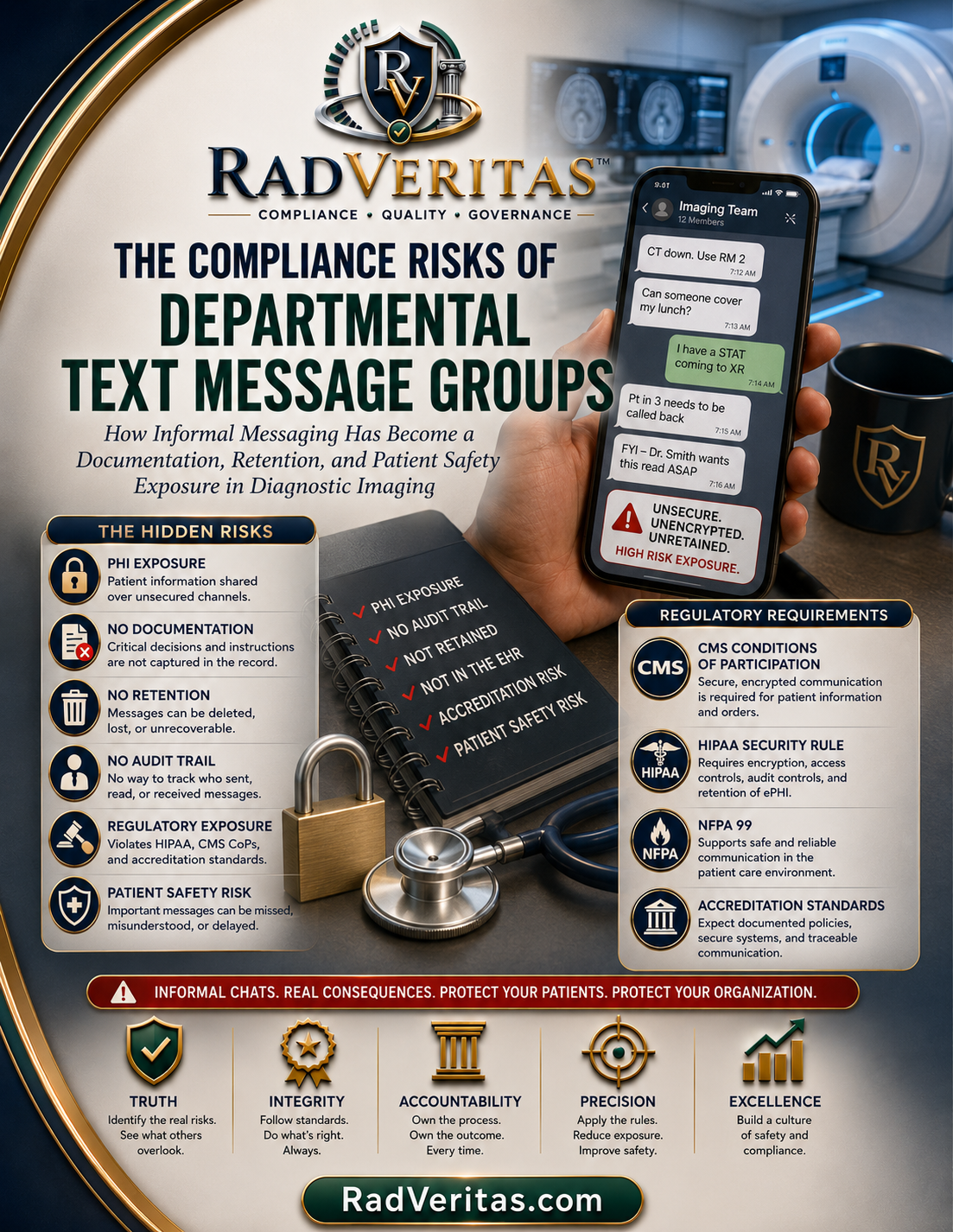
The Compliance Risks of Departmental Text Message Groups™
How Informal Messaging Creates Documentation, Retention, Privacy, and Patient Safety Risk in Diagnostic Imaging
Protect Patient Information. Preserve Critical Decisions. Strengthen Regulatory Compliance.
Departmental text message groups have become one of the most widely used communication tools in healthcare. While they offer speed and convenience, they often operate outside approved clinical communication systems, creating significant risks for patient privacy, documentation integrity, regulatory compliance, and patient safety.
The Compliance Risks of Departmental Text Message Groups™ equips healthcare leaders with the knowledge and practical strategies needed to identify, govern, and eliminate one of the most common yet least recognized compliance vulnerabilities in modern diagnostic imaging operations.
Developed for healthcare executives, diagnostic imaging leaders, compliance professionals, information security teams, privacy officers, and accreditation coordinators, this executive resource provides an enterprise framework for replacing informal messaging with secure, compliant, and defensible communication practices.
Why This Resource Matters
Every day, healthcare teams exchange time-sensitive information through group text messages.
Patient updates, workflow changes, staffing requests, physician instructions, critical results, and operational decisions are often communicated using consumer messaging platforms that were never designed for regulated healthcare environments.
Without proper governance, organizations may face:
Unauthorized disclosure of Protected Health Information (PHI)
HIPAA Privacy and Security Rule violations
Missing clinical documentation
No legal record of critical communications
No audit trail for decision-making
Inconsistent message retention
Lost or deleted communications
Accreditation deficiencies
Patient safety events
Increased legal and financial liability
This guide demonstrates why informal text messaging should be treated as an enterprise governance issue rather than simply a communication preference.
What Makes This Resource Different
Most organizations recognize the importance of secure messaging but underestimate the operational and regulatory consequences of informal departmental text groups.
This executive resource examines messaging practices through the combined perspectives of:
HIPAA compliance
CMS Conditions of Participation
Accreditation readiness
Patient safety
Information governance
Health information management
Cybersecurity
Legal defensibility
Enterprise risk management
Rather than focusing solely on technology, it provides leadership strategies for creating sustainable communication governance across diagnostic imaging operations.
Key Topics Covered
Secure Clinical Communication
Understand the regulatory expectations for communicating patient information through approved, encrypted, and monitored platforms.
Documentation Integrity
Learn why critical clinical decisions, physician instructions, patient updates, and operational communications must be appropriately documented and retained.
Privacy and Confidentiality
Identify how informal messaging increases the risk of unauthorized disclosure, unsecured transmission, and accidental sharing of Protected Health Information.
Audit Trails and Record Retention
Develop communication systems that provide traceable records, accountability, and defensible documentation during audits, investigations, and litigation.
Patient Safety
Recognize how missed, delayed, deleted, or misunderstood text messages can contribute to communication failures that directly affect patient care.
Leadership Governance
Establish organizational policies governing messaging platforms, user responsibilities, retention standards, monitoring, and accountability.
Key Risks Addressed
This executive resource helps organizations identify and mitigate risks associated with:
✔ Informal departmental group text messages
✔ Unsecured communication platforms
✔ Protected Health Information (PHI) exposure
✔ Missing clinical documentation
✔ Lack of audit trails
✔ Message deletion and data loss
✔ Inadequate record retention
✔ HIPAA Privacy and Security Rule violations
✔ Accreditation deficiencies
✔ CMS Conditions of Participation compliance
✔ Patient safety communication failures
✔ Legal and regulatory liability
Practical Leadership Strategies
The guide provides actionable recommendations to help healthcare organizations:
Develop enterprise policies governing electronic communications
Transition from consumer messaging platforms to secure clinical communication systems
Standardize documentation expectations for operational and clinical communications
Implement retention and audit trail requirements
Strengthen privacy and cybersecurity safeguards
Educate staff on regulatory responsibilities for electronic communication
Conduct communication risk assessments
Monitor compliance through routine audits and leadership oversight
Integrate messaging governance into quality improvement and patient safety initiatives
Build a culture of accountability where communication is secure, documented, and defensible
Designed For
Ideal for:
Diagnostic Imaging Directors
Radiology Administrators
Hospital Executives
Compliance Officers
HIPAA Privacy Officers
Information Security Leaders
Health Information Management Professionals
Risk Management Leaders
Accreditation Coordinators
Patient Safety Officers
Imaging Supervisors
Quality Improvement Professionals
Clinical Informatics Teams
Healthcare Legal and Governance Leaders
Organizational Benefits
Protect Patient Privacy
Reduce the risk of unauthorized disclosure of Protected Health Information by implementing secure communication practices.
Strengthen Regulatory Compliance
Align messaging practices with HIPAA requirements, CMS Conditions of Participation, accreditation standards, and organizational policies.
Improve Documentation Integrity
Ensure critical clinical and operational communications are properly documented, retained, and available when needed.
Enhance Patient Safety
Reduce communication failures that contribute to delays, misunderstandings, missed follow-up, and preventable patient harm.
Improve Organizational Defensibility
Establish complete audit trails, reliable record retention, and documented communication processes that support investigations, surveys, and legal proceedings.
Build Enterprise Communication Governance
Create standardized, organization-wide communication practices that improve accountability, operational consistency, and leadership oversight.
Built for Modern Healthcare Organizations
Fast communication should never come at the expense of patient safety or regulatory compliance.
As healthcare organizations become increasingly dependent on mobile technology, communication governance must evolve to ensure every message involving patient care is secure, traceable, appropriately retained, and operationally defensible.
The Compliance Risks of Departmental Text Message Groups™ provides the framework, policies, and leadership strategies needed to transform informal messaging into a secure, compliant communication ecosystem.
Every Message Matters
A single unsecured text message can expose Protected Health Information, compromise patient safety, undermine documentation integrity, and create significant regulatory liability.
The Compliance Risks of Departmental Text Message Groups™ helps healthcare leaders establish communication systems that protect patients, strengthen compliance, and support operational excellence through secure, accountable, and well-governed messaging practices.
Replace Informal Messaging with Enterprise Communication Governance.
Protect patient information. Preserve critical decisions. Reduce regulatory risk. Strengthen organizational accountability.
RadVeritas™
Compliance • Quality • Governance
Compliance Today. Excellence Every Day.
Expert Insights. Practical Solutions. Real-World Impact.
Helping Healthcare Organizations Build Secure Communication Systems That Protect Patient Privacy, Strengthen Documentation Integrity, Improve Patient Safety, and Achieve Sustainable Regulatory Compliance.
How Informal Messaging Creates Documentation, Retention, Privacy, and Patient Safety Risk in Diagnostic Imaging
Protect Patient Information. Preserve Critical Decisions. Strengthen Regulatory Compliance.
Departmental text message groups have become one of the most widely used communication tools in healthcare. While they offer speed and convenience, they often operate outside approved clinical communication systems, creating significant risks for patient privacy, documentation integrity, regulatory compliance, and patient safety.
The Compliance Risks of Departmental Text Message Groups™ equips healthcare leaders with the knowledge and practical strategies needed to identify, govern, and eliminate one of the most common yet least recognized compliance vulnerabilities in modern diagnostic imaging operations.
Developed for healthcare executives, diagnostic imaging leaders, compliance professionals, information security teams, privacy officers, and accreditation coordinators, this executive resource provides an enterprise framework for replacing informal messaging with secure, compliant, and defensible communication practices.
Why This Resource Matters
Every day, healthcare teams exchange time-sensitive information through group text messages.
Patient updates, workflow changes, staffing requests, physician instructions, critical results, and operational decisions are often communicated using consumer messaging platforms that were never designed for regulated healthcare environments.
Without proper governance, organizations may face:
Unauthorized disclosure of Protected Health Information (PHI)
HIPAA Privacy and Security Rule violations
Missing clinical documentation
No legal record of critical communications
No audit trail for decision-making
Inconsistent message retention
Lost or deleted communications
Accreditation deficiencies
Patient safety events
Increased legal and financial liability
This guide demonstrates why informal text messaging should be treated as an enterprise governance issue rather than simply a communication preference.
What Makes This Resource Different
Most organizations recognize the importance of secure messaging but underestimate the operational and regulatory consequences of informal departmental text groups.
This executive resource examines messaging practices through the combined perspectives of:
HIPAA compliance
CMS Conditions of Participation
Accreditation readiness
Patient safety
Information governance
Health information management
Cybersecurity
Legal defensibility
Enterprise risk management
Rather than focusing solely on technology, it provides leadership strategies for creating sustainable communication governance across diagnostic imaging operations.
Key Topics Covered
Secure Clinical Communication
Understand the regulatory expectations for communicating patient information through approved, encrypted, and monitored platforms.
Documentation Integrity
Learn why critical clinical decisions, physician instructions, patient updates, and operational communications must be appropriately documented and retained.
Privacy and Confidentiality
Identify how informal messaging increases the risk of unauthorized disclosure, unsecured transmission, and accidental sharing of Protected Health Information.
Audit Trails and Record Retention
Develop communication systems that provide traceable records, accountability, and defensible documentation during audits, investigations, and litigation.
Patient Safety
Recognize how missed, delayed, deleted, or misunderstood text messages can contribute to communication failures that directly affect patient care.
Leadership Governance
Establish organizational policies governing messaging platforms, user responsibilities, retention standards, monitoring, and accountability.
Key Risks Addressed
This executive resource helps organizations identify and mitigate risks associated with:
✔ Informal departmental group text messages
✔ Unsecured communication platforms
✔ Protected Health Information (PHI) exposure
✔ Missing clinical documentation
✔ Lack of audit trails
✔ Message deletion and data loss
✔ Inadequate record retention
✔ HIPAA Privacy and Security Rule violations
✔ Accreditation deficiencies
✔ CMS Conditions of Participation compliance
✔ Patient safety communication failures
✔ Legal and regulatory liability
Practical Leadership Strategies
The guide provides actionable recommendations to help healthcare organizations:
Develop enterprise policies governing electronic communications
Transition from consumer messaging platforms to secure clinical communication systems
Standardize documentation expectations for operational and clinical communications
Implement retention and audit trail requirements
Strengthen privacy and cybersecurity safeguards
Educate staff on regulatory responsibilities for electronic communication
Conduct communication risk assessments
Monitor compliance through routine audits and leadership oversight
Integrate messaging governance into quality improvement and patient safety initiatives
Build a culture of accountability where communication is secure, documented, and defensible
Designed For
Ideal for:
Diagnostic Imaging Directors
Radiology Administrators
Hospital Executives
Compliance Officers
HIPAA Privacy Officers
Information Security Leaders
Health Information Management Professionals
Risk Management Leaders
Accreditation Coordinators
Patient Safety Officers
Imaging Supervisors
Quality Improvement Professionals
Clinical Informatics Teams
Healthcare Legal and Governance Leaders
Organizational Benefits
Protect Patient Privacy
Reduce the risk of unauthorized disclosure of Protected Health Information by implementing secure communication practices.
Strengthen Regulatory Compliance
Align messaging practices with HIPAA requirements, CMS Conditions of Participation, accreditation standards, and organizational policies.
Improve Documentation Integrity
Ensure critical clinical and operational communications are properly documented, retained, and available when needed.
Enhance Patient Safety
Reduce communication failures that contribute to delays, misunderstandings, missed follow-up, and preventable patient harm.
Improve Organizational Defensibility
Establish complete audit trails, reliable record retention, and documented communication processes that support investigations, surveys, and legal proceedings.
Build Enterprise Communication Governance
Create standardized, organization-wide communication practices that improve accountability, operational consistency, and leadership oversight.
Built for Modern Healthcare Organizations
Fast communication should never come at the expense of patient safety or regulatory compliance.
As healthcare organizations become increasingly dependent on mobile technology, communication governance must evolve to ensure every message involving patient care is secure, traceable, appropriately retained, and operationally defensible.
The Compliance Risks of Departmental Text Message Groups™ provides the framework, policies, and leadership strategies needed to transform informal messaging into a secure, compliant communication ecosystem.
Every Message Matters
A single unsecured text message can expose Protected Health Information, compromise patient safety, undermine documentation integrity, and create significant regulatory liability.
The Compliance Risks of Departmental Text Message Groups™ helps healthcare leaders establish communication systems that protect patients, strengthen compliance, and support operational excellence through secure, accountable, and well-governed messaging practices.
Replace Informal Messaging with Enterprise Communication Governance.
Protect patient information. Preserve critical decisions. Reduce regulatory risk. Strengthen organizational accountability.
RadVeritas™
Compliance • Quality • Governance
Compliance Today. Excellence Every Day.
Expert Insights. Practical Solutions. Real-World Impact.
Helping Healthcare Organizations Build Secure Communication Systems That Protect Patient Privacy, Strengthen Documentation Integrity, Improve Patient Safety, and Achieve Sustainable Regulatory Compliance.