 Image 1 of 1
The Compliance Impact of Aging Department Signage™
Transform Department Signage from a Forgotten Maintenance Task into a Strategic Regulatory Compliance Program.
Because Yesterday's Compliant Sign May Be Today's Regulatory Deficiency.
Healthcare organizations invest significant resources in policies, procedures, equipment, and staff education, yet one of the most visible components of regulatory compliance is often overlooked.
Department signage.
Over time, regulations evolve, terminology changes, design standards are updated, and patient communication requirements expand. Signs that were fully compliant when installed may gradually become outdated, inconsistent, or inaccurate, creating unnecessary regulatory exposure and patient confusion.
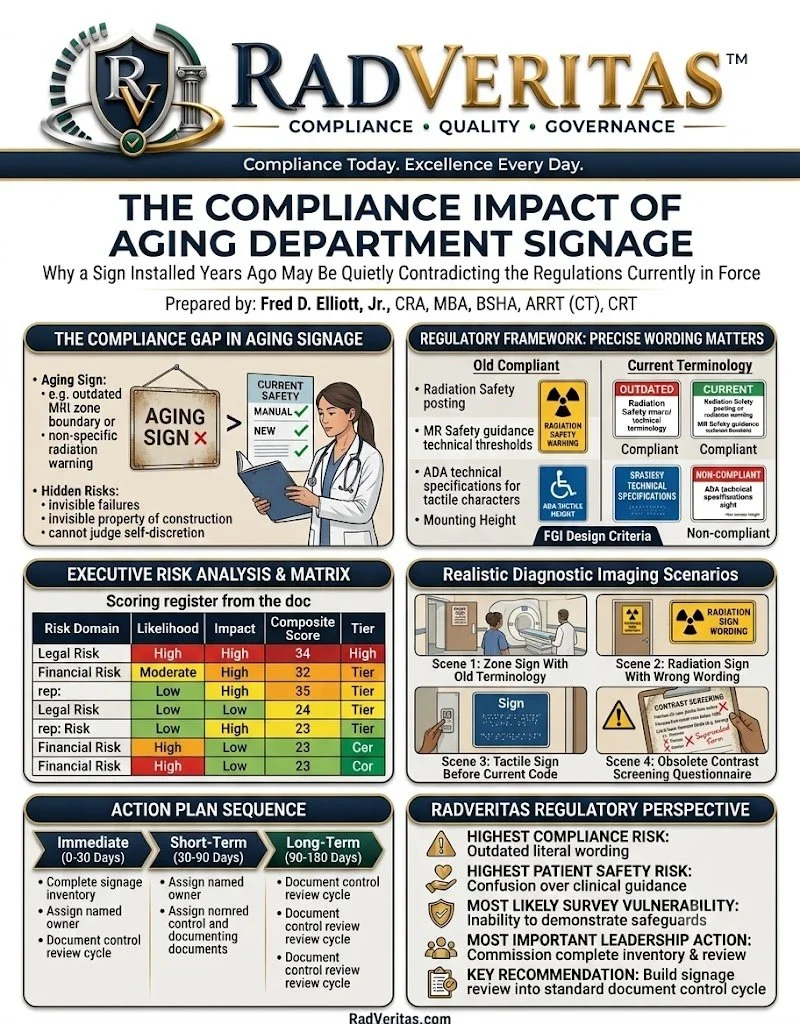
The Compliance Impact of Aging Department Signage™ provides healthcare leaders with a comprehensive governance framework for inventorying, evaluating, updating, and sustaining regulatory signage throughout diagnostic imaging departments and healthcare facilities.
This executive resource transforms signage management into a structured compliance program that strengthens patient safety, improves communication, and supports continuous survey readiness.
Why This Resource Matters
Every sign communicates organizational expectations.
Whether identifying MRI safety zones, radiation areas, restricted access, patient instructions, emergency exits, or departmental policies, signage serves as an extension of regulatory compliance and patient safety.
Without a structured signage governance program, organizations increase their exposure to:
Outdated regulatory terminology
Inconsistent safety messaging
Incorrect patient instructions
Obsolete warning signs
Accessibility deficiencies
Survey findings
Patient confusion
Operational inconsistency
Legal and regulatory liability
Documentation gaps
This resource helps organizations proactively identify and correct signage deficiencies before they become survey findings or patient safety concerns.
What Makes This Resource Different
Most organizations replace signs only when they become damaged or unreadable.
This guide treats signage as a controlled compliance document requiring routine review, standardized governance, and lifecycle management.
The framework integrates:
Regulatory Compliance
Accreditation Readiness
Environment of Care
Life Safety
Radiation Safety
MRI Safety
Patient Communication
Accessibility Standards
Facilities Management
Quality Improvement
Executive Oversight
The result is a sustainable signage governance program that evolves alongside changing regulatory requirements.
Comprehensive Topics Covered
Signage Inventory Management
Develop a centralized inventory of all departmental signage, including safety signs, regulatory postings, patient instructions, directional signs, and operational notices.
Regulatory Compliance Review
Evaluate signage against current federal, state, accreditation, accessibility, and organizational requirements to identify outdated terminology, obsolete references, and inconsistent messaging.
Patient Safety Communication
Ensure signage clearly communicates hazards, patient instructions, emergency procedures, and restricted access requirements using current standards and best practices.
Design and Accessibility Standards
Assess placement, visibility, readability, symbols, tactile features, language requirements, and accessibility considerations to improve communication for all patients and staff.
Document Control and Governance
Integrate signage into the organization's document control process with defined ownership, revision cycles, approval workflows, and version management.
Continuous Monitoring
Establish recurring audits, leadership walkthroughs, and performance indicators to maintain ongoing compliance and prevent signage from becoming outdated.
Key Risks Addressed
This guide helps organizations proactively reduce:
✔ Outdated regulatory terminology
✔ Incorrect safety messaging
✔ Obsolete patient instruction signs
✔ Inconsistent departmental communication
✔ Accessibility deficiencies
✔ Survey findings related to signage
✔ Patient confusion and misinformation
✔ Documentation and document control gaps
✔ Environmental compliance deficiencies
✔ Organizational liability associated with inaccurate postings
Practical Resources Included
This executive resource provides implementation-ready tools, including:
Department Signage Inventory Templates
Regulatory Signage Audit Checklists
Signage Risk Assessment Matrix
Document Control Procedures for Signage
Standardized Review and Approval Workflows
Accessibility Evaluation Checklists
Executive Walkthrough Guides
Corrective Action Plan Templates
Performance Monitoring Dashboards
Department Ownership Matrix
Annual Review Schedules
Continuous Compliance Audit Tools
Designed For
Ideal for:
Diagnostic Imaging Directors
Radiology Administrators
Facilities Management Leaders
Compliance Officers
Accreditation Coordinators
Radiation Safety Officers
MRI Safety Officers
Environment of Care Committees
Patient Safety Leaders
Quality Improvement Professionals
Risk Management Teams
Executive Healthcare Leadership
Organizational Benefits
Improve Regulatory Compliance
Maintain signage that accurately reflects current regulatory requirements, accreditation standards, and organizational policies.
Strengthen Patient Safety
Provide clear, consistent, and current information that supports safe patient care, informed decision-making, and hazard awareness.
Reduce Survey Findings
Identify and correct outdated signage before inspections, accreditation surveys, or regulatory reviews.
Standardize Communication
Ensure consistent messaging across hospitals, outpatient imaging centers, ambulatory facilities, and integrated health systems.
Enhance Operational Governance
Treat signage as a controlled compliance asset with defined ownership, review cycles, and documented accountability.
Build Continuous Readiness
Create a sustainable signage management program that supports long-term regulatory excellence rather than periodic replacement efforts.
Built for Modern Healthcare Organizations
Signs are more than wall decorations. They communicate expectations, reinforce safety practices, support regulatory compliance, and guide patients through complex healthcare environments.
Whether preparing for accreditation surveys, renovating imaging facilities, expanding services, or strengthening document control programs, The Compliance Impact of Aging Department Signage™ provides healthcare leaders with the tools needed to ensure every sign reflects current standards and organizational excellence.
Every Sign Tells a Story About Your Organization.
The most successful healthcare organizations understand that compliance extends beyond policies and procedures. It is visible in every patient-facing message, every safety warning, and every instruction displayed throughout the facility.
The Compliance Impact of Aging Department Signage™ helps healthcare organizations establish a proactive signage governance program that strengthens regulatory compliance, improves patient communication, reduces operational risk, and supports continuous accreditation readiness.
Current Signs. Clear Communication. Continuous Compliance.
Reduce risk. Improve consistency. Strengthen governance. Protect patients.
RadVeritas™
Compliance • Quality • Governance
Compliance Today. Excellence Every Day.
Expert Insights. Practical Solutions. Real-World Impact.
Helping Diagnostic Imaging Leaders Build Enterprise Signage Governance Programs That Strengthen Regulatory Compliance, Improve Patient Communication, Support Accreditation Readiness, and Sustain Operational Excellence Through Standardized Document Control and Continuous Review.
Transform Department Signage from a Forgotten Maintenance Task into a Strategic Regulatory Compliance Program.
Because Yesterday's Compliant Sign May Be Today's Regulatory Deficiency.
Healthcare organizations invest significant resources in policies, procedures, equipment, and staff education, yet one of the most visible components of regulatory compliance is often overlooked.
Department signage.
Over time, regulations evolve, terminology changes, design standards are updated, and patient communication requirements expand. Signs that were fully compliant when installed may gradually become outdated, inconsistent, or inaccurate, creating unnecessary regulatory exposure and patient confusion.
The Compliance Impact of Aging Department Signage™ provides healthcare leaders with a comprehensive governance framework for inventorying, evaluating, updating, and sustaining regulatory signage throughout diagnostic imaging departments and healthcare facilities.
This executive resource transforms signage management into a structured compliance program that strengthens patient safety, improves communication, and supports continuous survey readiness.
Why This Resource Matters
Every sign communicates organizational expectations.
Whether identifying MRI safety zones, radiation areas, restricted access, patient instructions, emergency exits, or departmental policies, signage serves as an extension of regulatory compliance and patient safety.
Without a structured signage governance program, organizations increase their exposure to:
Outdated regulatory terminology
Inconsistent safety messaging
Incorrect patient instructions
Obsolete warning signs
Accessibility deficiencies
Survey findings
Patient confusion
Operational inconsistency
Legal and regulatory liability
Documentation gaps
This resource helps organizations proactively identify and correct signage deficiencies before they become survey findings or patient safety concerns.
What Makes This Resource Different
Most organizations replace signs only when they become damaged or unreadable.
This guide treats signage as a controlled compliance document requiring routine review, standardized governance, and lifecycle management.
The framework integrates:
Regulatory Compliance
Accreditation Readiness
Environment of Care
Life Safety
Radiation Safety
MRI Safety
Patient Communication
Accessibility Standards
Facilities Management
Quality Improvement
Executive Oversight
The result is a sustainable signage governance program that evolves alongside changing regulatory requirements.
Comprehensive Topics Covered
Signage Inventory Management
Develop a centralized inventory of all departmental signage, including safety signs, regulatory postings, patient instructions, directional signs, and operational notices.
Regulatory Compliance Review
Evaluate signage against current federal, state, accreditation, accessibility, and organizational requirements to identify outdated terminology, obsolete references, and inconsistent messaging.
Patient Safety Communication
Ensure signage clearly communicates hazards, patient instructions, emergency procedures, and restricted access requirements using current standards and best practices.
Design and Accessibility Standards
Assess placement, visibility, readability, symbols, tactile features, language requirements, and accessibility considerations to improve communication for all patients and staff.
Document Control and Governance
Integrate signage into the organization's document control process with defined ownership, revision cycles, approval workflows, and version management.
Continuous Monitoring
Establish recurring audits, leadership walkthroughs, and performance indicators to maintain ongoing compliance and prevent signage from becoming outdated.
Key Risks Addressed
This guide helps organizations proactively reduce:
✔ Outdated regulatory terminology
✔ Incorrect safety messaging
✔ Obsolete patient instruction signs
✔ Inconsistent departmental communication
✔ Accessibility deficiencies
✔ Survey findings related to signage
✔ Patient confusion and misinformation
✔ Documentation and document control gaps
✔ Environmental compliance deficiencies
✔ Organizational liability associated with inaccurate postings
Practical Resources Included
This executive resource provides implementation-ready tools, including:
Department Signage Inventory Templates
Regulatory Signage Audit Checklists
Signage Risk Assessment Matrix
Document Control Procedures for Signage
Standardized Review and Approval Workflows
Accessibility Evaluation Checklists
Executive Walkthrough Guides
Corrective Action Plan Templates
Performance Monitoring Dashboards
Department Ownership Matrix
Annual Review Schedules
Continuous Compliance Audit Tools
Designed For
Ideal for:
Diagnostic Imaging Directors
Radiology Administrators
Facilities Management Leaders
Compliance Officers
Accreditation Coordinators
Radiation Safety Officers
MRI Safety Officers
Environment of Care Committees
Patient Safety Leaders
Quality Improvement Professionals
Risk Management Teams
Executive Healthcare Leadership
Organizational Benefits
Improve Regulatory Compliance
Maintain signage that accurately reflects current regulatory requirements, accreditation standards, and organizational policies.
Strengthen Patient Safety
Provide clear, consistent, and current information that supports safe patient care, informed decision-making, and hazard awareness.
Reduce Survey Findings
Identify and correct outdated signage before inspections, accreditation surveys, or regulatory reviews.
Standardize Communication
Ensure consistent messaging across hospitals, outpatient imaging centers, ambulatory facilities, and integrated health systems.
Enhance Operational Governance
Treat signage as a controlled compliance asset with defined ownership, review cycles, and documented accountability.
Build Continuous Readiness
Create a sustainable signage management program that supports long-term regulatory excellence rather than periodic replacement efforts.
Built for Modern Healthcare Organizations
Signs are more than wall decorations. They communicate expectations, reinforce safety practices, support regulatory compliance, and guide patients through complex healthcare environments.
Whether preparing for accreditation surveys, renovating imaging facilities, expanding services, or strengthening document control programs, The Compliance Impact of Aging Department Signage™ provides healthcare leaders with the tools needed to ensure every sign reflects current standards and organizational excellence.
Every Sign Tells a Story About Your Organization.
The most successful healthcare organizations understand that compliance extends beyond policies and procedures. It is visible in every patient-facing message, every safety warning, and every instruction displayed throughout the facility.
The Compliance Impact of Aging Department Signage™ helps healthcare organizations establish a proactive signage governance program that strengthens regulatory compliance, improves patient communication, reduces operational risk, and supports continuous accreditation readiness.
Current Signs. Clear Communication. Continuous Compliance.
Reduce risk. Improve consistency. Strengthen governance. Protect patients.
RadVeritas™
Compliance • Quality • Governance
Compliance Today. Excellence Every Day.
Expert Insights. Practical Solutions. Real-World Impact.
Helping Diagnostic Imaging Leaders Build Enterprise Signage Governance Programs That Strengthen Regulatory Compliance, Improve Patient Communication, Support Accreditation Readiness, and Sustain Operational Excellence Through Standardized Document Control and Continuous Review.