 Image 1 of 1
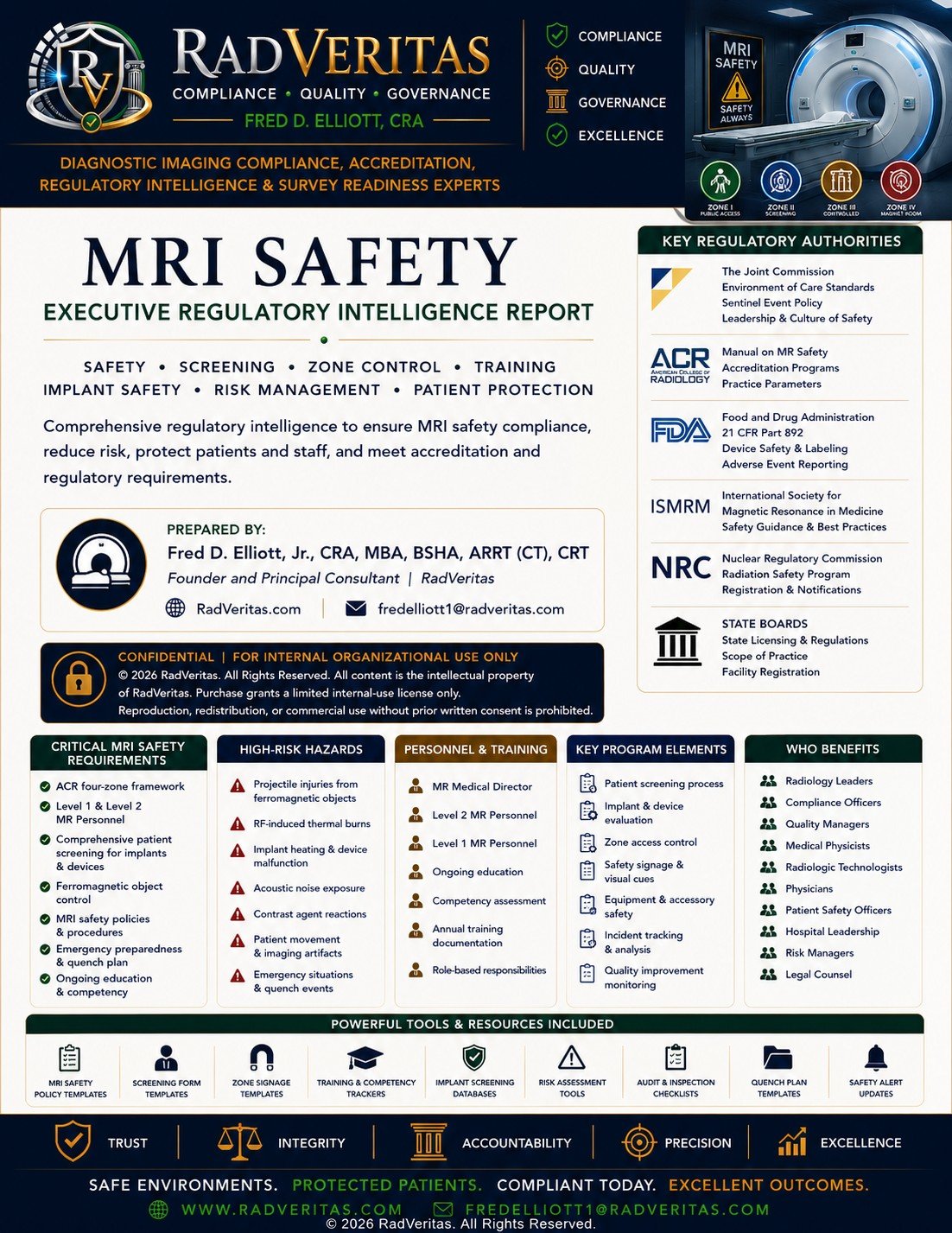
MRI Safety Regulatory Intelligence Report
The Complete MRI Safety, Patient Protection, and Accreditation Readiness System for Healthcare Leaders
One MRI Safety Failure Can Become a Sentinel Event
A patient with an unidentified implant.
An oxygen cylinder entering the magnet room.
An unscreened individual crossing into a restricted zone.
A pacemaker scanned outside approved conditions.
In MRI, mistakes are rarely minor.
They can be immediate, catastrophic, and life-changing.
Unlike most healthcare risks, MRI hazards are invisible. Powerful magnetic fields, radiofrequency energy, cryogenic systems, implanted devices, and restricted access environments create a safety landscape that demands constant vigilance.
The RadVeritas MRI Safety Regulatory Intelligence Report provides healthcare leaders with a comprehensive roadmap for protecting patients, safeguarding staff, reducing organizational risk, and maintaining continuous accreditation readiness.
Built upon current American College of Radiology (ACR) MRI Safety guidance, The Joint Commission expectations, FDA regulations, and industry best practices, this report helps organizations transform MRI safety from a compliance obligation into an operational strength.
Why This Report Matters
MRI-related injuries continue to occur across healthcare despite decades of published safety guidance.
Most MRI safety events are preventable.
They occur because of:
Incomplete patient screening
Implant evaluation failures
Weak zone access controls
Inadequate staff training
Poor emergency preparedness
Lack of leadership oversight
Inconsistent safety practices
These vulnerabilities often remain hidden until an accreditation survey, patient injury, regulatory review, or sentinel event exposes them.
This report helps leaders identify and correct those risks before they become organizational liabilities.
What You'll Learn
MRI Safety Governance
Develop a comprehensive MRI safety program aligned with current ACR standards and industry expectations.
Zone Control and Access Management
Strengthen oversight of:
Zone I
Zone II
Zone III
Zone IV
Restricted Access Controls
Visitor Screening Processes
Implant and Device Evaluation
Build defensible processes for:
Pacemaker Assessment
Neurostimulator Evaluation
Metallic Implant Screening
MR Safe Determinations
MR Conditional Reviews
MR Unsafe Identification
Personnel Qualification and Training
Understand requirements related to:
Level 1 MR Personnel
Level 2 MR Personnel
MRI Safety Education
Annual Competency Validation
MRI Safety Governance
Emergency Preparedness
Strengthen readiness for:
Projectile Incidents
Quench Events
Medical Emergencies
Sedation Emergencies
Fire Response
Emergency Evacuation
The Hidden Risk Most Organizations Underestimate
Many organizations believe MRI safety is primarily the responsibility of MRI staff.
The reality is different.
MRI safety is an organizational responsibility.
A patient transported from the Emergency Department.
A vendor entering the MRI suite.
A nurse unfamiliar with zone restrictions.
A contractor carrying ferromagnetic equipment.
Any one of these can create a life-threatening situation.
Organizations with strong MRI safety cultures recognize that safety extends beyond the magnet room and requires leadership engagement, operational discipline, and continuous oversight.
Build a Culture That Prevents Catastrophic Events
The strongest MRI safety programs are not built around surveys.
They are built around prevention.
The RadVeritas MRI Safety Regulatory Intelligence Report provides healthcare leaders with the intelligence, governance framework, and operational strategies needed to strengthen patient safety, improve compliance, reduce risk, and sustain accreditation readiness.
Because when MRI safety fails, the consequences can be immediate.
When MRI safety succeeds, patients never see the risks that were prevented.
Protect the Patient.
Protect the Staff.
Protect the Organization.
Prepared By
Fred D. Elliott, Jr., CRA, MBA, BSHA, ARRT (CT), CRT
Founder and Principal Consultant
RadVeritas
Compliance • Quality • Governance
Building Safer MRI Programs Through Leadership, Preparedness, and Accountability.
The Complete MRI Safety, Patient Protection, and Accreditation Readiness System for Healthcare Leaders
One MRI Safety Failure Can Become a Sentinel Event
A patient with an unidentified implant.
An oxygen cylinder entering the magnet room.
An unscreened individual crossing into a restricted zone.
A pacemaker scanned outside approved conditions.
In MRI, mistakes are rarely minor.
They can be immediate, catastrophic, and life-changing.
Unlike most healthcare risks, MRI hazards are invisible. Powerful magnetic fields, radiofrequency energy, cryogenic systems, implanted devices, and restricted access environments create a safety landscape that demands constant vigilance.
The RadVeritas MRI Safety Regulatory Intelligence Report provides healthcare leaders with a comprehensive roadmap for protecting patients, safeguarding staff, reducing organizational risk, and maintaining continuous accreditation readiness.
Built upon current American College of Radiology (ACR) MRI Safety guidance, The Joint Commission expectations, FDA regulations, and industry best practices, this report helps organizations transform MRI safety from a compliance obligation into an operational strength.
Why This Report Matters
MRI-related injuries continue to occur across healthcare despite decades of published safety guidance.
Most MRI safety events are preventable.
They occur because of:
Incomplete patient screening
Implant evaluation failures
Weak zone access controls
Inadequate staff training
Poor emergency preparedness
Lack of leadership oversight
Inconsistent safety practices
These vulnerabilities often remain hidden until an accreditation survey, patient injury, regulatory review, or sentinel event exposes them.
This report helps leaders identify and correct those risks before they become organizational liabilities.
What You'll Learn
MRI Safety Governance
Develop a comprehensive MRI safety program aligned with current ACR standards and industry expectations.
Zone Control and Access Management
Strengthen oversight of:
Zone I
Zone II
Zone III
Zone IV
Restricted Access Controls
Visitor Screening Processes
Implant and Device Evaluation
Build defensible processes for:
Pacemaker Assessment
Neurostimulator Evaluation
Metallic Implant Screening
MR Safe Determinations
MR Conditional Reviews
MR Unsafe Identification
Personnel Qualification and Training
Understand requirements related to:
Level 1 MR Personnel
Level 2 MR Personnel
MRI Safety Education
Annual Competency Validation
MRI Safety Governance
Emergency Preparedness
Strengthen readiness for:
Projectile Incidents
Quench Events
Medical Emergencies
Sedation Emergencies
Fire Response
Emergency Evacuation
The Hidden Risk Most Organizations Underestimate
Many organizations believe MRI safety is primarily the responsibility of MRI staff.
The reality is different.
MRI safety is an organizational responsibility.
A patient transported from the Emergency Department.
A vendor entering the MRI suite.
A nurse unfamiliar with zone restrictions.
A contractor carrying ferromagnetic equipment.
Any one of these can create a life-threatening situation.
Organizations with strong MRI safety cultures recognize that safety extends beyond the magnet room and requires leadership engagement, operational discipline, and continuous oversight.
Build a Culture That Prevents Catastrophic Events
The strongest MRI safety programs are not built around surveys.
They are built around prevention.
The RadVeritas MRI Safety Regulatory Intelligence Report provides healthcare leaders with the intelligence, governance framework, and operational strategies needed to strengthen patient safety, improve compliance, reduce risk, and sustain accreditation readiness.
Because when MRI safety fails, the consequences can be immediate.
When MRI safety succeeds, patients never see the risks that were prevented.
Protect the Patient.
Protect the Staff.
Protect the Organization.
Prepared By
Fred D. Elliott, Jr., CRA, MBA, BSHA, ARRT (CT), CRT
Founder and Principal Consultant
RadVeritas
Compliance • Quality • Governance
Building Safer MRI Programs Through Leadership, Preparedness, and Accountability.