 Image 1 of 1
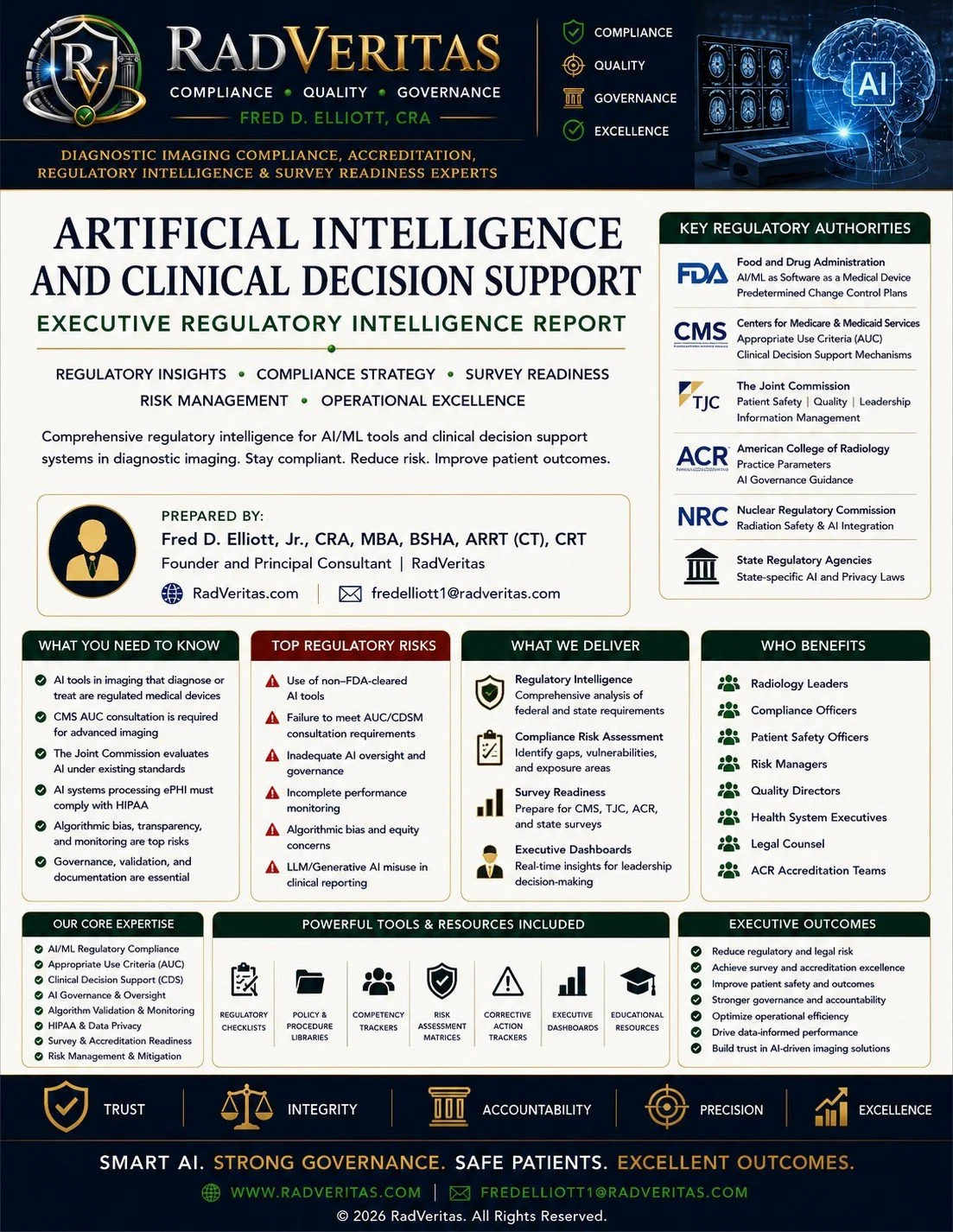
Artificial Intelligence and Clinical Decision Support
The Executive Guide to AI Governance, Compliance, Patient Safety, and Regulatory Readiness
Artificial Intelligence Is Transforming Healthcare. Is Your Organization Ready?
Artificial Intelligence is rapidly becoming one of the most disruptive forces in Diagnostic Imaging.
From automated image analysis and workflow prioritization to clinical decision support, report generation, dose optimization, and predictive analytics, AI is changing how healthcare organizations operate.
Yet with innovation comes risk.
Regulators, accreditors, attorneys, and healthcare leaders are increasingly focused on a critical question:
Who is governing the AI?
The RadVeritas Artificial Intelligence and Clinical Decision Support Regulatory Intelligence Report provides healthcare leaders with a comprehensive roadmap for safely implementing, governing, monitoring, and maintaining compliance for AI technologies used in Diagnostic Imaging and clinical decision-making environments.
Why This Report Matters
Many organizations have already deployed AI tools.
Few have implemented the governance systems necessary to manage them.
Without proper oversight, organizations face significant risks related to:
FDA compliance
CMS reimbursement requirements
HIPAA violations
Algorithmic bias
Patient safety events
Clinical decision-making errors
Accreditation findings
Vendor oversight failures
Generative AI misuse
Legal and liability exposure
The organizations that succeed with AI will not be those that adopt it first.
They will be the organizations that govern it best.
What You'll Learn
Artificial Intelligence Governance
Develop a structured governance framework that aligns innovation with compliance, safety, accountability, and organizational oversight.
FDA Compliance for AI
Understand requirements governing:
Software as a Medical Device (SaMD)
FDA-cleared AI tools
Predetermined Change Control Plans (PCCP)
Post-market monitoring obligations
Clinical deployment requirements
Clinical Decision Support Compliance
Navigate CMS requirements involving:
Appropriate Use Criteria (AUC)
Clinical Decision Support Mechanisms (CDSM)
Advanced imaging ordering requirements
Medicare documentation expectations
Generative AI and Large Language Models
Address emerging risks associated with:
AI-generated clinical content
Report drafting tools
Hallucinations and reliability concerns
Human oversight requirements
Clinical validation processes
HIPAA and Data Privacy
Strengthen oversight of:
AI vendors
Business Associate Agreements
Data security
Protected health information
Cybersecurity safeguards
Algorithmic Bias and Health Equity
Evaluate and monitor AI systems for potential bias, fairness concerns, and population-specific performance differences.
The Hidden Risk of AI Adoption
Most organizations focus on what AI can do.
Few focus on what AI can expose.
An AI tool without FDA clearance.
A vendor without a Business Associate Agreement.
A report generated by an unvalidated language model.
An algorithm that performs differently across patient populations.
Any one of these can create regulatory, financial, operational, and patient safety consequences.
This report helps leaders identify those risks before they become organizational liabilities.
Future-Proof Your Imaging Enterprise
Artificial Intelligence is not a future issue.
It is a current leadership responsibility.
Organizations that establish strong governance now will be positioned to adapt, innovate, and thrive as regulations evolve and technology advances.
Those that fail to do so may find themselves responding to problems that could have been prevented.
The RadVeritas Artificial Intelligence and Clinical Decision Support Regulatory Intelligence Report provides the framework to lead confidently in an AI-driven healthcare environment.
Innovation Requires Governance.
Governance Protects Patients.
Leadership Drives Success.
Prepared By
Fred D. Elliott, Jr., CRA, MBA, BSHA, ARRT (CT), CRT
Founder and Principal Consultant
RadVeritas
Compliance • Quality • Governance
Guiding Healthcare Leaders Through the Future of Diagnostic Imaging.
The Executive Guide to AI Governance, Compliance, Patient Safety, and Regulatory Readiness
Artificial Intelligence Is Transforming Healthcare. Is Your Organization Ready?
Artificial Intelligence is rapidly becoming one of the most disruptive forces in Diagnostic Imaging.
From automated image analysis and workflow prioritization to clinical decision support, report generation, dose optimization, and predictive analytics, AI is changing how healthcare organizations operate.
Yet with innovation comes risk.
Regulators, accreditors, attorneys, and healthcare leaders are increasingly focused on a critical question:
Who is governing the AI?
The RadVeritas Artificial Intelligence and Clinical Decision Support Regulatory Intelligence Report provides healthcare leaders with a comprehensive roadmap for safely implementing, governing, monitoring, and maintaining compliance for AI technologies used in Diagnostic Imaging and clinical decision-making environments.
Why This Report Matters
Many organizations have already deployed AI tools.
Few have implemented the governance systems necessary to manage them.
Without proper oversight, organizations face significant risks related to:
FDA compliance
CMS reimbursement requirements
HIPAA violations
Algorithmic bias
Patient safety events
Clinical decision-making errors
Accreditation findings
Vendor oversight failures
Generative AI misuse
Legal and liability exposure
The organizations that succeed with AI will not be those that adopt it first.
They will be the organizations that govern it best.
What You'll Learn
Artificial Intelligence Governance
Develop a structured governance framework that aligns innovation with compliance, safety, accountability, and organizational oversight.
FDA Compliance for AI
Understand requirements governing:
Software as a Medical Device (SaMD)
FDA-cleared AI tools
Predetermined Change Control Plans (PCCP)
Post-market monitoring obligations
Clinical deployment requirements
Clinical Decision Support Compliance
Navigate CMS requirements involving:
Appropriate Use Criteria (AUC)
Clinical Decision Support Mechanisms (CDSM)
Advanced imaging ordering requirements
Medicare documentation expectations
Generative AI and Large Language Models
Address emerging risks associated with:
AI-generated clinical content
Report drafting tools
Hallucinations and reliability concerns
Human oversight requirements
Clinical validation processes
HIPAA and Data Privacy
Strengthen oversight of:
AI vendors
Business Associate Agreements
Data security
Protected health information
Cybersecurity safeguards
Algorithmic Bias and Health Equity
Evaluate and monitor AI systems for potential bias, fairness concerns, and population-specific performance differences.
The Hidden Risk of AI Adoption
Most organizations focus on what AI can do.
Few focus on what AI can expose.
An AI tool without FDA clearance.
A vendor without a Business Associate Agreement.
A report generated by an unvalidated language model.
An algorithm that performs differently across patient populations.
Any one of these can create regulatory, financial, operational, and patient safety consequences.
This report helps leaders identify those risks before they become organizational liabilities.
Future-Proof Your Imaging Enterprise
Artificial Intelligence is not a future issue.
It is a current leadership responsibility.
Organizations that establish strong governance now will be positioned to adapt, innovate, and thrive as regulations evolve and technology advances.
Those that fail to do so may find themselves responding to problems that could have been prevented.
The RadVeritas Artificial Intelligence and Clinical Decision Support Regulatory Intelligence Report provides the framework to lead confidently in an AI-driven healthcare environment.
Innovation Requires Governance.
Governance Protects Patients.
Leadership Drives Success.
Prepared By
Fred D. Elliott, Jr., CRA, MBA, BSHA, ARRT (CT), CRT
Founder and Principal Consultant
RadVeritas
Compliance • Quality • Governance
Guiding Healthcare Leaders Through the Future of Diagnostic Imaging.